Leila - object library
Basic information
Project Title
Full project title
Category
Project Description
Leila is a model who contributes to a sustainable, attractive and inclusive lifestyle. Leila is a reality that, through the sharing of objects and ideas, promotes a new lifestyle, based on reuse and sharing. The possibility of sharing and reusing objects otherwise destined for disuse, not only reinforces the concept of circular economy, but also sets up a process of sharing that has an impact on the lifestyles of each of us.
Project Region
EU Programme or fund
Description of the project
Summary
Leila is a library of objects that promotes a sustainable use of consumer goods and contributes to the affirmation of a circular economy model, overcoming the linear one. A library of objects is an initiative that provides that, by sharing a personal object, you can borrow objects shared by other people, avoiding purchases and waste, based on mutual trust. Typically, Leila allows to share goods that by nature provide owners with excess capacity, as appliances, tools, etc. This provides a solution to the lumpiness of some goods that is that many items can only be purchased with excess capacity such as the unused car seats for daily commuters. Founded in 2016, in just five years Leila has grown: there are 3 corners in the city of Bologna, distributed equally in the offices of associations or commercial activities that collaborate with Leila's reality, including corners in the suburbs. Furthermore, in 2019, Leila obtained a space from the Municipality of Bologna to build the first real library of objects, constituting a space where members can meet. Leila is a service offered by the community to its inhabitants: through an annual membership of 20 euros and the sharing of one's own object, the member then has access to the entire library of objects (made available by others). Leila's model is inclusive because the membership price (20 euros) is negligible and allows access to a series of objects, instruments, tools, whose price (in terms of money and of ecological footprint) would be unsustainable otherwise. The quality of the objects it offers is satisfying and reflects the trust that the associates have among themselves and with Leila herself. In addition to sharing objects, Leila, through artisan workshops, is also a promoter of the sharing of knowledge and ideas that move in her space and among its members.
Key objectives for sustainability
Leila fully responds to the objectives of the circular economy through forms of sharing economy and by applying the rationale of the circular business model as Product as Services (PSS) and sharing platform. Likewise PSS, in the Leila model, the products are offered in subscription mode that do not require purchase and sale. This is intrinsically “circular” because people can share many items that are only used occasionally. The two most common approaches for keeping products in circulation are re-using or recycling them when their first owner is done with them. An even more interesting strategy, however, is making better use of products by sharing them – to make sure they are used more often and by more people. This occurs mainly through the full exploitation of the over-capacity of an asset. From this point of view, it contributes to a sustainable use of resources and it represents a medium by which to promote consumption and use patterns in citizens that have a lower impact on everyone's ecological footprint. The New European Action Plan for the Circular Economy (COM (2020) 98 final) establishes a program of actions to build a cleaner and more competitive Europe in co-creation with economic operators, consumers, citizens and civil society organizations. Our reality, Leila - The library of objects is based on a collaborative economy model. It enables the creative abilities of consumers and fully respects this goal, preserving the value of goods for a long time. For the consumer, the model arises in the context of markets for goods and services already manned by traditional companies, representing a concrete alternative to purchasing in order to have access to the use of an asset.
Key objectives for aesthetics and quality
Leila was aimed at making the reality forms of collaboration that require to be in a relationship of trust between strangers, neighbors, citizens. This aim was fulfilled during the first years of activity. So, those who joined Leila became part of a wider community. Leila is not a service based on help as an end in itself, is not based in charity, it is a reality that aims to provide its community with a satisfying experience. Those who participate in Leila become aware of the value of shared assets. The quality of the experience offered to all those who participate in Leila is owes a number of reasons:
- quality of shared objects, the quality of the objects that the individual shares is equal to that of the library;
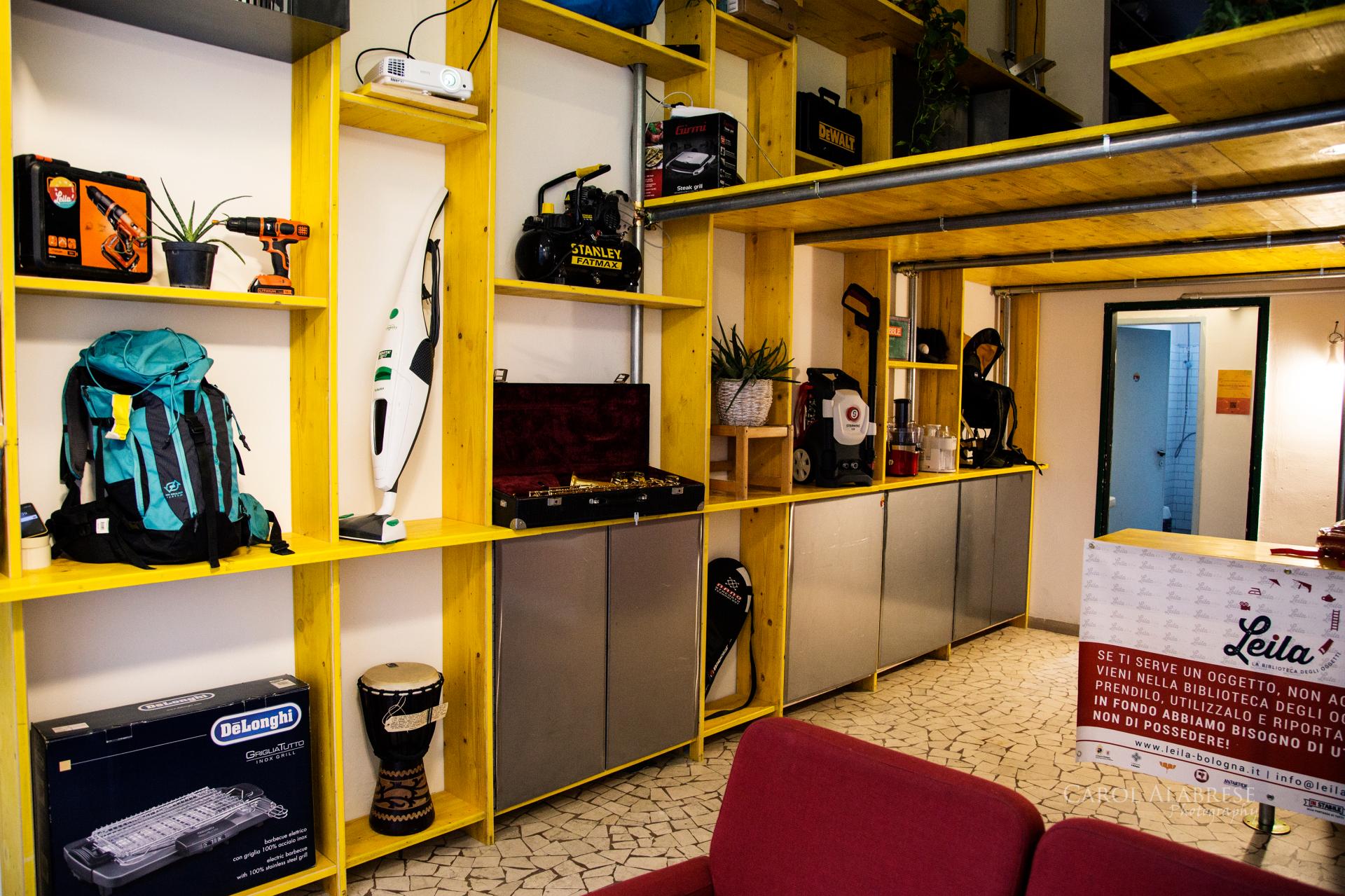
- quality of the place where the object comes in and out of loans: the hub. Environment itself does not refer to a place where is bestowed charity, but is a well-kept place with an aesthetic in line with modern but natural styles, all built with a creative reuse of materials;
- the quality of relationships that is supported by the fact that a network of events and collaborations with other realities revolves around Leila and this strengthens the concept of community and exchange not only of objects but of ideas;
Key objectives for inclusion
The sharing economy, or collaborative economy, is based on sharing, access and reuse rather than ownership and purchase. Collaboration is the center of a relationship between equals. The purpose of Leila in terms of inclusivity was to facilitate access over ownership by making use of the idling capacity of goods to improve the economic efficiency of sharing. Furthermore, Leila aimed to enhance social cohesion, increase trust in communities, empower individuals, and increase social ties among strangers. Leila fully achieved such objectives since:
- social exclusion among users in the form of discrimination or bias based on race, ethnicity, gender identity, sexual orientation, religion, class, or digital literacy has been not possible/allowed. Once the good is available to the other members, no exclusion is possible. It should be noted that this kind of exclusion experience is one of the most common limits of sharing platforms (e.g. Uber, Airbnb). From this side, Leila is not affected likewise other forms of sharing;
- People enter into a relationship with each other by collaborating, by sharing ideas and goods;
- The membership has an affordable price for which it is possible to access the use of objects whose market value can be much higher. Under this perspective, Leila has provided access to goods and services for people who could otherwise not afford them;
- By connecting with others, Leila has increased social interaction between people, fostering social cohesion within local communities. This has also led to empowerment of marginalised social groups, e.g. women, strangers, etc;
- Also under the perspective of the possible “technological barrier” (i.e. the use of loan service by the website), Leila had no barriers: who may not possess the requisite technology or skills to use the website are not excluded, can have access to goods simply going to Leila hub.
Results in relation to category
Leila is a process that has produced a concrete change in the lifestyle, representing an alternative and attractive solution to purchasing and consuming. All this is represented by the network that has been built around it.
The number of members is currently 244 and continues to grow despite the pandemic. Between 5 and 6 objects come out per week (and as many return), testifying to the continued participation of the members. Leila is also active on social media: Leila's site has an average of 150 visits per day, 941 followers on instagram in continuous growth (+ 41% recorded in May) and a community on fb of 4026 users.
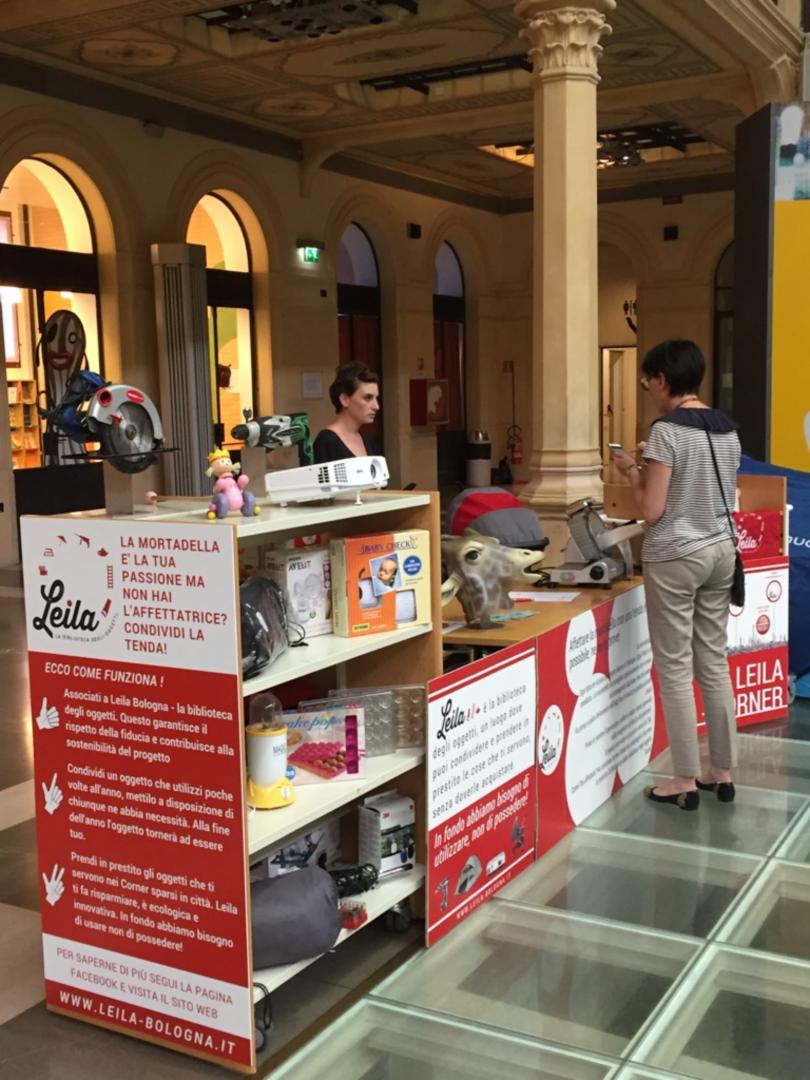
Over the years Leila has opened and animated several corners where citizens can register and collect the objects they need, the spaces currently used as corners are 7: Instabile Portazza, Confraternita dell’Uva, Velostazione Dynamo, Caffè Belmeloro, Biblioteca Salaborsa, La Balotta and the hub. Leila has always worked in synergy with associations and informal groups in the area, with which it has created 3 projects during the years, most of them still working, including: Empirico (2017), an urban regeneration operation that put in place through a container and that was designed for the transmission of artisan knowledge and for the enhancement of the artisan identity of Bologna; Mobile Cargobike (from 2018), which invests in the transmission of artisan knowledge, urban regeneration and sharing of games but, unlike Empirico, is designed for children through the creation of workshops in city squares; Baracca Festival (2018), the festival of knowledge sharing in the Baraccano Gardens with craft workshops, sports activities, music and live radio. Other partnerships has been Salaborsa Library (2017-2020), Sharing Ferrara Festival (2016), La Cura Festival - Kilowatt Bologna (2016), Guasto Village (2017) Cà Foscari University of Venice Families Share project (2019) Biografilm Kids (2019) Lagolandia (2019) Tutto Molto Bello Festival (2019
How Citizens benefit
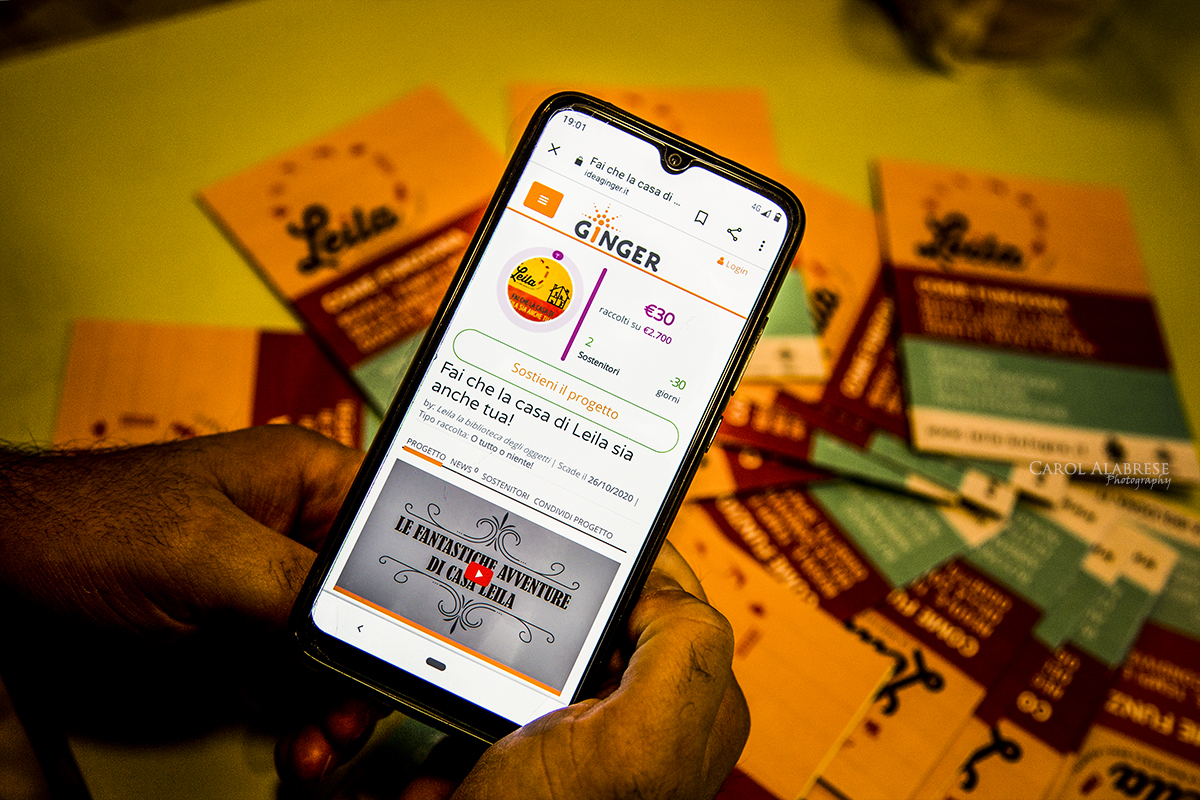
Over the years Leila has collaborated with many realities in the area, has created strong ties with them and continues to present initiatives that involve citizens in its entirety (for example, using the Cargobike to organize small events around the squares). With Leila, people come into contact with each other and collaborate, get to know each other, enjoy the pleasure of creating an exchange made even more satisfying by the fact that it takes place without the intrusion of a vertical institution and / or a brand. Leila is its members. An example is the crowdfunding process promoted in September 2020 which met with some success and allowed Leila to complete the office, thanks to the trust that people place in this reality. The headquarters was located within a neighborhood whose redevelopment is recent, precisely so that the service can contribute to the revival of a previously popular neighborhood. Citizens' adhesion to Leila revolves around not only individual motivation (the satisfaction of their own needs), but also attention to society (the desire to participate in something collective, to contribute to the needs of the social nucleus to which they belong), as a form of adherence to a value path. For these reasons and for its very structure, Leila is built and managed together with the citizens and the members who are part of it.
Innovative character
Leila is innovative from at least three different points of view. First of all, it proposes a change of thought, a cultural change: collaborative consumption is an economic model based on the sharing, exchange, trade or rental of products and services, to which access is granted beyond ownership. By offering a service that encourages this modality, Leila works together with her partners to seek a new and sustainable lifestyle.Innovation of Leila lays also in her attention to environment: Leil provides an answer to the consumer who wants to be attentive to the consumption of natural resources. Not only that, Leila also produces collaborative learning opportunities: open courses or forms of sharing and agglomeration of knowledge.In this way, innovatively, Leila promotes personal growth. Through trainings, workshops, experience sharing, social interactions Leila allow users to learn new skills and knowledge. In this way, Leila has created a large community, characterized by strong bonds of mutual trust between users. This community is both online (mention follower use), but also physical, let's think about social streets. In fact, digital technology is a necessary support and Leila also works in this direction: in all digital collaborative services, technological platforms, in the form of websites or mobile apps, are necessary to enable these services and make them scalable, useful, original. Thus Leila has its own platforms with which users can easily interface from home, where it is not possible to go to a corner.