Creating homes instead of apartments
Basic information
Project Title
Full project title
Category
Project Description
The primary aim of the residential building sector should be to provide people with real homes. Failing to do so results in many unsustainable buildings. A new design method, based on the results of the SUSOSTA project at the University of Cambridge, can help stakeholders create apartments that truly meet the needs of their residents. This design approach uses experimentally collected occupant preference data to ensure that rooms have right sizes and flats have the best, most adaptable layouts.
Project Region
EU Programme or fund
Description of the project
Summary
Hungary is experiencing a housing crisis. Apartments sell easily irrespective of how good they are, leading to a natural decrease in quality. Many low-quality residential buildings are being built, which cannot provide residents with comfortable and adaptable living spaces. Consequently, these buildings experience rapid obsolescence, which makes them highly unsustainable. Unfortunately, it is almost impossible to filter out these solutions, as it is difficult to objectively measure how good an apartment is at the design phase.
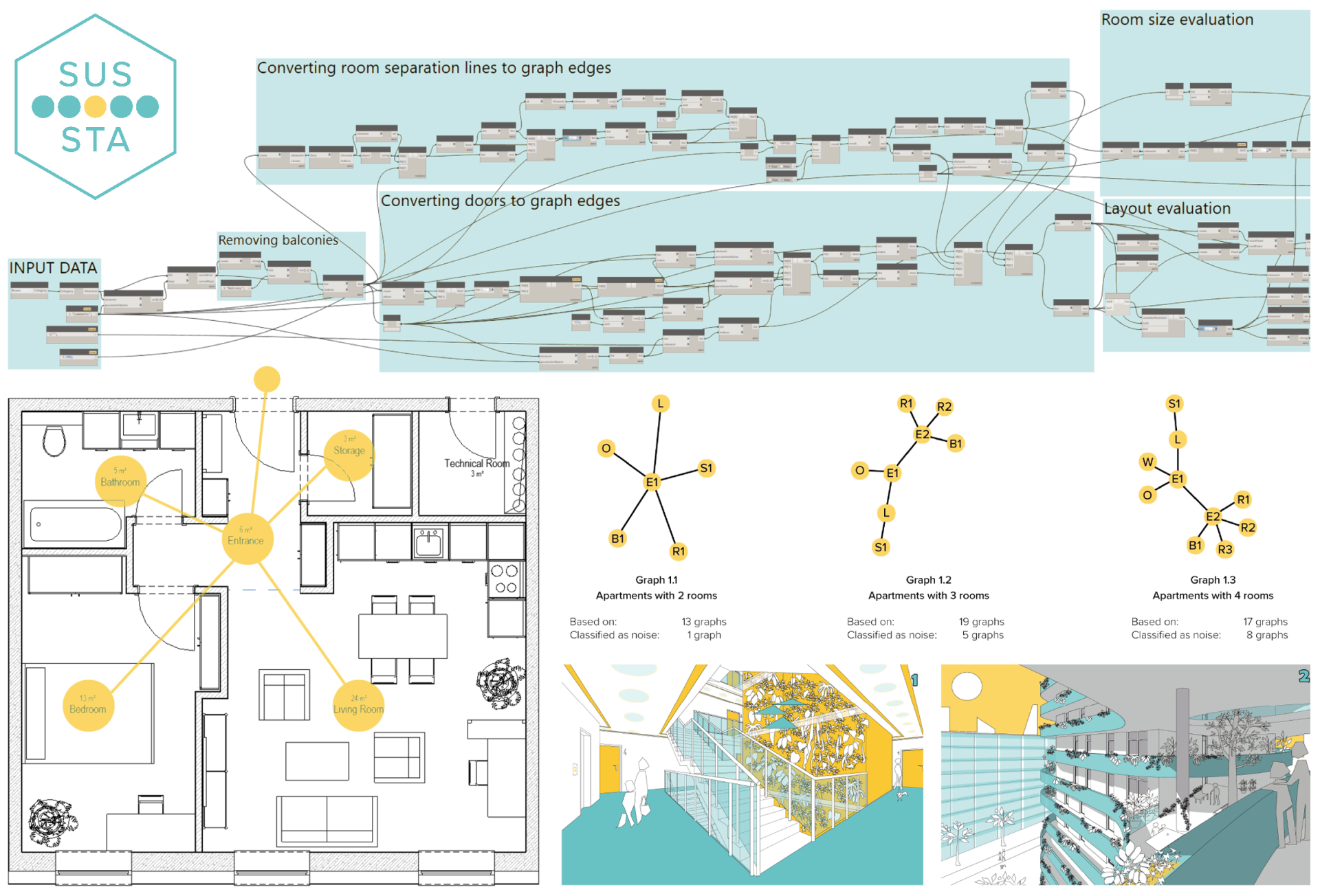
Parametric and data-based design approaches are frequently applied in shape-optimisation problems. These tools could also be used to find living spaces that meet the needs of the many. The SUSOSTA research project at the University of Cambridge investigates how to make standardised residential buildings more sustainable. The project has developed a design method called the Ideal Home Puzzle (IHP), which can determine the most preferred layouts and room sizes for different apartment sizes by applying space syntax tools to unbiased user preference data. While the project’s main goal was to aid informed decision-making about what homes are worthy of mass-production, the IHP method can also be used to monitor the quality of any residential building.
The current proposal’s goal is to develop a design tool for industrial practice based on the IHP, and in turn help all stakeholders create high-quality homes. The existing database of user preferences will be able to help designers choose optimal layouts and room sizes. Moreover, the project aims to develop an open-source plug-in for architectural design software, which could draw on the database to evaluate design solutions instantaneously. The project location is Hungary, where the initial data collection took place, but the general idea could be implemented anywhere, upon the collection of a new dataset. The results will be publicly available and presented at workshops focusing
Key objectives for sustainability
This project aims to support stakeholders in creating apartments that can really serve as homes by implementing a data-driven design strategy that considers the real needs of building occupants. With the developed tool, architects, developers and even authorities could evaluate design solutions from the perspective of expected resident satisfaction, and thereby avoid creating apartments that do not meet the needs of the majority or are in fact predictably substandard. This idea is about delivering only the buildings that we truly need.
Apartments that are homes are able to retain their value much better, as residents keep living in them longer. Having more homes on the market would increase sustainability, because residential buildings could operate longer without extensive renovations and would not be treated like disposable consumer products. This would extend the life expectancy of these buildings and reduce their ecological footprint, in line with the EU waste directive.
It is also important to note that the global COVID-19 pandemic has shown the world how important it is to have adaptable, high-quality homes. Quality housing also contributes to sustainability by providing residents with an environment that helps unwind, crucially contributing to their mental and physical health.
By expanding the current dataset, the project also aims to probe whether it is possible to mass-produce residential buildings also in line with sustainability principles. By mass-manufacturing or mass-customising such buildings, the optimisation potential of standardisation could be harnessed. First, this would allow prefabrication to become more widespread in residential construction, which would increase the industry's productivity and reduce construction waste. Second, it would also create an opportunity to reduce embodied carbon by using optimised load-bearing structures.
Key objectives for aesthetics and quality
All people-centred design methodologies help designers see their usual design process in a new light. As we start thinking about how we can make our residential buildings cosier and smarter, we have already made a huge step towards also making these buildings more aesthetically pleasing. The outlined design methodology can help us be more aware of what a well-equipped apartment is like and what are the ideal room sizes for people to find places for their personal belongings and hobbies.
Who wouldn't want to live in an apartment that can be adapted to their specific needs, where they can easily roll out a yoga mat, where the entire family has space to take off their shoes at the same time, and where there is a designated place for a dryer, coats, and even the used glassware that’s waiting to be recycled? But, as designers tend to compromise on the quality of living spaces due to, among others, pressures on time and attention, having such an apartment frequently becomes impossible right at the design desk.
The goal of people-centred data-based design is to raise the quality of apartments beyond functionality. A home shouldn't be all about making compromises and struggling to find places for the most common everyday items. The spaces of our homes should fit the demands of modern life, enhance their residents' well-being, and help them fully recharge.
If stakeholders put a greater emphasis on these issues, we can fundamentally alter the way our industry creates residential buildings. The current project would help in this transition by providing an initial database of unbiased preference data on layouts and room sizes, and an Evaluator Plug-In that could provide instant feedback on how much a design fits the preferences of people. The dataset can be further increased or refined to reflect the needs of specific social groups and the Plug-In can also compare layouts with any predefined arrangement. With these tools an improved quality of
Key objectives for inclusion
The right to decent and adequate housing is a basic human right. However, today, housing crises are emerging in many European cities. Students, young families, and working-class people, who are essential to the cities’ functioning, are increasingly being pushed out of the centres into suburban real estates. It is of course extremely difficult to combat such social trends, but the ideas in the current project would help architects do what they can within their power to overcome the housing crises.
In many cases, the quality of an apartment depends only on attention and goodwill. In a new development, the design fee is almost negligible compared to the cost of the whole construction. This raises the question: why should not we take the time to make something truly worth building out of the concrete and steel? Building low-quality housing solutions take the place of projects that would truly mean a solution for large families, new graduates, and especially the poorest, who are desperately searching for adequate housing. The tools created by this project can help designers and decision-makers ensure that the homes that are built really serve the needs of the people, no matter whether we are talking about a downtown high-end estate or an affordable housing project on the outskirts of the city.
Adaptable, high-quality homes reduce the need for new housing, though it must be acknowledged that it does not, in itself, solve the underlying social problem. Nonetheless, the creation of quality homes that people are genuinely happy to spend time in can lead to the rise of well-functioning communities and neighbourhoods. As a result, it also has the future potential to create new local city centres that provide workplaces. Moreover, a general increase in the quality of housing would affect most exactly those social groups who are not able to choose apartment freely from the market. Therefore, this project can help to make a small step toward a more just and inclusive future.
Innovative character
To improve user experience in the age of information and big data, our computers, mobile phones, cars, and sometimes even vacuum cleaners are constantly collecting data about what we prefer and how we use them. Our decisions are frequently shaped by recommendation algorithms that offer options tailored to our taste. In contrast, the way in which dwellings are created has become increasingly impersonal over time. Nowadays, most real estate developments are mass-housing projects in a market that has a shortage of affordable housing. The lack of competition means that developers have no real incentive to make homes that reflect the needs of those who live in them.
Today, data-based design is primarily used to solve problems in the domains of structural and building physics-centred optimization. However, these methods, which have already been applied in various optimisation tasks, could also be used to tailor residential buildings to people’s preferences. The idea of the current project is innovative in that it further develops existing methods to solve a new task. The project would develop a new tool that provides real-time feedback on how well a target group's needs are reflected in the interior design of a residential building, giving both designers and authorities important information they do not presently have access to.
The way IHP data is collected is also innovative. Collecting unbiased data on ideal housing is a challenging task. It would be misleading to predict and deduce the quality of an apartment from sales data alone, since the available housing supply shapes the demand. In addition, there are multiple other factors that affect sales data (e.g. the location of the project), which should not be ignored. In contrast, the IHP data collection, in which participants were asked to assemble their ideal apartment from freely variable room elements, provided an opportunity to abstract away from reality and to think about homes in a maximally