The Flux
Basic information
Project Title
Full project title
Category
Project Description
Transit hubs are the new fle(u)x!
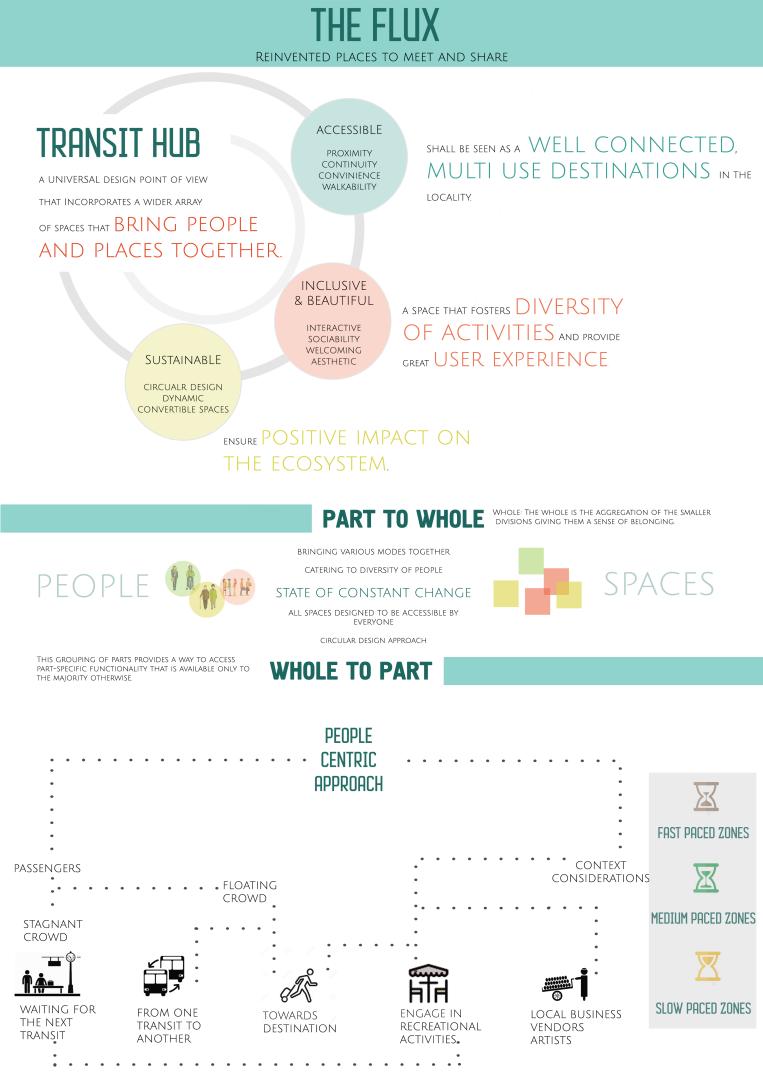
A Transit hub is a node that goes through a state of constant change (~flux) in less duration of time. These are public spaces that can be seen as well connected, multi-use destinations that foster diverse activities and provide a great user experience. Developing transit spaces as community-building public spaces encourages people to use public transport, and also paves way for designing a wider array of spaces that cater to meet and share!
Project Region
EU Programme or fund
Description of the project
Summary
Transit hubs are the new fle(u)x!
A Transit hub is a node that goes through a state of constant change (~flux) in less duration of time. These are public spaces that can be seen as well connected, multi-use destinations that foster diverse activities and provide a great user experience. Developing transit spaces as community-building public spaces encourages people to use public transport, and also paves way for designing a wider array of spaces that cater to meet and share!
A person traveling from one point to another should view the travel as more of an experience than just a journey. A transit node has much more potential to it than to just act as a nodal integration of the transportation modes. Being the most accessible point in the locality, it can contribute as a community space that allows a strong social purpose. With more feasible access guaranteed, people can reply on these spaces for a good community center.
Apart from answering questions like - When a person moves from one transit mode to another what does he experience on his way? What does a person do when there is significant waiting time between two different transits, whether he prefers to take the time or is forced to wait up for the next ride? How about two people on their way to different destinations plan to meet at this node?
The design also has to answer questions like - How does this affect the immediate neighborhood? Does it cater to their needs as well? Are there local businesses-stalls/vendors that could benefit from this? Since it is open 24/7, how can we use the resources to design convertible spaces (like provide shelter for the homeless at night)? Adding a bit of culture and tradition of that locality, for example, can it encourage activities like streetscape theatrics, interactive installations and such?
The answer to all these questions results in a space that contributes to beautiful, sustainable, and inclusive places!
Key objectives for sustainability
~ Designing spaces that are welcoming, comfortable and accessible results in people preferring public transportation over individual vehicles. This contributes towards reducing single-use vehicles and paves the way towards a sustainable transportation system.
~ Since this space shall remain open to the public 24/7 all throughout the year, they can be designed as convertible spaces to use the available resources without wasting them; wastage of resources also contributes to a non-sustainable approach.
~ In today's world, it is a given that every design has to sustain itself.
~ The whole design has to be able to sustain the energy requirements by itself by incorporating sustainable ways of energy generation. This includes calculating the impact it would have on the earth and how to make them a positive one by implementing energy-efficient design strategies like establishing thermal comfort, renewable energy derivation techniques, reducing carbon footprint.
~ Circular design approach has to be followed right from the beginning of design development stage. Any product that has to be used in the design should start from a circular design approach. This ensures the positive impact any design would have on the ecosystem throughout the life span of the space.
Key objectives for aesthetics and quality
The design is more about the experience of the journey and less about the destination. Each and every pause a passenger/visitor decides to make, it should be aesthetically pleasing and give them a sense of belonging and comfort.
With footfall being high in such spaces, the spaces have to be carefully planned in order to make them look aesthetic and not chaotic. to achieve this, the movement of people shall be categorized into three based on their pace :
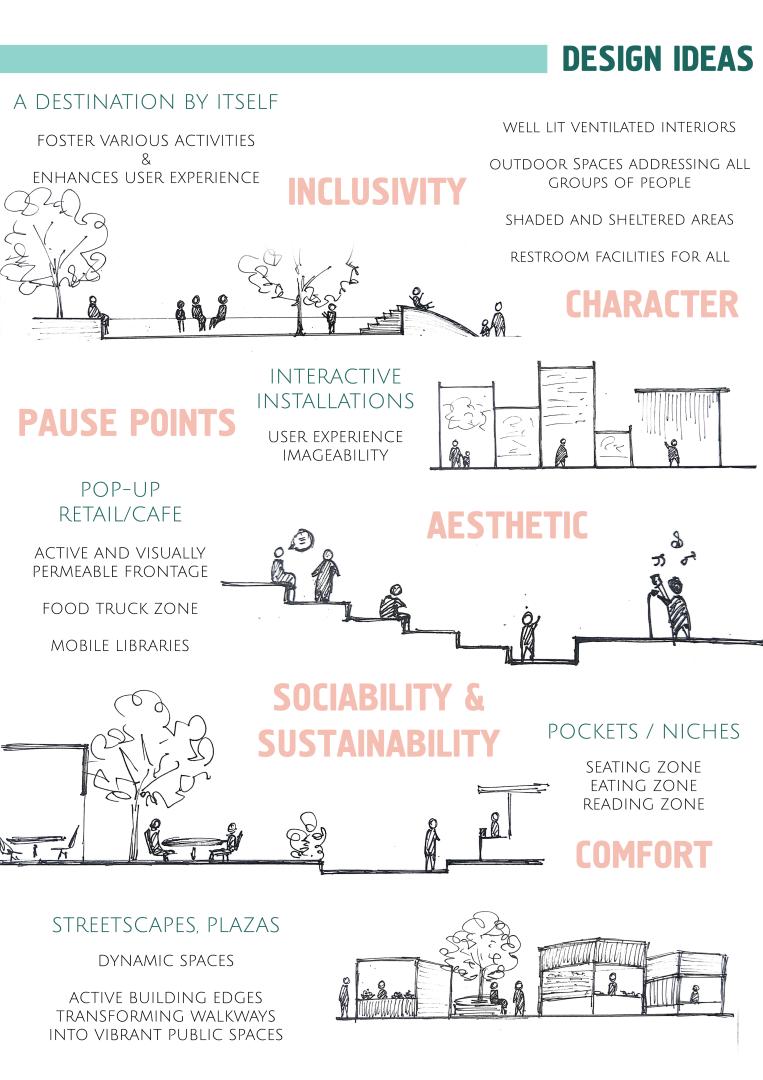
~ Fast-paced zones. People moving at a faster pace in order to catch a transit on time/switch modes/reach destination, have only minutes of attention to pay to the design. Thus, the design has to be in such a way that it captures their attention and also caters to their immediate requirements. This shall be achieved by including small pause points such as pop-up retail/cafe, active and visually permeable frontage, food trucks, mobile libraries, interactive installations, and such. This adds to the aesthetics of the space greatly; gives character and a refreshing vibe that makes this space look lively!
~ Medium-paced zones. Passengers who wish to spend time between their commutes and visitors who walk into the space looking for a community space should be offered recreational activities and dynamic spaces that allow them to engage in activities like reading, indoor games/ play area for kids, workspaces, eateries and refreshing zones. This adds to the senses of sight, experience, and energy of the whole design!
~ Slow-paced zones. People who spend more than a few hours here, would require spaces to rest, enjoy some entertainment and spend time leisurely. These shall be provided by designing spaces that provide comfort and reduce the chaos thereby adding to the aesthetics of the space!
Key objectives for inclusion
~ Inclusion in designing such spaces starts at the smallest details in design like accessibility to physically challenged, catering to all age groups and all people at the best possible cost.
~ Since it is open 24/7, the resources may be used to provide shelter for the homeless at night (convertible spaces), a safe space for small businesses to expand, spaces that encourage cultural activities.
~ Basic necessities like toilets for men, women, and gender-neutral toilets for people of any sex, be it transgenders who prefer to use neutral toilets or a 4-year-old son accompanied by his mom or a 4-year-old daughter accompanied by her dad or physically challenged people who required assistance; waiting spaces for them with necessary provisions to be designed too.
~ The immediate context that depends on this hub for spaces like a jogging track, grocery store, workspaces, creche, eateries, park, and such.
Innovative character
~ The fact that this public space has the greatest advantage of being connected to the rest of the city, makes it more approachable and accessible.
~ Dividing the spaces into three paced zones helps to regulate the community-building aspect of the design. This level of planning and designing paves the way to a more friendly, accessible public space.
~ Public spaces on wheels! Within the transit also, activities can be fused. Like each compartment in a metro/train shall be designed as workspaces, libraries, eateries.etc., This greatly helps people utilize their travel time by engaging in activities rather than spend it idly. This could be a new version of public space!