Adapting travellers’ concept of housing
Basic information
Project Title
Full project title
Category
Project Description
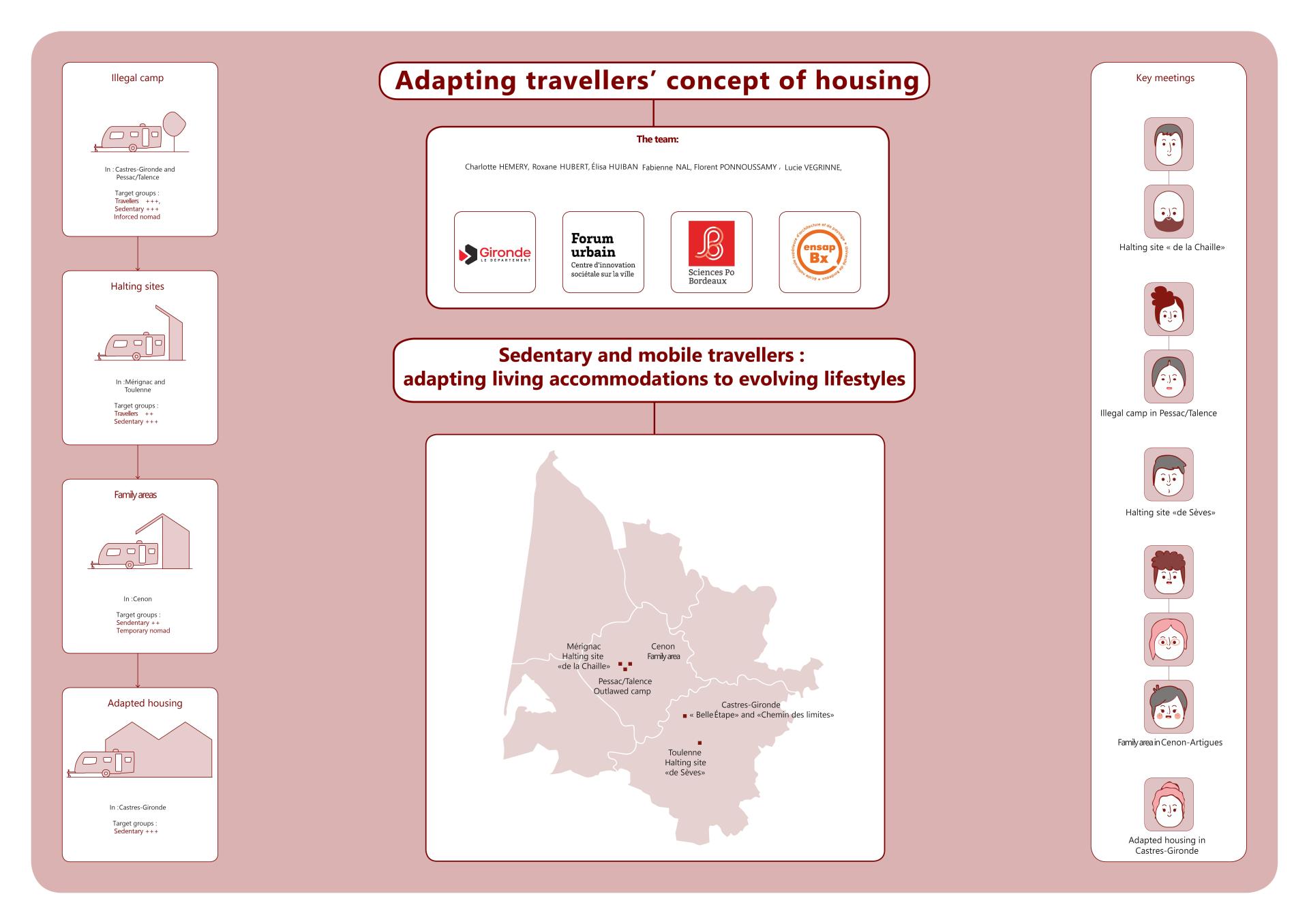
Travellers face numerous social challenges due to their lifestyle. Supporting their ways of living is a key solution to improve their social integration. Some travellers are willing to settle down but transitioning from a caravan to a built house can be a challenge. Others still favour an itinerant lifestyle but often lack halting sites. Our projects H.O.M.E. and the “Pop-up halting site” introduce modular and mobile solutions to better integrate travellers in our society.
Project Region
EU Programme or fund
Description of the project
Summary
The H.O.M.E. (Housing Offer Modular and Evolutive) and “Pop-up halting site” projects are complementary solutions that aim at answering different housing needs among travellers.
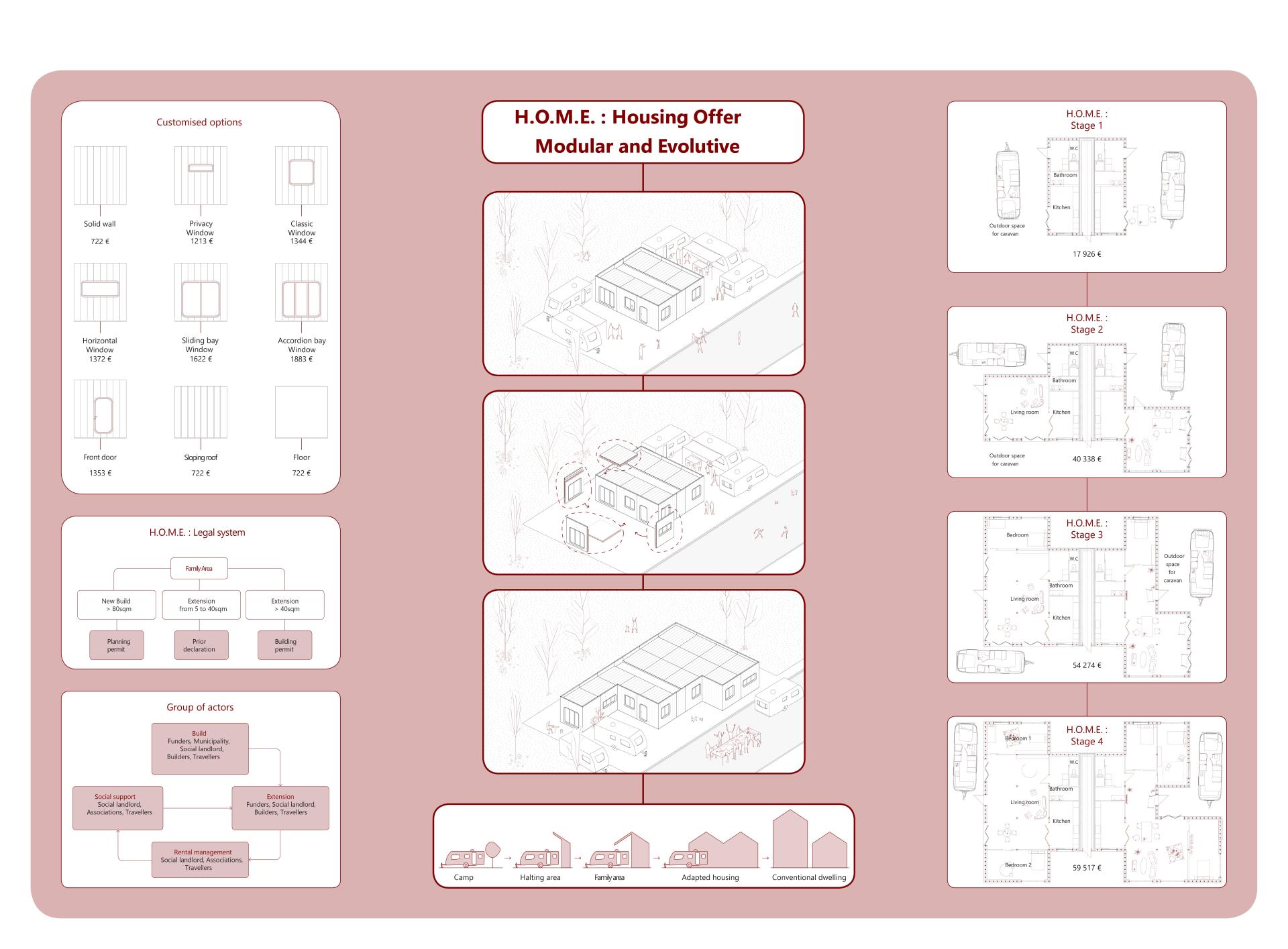
The H.O.M.E. project presents a way of assisting travellers’ willingness to settle down through a gradual transition from a nomadic way of life to a sedentary lifestyle. H.O.M.E. combines several benefits : a modular and evolutive housing, a personalisation of the built aesthetics and is co-designed with the travellers. The project is developed from the caravan and its adjoining sanitary unit on halting sites. Based on the household’s specific needs, ready-made panels are rented by the travellers and installed to create rooms (kitchen, bedrooms, living areas…). More panels can be added over the years to enlarge the house. The caravan, as a core element of the travellers’ cultural identity, remains central at every step and can still be used to travel. But it can be removed if the household wishes. The panels are designed to replicate the caravan's aesthetic and functionality in order to ease the housing transition.
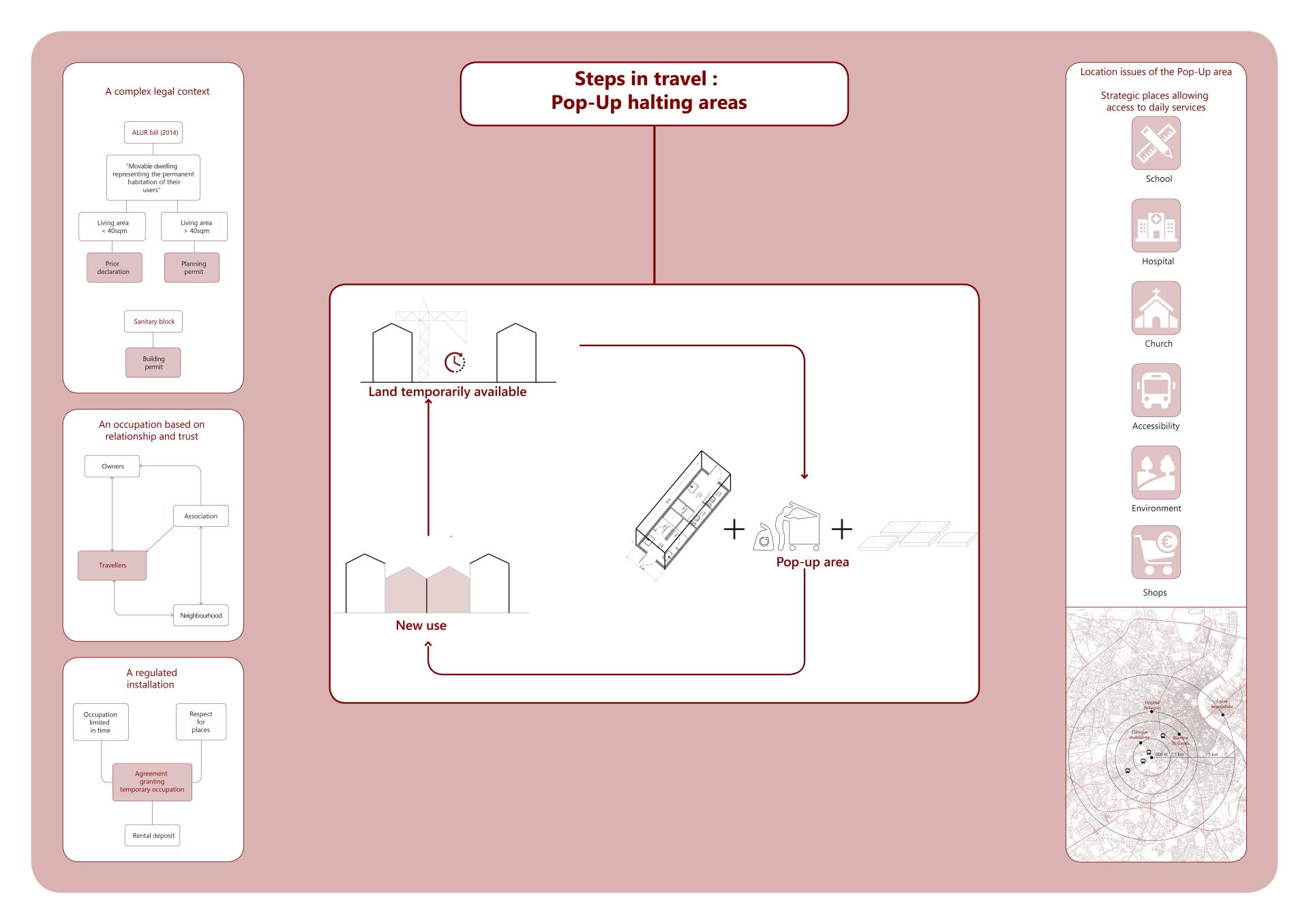
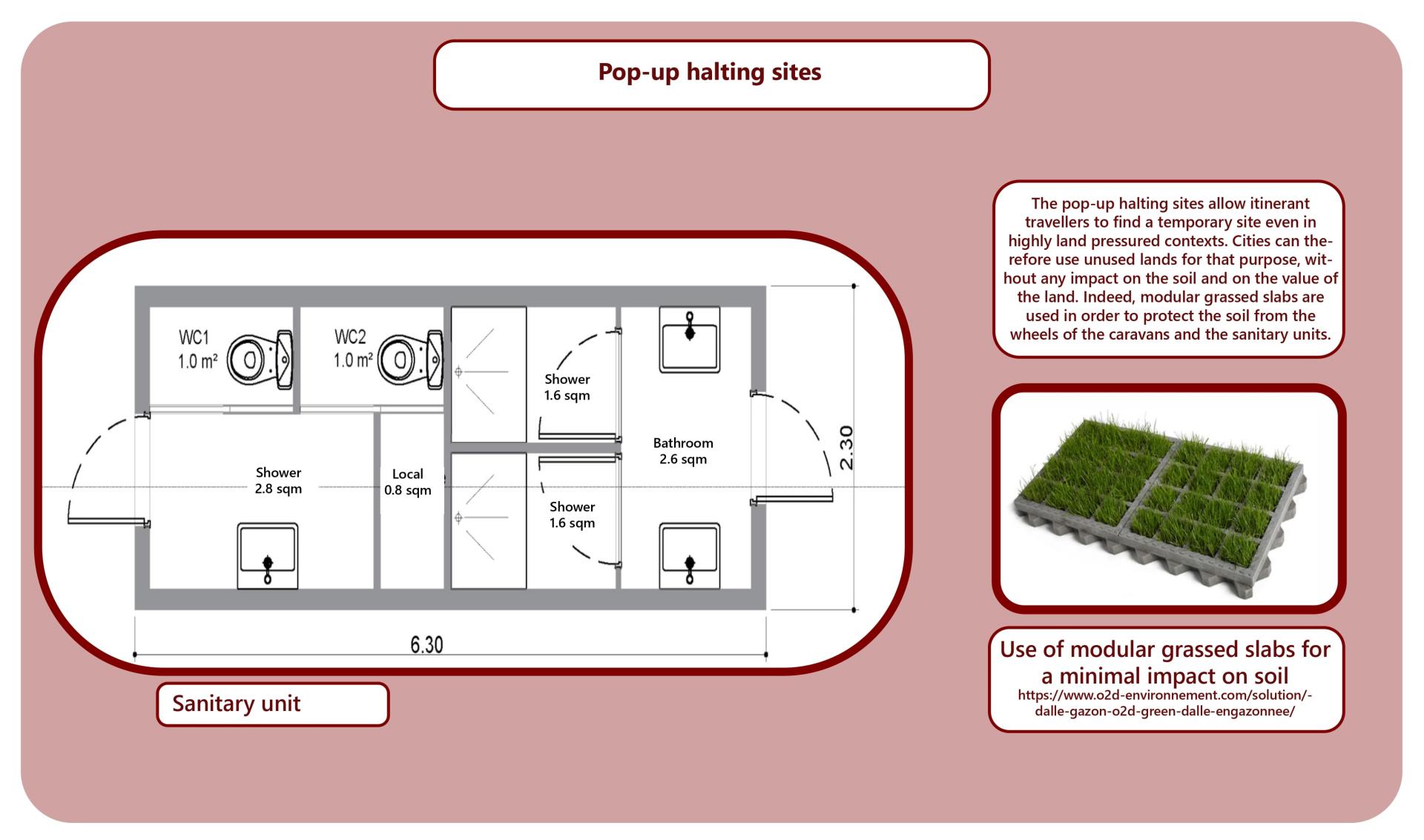
The “Pop-up halting site” creates a flexible way of welcoming temporarily travelling communities and increases the number of sites available to welcome travellers. Set up on any sort of land (urban wasteland, car park, private land…) this ephemeral halting site puts unused but prepared land (connected to existing networks) to good use. On this halting site a formal sanitary facility with toilets and showers can be installed. In case water and electricity supplies are compromised, the use of dry toilets or mobile sanitary vehicles can be considered. An agreement on temporary occupation co-signed by the landlord, the travellers and a third party acting as a mediator (e.g. local association), certifies a regulated occupation of the land (rent, limited occupation period, upkeep).
Key objectives for sustainability
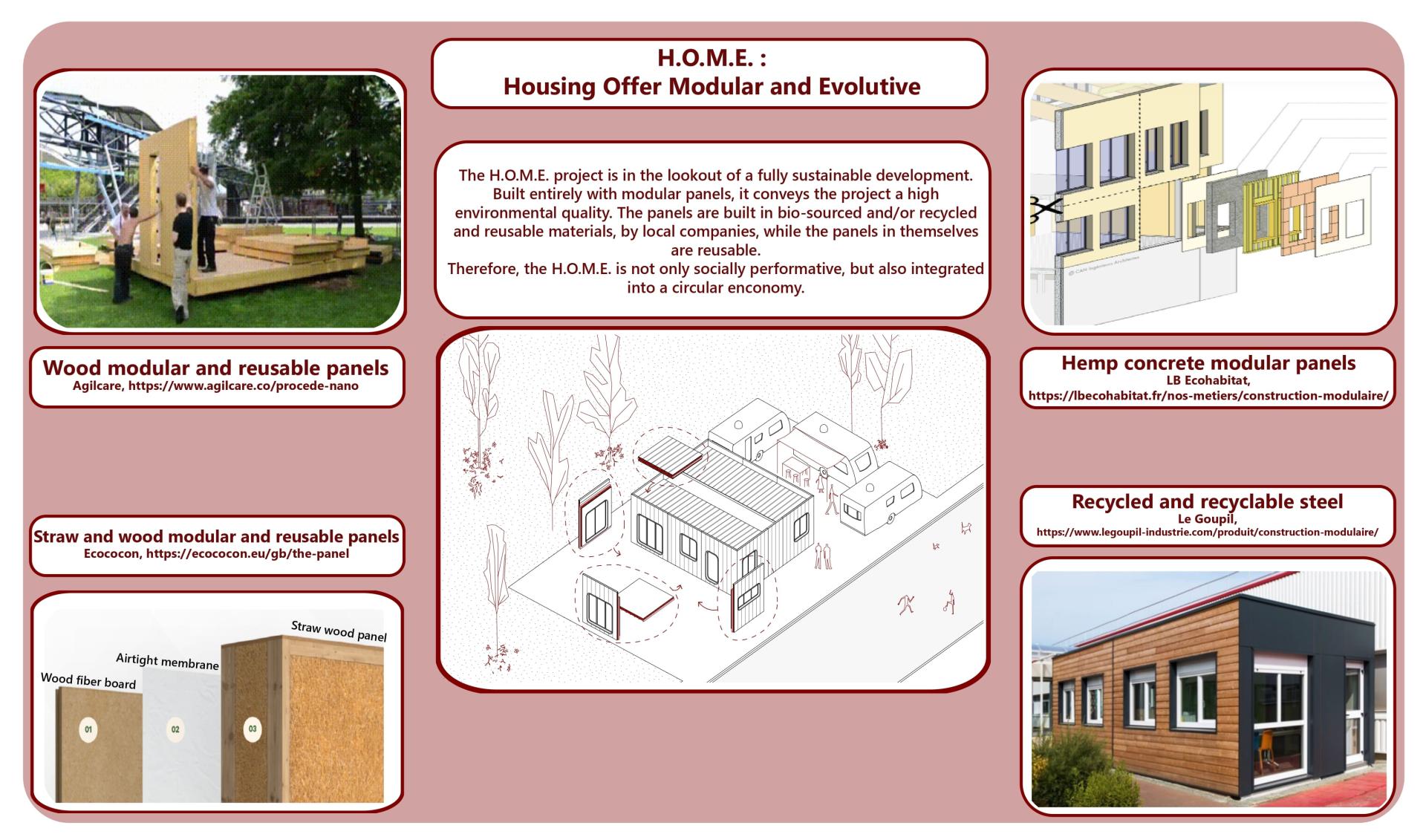
The modular panels for the H.O.M.E. project are prefabricated and ready to assemble on site. It allows them to be easily reused for another family once the previous family moves out. H.O.M.E. is also designed to be evolutive following the growth of the family and its evolution towards a sedentary lifestyle: new panels can easily be added to the basic structure. Designed to be easily assembled offsite, they need little workforce and time to be handled, which lowers the price and makes the modules financially accessible. The panels also reduce the carbon footprint of the project, as the panels are reused for a long time, in favor of a circular economy. Furthermore, a majority of the materials used to build the panels are biosourced (wood, straw, hemp...) and/or recycled, such as recycled steel to imitate the aesthetics of the caravans. Regarding energy and resource consumption, the H.O.M.E. ’s slope roof allows rainwater harvesting and the panels ensure an improved heat insulation compared to the current sanitary units on halting sites.
The Pop-up halting sites offer a new solution for travellers, while respecting the aim of zero artificialization, especially in urban areas that often lack halting sites due to the pressure on their lands. Indeed, the concept obeys to the aim of land recycling linked to temporary urbanism. Our project allows the travellers to find a temporary solution, while using vacant land. For instance, it allows a piece of land to be used pending the development of an estate project. The added value to that temporary use is plural : the city owns new land to welcome itinerant travellers and during their stay the site is looked after by the travellers, therefore preventing illegal occupation. Then, when the site is about to be developed, the families leave an undamaged land, thanks to their care and grassed slabs which leave no footprint. Moreover, the sanitary block units can be used again on other Pop-up halting sites.
Key objectives for aesthetics and quality
For the H.O.M.E. project, the design of the panels is inspired by the architectural vocabulary of the caravan and the traveling culture : windows with rounded corners, sliding doors, use of steel and colors inspired by caravans. These aesthetics were thought in order to respect the travellers’ history and identity and to ease their adaptation from the caravan to their new way of living. A catalogue presents the options available for the travellers to choose from, depending on their desires and needs, for example in terms of intimacy and size. Many travellers who have already decided to settle down still live in their caravan, possibly with an adjoining sanitary unit on halting sites. These are usually very basic and have poor heat insulation. The H.O.M.E. therefore provides an improved everyday comfort for sedentary travellers. The modular and evolutive characteristics allow each family to live in a chosen environment, therefore enhancing their personal experience of living in a built house while staying close to their caravan.
Pop-up halting sites are a sizable improvement to outlawed camping sites on wasteland or carparks where there is no secure power connection and water supply. A Pop-up halting site ensures access to both electrical and water resources. If the targeted site is an undeveloped piece of land, grassed slabs can be installed so as to raise the caravans above the soil and prevent poor outdoor living conditions due to bad weather. These grassed slabs also protect the land from any deterioration from parked vehicles. Equipments on halting sites are minimal (sanitary block and waste skips), creating a discrete and comfortable area for a temporary stay. Travellers on Pop-up halting sites can therefore enjoy a serene environment.
Key objectives for inclusion
The H.O.M.E. and Pop-up halting sites are designed to improve the living conditions of sedentary, semi-sedentary and itinerant travellers, a core step towards an improved social integration of these groups. Travellers are often relegated on the margins of society and outside policy priorities. Both projects were developed based on conversations with the travellers themselves, local authorities and a local association.
The H.O.M.E. solution is a way for travellers to experience a smooth transition from their life in a caravan to a built house. Their implication in the design of the modular house and possibly in the making of the house through a workforce development project are ways to enhance travellers’ social and professional inclusion. Throughout the different steps of the H.O.M.E. evolutions, the support of social workers and local associations secures their adaptation and social integration in the long run.
Pop-up halting sites allow itinerant groups to camp on available land closer to cities and are therefore better integrated in the urban network and among the rest of the population. This configuration is an important step towards social mix. Travellers are closer to urban services such as transport, schools, health services and employment areas. Proximity with these services are essential for social inclusion. The decent and hygienic living conditions on Pop-up halting sites contribute to brighten the external view on the site and better integrate these living areas in the city. Also, the agreement on temporary occupation regulating the sites is also designed to initiate a conversation between the travellers, the landlord but also local associations and even neighbours. Mediation is at the heart of the Pop-up project.
Innovative character
The H.O.M.E. and Pop-up halting site concepts are innovative in different ways : on an architectural level of course, and also on a social level as these projects were designed with and for travellers. These concepts are challenging the very notion of “dwelling” and welcoming. Housing is a key factor for social integration : creating a modular house and welcoming site tailored to travellers’ needs is the best way to ensure their inclusion.
Travellers often seem not to be a priority in public policies. They are given the very minimum on halting sites: water access and electricity. There is no intermediary housing between halting sites and common housing (house, flat). Thus, the changes are often too radical for travellers willing to settle down. Our solutions offer an evolutive and softer transition, complying with modern comfort standards. Offering this personnalisation of housing would reduce the risks of travellers abandoning the process of sedentarization due to a lack of preparation and support during the transition.
The Pop-up project is also about improving hosting conditions for the groups still travelling, and facilitating their territorial integration. Illegal camps are still numerous, and raise issues both for the travellers (sanitary conditions) and for the neighborhood (nuisances, degradation of the environment). The Pop-up halting sites aim at : increasing and improving temporary welcoming facilities, avoiding illegal camps that do not meet the minimum sanitary standards, making use of vacant spaces in cities and villages, integrating travellers in society.
H.O.M.E. and Pop-up halting sites are complementary solutions that encourage a better integration of travellers in our sedentary societies. To sum up, our propositions are innovative because they offer flexible housing solutions to a poorly considered population. We believe these projects could have a positive impact on the social integration of travellers.