Grössling
Basic information
Project Title
Full project title
Category
Project Description
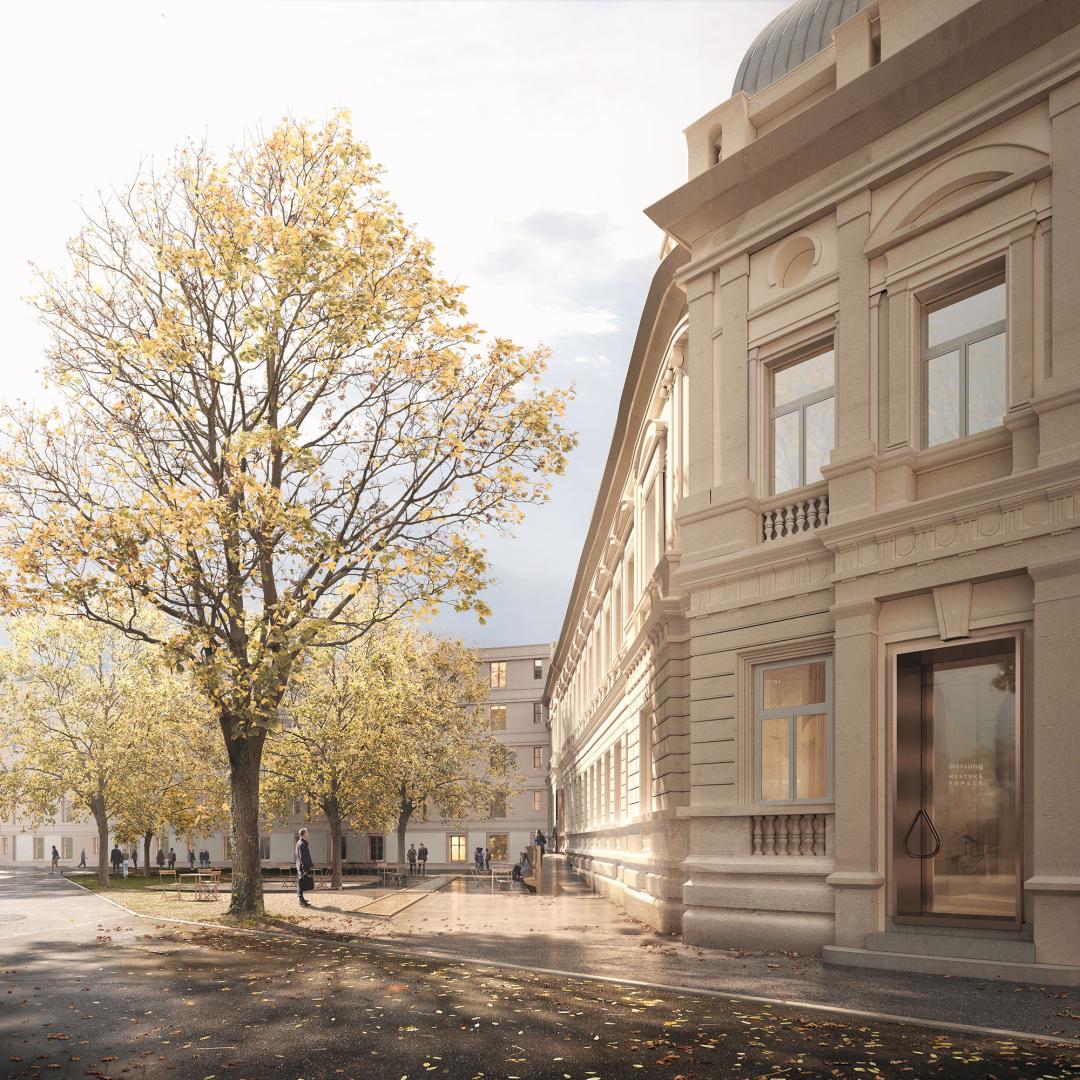
The City of Bratislava and the Metropolitan Institute of Bratislava have the intention to restore the original function of the Grössling Bath and complete it with new forms of cultural-community activities and thus open the space to the public.
In addition to the renovation of the bath section, we also plan to move part of the City Library into the separate area of the object and thus create a public institution which will be accessible to everyone.
Project Region
EU Programme or fund
Description of the project
Summary
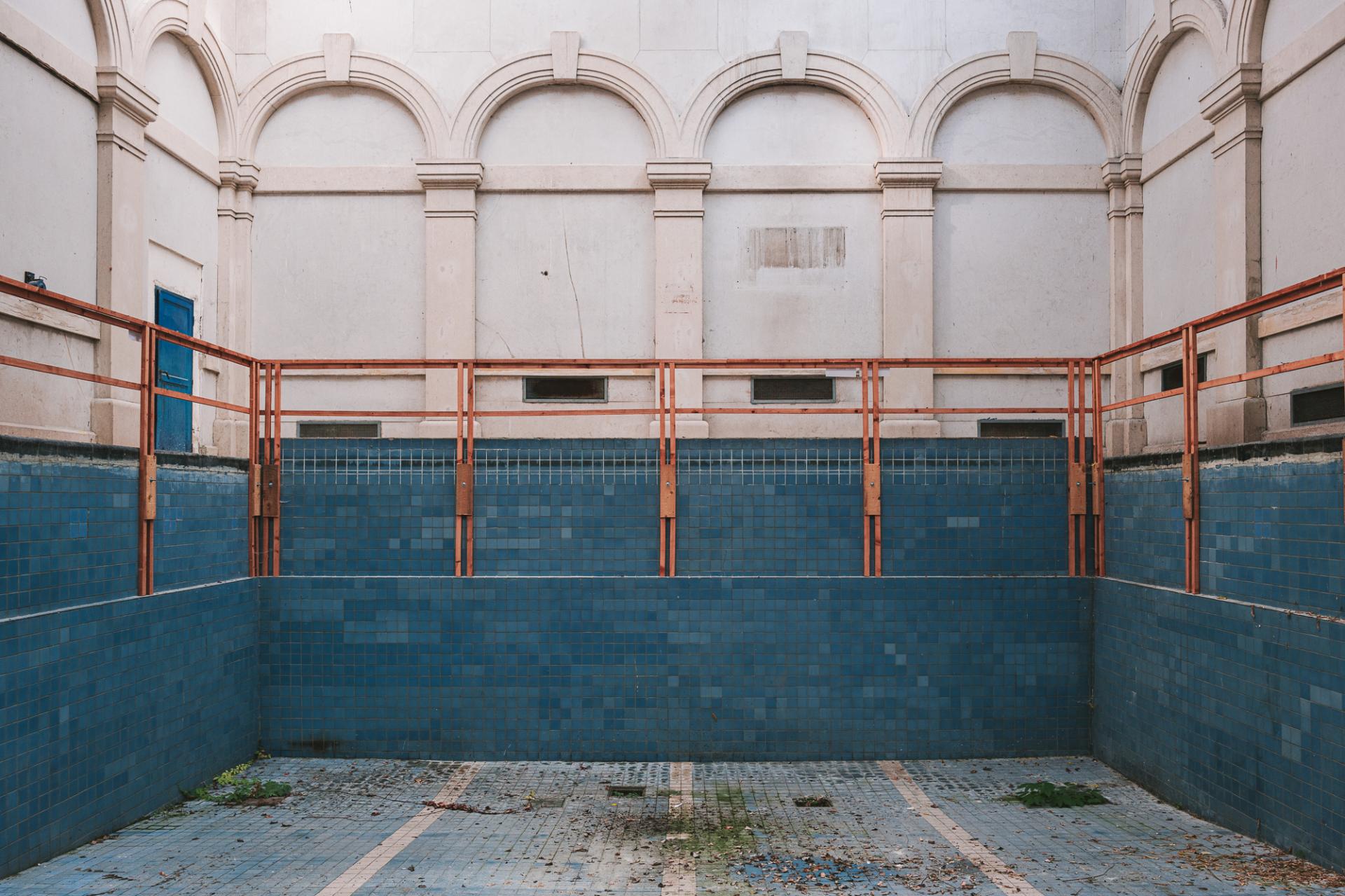
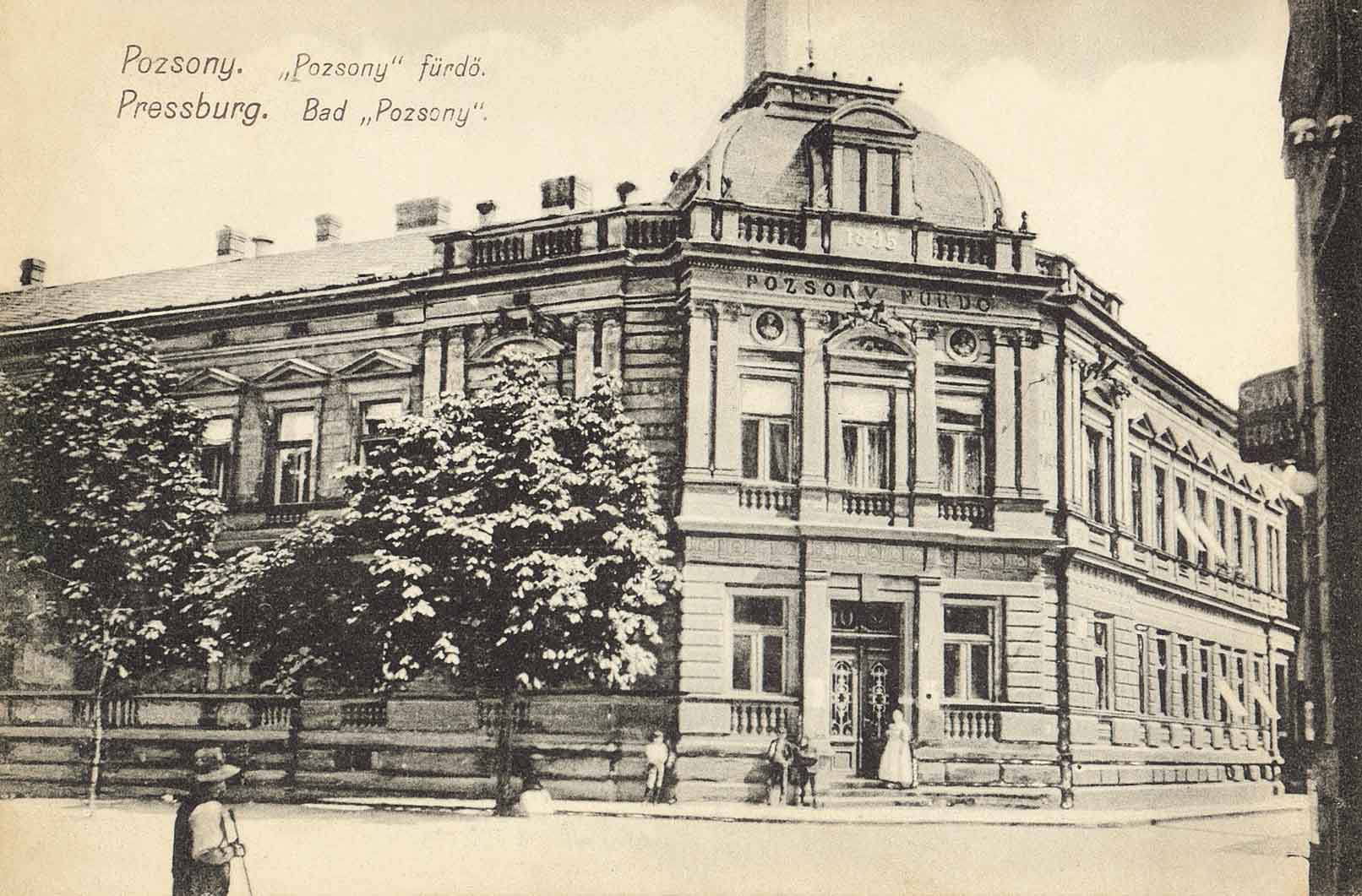
Grössling City Bath (build 1895 ) is an iconic building in Bratislava. During the hundred years of its existence, the Bath went through many construction modifications. The part of the building was used for administrative purposes until 2007, but the Bath last served its original purpose in 1994. Since then, the building complex is falling into disrepair and itʼs unused.
On the one hand, this longterm unresolved state creates a construction and technical problem with the maintenance of the monument, on the other the perception of the bath function and its irreplaceable social and cultural position for the creation of quality life in the municipal environment vanishes over time. The nonfunctional object does not communicate with its surroundings and does not offer the residents the possibility to participate in the public space. The city of Bratislava has come up with an intention to restore the original recreational function of the former Grössling Bath.
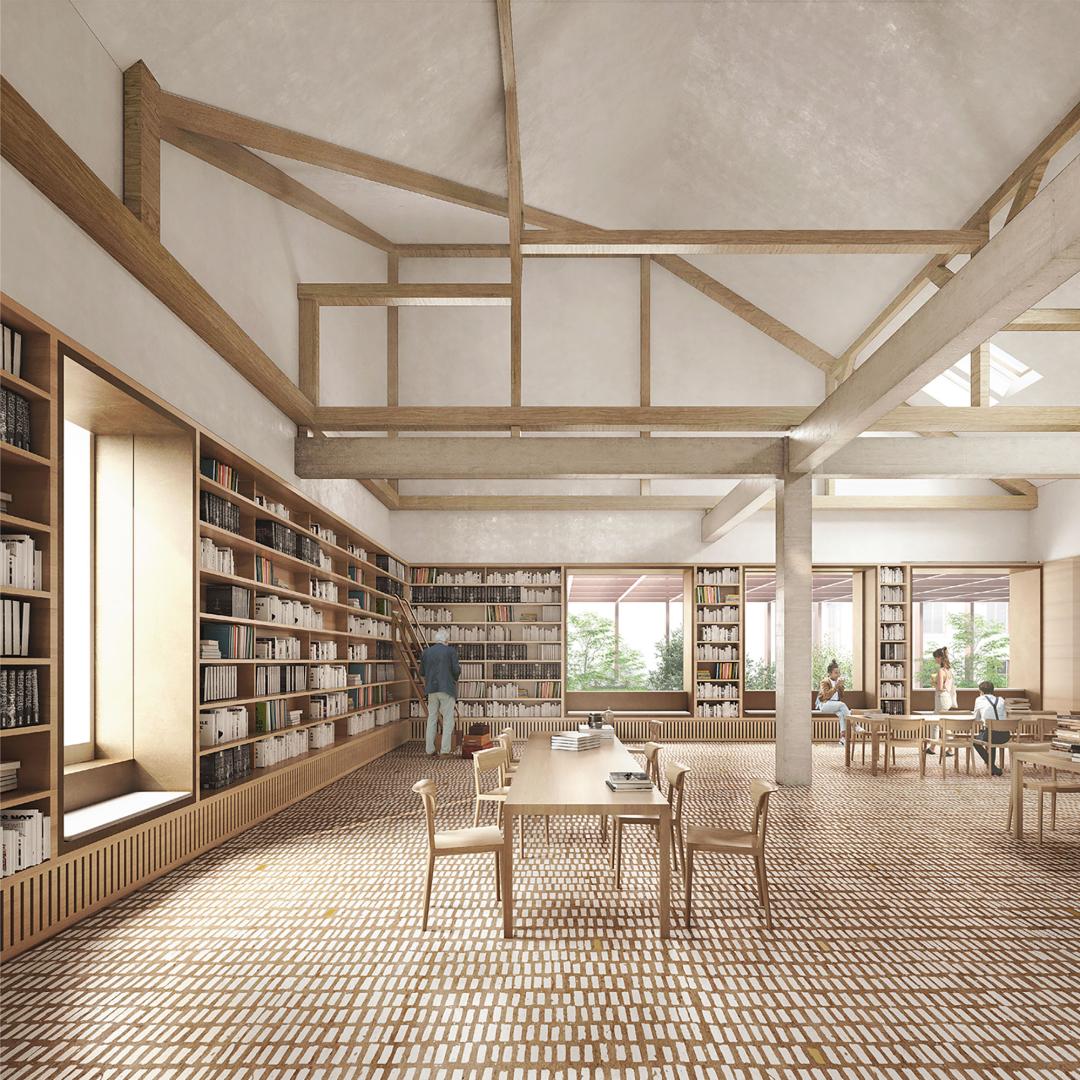
In line with today‘s trend to create spaces that provide a combination of different features to its users, the restoration plan envisages a combination of both city bath and library function by moving one of the City library department to these premises. By adding the educational and cultural function, the building becomes a fully-fledged public institution open to public.
The main concept of linking these two functions is „the immersion“. On the one hand, it represents the immersion into the bath atmosphere, a place for relaxation and rest, and on the other hand, it represents the immersion into books and the calm space of the library. Both functions offer the visitors the possibility to relax and gain new impulses.
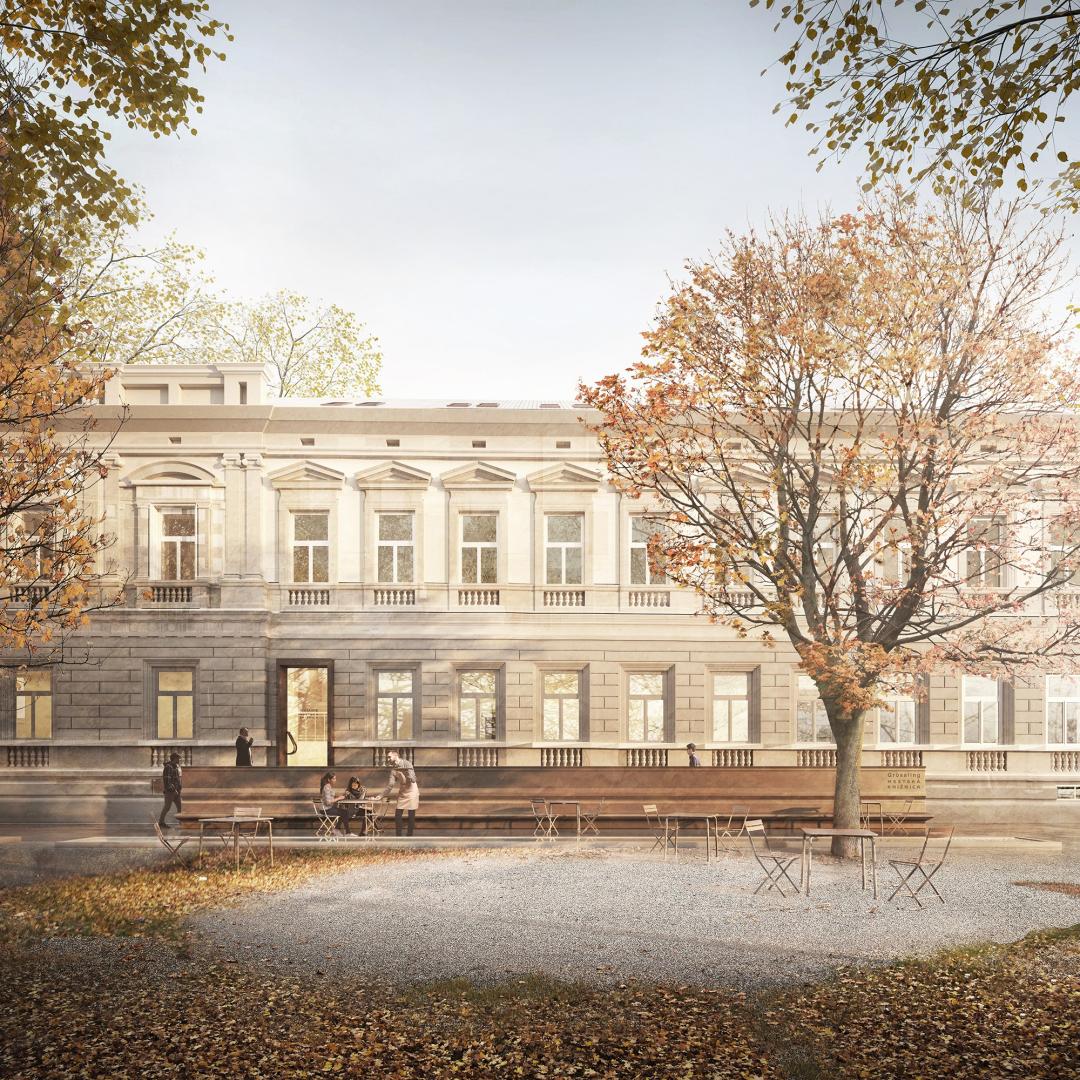
The two separated spaces shall be interconnected by a café which, together with the park is a part most open to the public. The park should become the meeting point both of the local inhabitants and the Grössling visitors.
Key objectives for sustainability
The building can be divided into 3 parts. A part that is completely free of charge and accessible, which is the municipal library ( 1800 m2 ) and the public space ( 1400 m2 ) which are parts run by the municipal budget. The second part is the part with free access but offering services and is the café ( 200 m2 ). The third part is the bath ( 6000 m2 ) which is accessible for a fee. The entrance fee to the bath ( 7-12 EUR ) guarantees long-term sustainability and inclusiveness in price.
The economic model of the bath is set up for a long-term sustainability. Investment costs are financed by a bank loan repayable in 20-25 years. After repayment of the bank loan, the revenues will allow for the reconstruction of the building from own resources and the construction of new functions.
The bath itself is also energetically sustainable. 30% of the bath energy is supplied by green energy. From a technical point of view, it is also important to save energy, which means that it is not only the energy produced that is important, but also the costs not spent. This means that the whole building will be managed by an automated smart system. The system will allow passive ventilation and automatic shading which will save other 15% from the costs.
Key objectives for aesthetics and quality
The architectural designs for the bath and the library were selected in a two-round international architectural competition, which attracted 77 entries from 17 countries. The winner of the competition was a young architectural company from Florence.
Our aim is to create a new social public space in the city. A space that is not only a space for recreation but also a space for social discourse.We know many combinations of public institutions, but these two functions (bath and library) give a whole new meaning to recreation. It is first and foremost intellectual recreation and a place for new ideas.
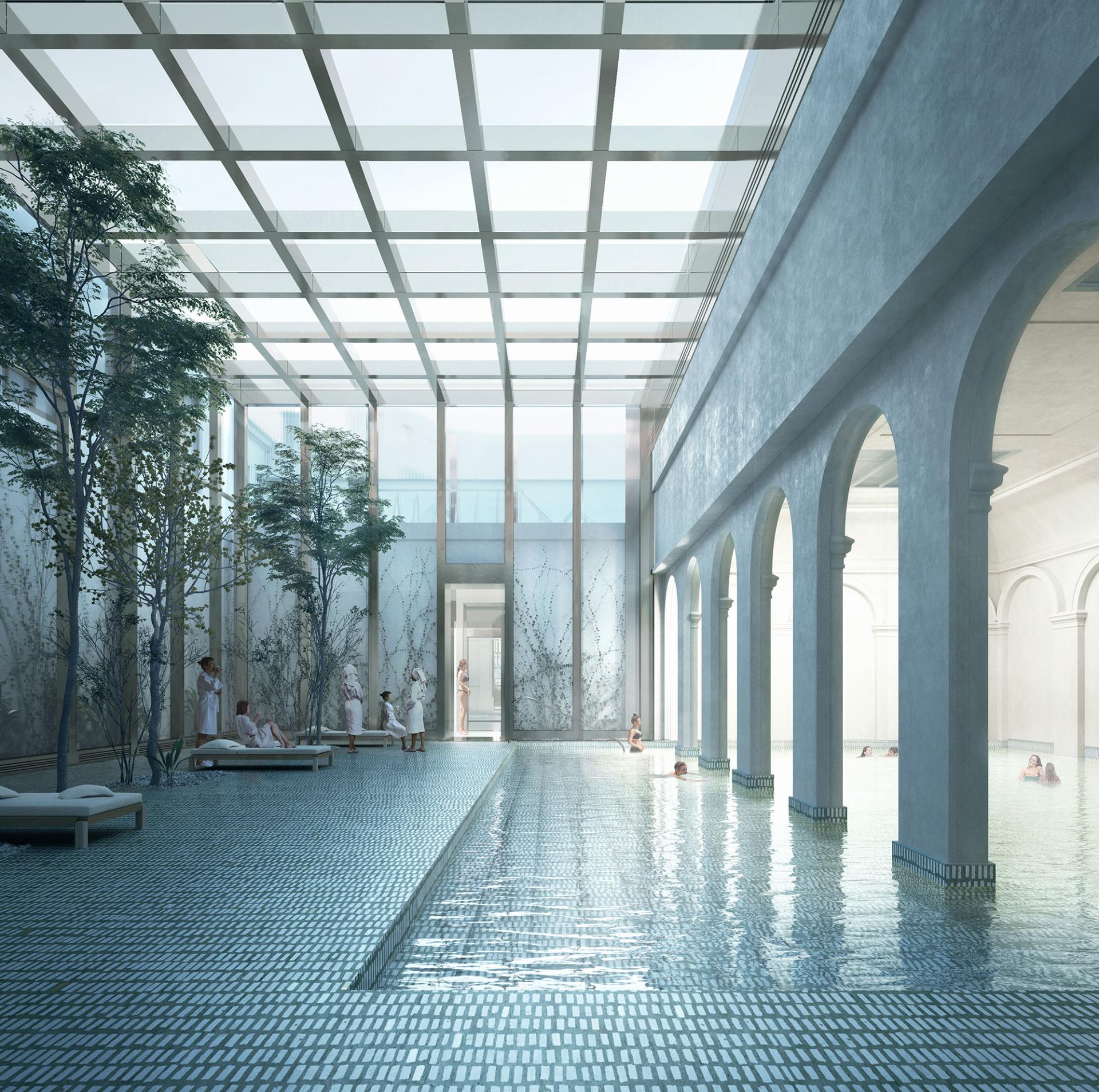
The architecture itself and the design of the interior spaces take into account the advantages of the old building and work with the advantages of the new building. We are reopening the arcades, reviving the pools that were filled in during the Second World War. Every new element of the building will make a new function. For example, the entrance ramp that facilitates barrier-free movement is also a public bench modelled on the "panca di via" in Florence, a waiting bench attached to buildings. The new greenhouses bring back the style of orangeries of the old baths, whose glass surfaces are also solar panels.
Our aim is to create an inclusive space where, like the baths in Rome, discourse and immersion in thought are the main objectives.
Key objectives for inclusion
In our understanding, there are two steps of creating an inclusive space. One is the design of the technical space and the other is the design of the accessible space.
Accessible space is primarily a financial issue and relational issues, It is important that the design of the Grössling bath and the library started with a participatory process involving more than 2000 people. This was the first step in involving people. The second step was to involve small groups of people who were thematically linked to the library or bath function. The third step was to explore the history of the bath, publishing different stories about the bath. Each stage was designed to bring people closer together.
Accessible space is also a material issue. The library will be a free accessible space, but the baths will have to be paid for. During the planning process we divided the baths into 2 units. The basic unit will be the recreational bath itself, with a full day ticket of 7 EUR. The second part is the sauna area with an entrance fee of 12 EUR.
For the technical space, it was important that access to the building should be a one-off barrier. It is planned to create a ramp to access all the sites. In addition, all venues are easily accessible.
Often public buildings only cater for people with reduced mobility, but it is important that a bad design can also be a barrier for people who cannot see or have poor vision, and it was important in the design to give preference to the elderly when it came to the distribution of the lockers so that they have the shortest route.
Results in relation to category
Very few historic buildings can regain their original function. This is obviously for technical reasons, as these functions are no longer relevant. When the spa opened in 1895, the following newspaper article appeared :
"The baths are a vital necessity for the men of the century, who live in a feverish hurry, or who are in a thousand worries and troubles, to relax their nerves, tired with work." 1897, journal
Our plan is to restore the spa to its 1897 state when it was in its golden age. As an old new means of immersion, the spa is a place of discourse and a place of public life that is always topical. The library as a meeting place and not primarily a repository of books, the public space that is the anteroom of the whole complex can be an important site in a busy city.
How Citizens benefit
The participatory process consisted of two major parts.
In the first part, experts from the two functions and external experts were consulted. We worked with the director of the Budapest Baths, swimmers, architects and sauna builders to develop the bath function. For the library function, we worked with writers, the library director, a bookshop owner and an event organiser.
In the second part, we asked people's opinions through an online questionnaire and small focus groups ( elderly, wheelchair users ).
The results were published and presented online and in small focus groups. The final result of the participatory process was given to the architects during the architectural competition , and an evaluation criterion for the jury was the architectural reaction to the final result.
Innovative character
The most important innovation is the merging of two functions that at first seem to be not close. Although we are technically talking about 2 separate building sections, the two functions will operate under one communication. The baths are defined as a social and not a sporting space. Economically, the overall structure will create an open space for everyone.
The technical approach is also innovative, in which it is important not to aim for a technically hypermodern building, but rather to try to create a building that works logically. The glass surfaces are used as solar panels, and a simple system can control passive ventilation by opening the roofs automatically. By planting plants we can regulate the indoor microclimate. We have our own cargo bicycle system to transport goods, as the building is located in a residential inner city zone.