Re-enactment:
Basic information
Project Title
Full project title
Category
Project Description
Re-enactment: Lilly Reich’s Work Occupies the Barcelona Pavilion is a response to the gender inequality that haunts credit recognition. It broadens the understanding of the architectural project’s scope while questioning architectural elements’ transformation potential. Originally a research project implemented as an art intervention, now also an ongoing book project, it searches new paths to disseminate architectural knowledge as it looks at modernism through the lens of contemporary concerns.
Project Region
EU Programme or fund
Description of the project
Summary
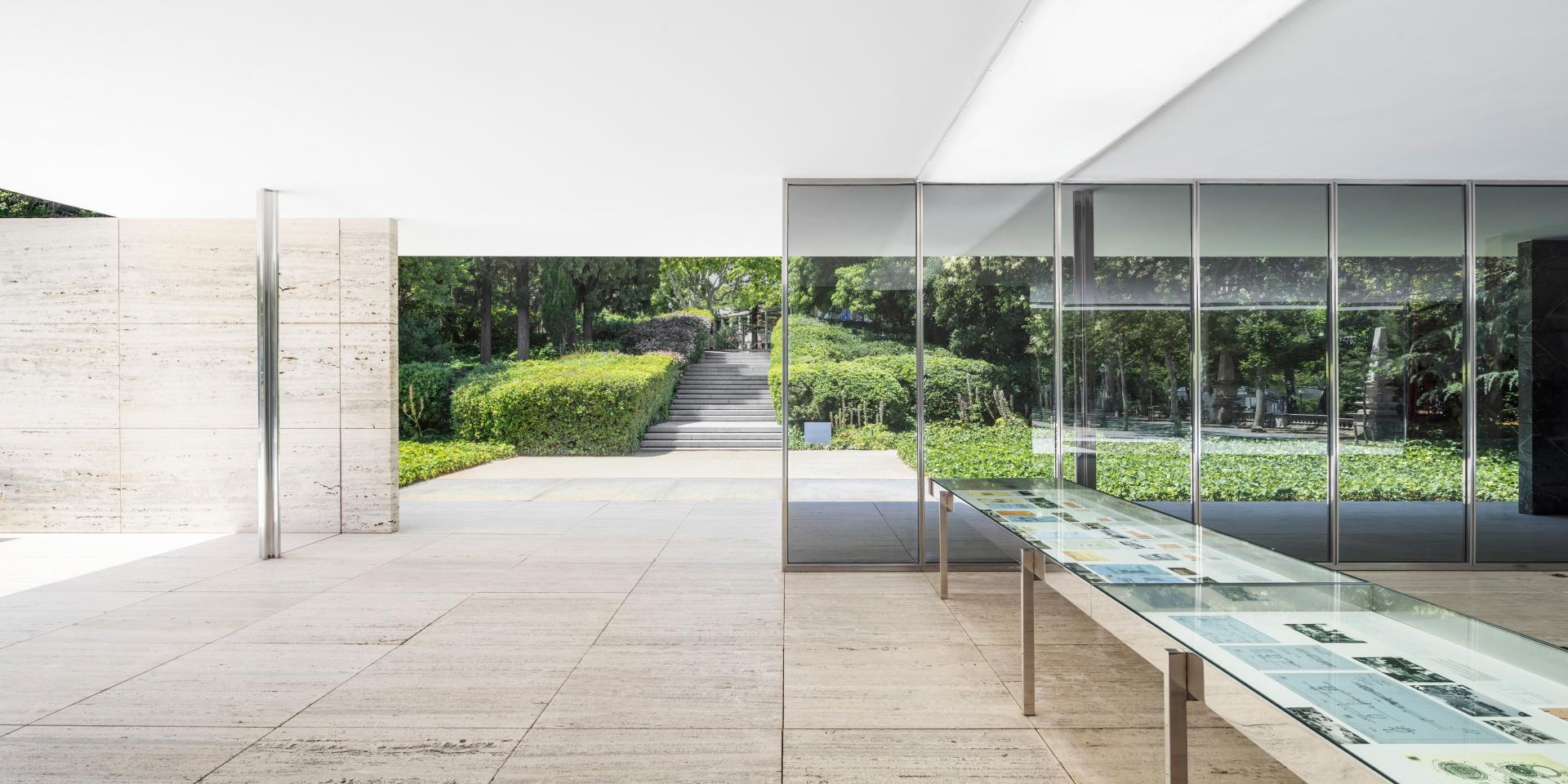
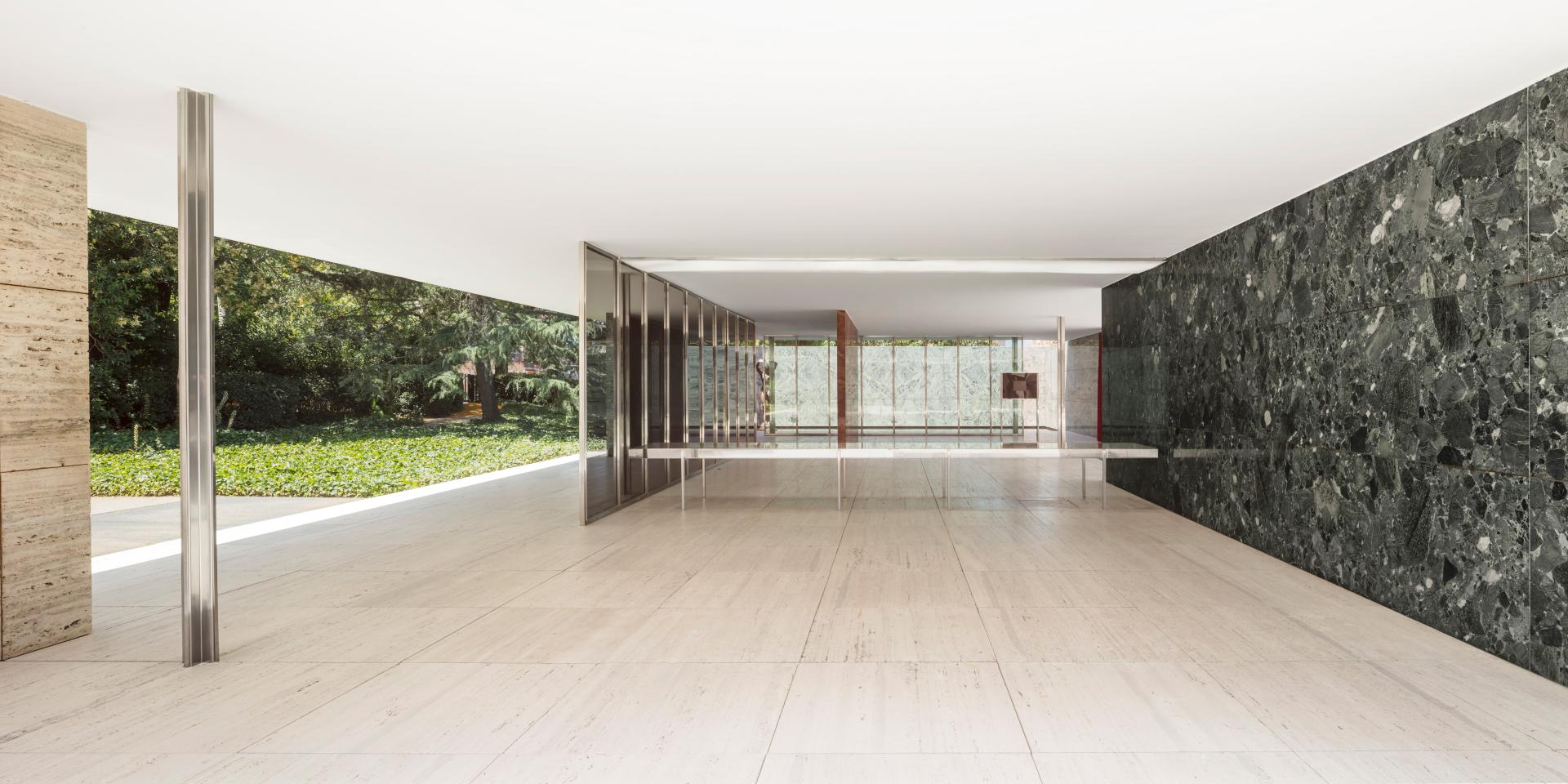
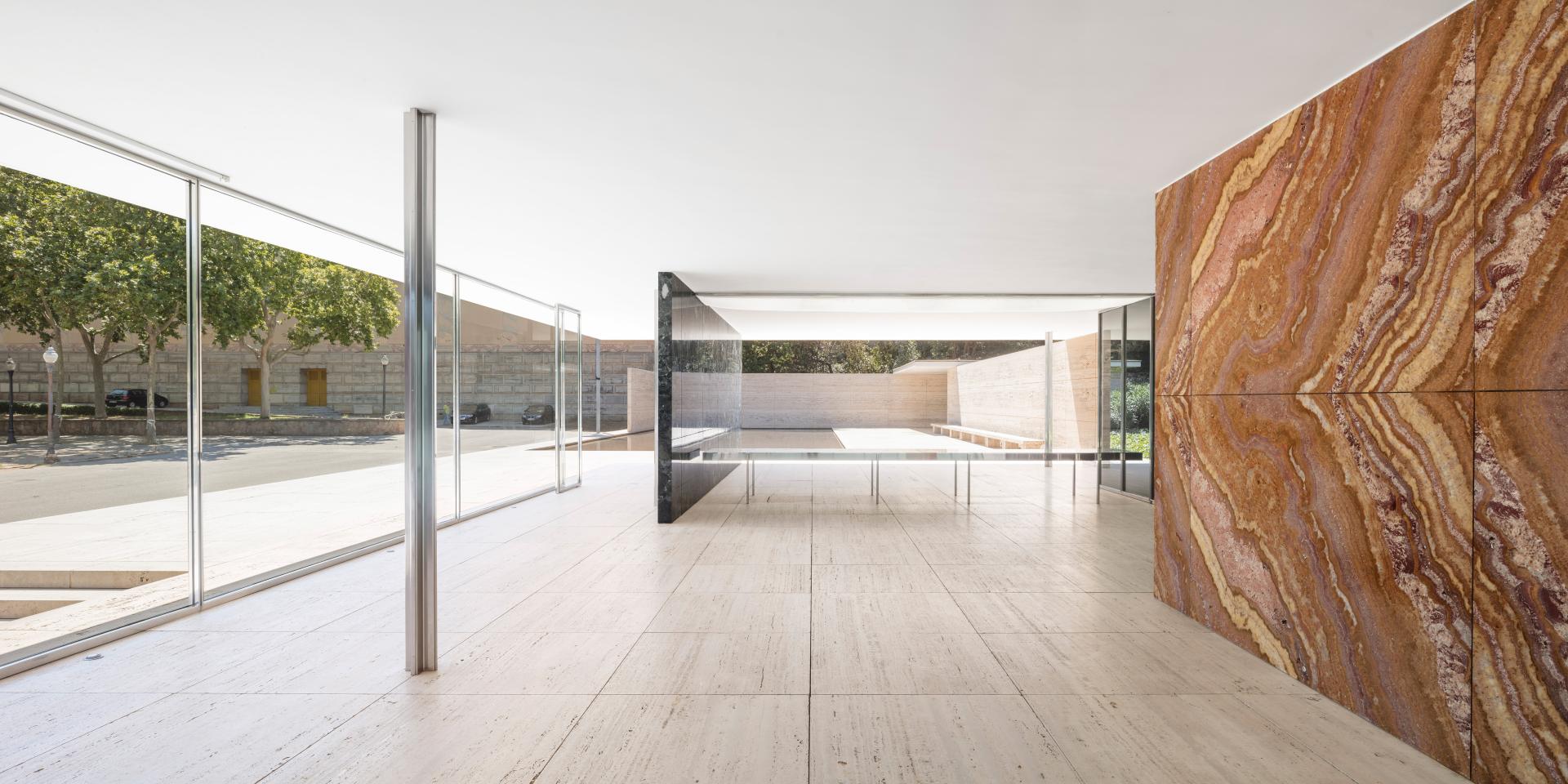
In which moment was the trace of Lilly Reich’s work lost? Why was she left out of the books and catalogues that reproduced the Barcelona Pavilion and that catapulted Ludwig Mies van der Rohe to world fame? How is it possible that the work of a woman architect that was recognized at the time has been so blurred over history? Re-enactment: Lilly Reich’s Work Occupies the Barcelona Pavilion (March 6-July 15, 2020) is the ephemeral intervention that materialized a silenced authorship at an architectural and documentary level. It is an intervention that eliminated one of the main architectural elements of the pavilion –its milky-glass light box– to incorporate two horizontal display cases reconstructed with original plans from 1929, which Lilly Reich had designed for the 1929 International Barcelona Exposition. A prolonged display table occupied the space of the light box –the very projection of the skylight– and opened what was an unknown vista until then, while it unveiled the true context in which the pavilion emerged with archival evidence. A vertical display/screen, with two films from the official opening of the German section of the International Exposition to each of the sides, offered coinciding points of view with the experience of the actual pavilion and made evident the technical and formal link of the new architectural elements with those of the reconstructed pavilion. The table and the screen, the two display cases, designed in 1929 and reconstructed and incorporated to the representative pavilion, managed to demonstrate that the reading of this mythical work of architecture is incomplete, when it is not considered the more ample work developed by Mies van der Rohe and Lilly Reich for Germany in the Exposition. The created dialogue between the displays and the pavilion’s elements and the demonstration of their belonging to the same technical and design genealogy was able to demonstrate Lilly Reich’s co-authorship in the overall project.
Key objectives for sustainability
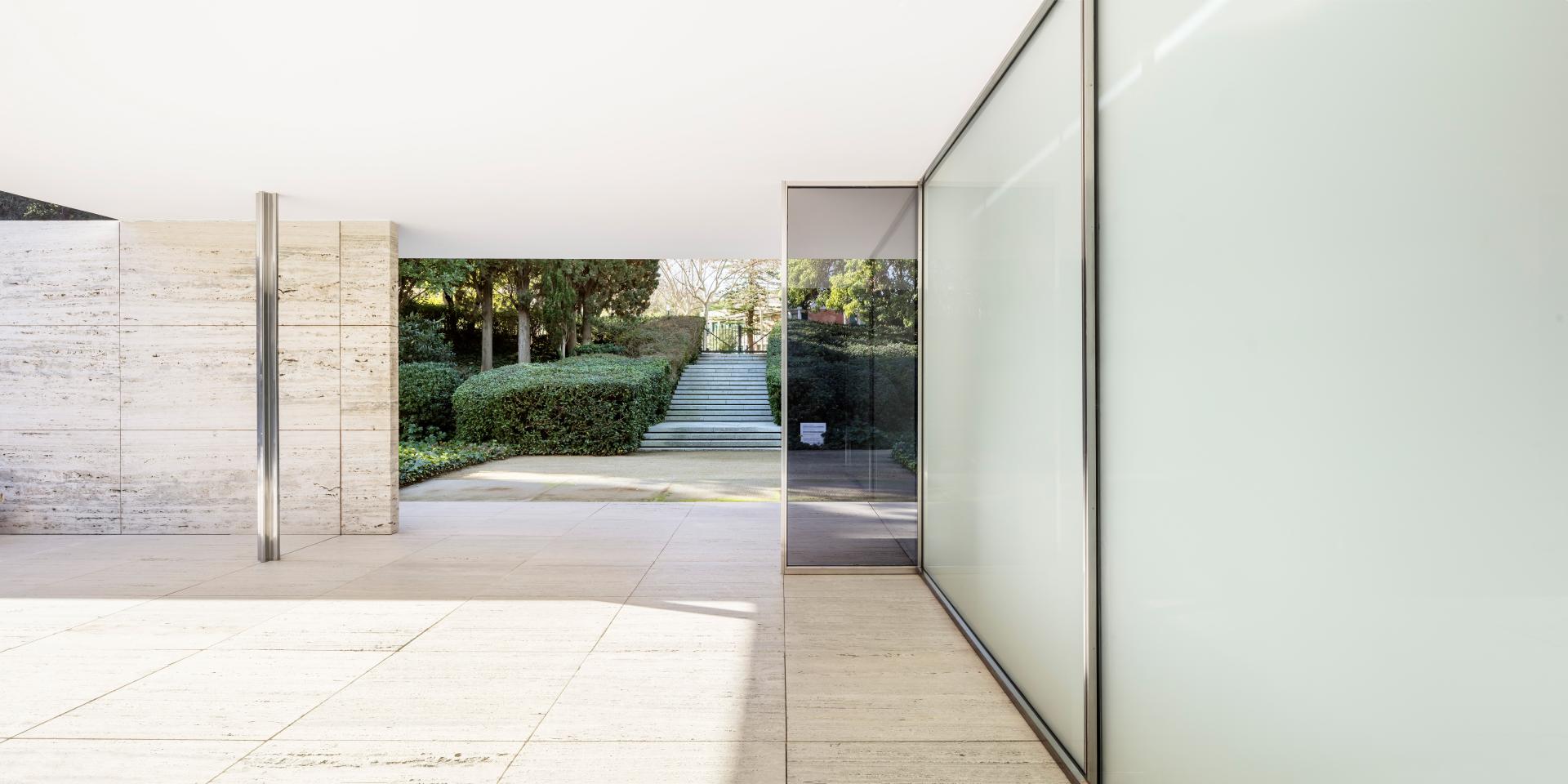
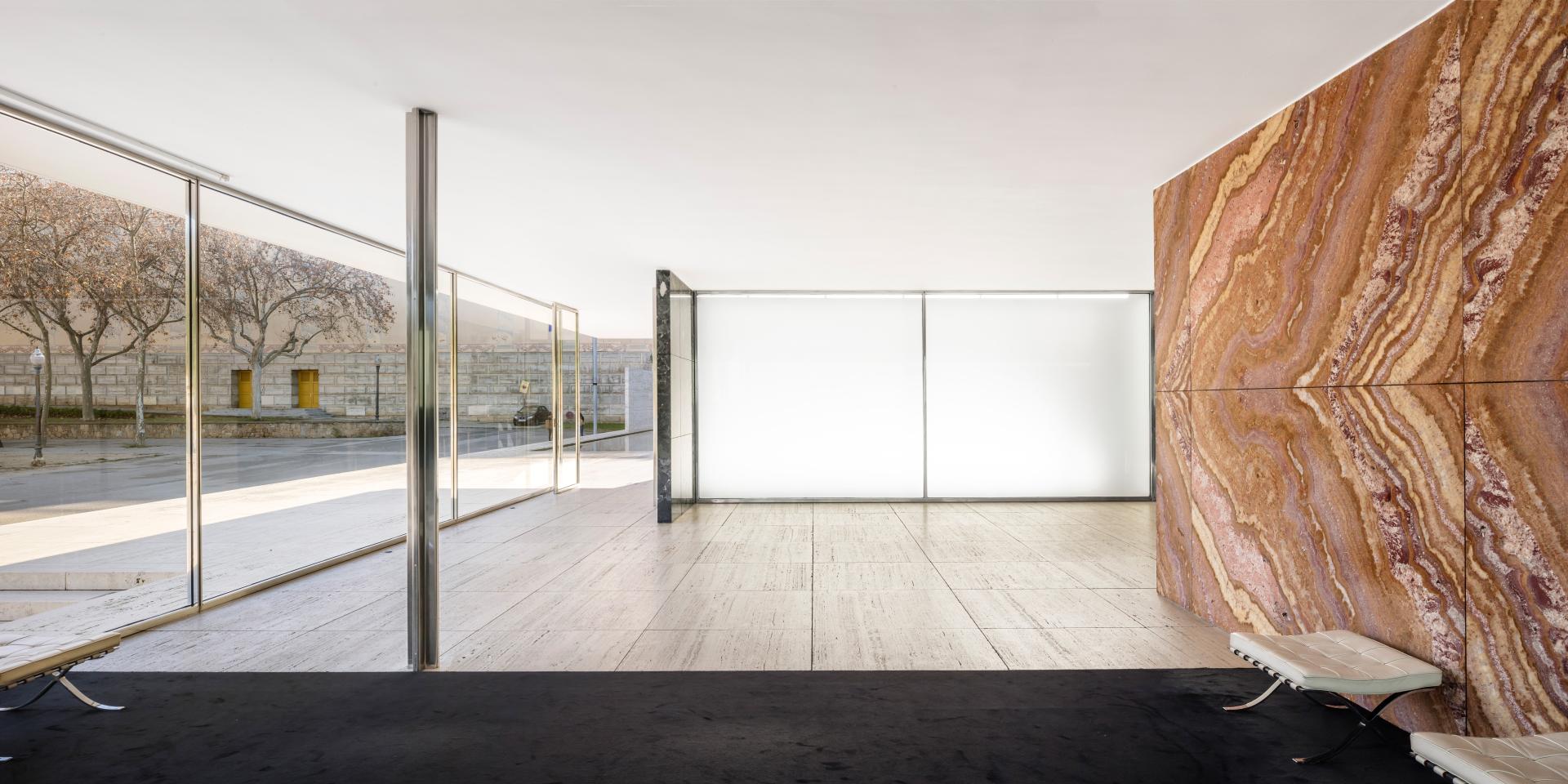
The largest transformation came from the dismantling of the existing milky-glass light box (which has been interpreted as the “heart of the pavilion”) and the unveiling of the skylight. All the dismantled materials were put back into place when the intervention closed. There was no waste in the transformation of the architectural elements.
The skylight was opened following a four-step process. First, the layer of paint darkening the glass at the module of the screen coinciding with the width of the skylight was eliminated, rendering it transparent. Then, the four pieces of glass composing the double-glazed screens of the skylight were removed. At that moment, besides the expected longitudinal visual continuity, an additional transparency towards the side garden was established. Next, the intermediate mullion as well as the perimeter metalwork located on the floor and two sides was dismantled to allow for the visual continuity of the floor as well as the glass screen and the marble wall. The upper mullion was left intact to be able to fix to it a new ceiling. For the final step, a longitudinal piece of white fabric covered the entire span, creating a horizontal screen of light. The original width of the skylight (which is usually invisible to the visitors) was made explicit by means of this new horizontal screen, while the threshold between the interior and the exterior was emphasized.
The two reconstructed display cases, following the original plans of 1929,kept at the Lilly Reich Collection in the Mies van der Rohe Archive at The Museum of Modern Art in New York, had been built by a local blacksmith, following the plans as well as the tradition of Barcelona. These two reconstructed display cases will become mobile, travelling to different cities, before ideally becoming part of a permanent collection of a museum in Barcelona. The itinerant exhibition is one of the next steps to be developed as outcome of the project.
Key objectives for aesthetics and quality
1. One key objective was to reveal the Barcelona Pavilion in a way that had never been seen or experienced before, to clearly make space for that “other gaze.” The goal was to make the space for the gaze of the woman who was engaged in the development of the original project, but who had been for so long neglected.
The art intervention removed the heart of the Barcelona Pavilion—its luminous wall (its milky-colored, double-glazed light box)—, and replaced it with a display table originally designed by Lilly Reich for the industrial exhibitions. The re-constructed lengthy horizontal display table occupied the same space of the light box in order to open a completely unknown vista.
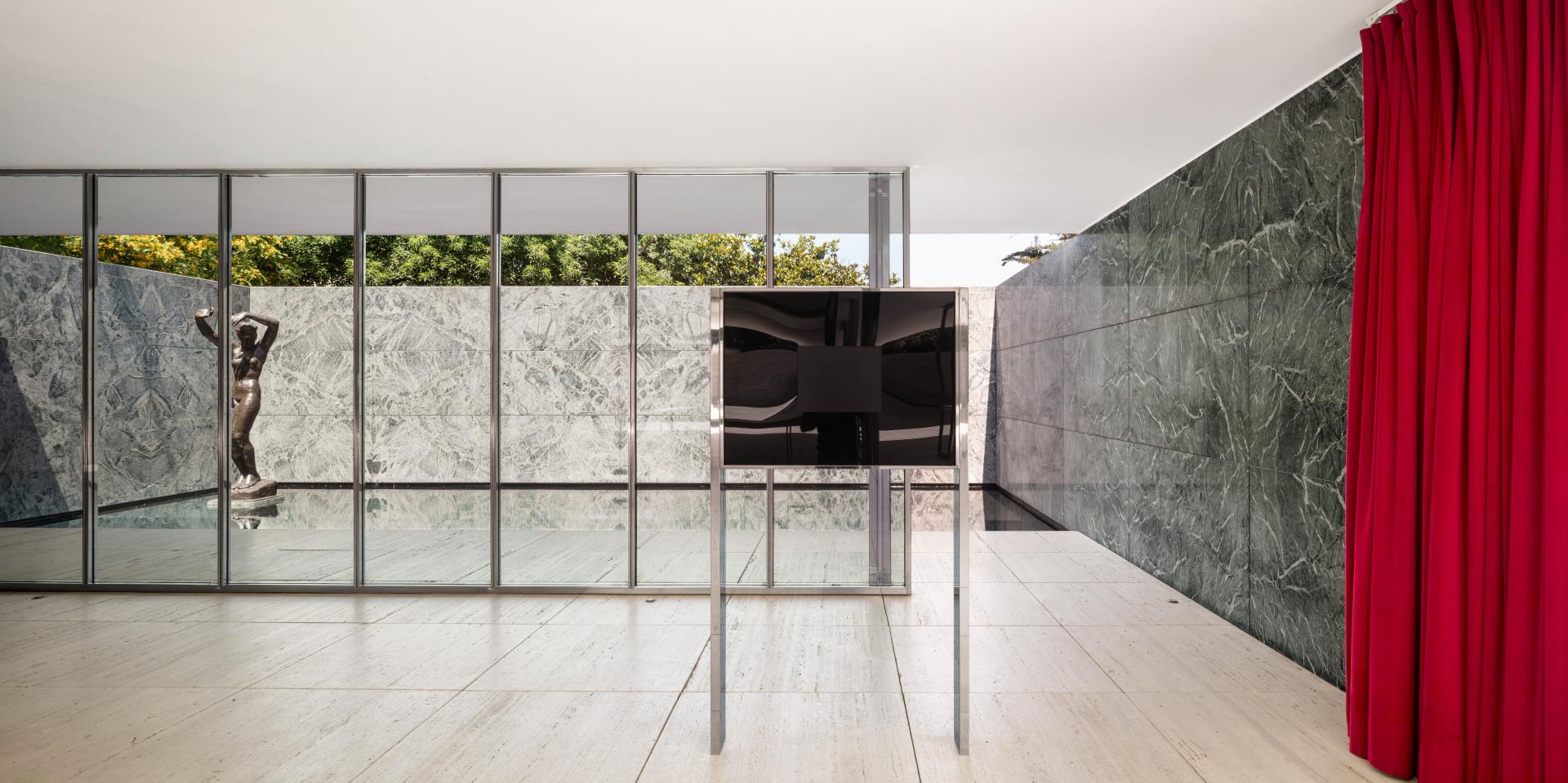
2. A vertical display case, placed in the visitor’s path toward the inner reflecting pool, showed two different film sequences from the exhibition opening in 1929. The main goal was to reveal that Lilly Reich missed her own opening, as she disappeared later from the discourse of architectural history. Mies can be clearly seen in both films. But no-sign of Lilly Reich.
The display case was placed so that some of the positions in the moving images from the opening of 1929 were matched with viewpoints that could be experienced in 2020 in the Pavilion. The two films also revealed how, during the opening of the exhibition in 1929, visitors started their walking sequence in the Pavilion, continuing through the industrial exhibits in the Palaces. They were able to demonstrate that there was an experiential and also a formal continuity between the Pavilion and the Palaces.
3. The two reconstructed display cases were envisioned to bear witness to the homage that the first edition of the eponymous grant has paid to Lilly Reich’s work. And at the same time, they will serve as material record of the effort that is still needed in order to acknowledge silenced authorships in collaborative practices.
4. Photography by Adrià Goula, during and after the transformed cultural heritage.
Key objectives for inclusion
Recognition of authorship is not physically traceable when it comes to architecture. The discipline’s inherent mediation by and obligation to drawing has historically prevented any automatic identification of the author in her or his work. When there is a canon established in a certain building, regarding a grand master architect’s single authorship, but there is also significant historical evidence to prove the involvement of another partner in its development, what are the possibilities left?What are the tools to prove and materialize an authorship?
With a material life of only eight months, the Barcelona pavilion is a mythical work that catapulted Mies van der Rohe —and not Lilly Reich— to world fame.The Barcelona exhibits are overshadowed by the autonomous architecture of the pavilion—just as architectural history has always considered Lilly Reich only as an interior designer of exhibitions rather than as a true architect.
In this project, the two display cases, designed in 1929 and reconstructed in 2020, and incorporated in the space of the reconstructed building (1986), demonstrated that the reading and interpretation of the Barcelona Pavilion is incomplete, when the range and scope of the work developed by Mies and Lilly Reich in the entire project of Barcelona is not considered. The dialogue established between the display cases and the Pavilion’s architectural elements—and the showing of their provenance from the same technical and design genealogy—demonstrated that Mies and Lilly Reich never split the project of the German Pavilion and the German Exhibits, and included Lilly Reich in those narratives that had been neglected until now.
As the jury of the FAD Prize has underlined, “this transformation is an important manifesto for our days: for claiming the relevance of the contribution of one of the leading women of the architectural scene who, like many others, deserves to be rescued from the secondary role that the history had reserved for her
Results in relation to category
“And I just entered… and I could not believe my eyes: a double glazed wall of white color had been entirely removed… some kind of an invisible skylight…If to make visible that invisible wall [when comparing it with her sisters, made of exotic and evocative materials] it sufficed to completely eliminate it, to give light to the work of Lilly Reich there was no better place than that skylight…A sort of heartbreaking and touching metaphor that, in direct connection with the creed of ‘less is more,’ transformed on something extremely beautiful what had been a documentary investigation.”
— Frederic Montornés, Montornes.net
“Going to an intervention and finding out that the plan of the pavilion that we know by heart has been dismantled is not only an impact to our memory but also to our architectural certainties. What happens if we eliminate one of its visual limits…? The space that we called interior is transformed into a porch, the pavilion’s architectural integrity is put under question. Martínez de Guereñu noticed it and this is why she relied on that limit…to place the display table…All the eyes directed to the absence of the vertical element usually enclosing that side, all the eyes placed on a display case originally designed for the German Section of the Exposition.”
— Roger Miralles, Archivo español de arte
“Undoubtedly, the most forceful, provocative and courageous intervention at the pavilion was conducted by Laura Martínez de Guereñu in March 2020. Never has the pavilion been so directly violated – but has violence against a building ever made so much sense? Laura Martínez [de Guereñu] ripped out the heart of Mies’ pavilion, its luminous wall, and replaced it with a display table designed by Lilly Reich and a documentation of her plentiful work at the exhibition, routinely dismissed or overlooked by the critics. And something else emerged… which was hard to admit… - a better Barcelona Pavilion.”
— Dietrich Neumann, a+u. Architecture and Urbanism
How Citizens benefit
Unfortunately, the art intervention closed after only one week due to the spread of Covid-19 (it was opened on March 6, 2020, just one week before the national emergency was declared). Once the first confinement was raised, the intervention was extended until July 15, 2020, to try to attract some international travelers. However, the impact of the pandemic was much higher than what it was anticipated, and both travelers and local visitors were drastically reduced, while the intervention was physically experienced by much fewer people than originally envisioned.
The project had an ample coverage in national and international media. To name a few:
RADIO: RNE5. Todo noticias, 18:37h (March 11, 2020) [9 min] Teresa Pascual, “Lilly Reich en el Pabellón de Barcelona”
PRINTED PRESS: EL PAÍS (March 23, 2020) José Ángel Montañés, “El Mies van der Rohe saca su lado femenino”
TELEVISION: TV3. Night News (June 16, 2020) [1:33 min] Xavier Abad, “Segona beca Lilly Reich per la igualtat en l’arquitectura”
As an impact of the intervention in the media, the journalist Begoña Gómez-Urzáiz made up the name “the Syndrome of Lilly Reich” to identify a reality that is still present, which is the way in which women architects (and creators of other fields) are shadowed by the male stardom.
The project has also been reviewed by scholars, who had published articles in Spain, Germany, and North America: Roger Miralles, Anke Blümm, Helen Robertson.
Now, we (the Fundació Mies van der Rohe, promoter of the project and myself) have a new project of a two-volume publication, which will be the final form of an investigation focused on making the work of Lilly Reich visible. It will be a long overdue recognition of the work of Lilly Reich (as well as that of many women that have practiced in conditions of inequality) in printed form, which will not depend on visitors, since it will be internationally distributed and it will endure over time.
Innovative character
With an ephemeral intervention of re-enacted architectural elements, a curatorial statement was made within a re-constructed building. Re-assembling some of the original architectural elements and making the project understandable to the broad public, knowledge of architecture was disseminated throughout a mythical work, while questioning the idea of originality, reproduction and endurance of buildings.
Conceived as a locus of cultural exchange, the exhibitions were used by the Bauhaus to showcase their work and to contribute to the renovation of the image of the Weimar Republic internationally. More than 100 years later, the transformation of the space of the German Representative Pavilion –part of our preserved cultural heritage–, reenacting architectural elements originally created to showcase some Bauhaus objects in the Barcelona Exhibits, reveal the continuity that both architects (Mies and Lilly Reich) unfolded across scales, and allow history, and the rich exchange between Germany and Spain, to go full circle.