"European Uchronia": a new film subgenre
Basic information
Project Title
Full project title
Category
Project Description
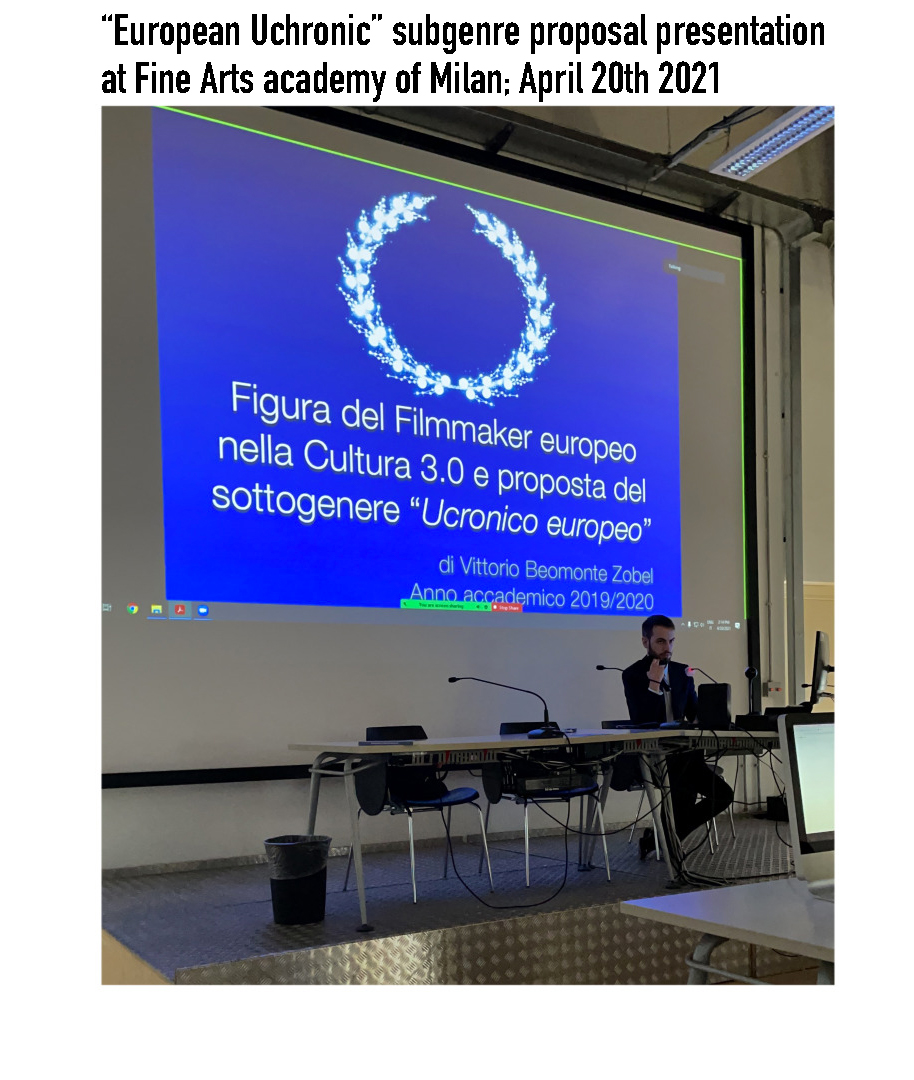
"European Uchronia" (or "Eurochronia") is a sci-fi and contemporary uchronia "cross genre" concept. Conceived as dissertation at Fine Arts Academy, this film subgenre represents narratives set in a Europe with an alternative historical course, where the ecological transition has already been completed, but dangers of the digital revolution are just on the corner. My Short movie "Braindrain", a practice transposition of theory, deals with digital ethics topic following Cambridge Analytica scandal
Project Region
EU Programme or fund
Description of the project
Summary
"European Uchronia" (or "Eurochronia") is a film subgenre concept resulting from the contamination of the genres of near-future science fiction and contemporary uchronia. In the historical time of SVOD digital platforms, film content has become increasingly valuable and, as digital competitors increase, Europe could play a key role in the originality of its future audiovisual content.
The narratives of this sub-genre are all set in these years, in an alternative historical line where a utopian Europe has already become the first ecological world power, but still struggles to achieve a place among the technological powers. From this assumption, European Uchronic movies deal with contemporary issues related to the digital revolution and the ecological.
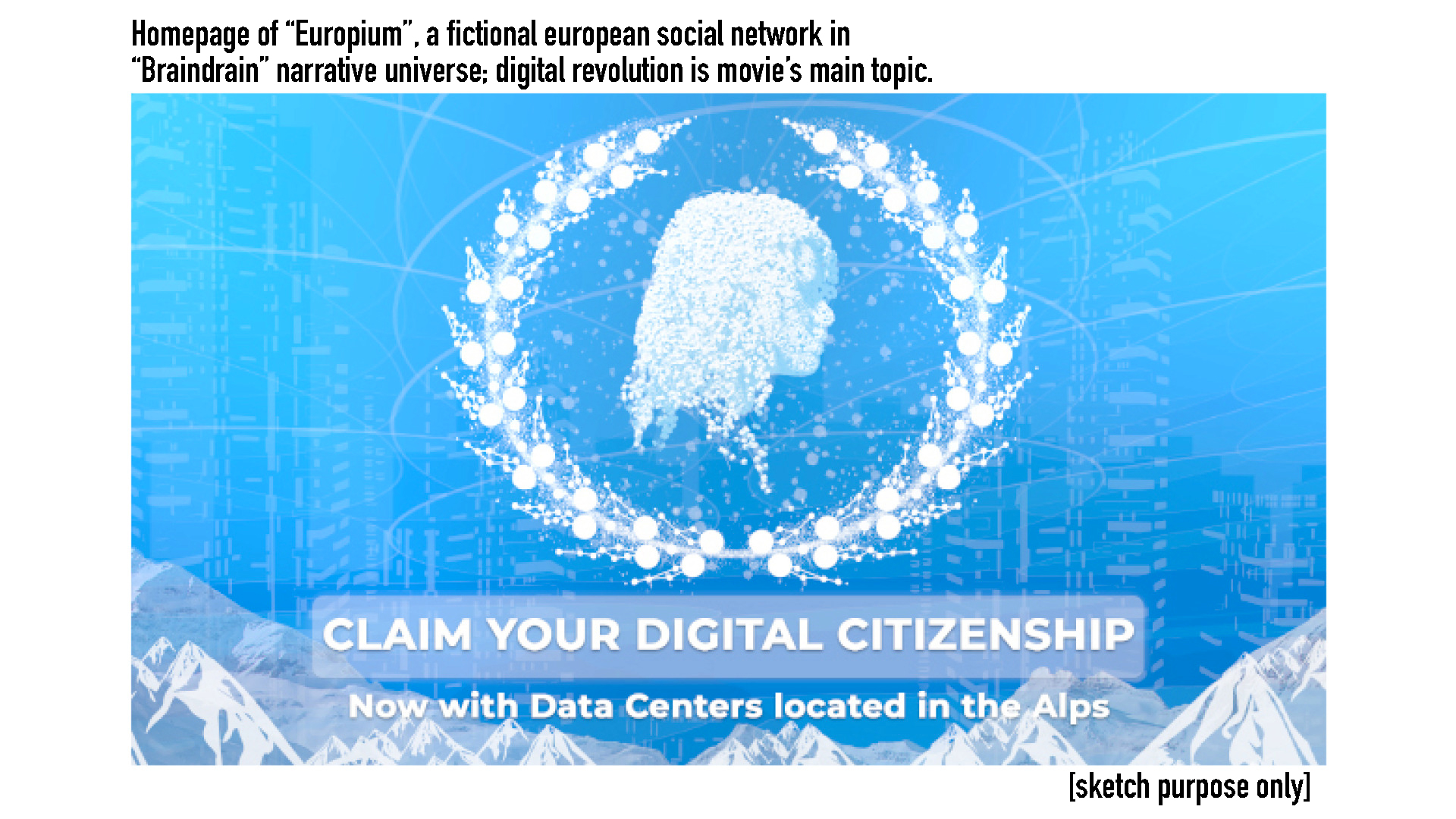
The practical experimentation of this sub-genre took place with the short film "Braindrain", which was written, directed and produced independently during the first and second waves of the pandemic in Milan. The project deals with digital issues that have been accentuated by the Covid-19, such as digital ethics, fake news, generational digital divide, influencer's role in society and personal data protection.
Eurochronic films aim to be made through eco-friendly productions, so that more contacts can be made and more working relationships can be established. Sustainable productions in Europe will be more and more prevalent, so the time to study these dynamics and work with them is now.
It should be specified that the proposal is still in an embryonic state, as it has been developed for less than two years. Possible changes may be made in the future.
Key objectives for sustainability
The sustainability approach in European uchronic films has to be dual:
On the production side, the goal is to seek out a network of experts in the practice of sustainable set across Europe and work with them as "Green coproductions" (or learn from them, as a recent graduate).
I am truly glad to affirm that our production "Braindrain" was partially supported by "GREENFILM", an entity created by "Trentino film commission" who supported us with an evaluation criteria about best environmental impact reduction manners, transportation optimisation, fair catering operations and waste management.
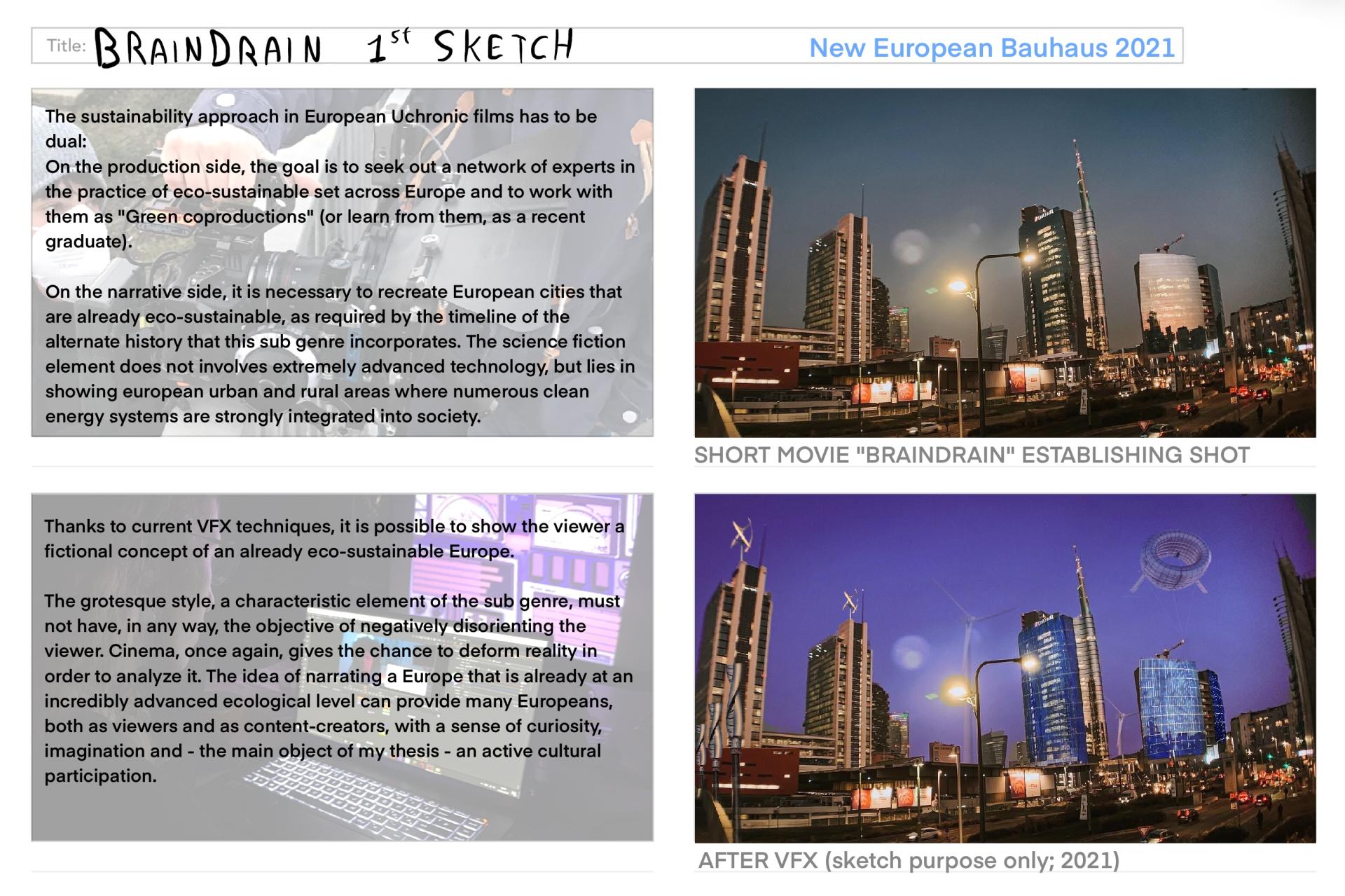
About the narrative side, it is necessary to recreate - by VFX - european cities that are already eco-sustainable, as required by the timeline of the alternate history that this subgenre incorporates. The science fiction element does not involves extremely advanced technology, but lies in showing european urban and rural areas where numerous clean energy systems are strongly integrated into society.
Thanks to current visual effects techniques, it is indeed possible to show the viewer a fictional Europe. Cinema - once again - gives the chance to deform reality in order to analyze it. The grotesque style, a characteristic element of the subgenre, must not have, in any way, the goal of negatively disorienting the viewer.
The idea of narrating a Europe that is already at an incredibly advanced ecological level can provides many europeans, both as viewer and as content creators, with a sense of curiosity, imagination and, the main goal of my academy dissertation, stimulates an active cultural partecipation.
Key objectives for aesthetics and quality
I proposed a concept related to cinema because the cinematic medium, given its nature, is the most suitable means to guide the viewer towards real experiences aroused by imaginary worlds.
The photography of European uchronic films is composed of an accentuation of colors to emphasize the imaginary, dream-like aspect of the narrations. A type of aesthetic that, of course, could be rediscussed later depending on the opinions of other decision-makers in co-productions. An example of this is in the sketch "Sketch_NEB_12", where the coloring of the sky emphasizes the aesthetic of a surreal world
VFX play an extremely important role, both in narrative function and in aesthetic function and quality of experience. Retouching European environments is certainly one way to maximize the viewer's experience, but altering the landscapes of Bavaria or southern Italy too much could have the reverse effect and therefore destabilize those watching a European uchronic film. The cautious use of VFX is decisive for the right balance between the quality of enjoyment of the film and respect for the natural or urban environments of European cities.
As you can see from the sketches, the aesthetics of European uchronic films will have to be studied and elaborated further (a process that could take months, if not years, out of respect for the same landscapes known worldwide). But the goal remains clear and attainable: the creation of utopian European environments where clean energy systems have achieved staggering ubiquity and where the viewer is allowed to immerse themselves in these sci-fi landscapes and make their own experience.
Key objectives for inclusion
As graduate young people, we firmly believe that, for this kind of film genre proposal, inclusion concept has to be between europeans first (mainly due to our lack of knowledge and experience of LGBTQ+ issues and themes). The narratives of the "European Uchronic" subgenre films are intended to represent a matured european interculturality, with each european state maintaining its own identity within a globalized context.The cultural exchange of the characters, within the ecological metropolis characteristic of this subgenre, makes this ideal concept an integral part of the "multicultural storytelling" that we experimented with the graduation short film at the NABA fine arts academy.
In our short film "#BrainDrain" plot, the Afro-Italian protagonist named Loren, meets an Italian-Spanish (Marcus) and a Swiss (Augusto) character in Milan. The characters live in a European context that allows them to interact with each other and pursue their goals.
Within the cast and crew, we hired professionals from different parts of Europe, in particular four figures from Munich, Besozzo, London and Bucharest, attempting to conduct - for the first time - work relationships in English. These Collaborations have not only proved to be well worthwhile, but have increased our desire to work in co-productions with professionals from all over the continent.
Innovative character
European creativity always flourished after social tragedies.
CoVid-19 pandemic had only one silver lining: it has united Europe more than ever in the last years. The Eurochronic subgenre, if treated together with experts in narratology, digital revolution, SVOD platforms operations and sustainable energy systems, can become the beginning of a new european green season of cinema, more imaginative as Fellini taught us and more sustainable, as our future directors, producers and entertainment figures could teach us.
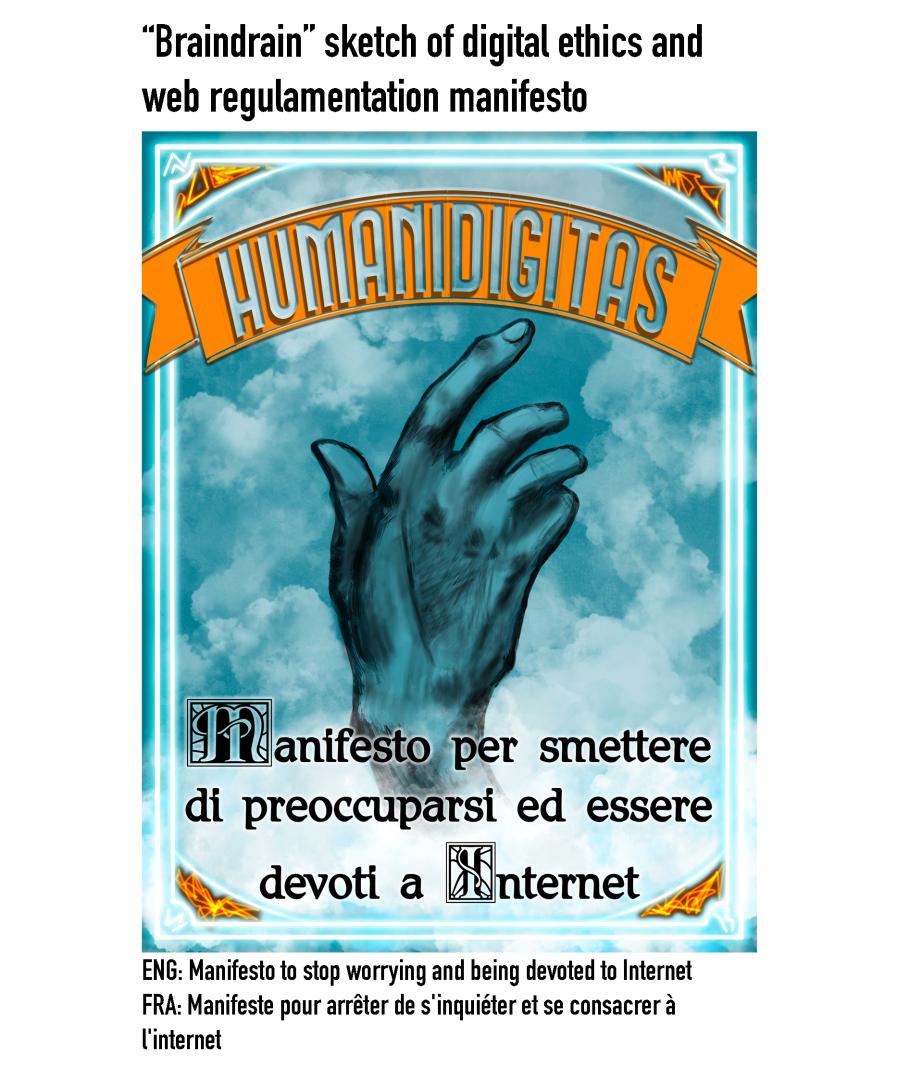
The innovation element is present in "evolved" European metropolises with utopian clean energy systems, or in the creation of a manifesto on digital ethics and big data, as it happens in the narration of my film "BrainDrain", inspired by the digital revolution. But the main innovations will come from the next great authors who will work side by side with their european colleagues, writing their next Eurochronic film. Multicultural, green, digital, imaginary.
Characters from all over the continent meet, suffer losses, gain victories and develop conflicts in a dreamlike cinematic storytelling set in a Europe transformed in a fictional ecological powerhouse as we have never seen it before, where the uchronic course of events allows a high level of enjoyment for the viewer who, in the historical moment of SVOD digital platforms, has the opportunity to actively participate in the knowledge of all the European cultures involved in the future films of this subgenre.
Devastated by the pandemic, Europe can show the world how the enjoyment of cultural content can evolves after the pandemic. As the mainly author of this sub-genre development, I would like to think that these types of films must be primarily developed only with co-productions or associated productions between countries - in order to build a real european cinema season (and not multiple national seasons) with one main objective, to be accessible by most countries both inside and outside the union