Cyborg City
Basic information
Project Title
Full project title
Category
Project Description
The cyobrg city is a systems design project that designs the future relational dynamics between the citizens of the future and the places they inhabit. Urban spaces are rethought to be modified as fluid places: the cyborg and non-enhanced human being will be able to define the temporary functions of an area on three layers (the real, the real-virtual, the virtual). The Cyborg city does not impose a preconstructed model to adapt to, but is based on a bottom-up process.
Project Region
EU Programme or fund
Description of the project
Summary
The Cyborg City is a systemic design project that focuses attention on the relational dynamics between enhanced (cyborg) and non-enhanced citizens, in a scenario for the long-term planning. With a view to developing the economy of self-realization (prefigured by the global think tank "Millennium project"), the Cyborg city rethinks urban spaces through a Bottom Up process: it is the citizens who define the functions of places and not the place to impose its specific function. The places of the city are malleable: the specificities are no longer understood in terms of function but of the possibility of behavior.
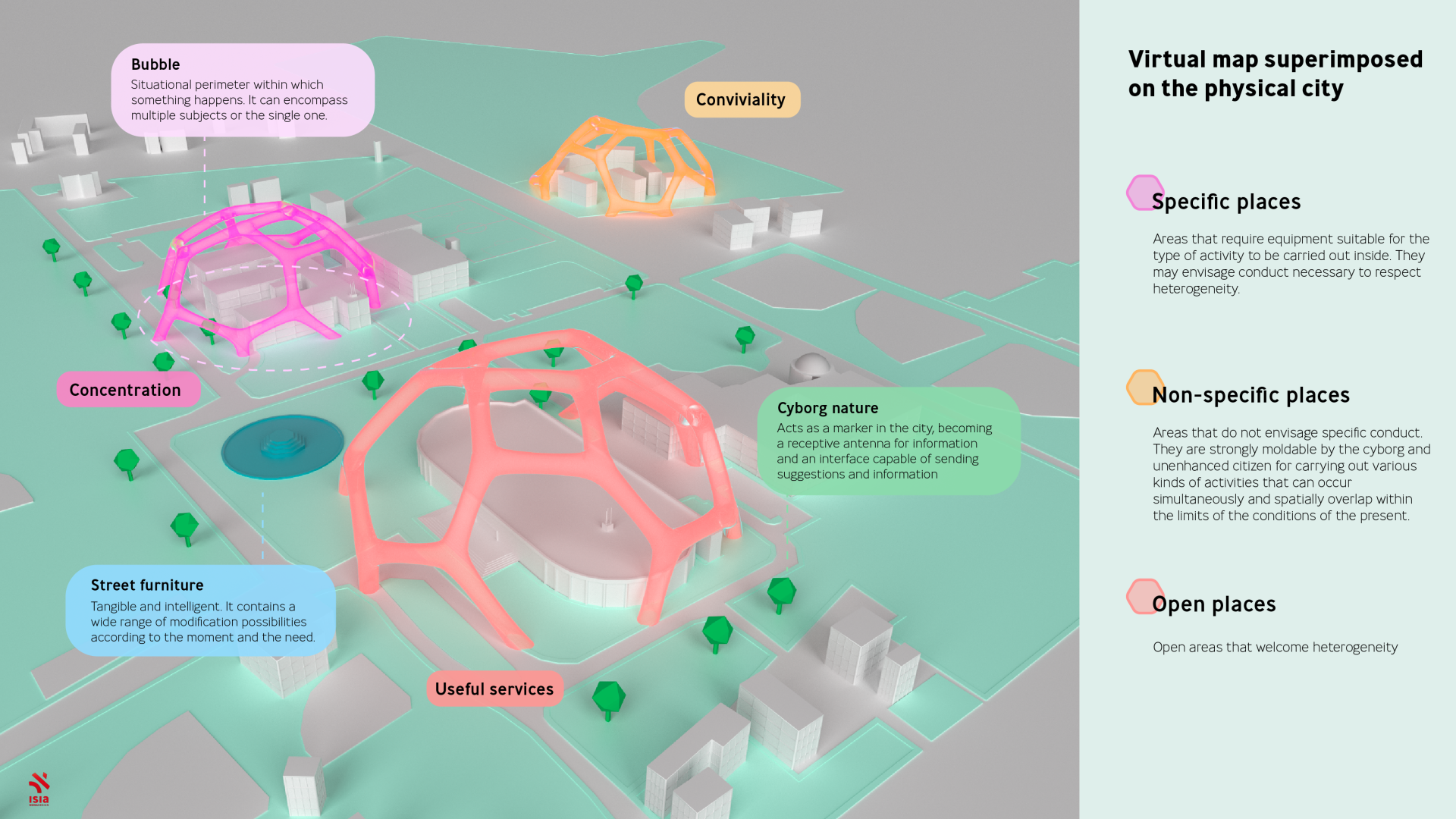
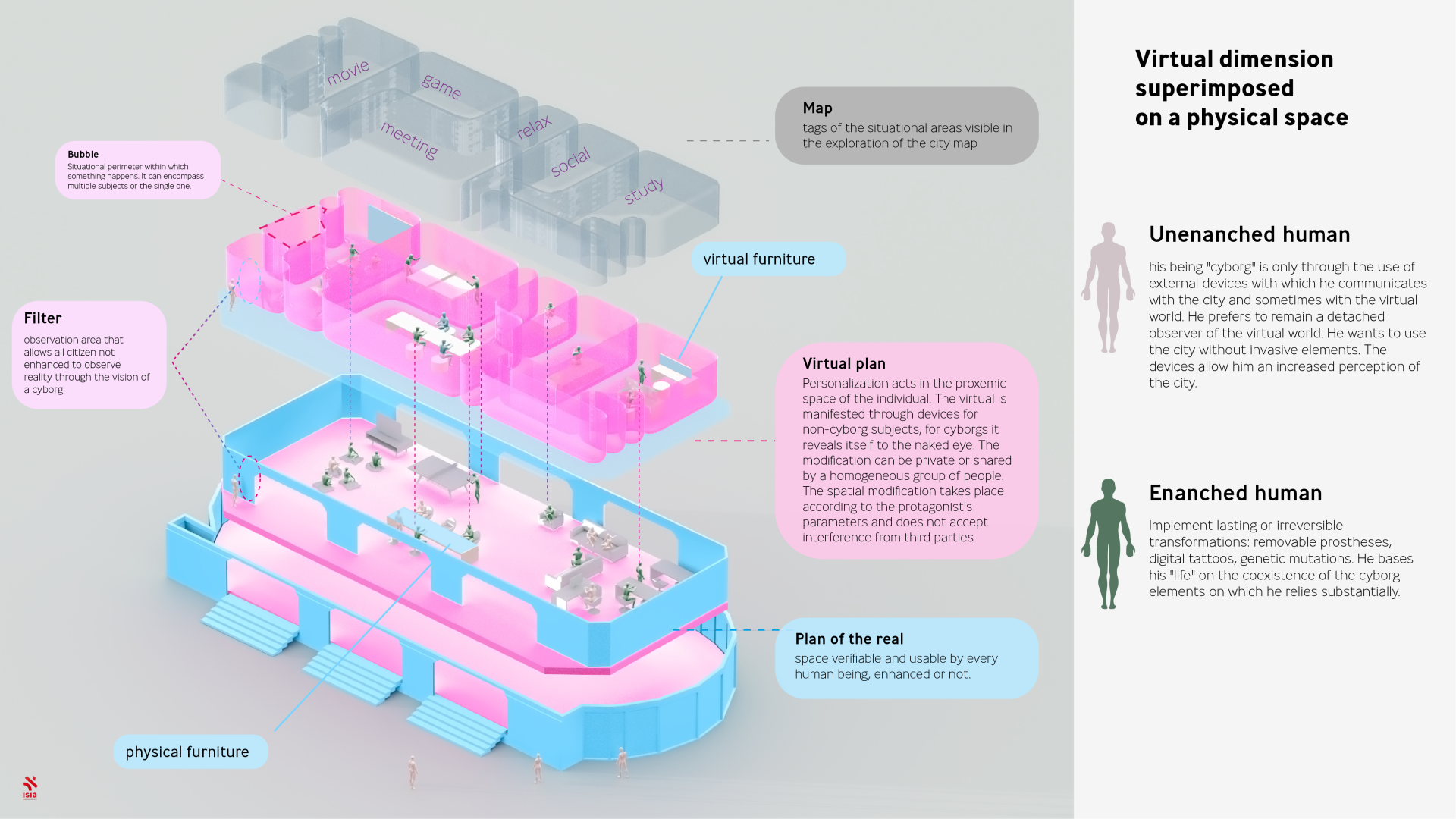
The citizen, emancipated from the need for work, experiences the city as a continuous laboratory of active citizenship, plans its activities and adheres to the continuous proposals that are born and evolve. Through the development of intelligent Cyborg and Device technologies, the spaces of the city are rethought through three levels: the physical, the real / virtual and the virtual. The city assumes adaptive behaviors, the citizen is able to move fluidly between: a self-referential vision, in which the personalization of the aesthetic and functional aspects, acts according to individual parameters and is precluded to others; a heterogeneous vision visible to all, in which spatial modification is the synthesis of collective choices and needs; a homogeneous vision, physical or digital, accessible to groups of citizens united by common intentions or by similar levels of cyborg modification of bodies. By respecting the different individual choices for modifying the body's potential, the cyborg city allows each citizen to actively act on places, through an intelligent urban furniture that is made up of elements such as thresholds (borders of introduction to situational areas), heterotopic filters (urban lenses that allow the unmodified eye to physically visualize the virtual plane juxtaposed to the city), cyborg plants capable of operating as natural interfaces...
Key objectives for sustainability
If today each space corresponds to a specific function, the environments of the Cyborg City are adaptive: a library emancipates itself from a place of study to a place of concentration that welcomes a range of activities that are currently impossible to combine in the same place. Adaptivity reduces energy and construction process costs. Movements are minimized, the citizen is not forced to move from one point of the city to another out of necessity, but only out of will. Personal information and visualizations travel on the digital plane, reducing energy costs.
Social sustainability, on the other hand, translates into the goal of designing an inclusive society. The cyborg city is founded on offering in the near future a model of inclusion and equal opportunities for all citizens, regardless of the cyborg modifications that they want to adopt on their own body. The Cyborg city does not impose a pre-built model to which the citizen must adapt, but is based on a bottom-up process in which human beings are the designers of the place they inhabit and live: social sustainability is also understood as a degree of satisfaction of the inhabitants.
A citizen who can experience the city, following their dreams and activating situations together with a community, can be a satisfied and grateful citizen.
Key objectives for aesthetics and quality
A multidimensional and subjectively modifiable city allows you to adapt with high degrees of satisfaction for the individual and the community in terms of usability, clarity and form.
The Cyborg city works through the integration of intelligent street furniture, body implementation technologies and data visualization and management interfaces. The street furniture is metamorphic, adapting its conformation to the situational need to which it must respond. It manifests itself as a threshold, natural interface or totem, proxemic bubble and visualization filter. It interacts with the citizen according to his needs.
Through street furniture or their own physical enhancements, the citizen is able to visualize the layers of the city and the information that circulates through customized parameters both in functional and aesthetic terms (the latter understood both as knowledge and sensitive experience, and as sensitive conformations of perceptive objects). Each citizen is able to develop a unique and peculiar combination.
The heterogeneous visualization of the city, unlike the subjective one, changes according to the plurality of subjects: the visible space is the synthesis of a collective choice in a specific moment and situation. This level affects most of all in the construction of a strongly collective and participatory dimension in the city.
Key objectives for inclusion
The cyborg city integrates the biological and technological planes to overcome the traditional dichotomy: nature - culture. Citizens have the possibility of freeing their subjectivity from unchanged and universal identity criteria.
The city is not a uniform and homogeneous totality, but a collective urban network, with fluid and reconfigurable borders. It is designed to be inhabited by a hybrid demography (especially in terms of physical enhancement) in a horizontal way, able to accommodate the chaos of complexity, maintaining a reticular organization that continuously updates the urban space.
The fundamental objective of the project is to develop interactions of modification and visualization of places in the city that are fully accessible to all citizens, so that an unmodified man has the same centrality as the cyborg man.
Innovative character
Urban spaces are increasingly filled with connected objects. This has prompted many corporations to invest in technological urban planning models to make cities smart. The irruption of the digital in the city has also led to questioning the negative consequences that could occur following a vertical approach to urban design. The innovative character of the Cyborg City is based on the awareness that technological expansion and evolution will be inevitable: design has the task of offering a different perspective on the future of the city through a horizontal rather than a vertical approach. The cyborg city traces a new possible path on how technology can actually be the engine of an active and participatory citizenship, designer of urban spaces, marked by inclusiveness.