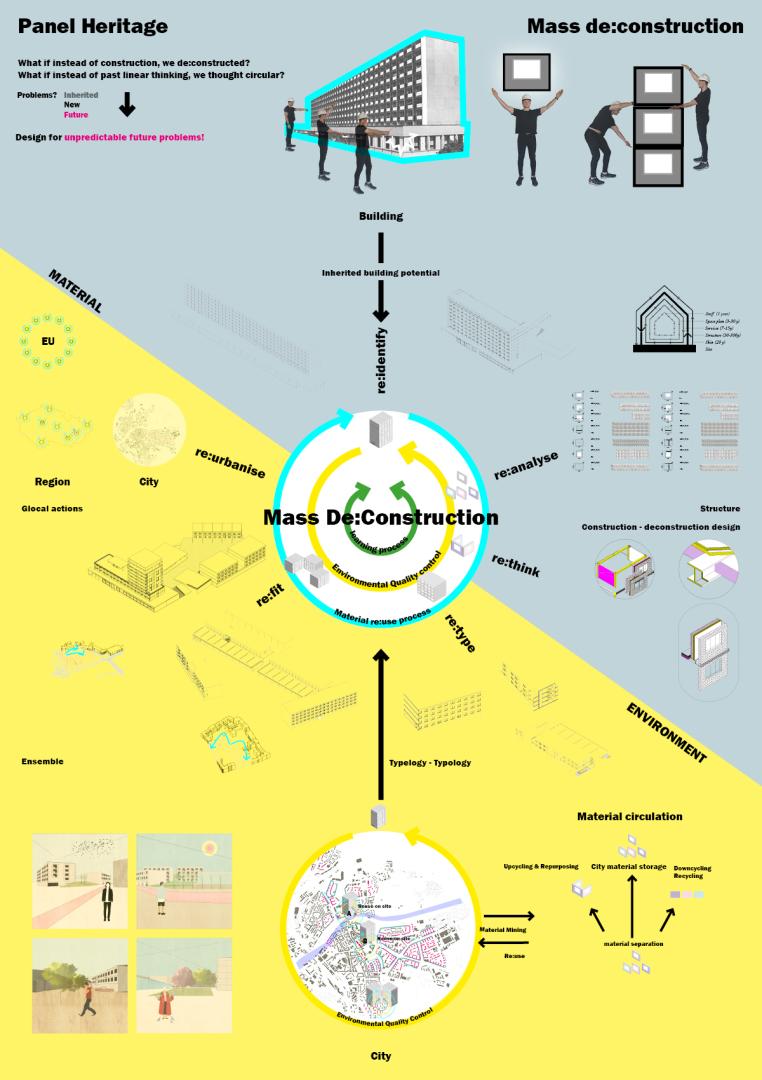
Panel Heritage - Mass De:Construction
Basic information
Project Title
Full project title
Category
Project Description
What if instead of demolition, we de:constructed? And what if this process was conceived not linear, but circular?
At brink of destruction, this project outlines possible new futures of European post-war-mass-constructed-prefab housing, whilst re:using the inherited potential of its material quantities and sites qualities.
Project Region
EU Programme or fund
Description of the project
Summary
The initial brief was to confront an existing abandoned prefab housing site in my hometown. As I inspected the site and its problems, I soon realized this is a much broader problem. 1/3 of the all Czech housing, that is around 1 200 000 units, are is still in these, now technically and morally outdated buildings. That indeed requires something different than common approach to project. Therefore, I did not come up with a design unique to the site. I proposed a design process - mass de:construction, which was verified on the case study sites.
Key objectives for sustainability
In the times of environmental crisis, and as we are inevitably running out of primary materials, we need a systematic approach how to how to deal with this problem omni-present in Europe. The process integrates the uniqueness of the local situation and broad knowledge base into a learning loop that can be shared on a European level.
The prefab heritage is an ideal experiment for principles of circular architecture, as It already integrated many principles that comply with circularity in today’s perspective: systematic types, prefabricated elements, modularity, material efficiency, detachable mounts... My approach is to reuse these values, instead of destroying them. Making the new constructions adaptable de:constructable, re:usable and at the very end of possibilities, re:cycable with ease. As the key lesson learned is that we need to build for the unknown futures.
Once an each building type is thoroughly analysed, and prototypes are tested, the mass de:construction process can be repeated in a very efficient manner. Balancing the initial investment costs that usually come very high in a case of re:constructions.
If cities really want to be smart, they must learn how to renew itself. Already, many materials are not found naturally, but we need to dig into anthropogenic repositories. By 2050, 65% of the world’s population is predicted to live in cities. World can be thought of a city network, rather than states. As these cities will struggle for survival, the material needs must be satisfied from within. The Panel Heritage is one such a repository.
Key objectives for aesthetics and quality
The problem with prefabs is also that it no longer meets our ideals in terns of living environment qualities and aesthetics. Through the process of de:construction we can introduce new looks, perhaps less uniform approach and much more open-relationships. Not only on the level of buildings, but also public space aestehtics, that has been neglected for decades and treated as a necesarry junk-space.
Key objectives for inclusion
Different typologies of housing can be designed and few of such were verified on a case study, such as baugruppe principles, student housing, affordable housing, family row houses.
The concept can meet various demands and it is always to be co-created on a basis of participation with the community. Especially as the flats are still inhabited.
The learning loop platform that goes with this design ensures ideas are shared across Europe and contributes to better solutions with the community.
Innovative character
The project deals with heritage in much broader spectrum than just renovation of particular building. Such renovations mostly only prolongs the life, but thats not necesarrily the right way to go, eventhough its probably the easiest one. It takes advantage of systemic characted of this heritage and its modular structure. (Modularity being a key principle of Circular Economy). Cities can no longer rely only on use of primary materials, as the carbon neutrality is the goal. These building are mostly reinforced concrete and this material has a huge carbon footprint. We should up-cycle it, rather than crushing it into pavings and most value is lost. Whilst some cities grow and are in need of materials, other cities shrink, therefore material is redundant. We need to design in such a way we can easily meet the demands or lack of it, using adaptable and modular systems.