RogLab Creative Hub
Basic information
Project Title
Full project title
Category
Project Description
RogLab Creative Hub is a shared community space in Ljubljana, the capital of Slovenia. The original plans in 2012 envisaged it as a way of involving a wide range of stakeholders in the revitalisation of the former Rog factory in the city centre. Since then it has acquired a life of its own and, with input from 6000+ diverse stakeholders who have helped shape its vision and programme, is now being scaled into a new public institution for the 21st century, focusing on sustainable development.
Project Region
EU Programme or fund
Which funds
Other Funds
Second Chance (2010 - 2013) - Interreg Central Europe
FabLabNet (2016 - 2019) - Interreg Central Europe
Description of the project
Summary
After phasing out much of Ljubljana’s industrial activity, the city wanted to find a new use for one of its most iconic buildings, the former Rog factory, while preserving the city's industrial tradition. It conducted a study to identify the best route forward in the new era of decentralised, digital industrial production, and to guide its revitalisation plans. The plan was to develop a new organisational model that would bring together a range of sectors in the creative industries in a shared fabrication space, where they could share knowledge and ideas and thereby create innovative products.
In 2012 a small-scale pilot version was conceived by Slovene cultural managers Meta Štular and Urška Jurman: the RogLab creative hub mainly focuses on the architecture, design and visual arts as part of the city's systematic use of development projects to empower creatives from different disciplines. In its 30m² container unit between the Ljubljanica River and the former Rog factory, RogLab soon took on a life of its own and became a multidisciplinary hub for production, innovation and education.
RogLab supports users of all ages, professions, nationalities, social backgrounds and genders. To date, 70% of them have been women. With its strong focus on contemporary challenges – digitalisation, sustainability, ageing, climate change, disability, etc. – RogLab encourages designers, architects, engineers and artists to turn their attention to urgent societal issues and serve the wider community.
A challenging participatory approach, often involving conflicting interests, has been at the heart of the project from the start. By actively involving creatives and the public in a hands-on development process, the project has not only made a major contribution to community involvement in city planning, but has also been able to provide local decision-makers with real-world information and user feedback, which could then inform the plans for a new public institution,
Key objectives for sustainability
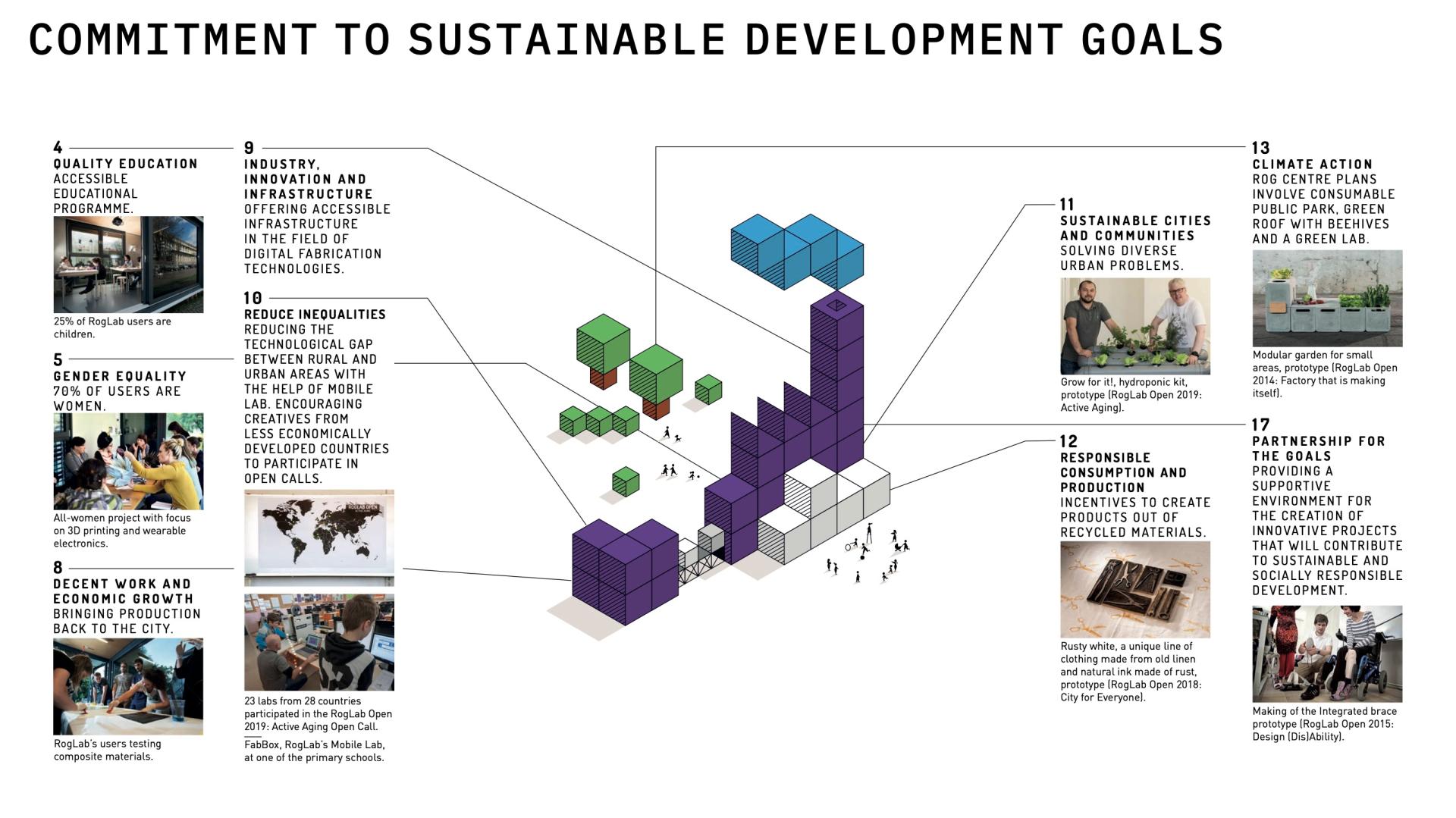
RogLab actively promotes the values of the Sustainable Development Goals and the New Urban Agenda.
Quality education for all (SDG 4)
- Free/accessible programmes for all ages
- 150+ workshops (children/adults) (2013-2020)
- 13 intergenerational workshops (2013-2020)
- 50 presentations (2013-2020)
Gender equality (SDG 5)
- Dedicated women-only/women-led programmes; 70% of users female
- 50% of staff female
- GraFEM: women's graffiti/street art programme
Decent work and economic growth (SDG 8)
- Building on industrial heritage and new technologies to restore manufacturing
- 30 prototypes created (2013-2020)
Industry, Innovation & Infrastructure (SDG9)
- Making digital fabrication technologies accessible to all
Reducing inequalities (SDG 10)
- Mobile lab to reduce the technological gap between rural and urban areas
Sustainable cities & communities (SDG 11)
- Open Calls to tackle urban challenges, e.g.:
- Supportive environment for the creation of innovative projects for sustainable and socially responsible development
Responsible Consumption & Production (SDG 11)
- 2015: Design Disability (design for users with physical disabilities)
- 2019: Active Ageing (highlighting the needs of the elderly)
- Open Calls promote socially and environmentally responsible projects: recycling, reuse & repair; sustainable fashion; ecological mobility
- Public courses on development of circular materials e.g. fruit composite materials
Climate action (SDG 13)
- Awareness-raising and support for designers re. circular economy, recycling and environmental protection
Partnerships for the goals (SDG 17)
- 40+ partners for the RogLab programme
- International Open Calls target less developed countries
- Regular network-building, e.g. at global FabLab Network conferences and EU Development Days
- Second Chance project, supported by the European Commission: 10 partners, 300+ stakeholders
- FabLabNet project
Key objectives for aesthetics and quality
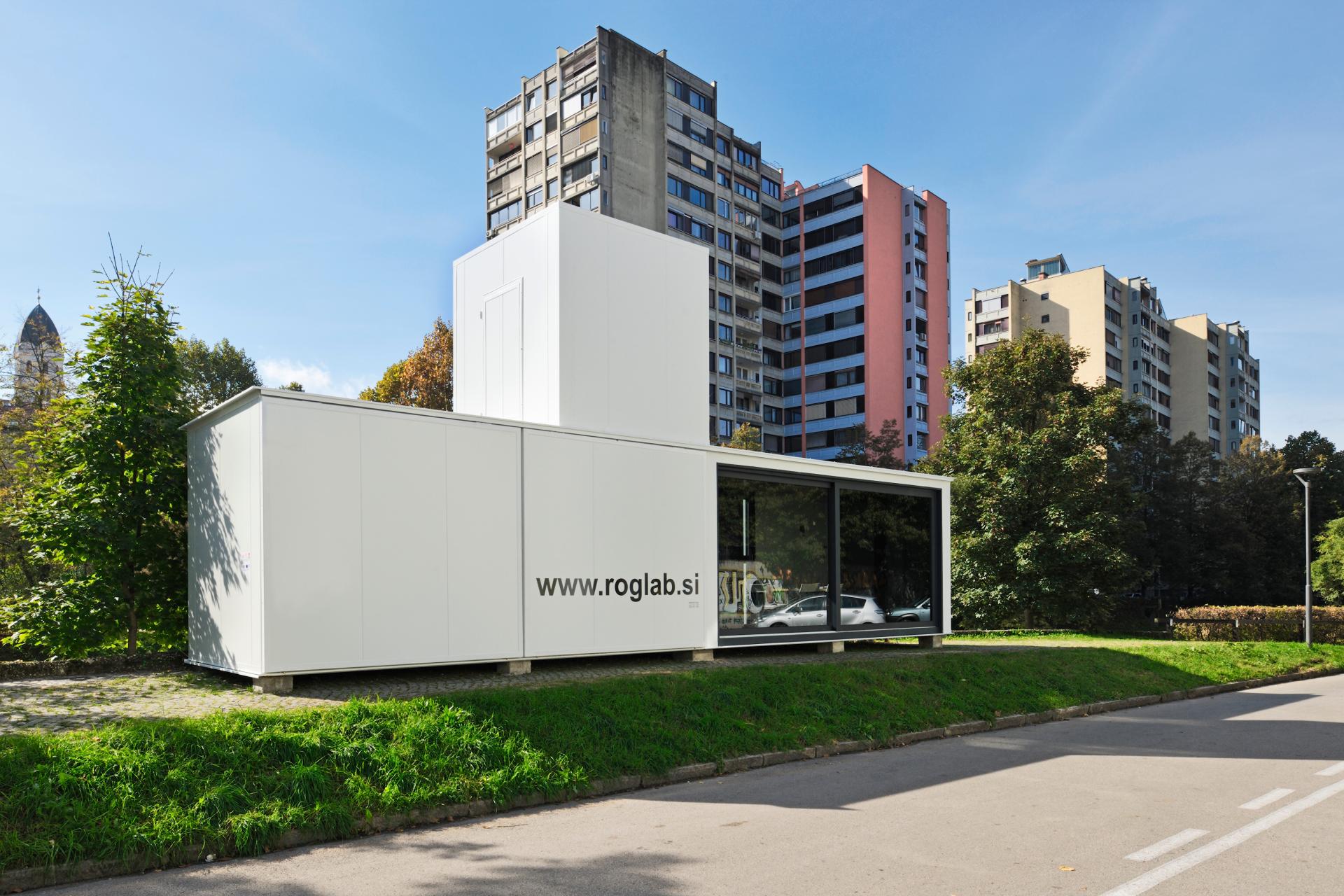
RogLab is based in a stylised white container designed by the Slovene architect, Jure Kotnik. Small pavilions like ours are often used to introduce larger urban development projects, since they communicate something of both the project and the future of the location. In accordance with the plug and play principle, ISO containers are often used for this, since they are easy to move and quick to install. The container form also communicates the transitory nature of the built environment and encourages the public to see the city as a constant work in progress at a time of rapid social, environmental, economic and technological change. Unlike many similar pavilions, RogLab does not communicate its plans (the makeover of the almost 9000m2 former Rog factory) by means of models, sketches and presentations, but instead addresses the public and future users by providing content in the form of a creative manufacturing laboratory.
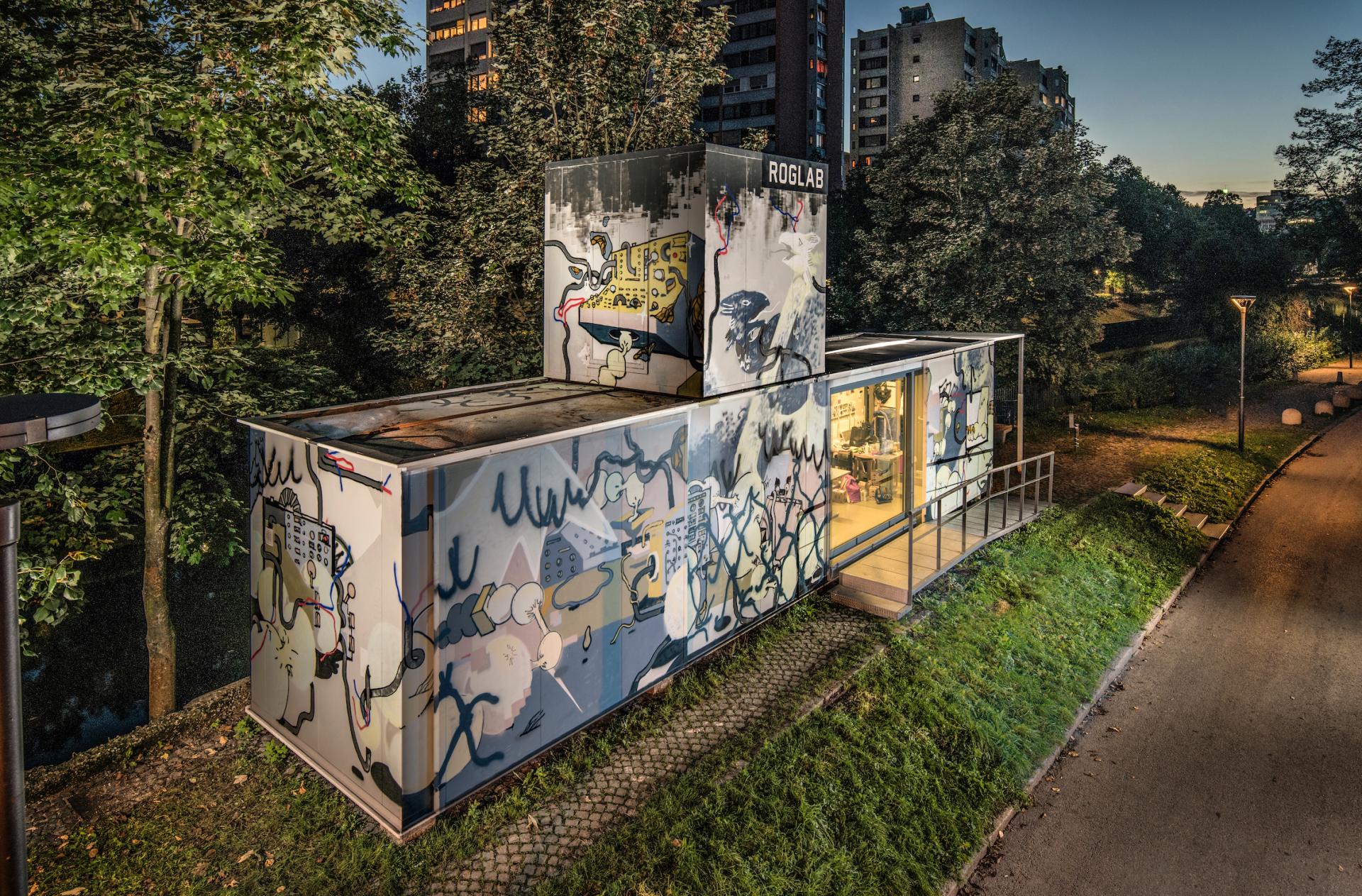
The RogLab container is located on the banks of the Ljubljanica River, next to the former Rog factory, and consists of two ISO containers with an additional cube on top, reminiscent of the T-shape in Tetris. Its modularity communicates the idea that RogLab will adapt to the needs of its users. One side of the container is almost entirely glazed and can be closed completely. The unit is at ground level, next to a footpath, and has a big window facing the street, inviting passers-by to come in. At first it was wholly white, like a white box turned inside out, encouraging people to co-create it. It has long been covered in graffiti of various kinds, but in 2020 we went one step further and officially dedicated the external surfaces to graffiti and street art. RogLab now also runs the GraFEM programme, which aims to empower female graffiti and street artists and promote women’s graffiti and street art culture. Our first invited artist was Nez Pez, whose art has made the RogLab container blend into its environment even more than before.
Key objectives for inclusion
The formal participatory process started with the EU Second Chance development project, whose pivotal contribution has been its methodological approach to culturally developing and revitalising degraded industrial areas. The project connected diverse stakeholders (educational, research, cultural institutions and businesses) including grassroot stakeholders (designers, artists, temporary users of the former factory premises, neighbours and NGOs). The participatory process results opted for the development of a diversified space with shared manufacturing workshops and jointly used spaces in which individual creators, businesses, NGOs as well as educational and research institutions could make use of the common infrastructure coupled with appropriate support programmes.
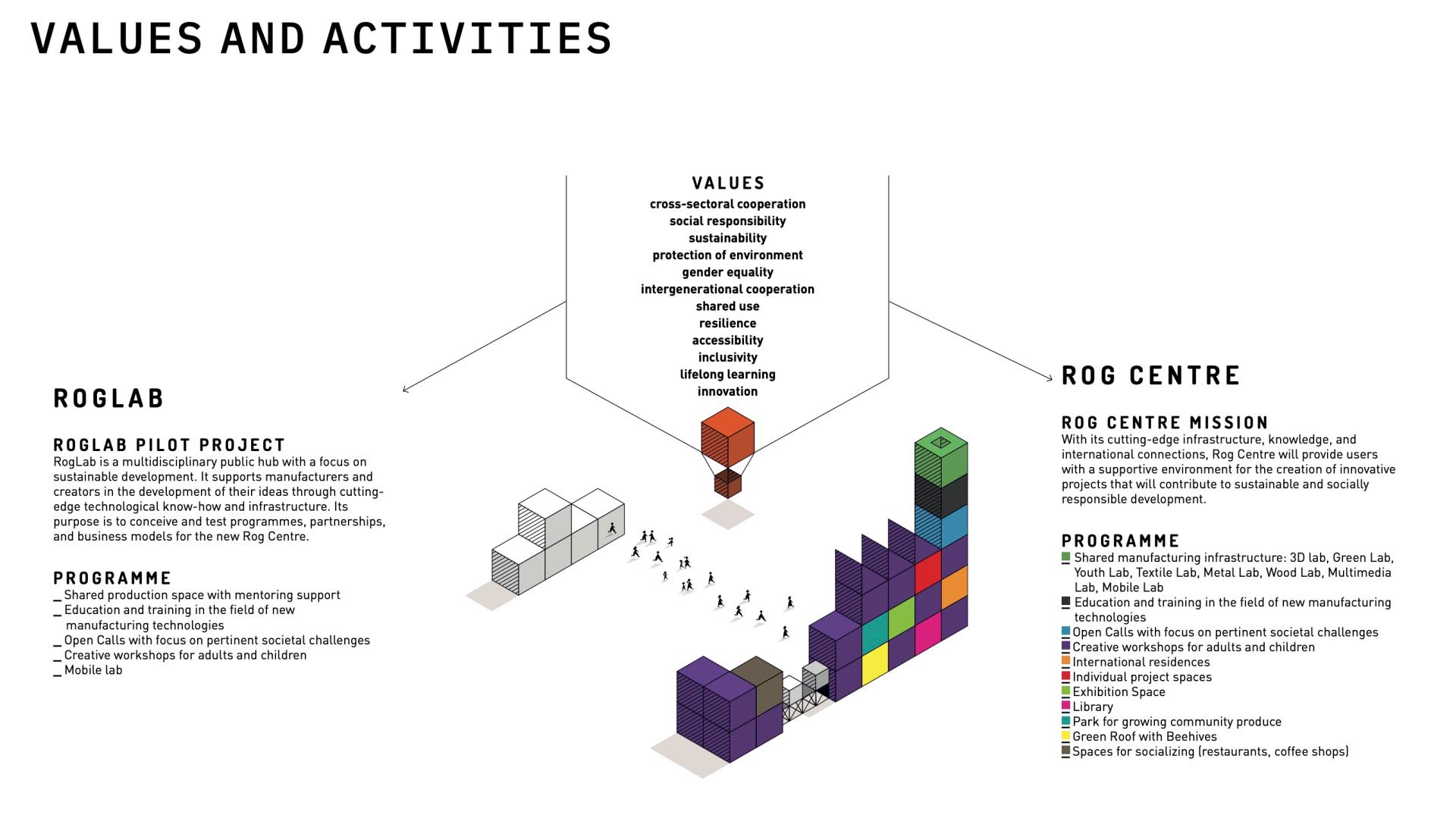
The RogLab pilot was designed to test the outcomes of these processes on a small scale: the programmes and a participatory management model that can be used for the new multipurpose hub named the Rog Center in the once renovated factory.
More than 6000 users and 80 stakeholder organisations have been involved in the development process in the last decade, whether through research, focus groups, or the testing of prototype programmes. Throughout this process, there have been changes in the structure of stakeholders and their relationships to the project (e.g. first generation of temporary users have been actively involved in Roglab’s activities, while their successors were untrusting towards the City’s development policies however a constructive agreement couldn’t be reached despite many mediation attempts).
In 2019, the City of Ljubljana re-submitted the redesigned and tested plans for the Rog centre to the stakeholders, who after a revision approved them. After the renovation, which will be finished by 2023, the revitalised building of the former Rog factory will offer almost 9.000 m2 of space for public programmes, developed in the RogLab hub through a long-term participatory process.
Results in relation to category
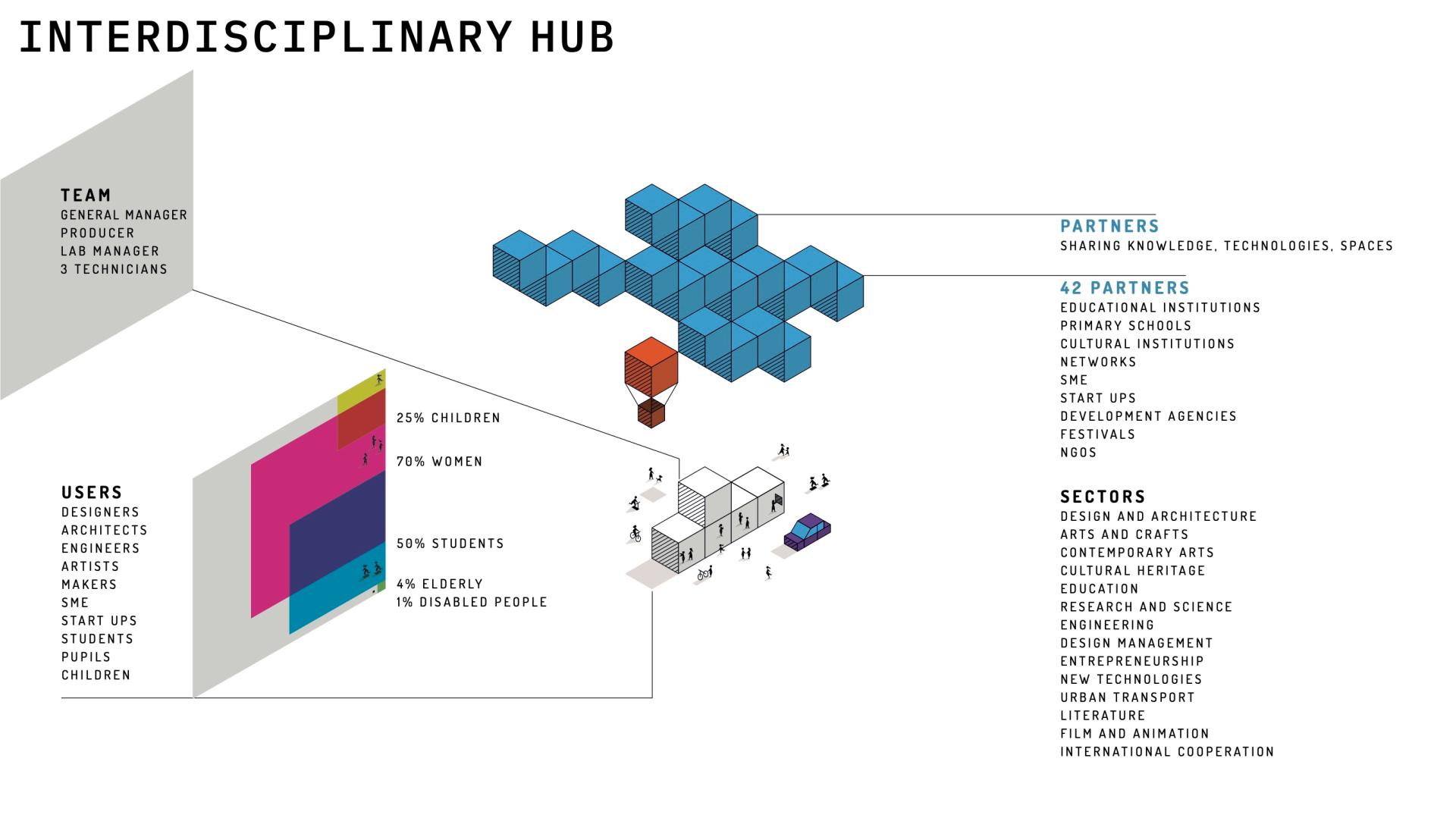
RogLab shares its resources (space, staff, machinery, communication channels, etc.) with its 42 interdisciplinary partners, both local and international, ranging from civil society organisations to tech companies and educational institutions. As well as proposing and co-producing the programmes, our partners give feedback and advice on our development plans. This has many benefits for partners and the creative community in general: better exchange of information, more efficient use of capacities and resources, a strong sense of ownership, and better services for the public.
RogLab’s main impacts are:
Transparency: we continuously involve stakeholders, partners and users in our development plans.
Improved efficiency: we connect local and international partners from diverse disciplines in order to offer better services to the public.
Empowerment of women and children: we provide women-led programmes; 70% of RogLab users are women, and between 2013 and 2020 we held 89 children’s workshops.
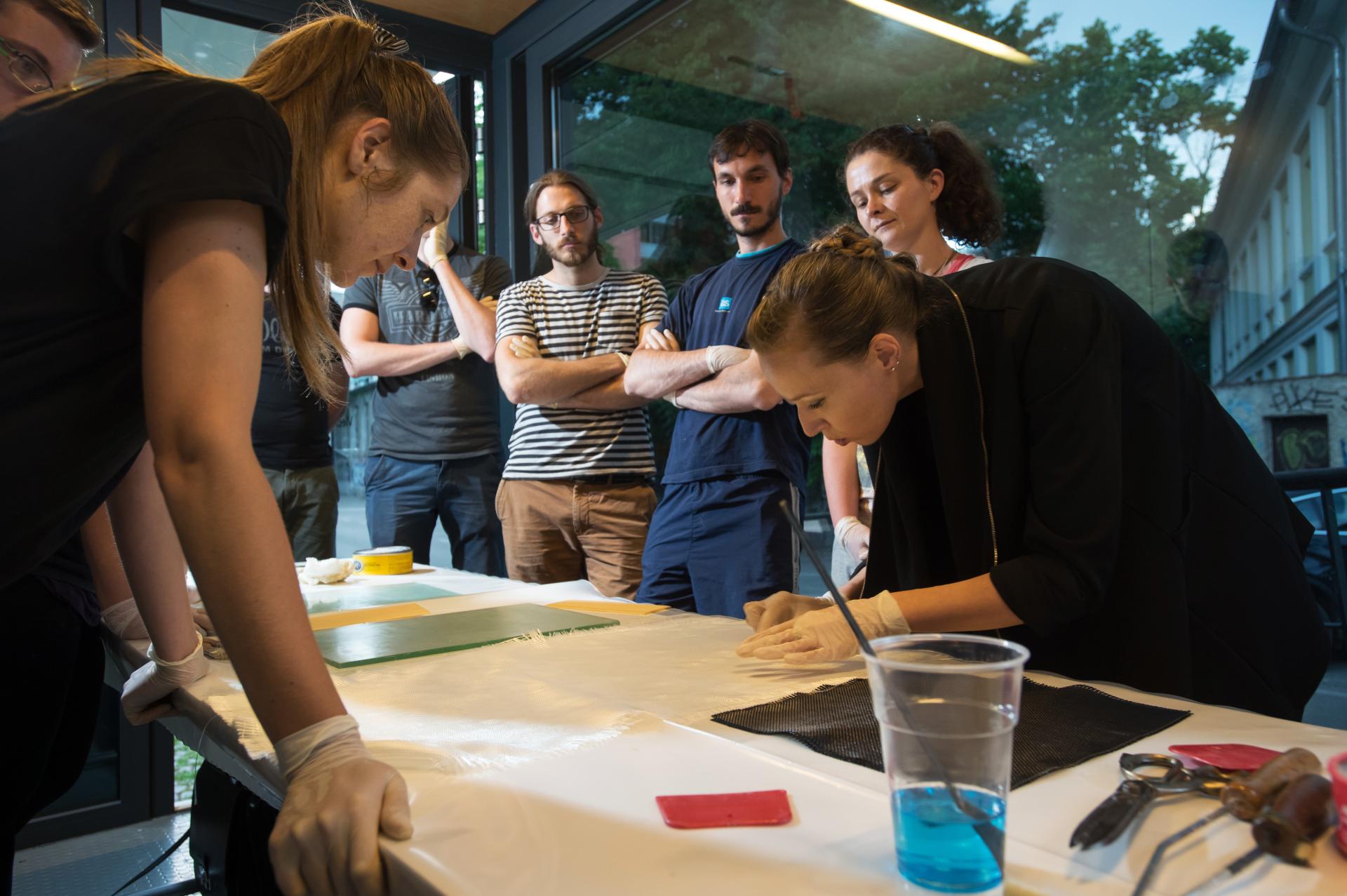
Closing the technological gap: we provide better access to new fabrication technologies and knowledge: between 2013 and 2020 more than 800 people attended RogLab training courses on the independent use of digital fabrication technologies, and our fabrication facilities have been used more than 2500 times. Our mobile lab provides services to people in remote towns and villages.
Sustainability: RogLab has given grants to projects tackling ecological and societal issues. We have done this through open calls and collaboration with over 30 international partners, resulting in the creation of 30 prototypes between 2013 and 2020 .
Social sustainability and innovation: we use participatory methods for the design of RogLab, building a value-driven community in the proces.
Revitalisation of industrial cultural heritage: In line with The Nizhny Tagil Charter for the Industrial Heritage recommendations we acheived the greatest possible compatibility between the new and old uses of the site.
How Citizens benefit
The transition to a free-market economy in the 1990s led to the collapse of Slovenian factories. Industrial activity started to rebuild in the form of SMEs, but they often lacked basic resources. According to a recent analysis by the Institute for Economic Research in Ljubljana, 7% of employees and 10.5% of businesses in Slovenia work in the cultural and creative industries. The RogLab initiative provides SMEs in the manufacturing and creative industries with shared infrastructure and knowledge, and a professional network.
RogLab directly affects 700 individual users per year (70% women, 50% students, 25% children, 4% elderly, 1% disabled people). It has 70 regular annual members. The Rog Centre is expected to directly affect 60,000 people per year by 2027 (based on a 2019 financial analysis by the Faculty of Economics at the University of Ljubljana).
Stakeholders, residents: participated in the EU development project between 2010 and 2013 and the stakeholders’ workshop to approve the Rog Centre Utilisation Concept in 2019
Partners (educational and cultural institutions, fab labs, SMEs, schools, NGOs): developing and testing RogLab programmes and services, providing feedback on Rog Centre development plans, development of the Rog Centre financial model (2019), communicating with diverse target groups about RogLab and the Rog Centre
Users (creatives, SMEs, manufacturers, students): using and testing RogLab programmes and services, providing feedback on proposed Rog Centre public services
Disabled people: co-designed the user-centred project, Design (Dis)Ability 2014-16
Elderly: co-designed the user-centred project, Active Ageing 2019
Women: co-designing the female-led RogLab programmes
Education professionals: co-designing the educational programmes
Innovative character
The RogLab method of developing a new public facility is unique in Slovenia and almost certainly also in Europe as a whole. This is the first time in almost a decade that such a major public investment in a cultural institution has involved this level of participation in the planning process. RogLab is acting as the pilot for the future Rog Centre, while also leading its own independent life as a creative hub.
The pandemic has exposed a great many social and environmental injustices and strengthened our conviction that, in the longer term, these can only be eliminated through systematic investment in just living conditions for all and environmentally sustainable solutions.
Innovation in RogLab is being sustained by a flexible management model on the basis of a public-private-civil partnership that requires constant dialogue; by a professional culture that encourages open communication with staff and partners and tolerates failure; by listening to and implementing stakeholders’ suggestions and thus creating a sense of ownership; by reducing bureaucratic obstacles and thereby giving as much public access to RogLab services as possible; and by creating an interdisciplinary space with shared infrastructure and knowledge.