Unaffordable Italy
Basic information
Project Title
Full project title
Category
Project Description
The large Stadium by Calatrava represents the symbol of unfinished architecture in Italy, located in the middle of the Roman countryside. The challenge of this project is reinventing the strong landmark already existing in the rural landscape, and transforming it in a new scientific pole made it from and for the community. The unfinished stadium is reactivated mainly as a museum dedicated to the sciences, then by hosting in part some research spaces.
Project Region
EU Programme or fund
Description of the project
Summary
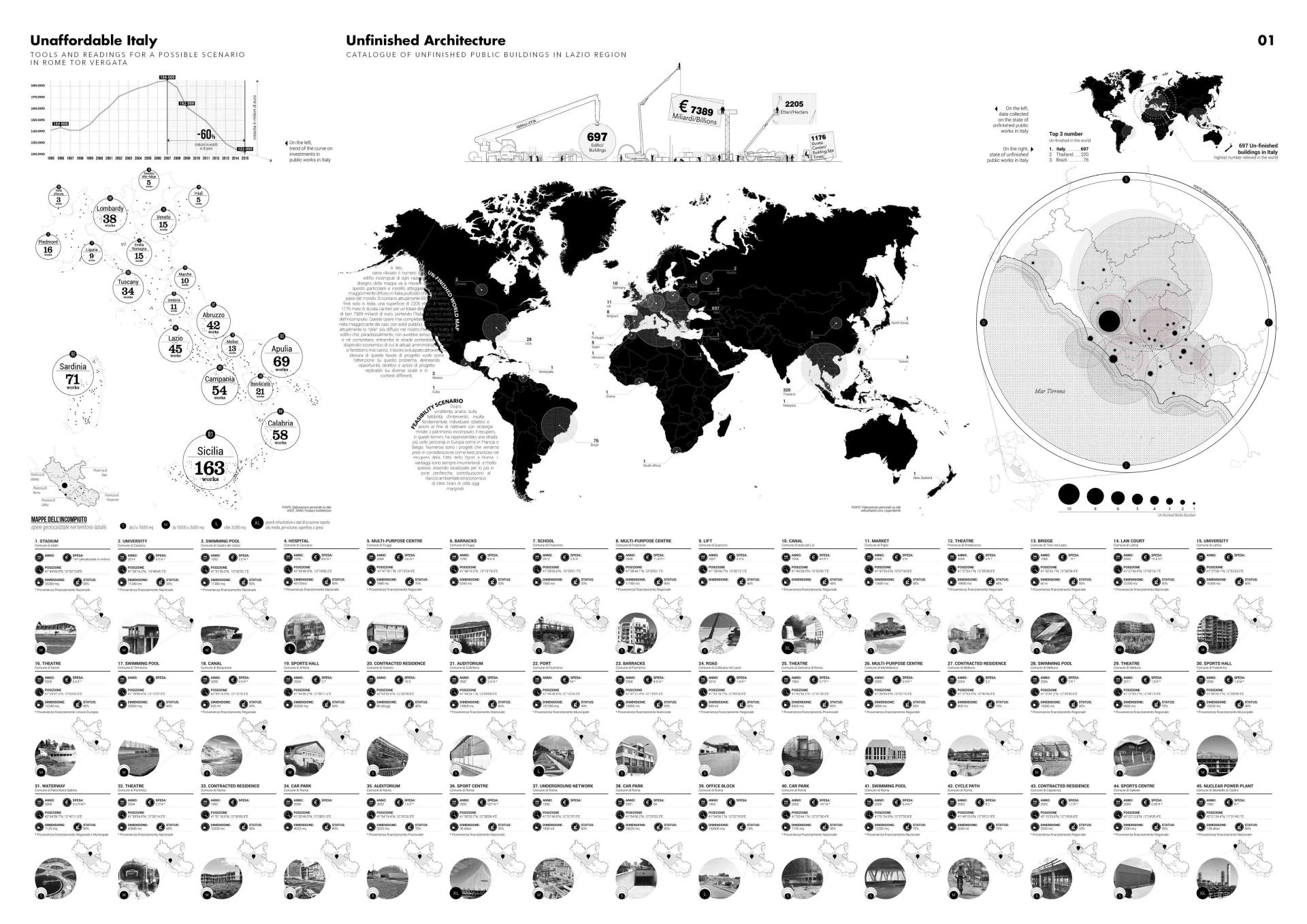
The Olympic Stadium by Calatrava, named "Città dello Sport", represents the symbol of unfinished architecture in Italy, for moneys already spent and for the big waste of territories at the moment not used. This large structure nowadays completely abandoned in its state of surreal and undisturbed "white elephant", is located at the periphery of Rome in Tor Vergata, in the middle of the countryside.
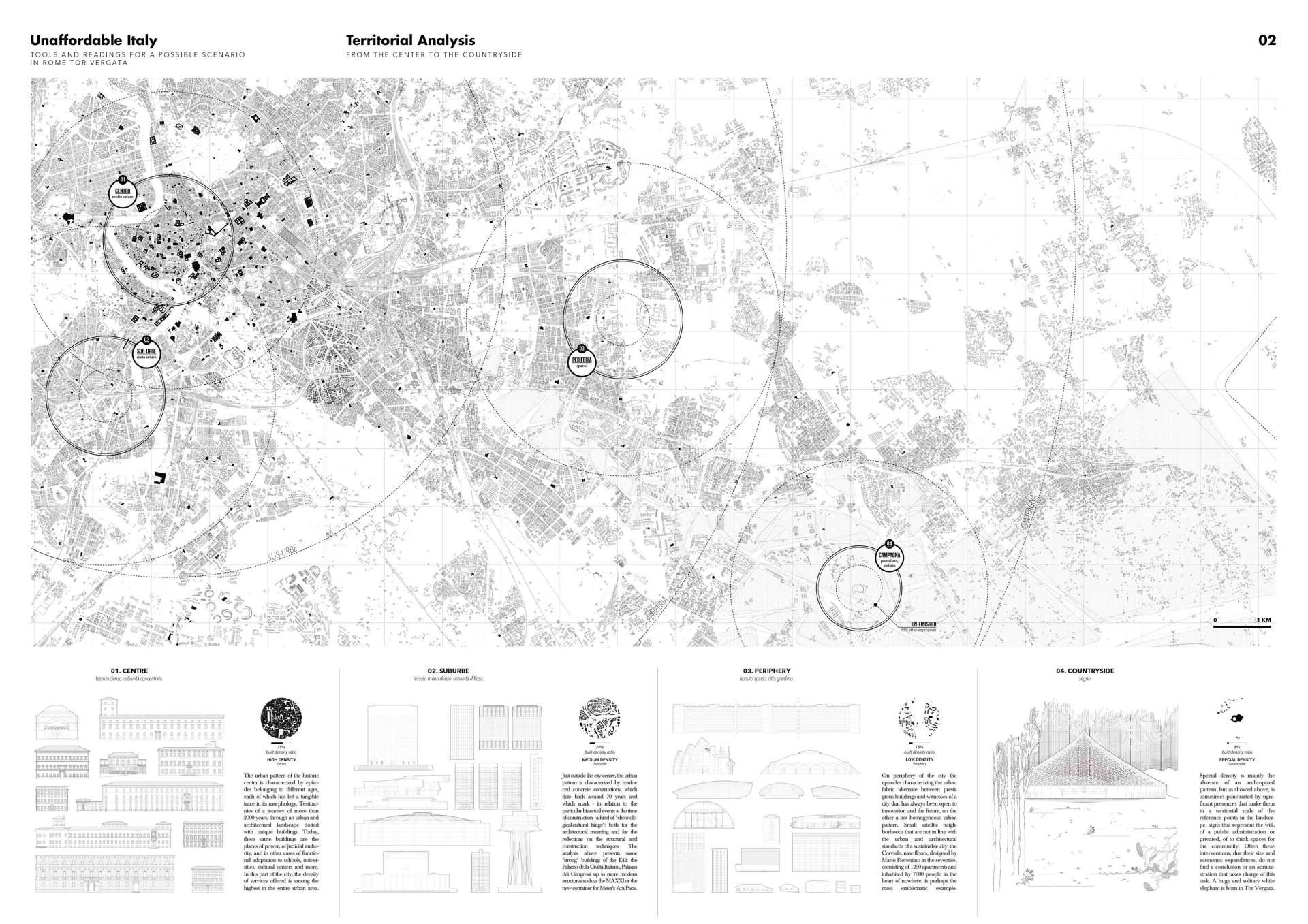
From the center to the countryside, there is an emerging landscape discontinuity, of which Calatrava's Olympic Stadium represents its most symbolic moment, a contemporary ruin in Rome.
The challenge is reinventing the strong landmark, already existing in the rural landscape, and change it for an attractive cultural centre. The architectural project wants to react as a new and innovative scientific pole for researchers and everyday users.
Key objectives for sustainability
The stadium by Calatrava, could find its ideally conclusion in a new centre for international studies. This could be possible thank to a strong and competitive connection between the numerous scientific excellence centers that are localized in the surroundings. More specifically the Italian Space Agency (ASI), the European Space Agency (ESA), the University of Tor Vergata, the Observatory, the National Institute of Astrophysics and many others. Each of these centers would find its own extension within the architectural drawing, making a place for the exchange of knowledge. The building, a currently unresolved place can become something else by regenerating the area all around.
Key objectives for aesthetics and quality
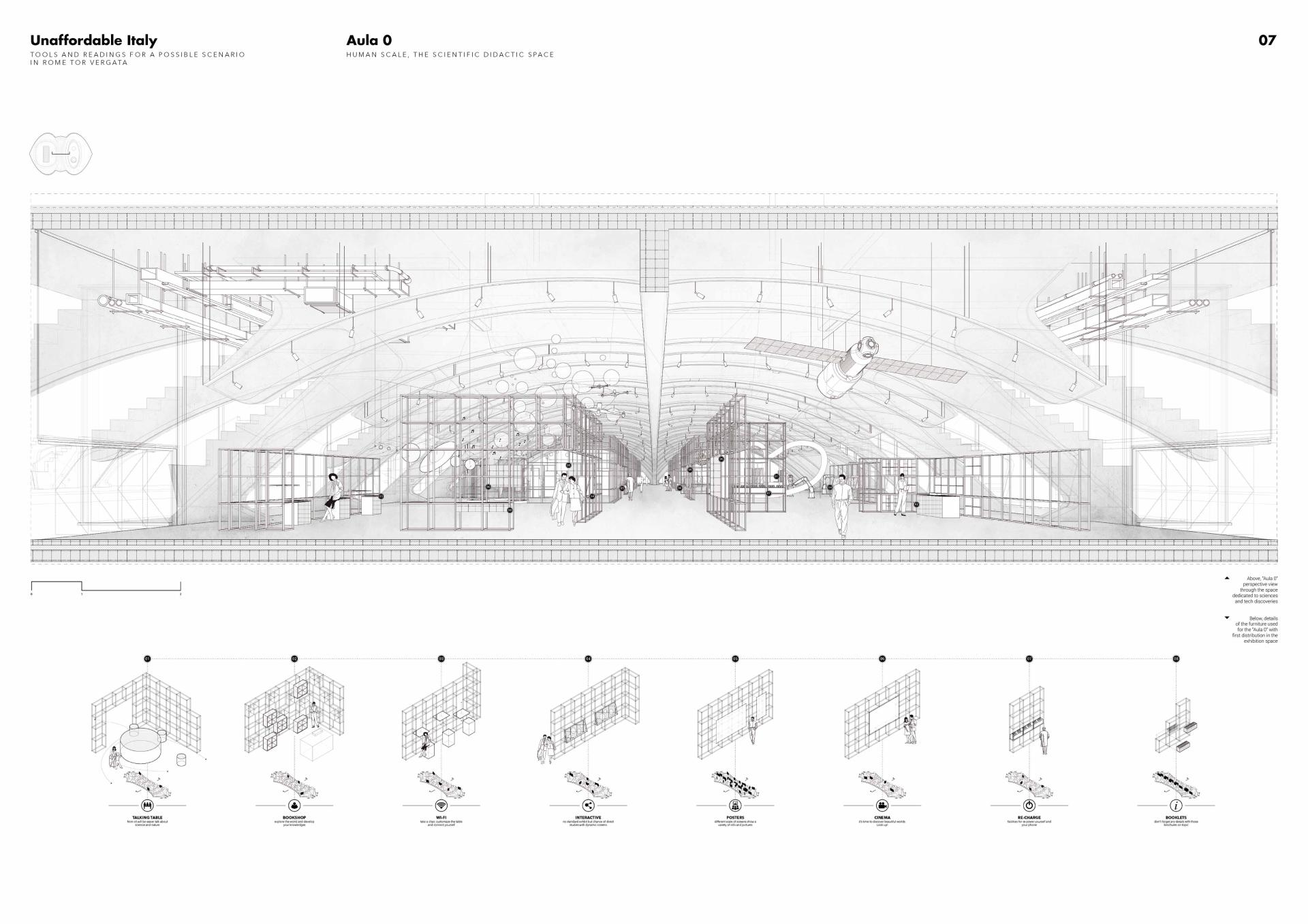
The unfinished stadium is re-functionalized mainly as a museum dedicated to the sciences, then by hosting in part some research spaces. What is proposed is a dynamic space where the user is not just a spectator within the path, but becomes an actor interacting with the space all around through interactive furnitures, modular display grids that will allow autonomy in the creation and also management of complex spaces, adaptable and also contents to study deep.
Key objectives for inclusion
The unfinished stadium can become an opportunity for rethinking the urban scale of Tor Vergata. The reuse of the architectural object is configured as a science district where the countryside becomes domestic, participatory. From the rural landscape, the user is informed that something is taking place: a space in making, evolved, contaminated and still transcribed, dichotomous, superimposed and intercepted. The museum is combined with research spaces, thanks to an integrated AI (Artificial Intelligence) system of continuous exhibited space and no standard exhibits, the visitor/content relationship is now madded, so the meaning of museum drastically approaches the contemporary world of the visitor. In the project, in fact, the user can manage the contents which "informs" the space and takes an active part in the creation of exhibitions - productions - meetings. An open source museum, not just a physical building, but an aspiration to freedom in all fields of knowledge.
Innovative character
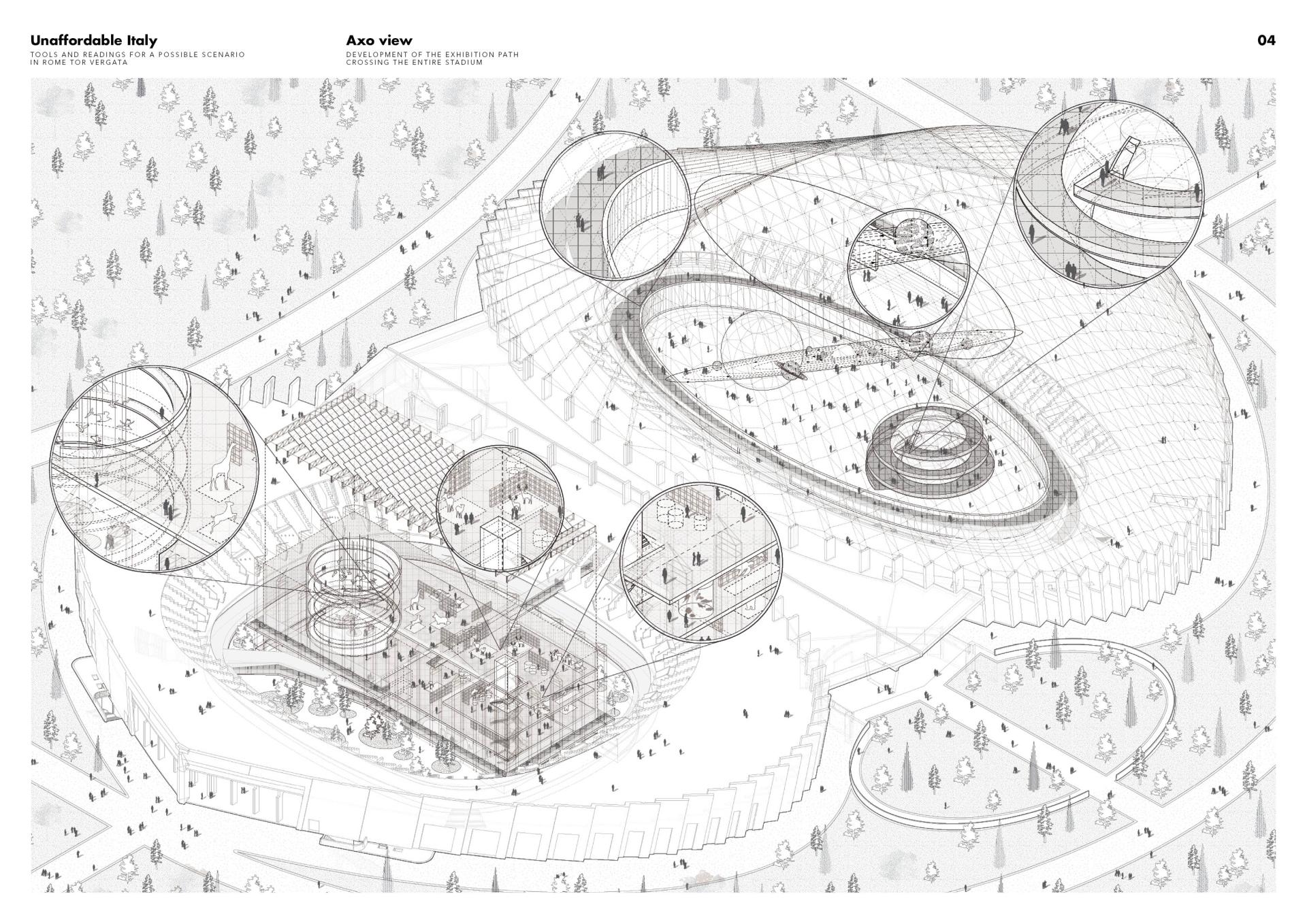
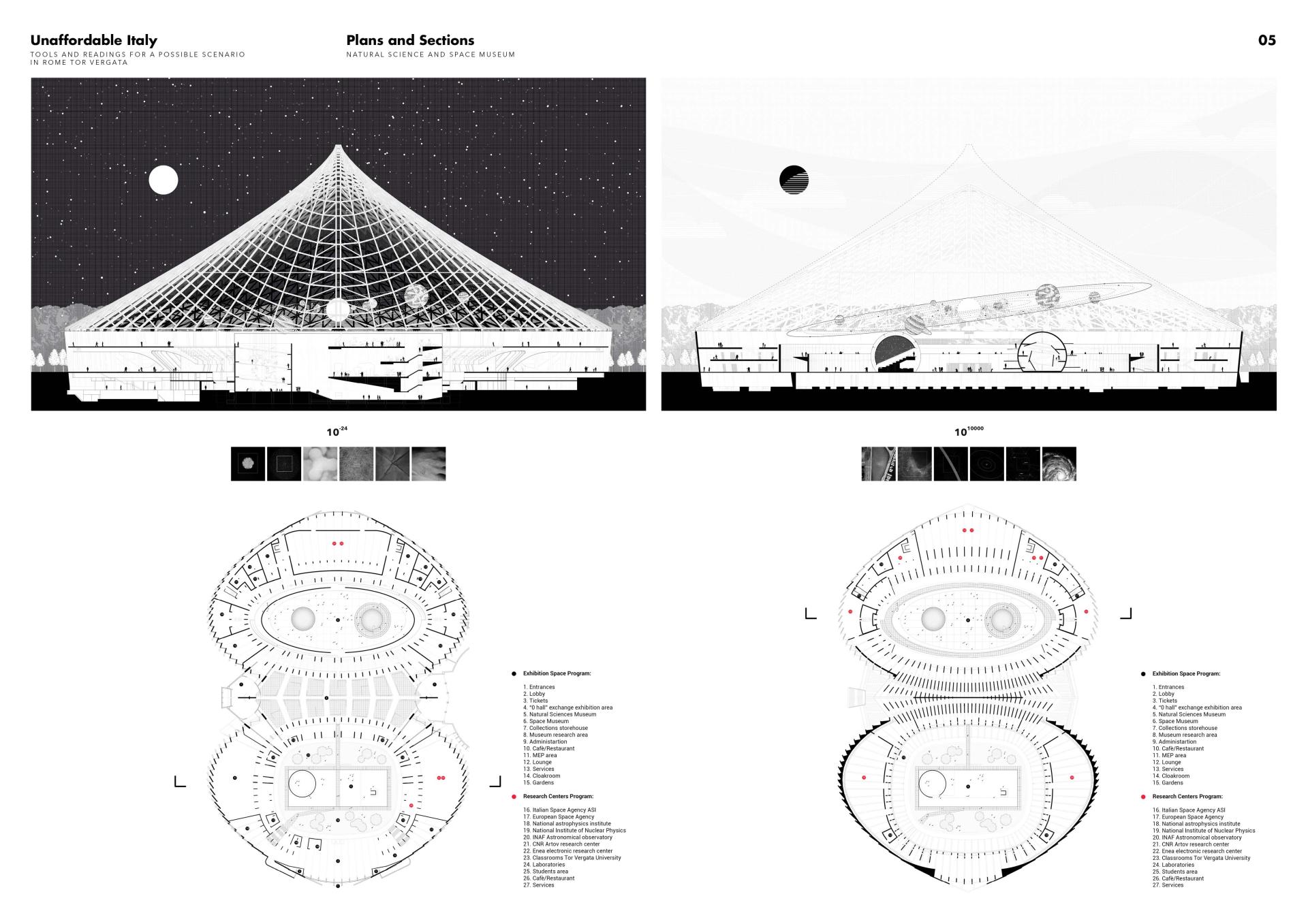
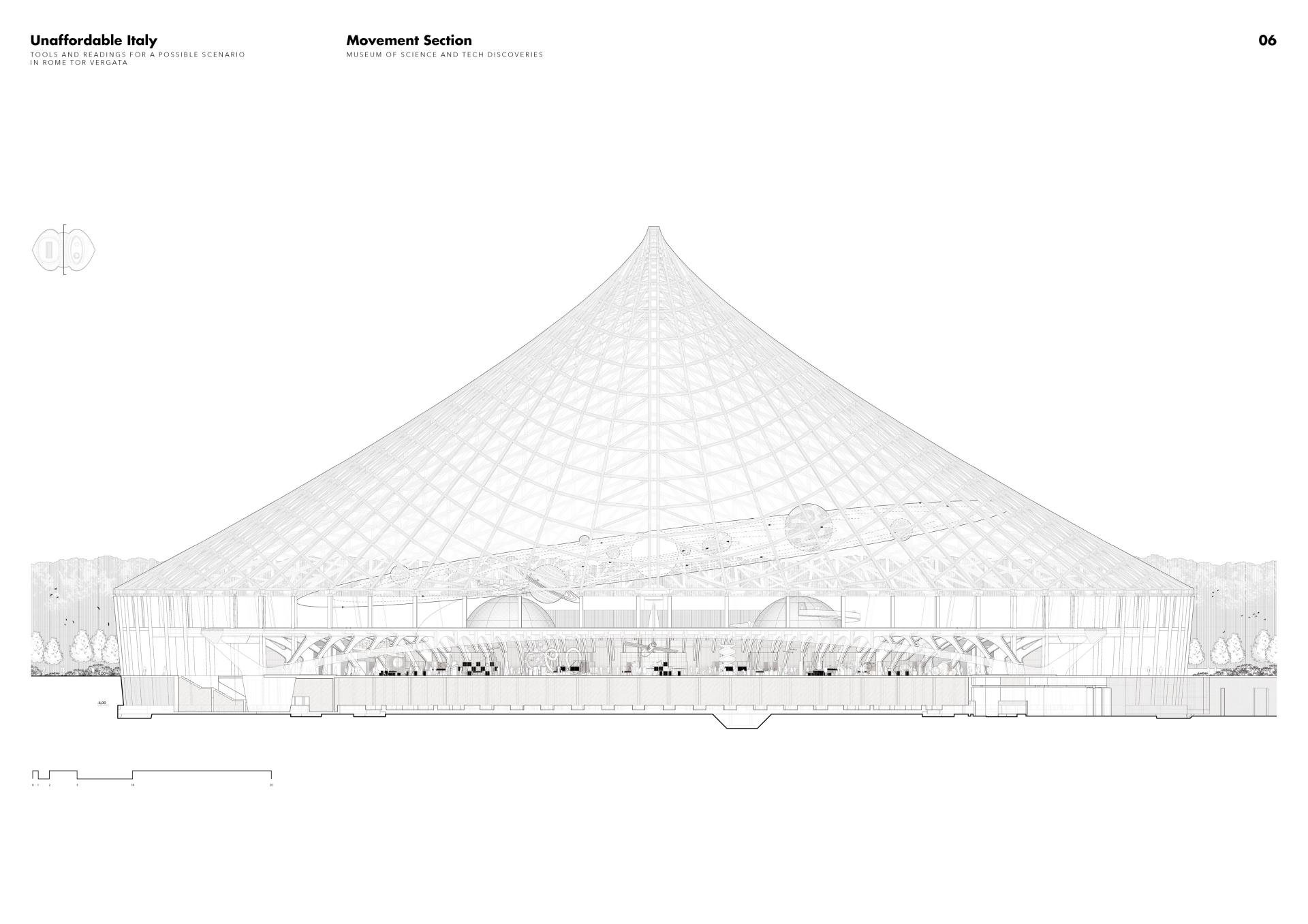
The idea is a continuous path developed on three different levels, it covers the entire surface of the existing building and follow the current morphology but in a new compositional way: the underground floor, the zero, the suspended walk.
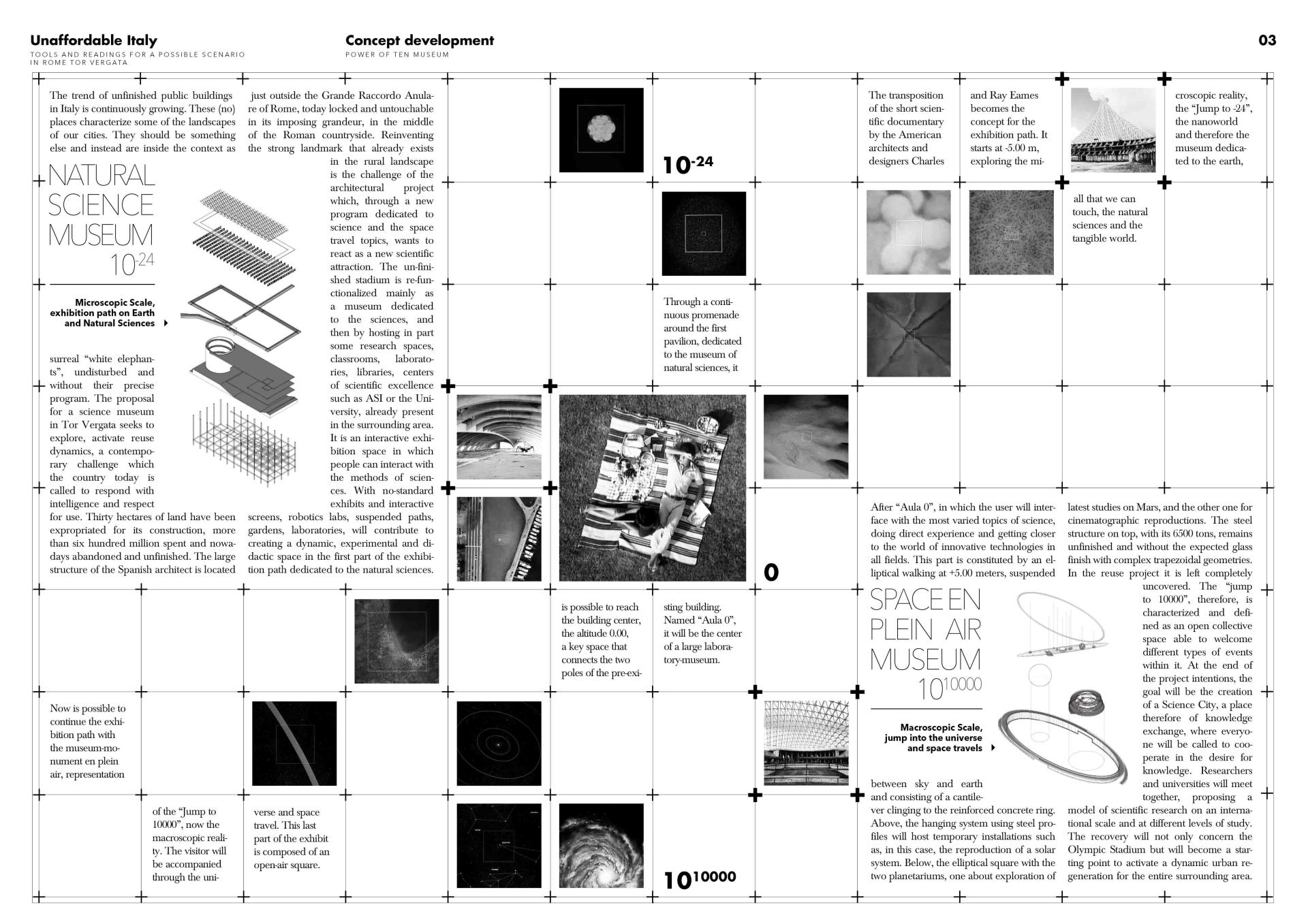
A jump from microscopic to macroscopic reality inspired by the famous short documentary “Powers of Ten”, realized in '77 by the American couple Charles and Ray Eames. Respectively they introduce the visitor to the natural sciences, after through the museum of technology, and then to the “jump to 10000”, representing the universe and space experience.
Thus, as an exercise of utopia at monumental scale, the museum of science is born, or rather, a district of sciences, enhanced and surrounded by the presence of prestigious institutions.