New Youth Hostel Bayreuth
Basic information
Project Title
Full project title
Category
Project Description
Daggy dorms are out – this new building is a sign that youth hostels have a future as inclusive meeting points for all age groups.
The new building of Bayreuth´s 180 bed hostel is a contemporary reinterpretation of the traditional hostels and places the focus on the creation of a new inclusive prototype with an architecturally appropriate expression. Inclusion becomes alive, for guests and the workforce alike.
Project Region
EU Programme or fund
Description of the project
Summary
Daggy dorms are out – this new building is a sign that youth hostels have a future as inclusive meeting points for all age groups.
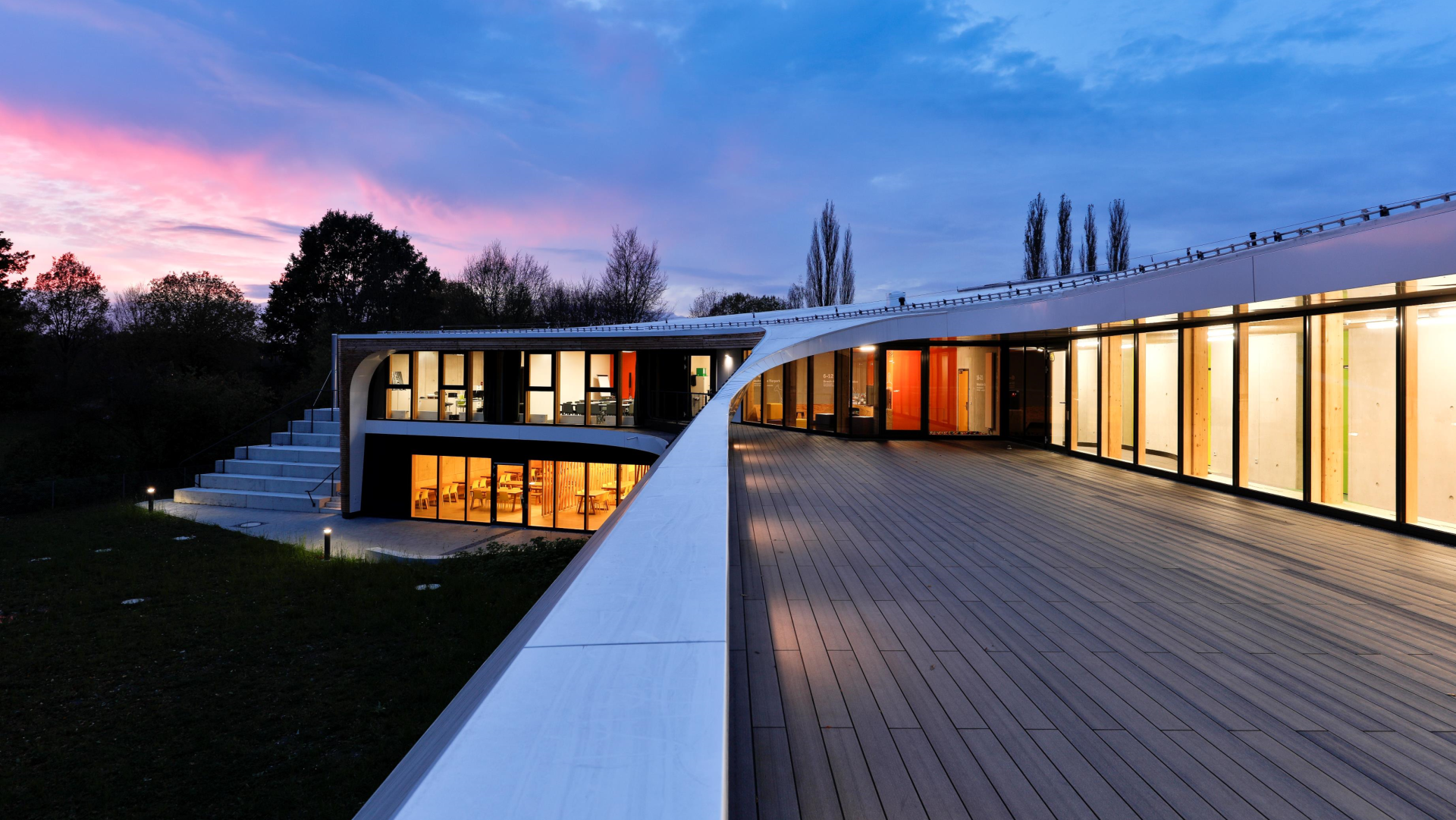
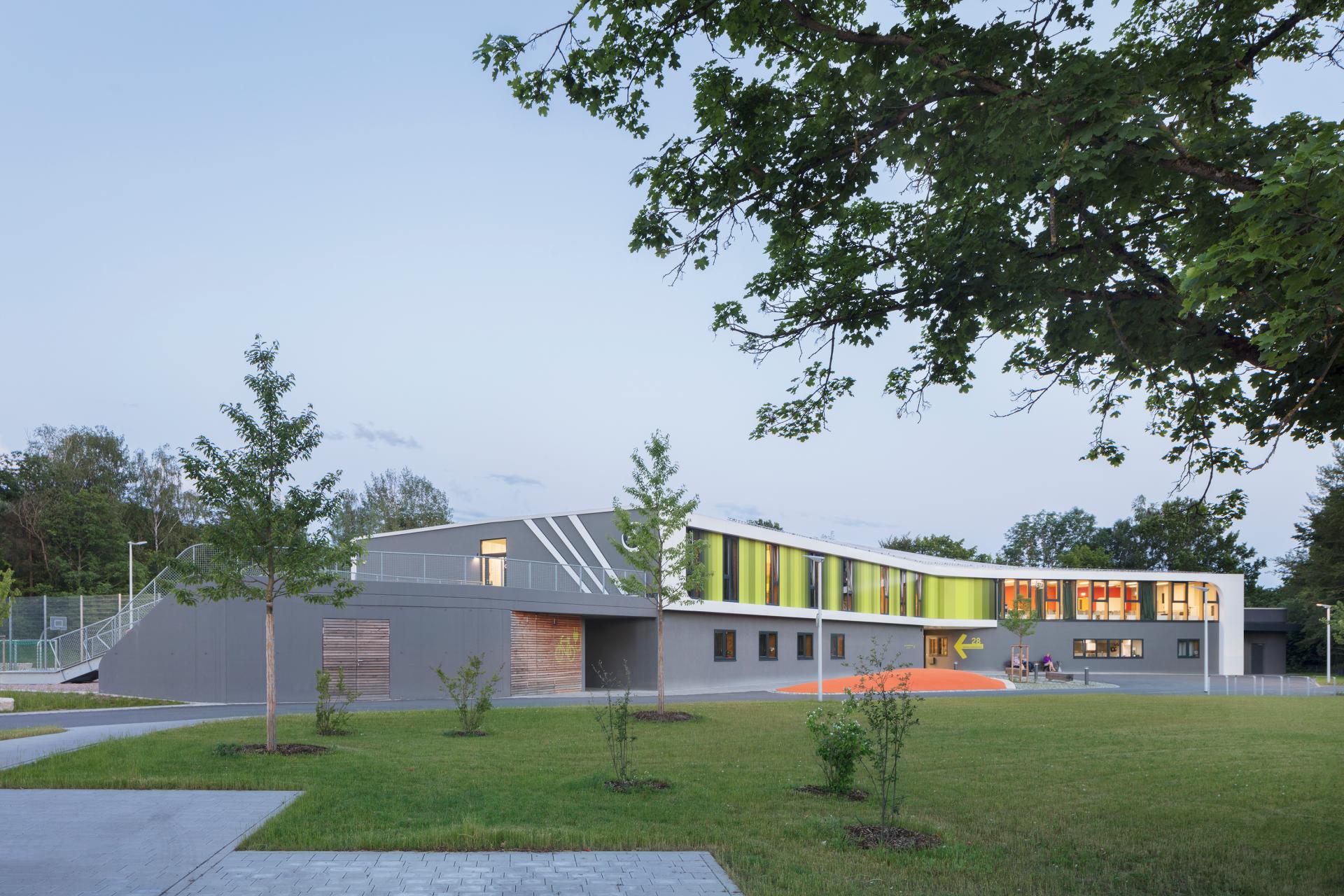
The new building of Bayreuth´s 180 bed hostel is a contemporary reinterpretation of the traditional hostels and places the focus on the creation of a new inclusive prototype with an architecturally appropriate expression. The project is part of an overall concept that was developed by the German Youth Hostel Association (DJH) and LAVA (Laboratory for Visionary Architecture) for a new proto-typical generation of hostels, characterised by an innovative spatial configuration, sustainability on functional, energetic and social levels.
Youth Hostels are known for offering hospitality for children and young adults travelling on their own or in groups. They also are known for diverse educational, experiential and recreational programmes of high pedagogical value, focussing on environment, health, sports, culture and social learning. The Bavarian Youth Hostel Association wanted to create an open an mindful atmosphere with the potential to expand their service to new customers like inclusive school classes. Founding an inclusive business operation strengthens the special profile of the project – not just providing cheap beds but being a place for learning and cultural education for young and mentally young people. Inclusion becomes alive, for guests and the workforce alike.
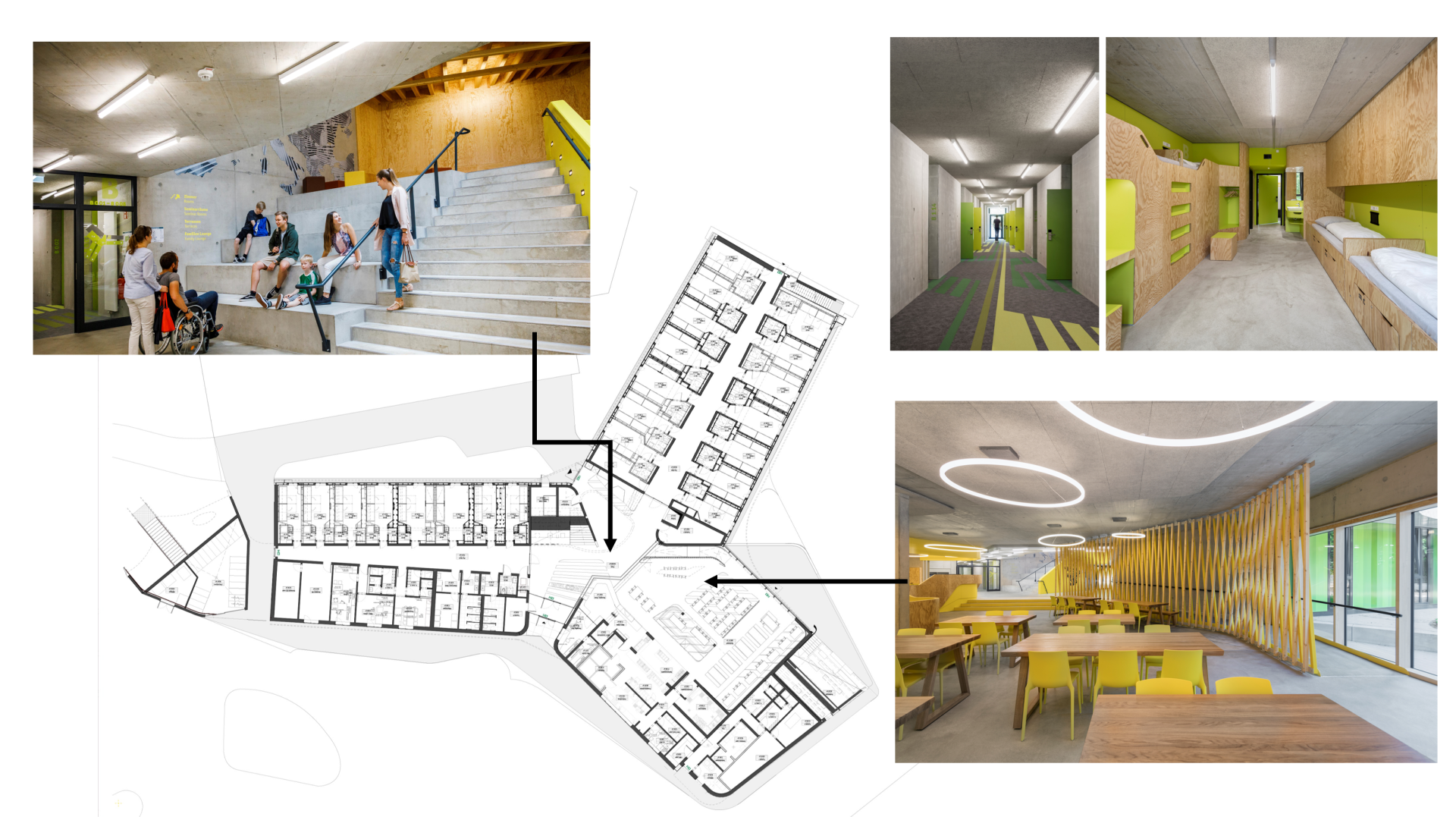
The new Y-shaped hostel follows three overarching principles:
International - the design creates a feeling of place featuring the European network of partner cities of Bayreuth
Inclusive - integration of everybody, providing support to people with disabilities, as guests but also amongst the employees
Innovative – a special configuration for the whole building, room modules, material use and design.
Key objectives for sustainability
Sustainability is treated in an holistic way, combining a consciousness for resources, energy consumption and locally sourced materials with a social agenda.
Despite its elongated low volume, the highly insulated building fulfils low-energy standards using a wood pellet heating and efficient insulation. The foundations and the slab of the first floor are made form concrete, the facades, the roof and most interior separation walls are made of wood. The materials are chosen based on different utilisation cycles for different parts (construction, façade, technical development) to make the building flexible for future changes of function. The technology applied is highly robust instead of technical gimmicks, making the building an equivalent to 'MIR' rather than an 'ISS'.
The most central aspect is making the building a focal point for community, as open and accessible to everybody. For a large part of the building, a user-centered design approach has been chosen applying principles of universal design to allow people with handicapes to use all functions.
Key objectives for aesthetics and quality
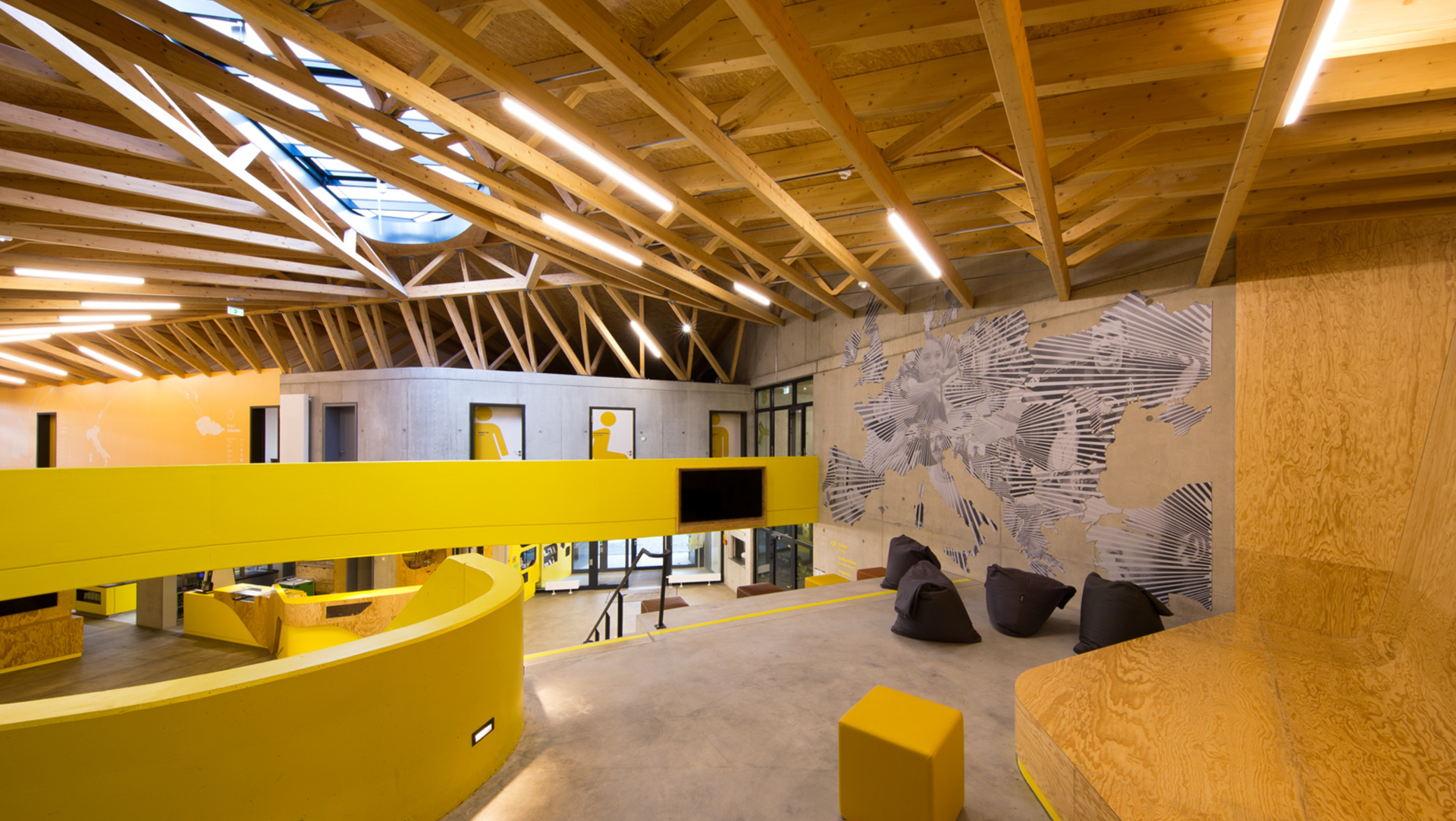
The design of the projects is based on creating a contemporary update reflecting the social and sustainable values embodied.The new hostel updates the architectural expression with an elongated long volume embedded into the landscape with a surprise element a high central foyer giving unexpected perspectives with special material and colour combinations.
The central atrium serves as a hub for (digital) entertainment, interaction and communication meeting the youth hostel motto: "to experience community". A skylight above brings daylight to the central amphitheatre, which connects with the different levels, while horizontal and diagonal sightlines guide the visitor through the building.
"Hard but hearty": authentic materials are characteristic for the building – what is wood looks like wood, visibility of construction - no fake surfaces. The use of bright colours, untreated, natural materials and strong graphical elements creates an uncommon, friendly background, triggering curiosity and openness. Within a short time, the building became an attractive social meeting point, bringing together a wide range of people with different age and interests, social backgrounds and physical and mental conditions.
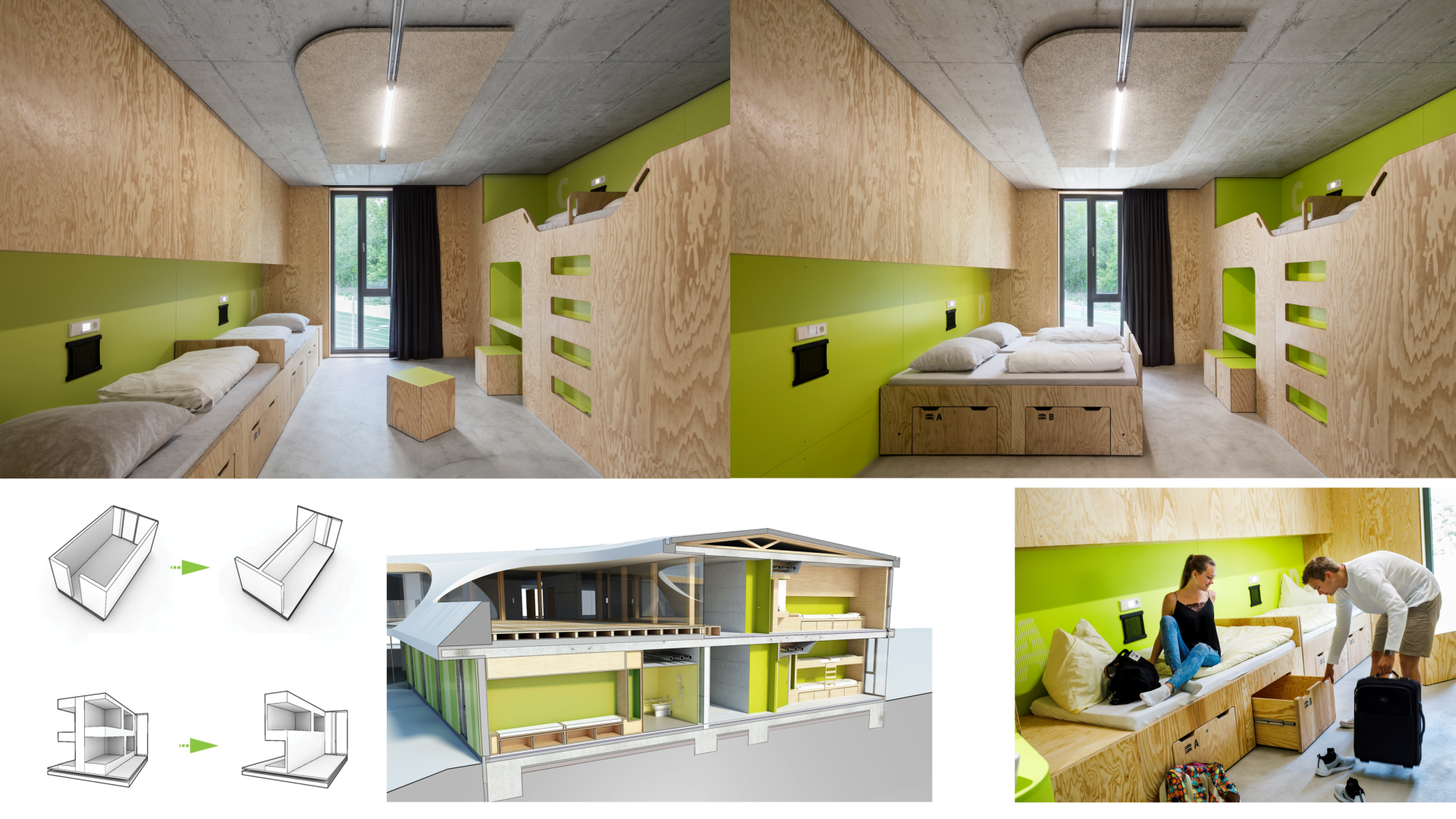
The separating walls between rooms are defined by non-load-bearing modules made of wood, which allow individual room configurations of variable sizes. These deep walls take up bathrooms and beds of different types alike. Their innovative design allows for different rooms sizes ranging from 2 to 6 beds in one room - in different configurations where the low beds can be rotated creating a 2+2 or 2+4 bed configuration, This makes the rooms attractive to school classes, families or even cultural tourists. On the ground floor, all rooms in one wing are designed to cater to the need of people in wheelchairs who can use the rotated beds.
Key objectives for inclusion
Youth Hostels are known for offering hospitality for children and young adults travelling on their own or in groups. They also are known for diverse educational, experiential and recreational programmes of high pedagogical value, focussing on environment, health, sports, culture and social learning. These offerings have been extended to people with handicaps. During the entire planning process, experts for the needs of handicapped people have been consulted and been involved in the development of the design.
Founding an inclusive business operation strengthens the special profile of the project – not just providing cheap beds but being a place for learning and cultural education for young and mentally young people.
The project has been financially supported by the following partners:
- Bavarian Ministry for Family, Work and Social Affairs
- City of Bayreuth
- Oberfranken Trust
- State of Bavaria Trust
- Aktion Mensch
- Bavarian Center for Family and Social Affairs
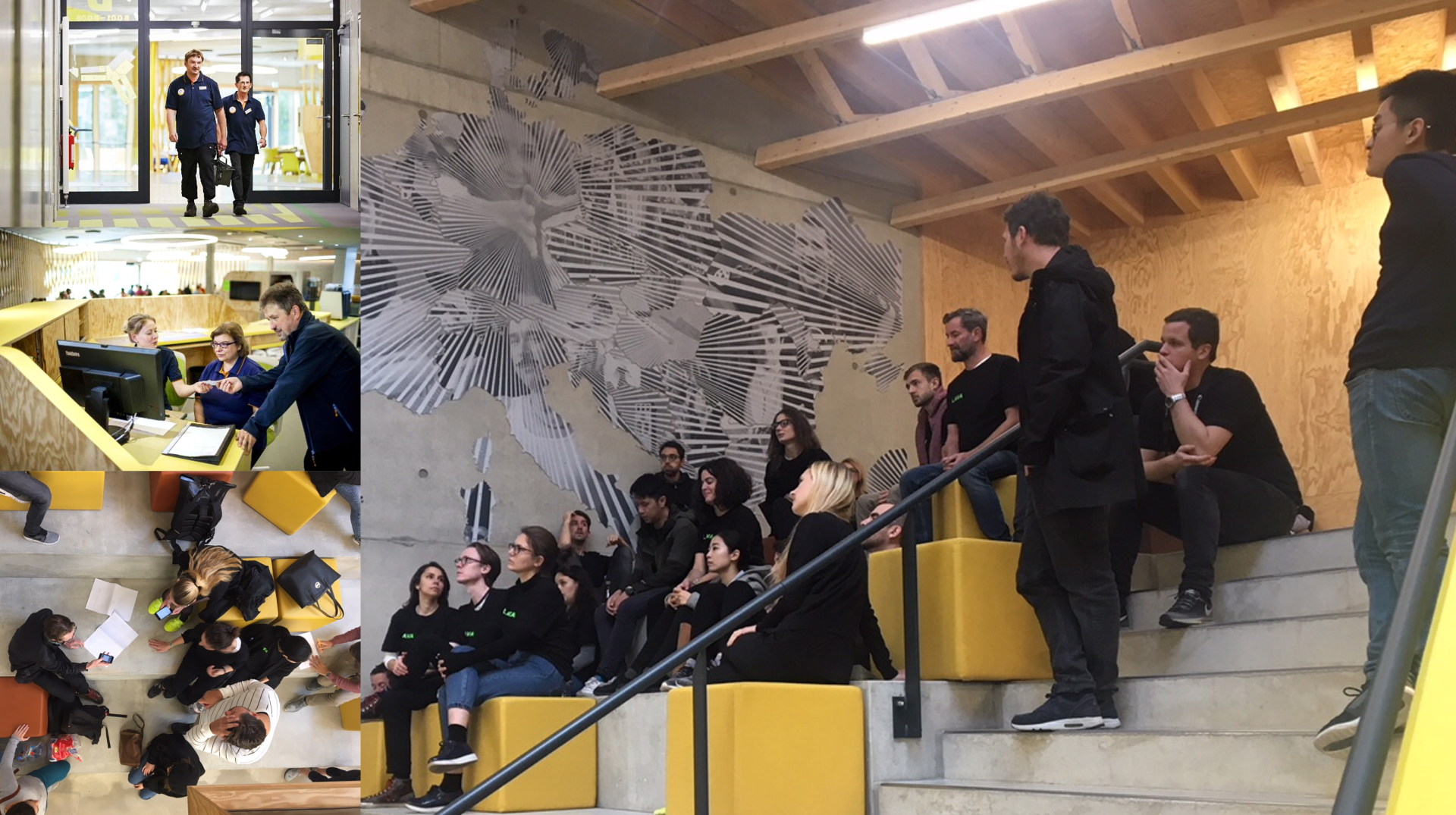
Based on this, the amount of work spaces is increased from 12 to 17. The amount of employees with handicaps was increased from 2 to 8, turning the Youth Hostel into an inclusive business (40% of employees are handicapped).
Results in relation to category
The Bavarian Youth Hostel Association wanted to create an open an mindful atmosphere with the potential to expand their service to new customers like inclusive school classes.
The project received media attention and is well-frequented and liked by different guest like school classes, culture and sports tourists (including music lovers attending the Wagner Festival) and people coming for educational seminars held on weekends.
"Aktion Mensch" has featured tow of the employees in short movies:
Inklusive Jugendherberge - Aktion Mensch (aktion-mensch.de)
Inklusionsbetrieb Jugendherberge Bayreuth - Aktion Mensch (aktion-mensch.de)
The chamber of Architects regards the project as one of the best practise examples for an inclusive project:
Inklusiv gestalten – Arbeit und Inklusion – Online-Regionalkonferenz Bayern (byak.de)
How Citizens benefit
The mayor and the municipality actively supported the concept of an inclusive hostel.
The Bayreuth Youth Hostel developed form an outdated hostel with 34 rooms and 142 beds to a contemporary attractive facility with 52 rooms and 180 beds. The new facility caters to the needs of new types of guests bringing different people into the city.
The project is frequented by citizens and guest meeting for sports events and workshops and seminars taught at weekends.
Innovative character
The project is a showcase for the brave application of new business principles (inclusive operation), an expansion to new types of guests and the definition of a fresh spatial, material and graphically recognisable building. Shifting the focus form a quick ROI (return on invest) not only allows for a more sustainable business but also for a new definition of an appropriate building, focussing on better materials and spatial qualities.