Hal5
Basic information
Project Title
Full project title
Category
Project Description
Hal5 is a financially self-sustaining temporary redevelopment of an abandoned protected railway hall.
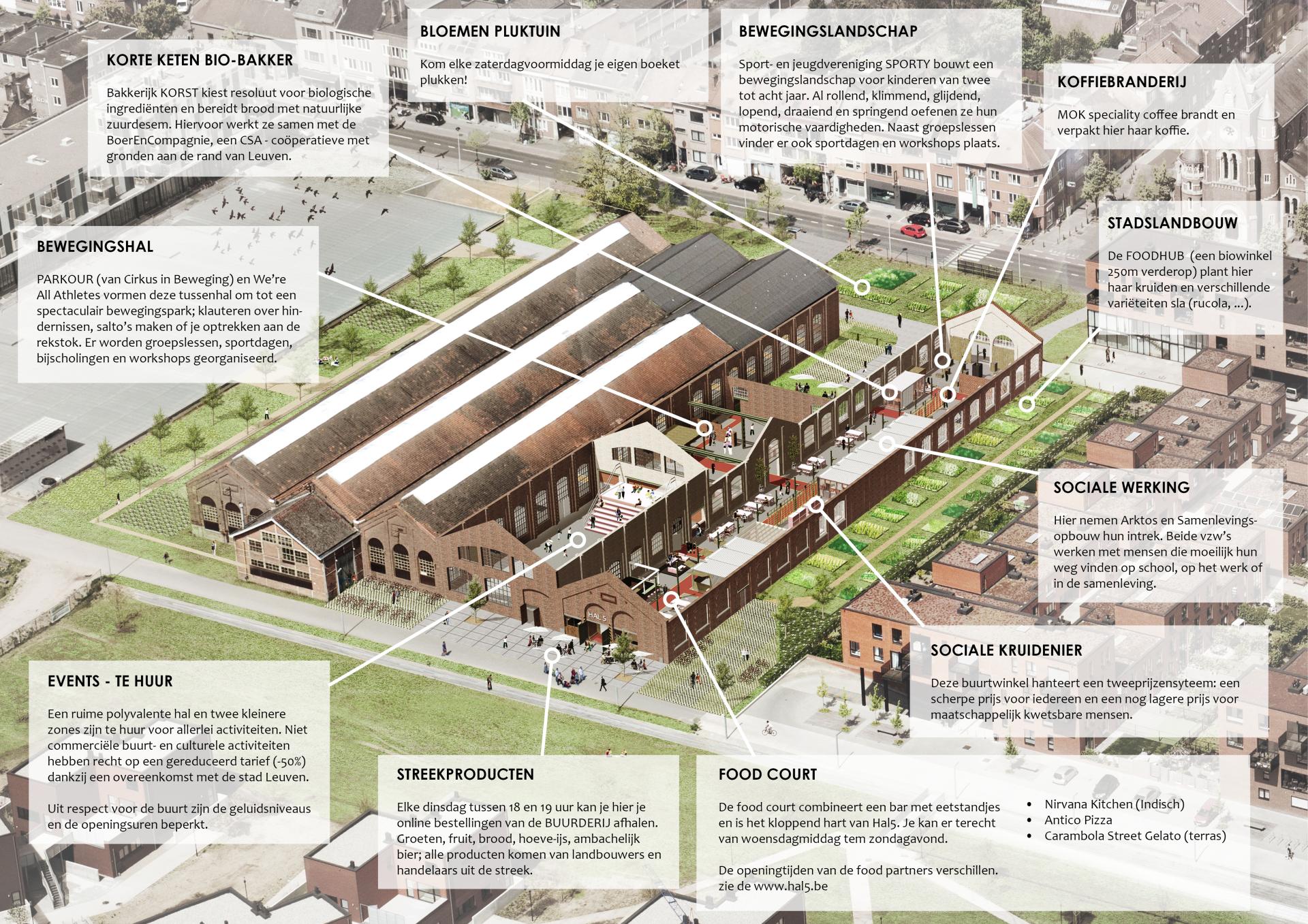
The project was initiated by the neighbourhood and provides affordable space and cross breeding between social organisations, entrepreneurs and the neighbours. The project includes a food court with a bar, a social grocery store, event spaces, parkour halls for adults and todlers, social organizations, a coffee roaster, a short-chain bakery, urban agriculture and a flower picking garden
Project Region
EU Programme or fund
Description of the project
Summary
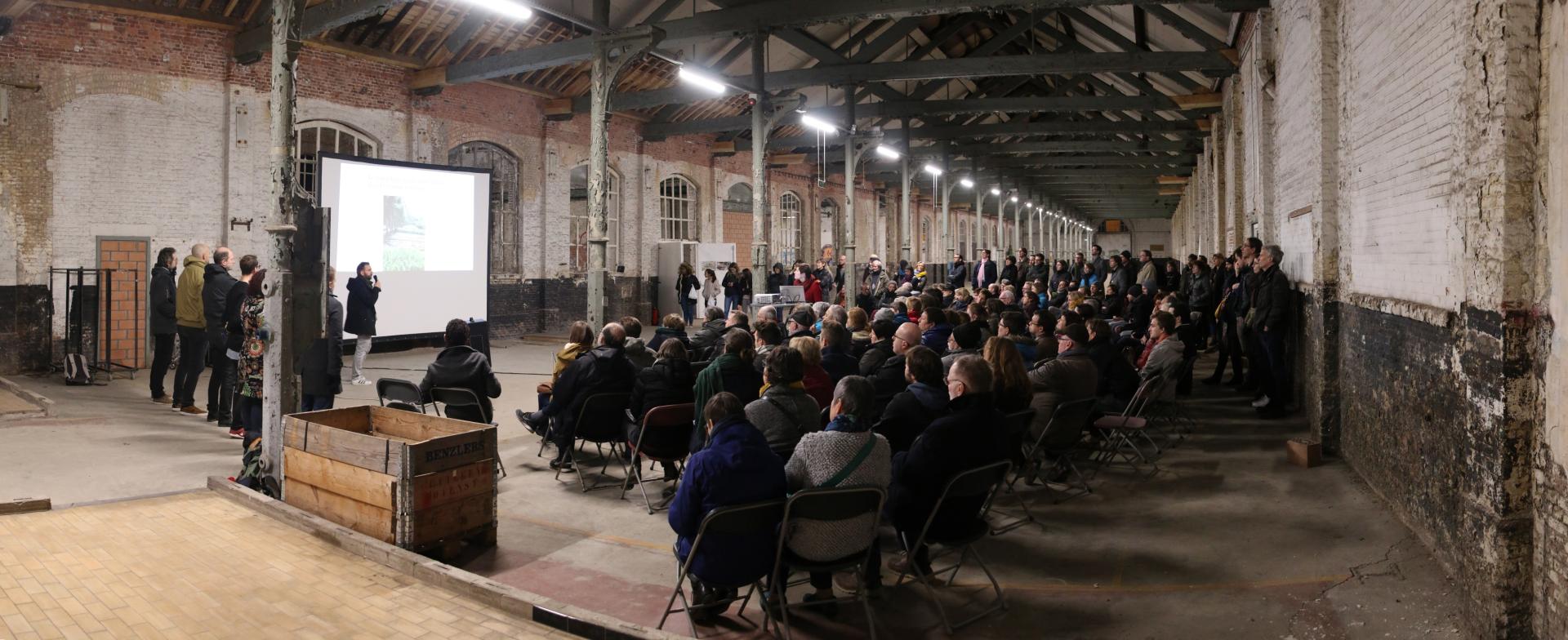
For years, a protected industrial railway hall (2000m²) behind the station of Leuven (Belgium) stood empty. The city of Leuven (the owner) had tried, but failed to find partners for a permanent redevelopment. A group of neighbours (some of them architects) convinced the city that they could create a financially self-sustainable temporary development (minimum 5 years) that could become the seed for a permanent (phased) development. The city took up this challenge and teamed up with the initiators in an unique way.
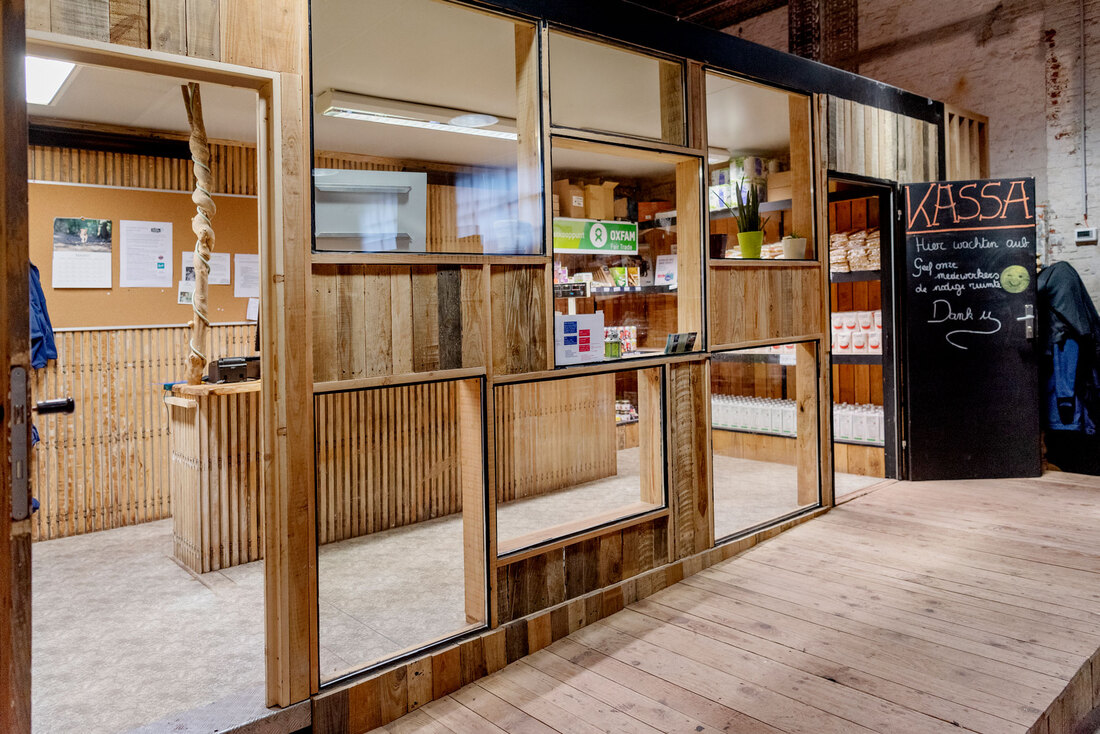
The redevelopment was organized around 4 themes: sports, food, community building and sustainable entrepreneurship. It focused on providing affordable space and cross-breeding between very diverse urban actors. The project includes a food court for starting food entrepreneurs with a bar, a social grocery store, event spaces, a free running (parkour) hall and an exercise landscape for toddlers, offices for 2 social organizations, a coffee roaster and short-chain bakery, urban agriculture and a flower picking garden.
Hal5 was developed, built and financed (EUR 400,000) by the users and the neighbours. Hal5 is an experiment in ‘city making’: an extreme programmatic mix in a dense residential neigbhourhood, alternative financing, a lead time from concept to opening of 8 months, co-creation with 15 very diverse partners, ...
The project started almost 4 years ago and rapidly became one of the social hotspots in town. It is, even during corona times, financially healthy and talks are ongoing (with the city) to investigate how this project could be the start of the permanent redevelopment.
Key objectives for sustainability
Hal5 integrates the 4 pillars of sustainable development: economic, social, cultural and environmental development.
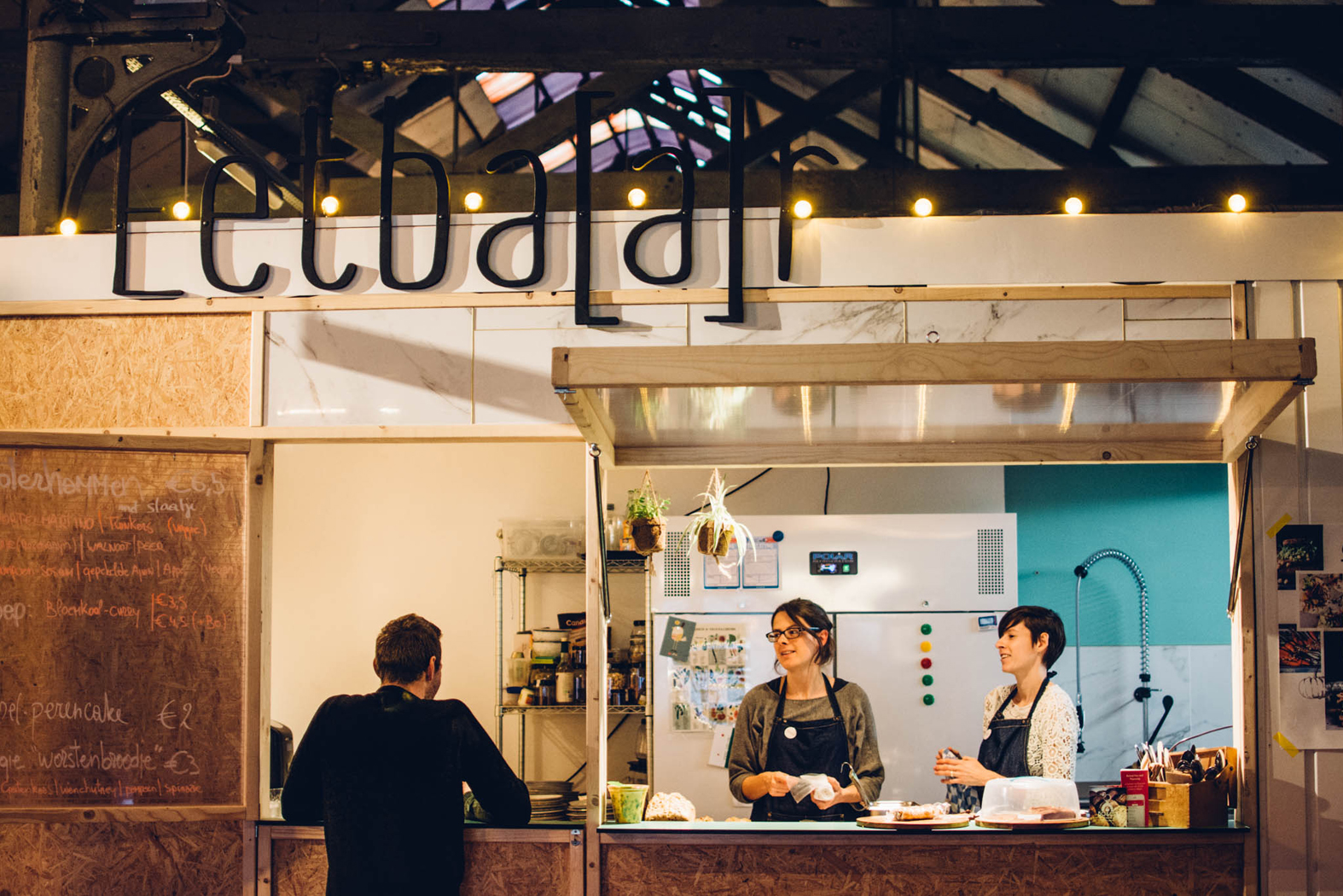
In terms of economic development: it provides affordable space and a fertile breeding ground for starting food entrepreneurs: an IT consultant who gave up his job to start a flourishing pizzeria (employing >5 people), an artisanal coffee roastery, a sourdough bakery using only local products, a Palestinian falafel food stand, an artisanal ice cream bar… Different other starting entrepreneurs emerged in Hal5 and spread their wings to other (bigger) places in town. Moreover job programs from the social organization helped different local youngster with difficulties on the regular job market to find jobs within Hal5!
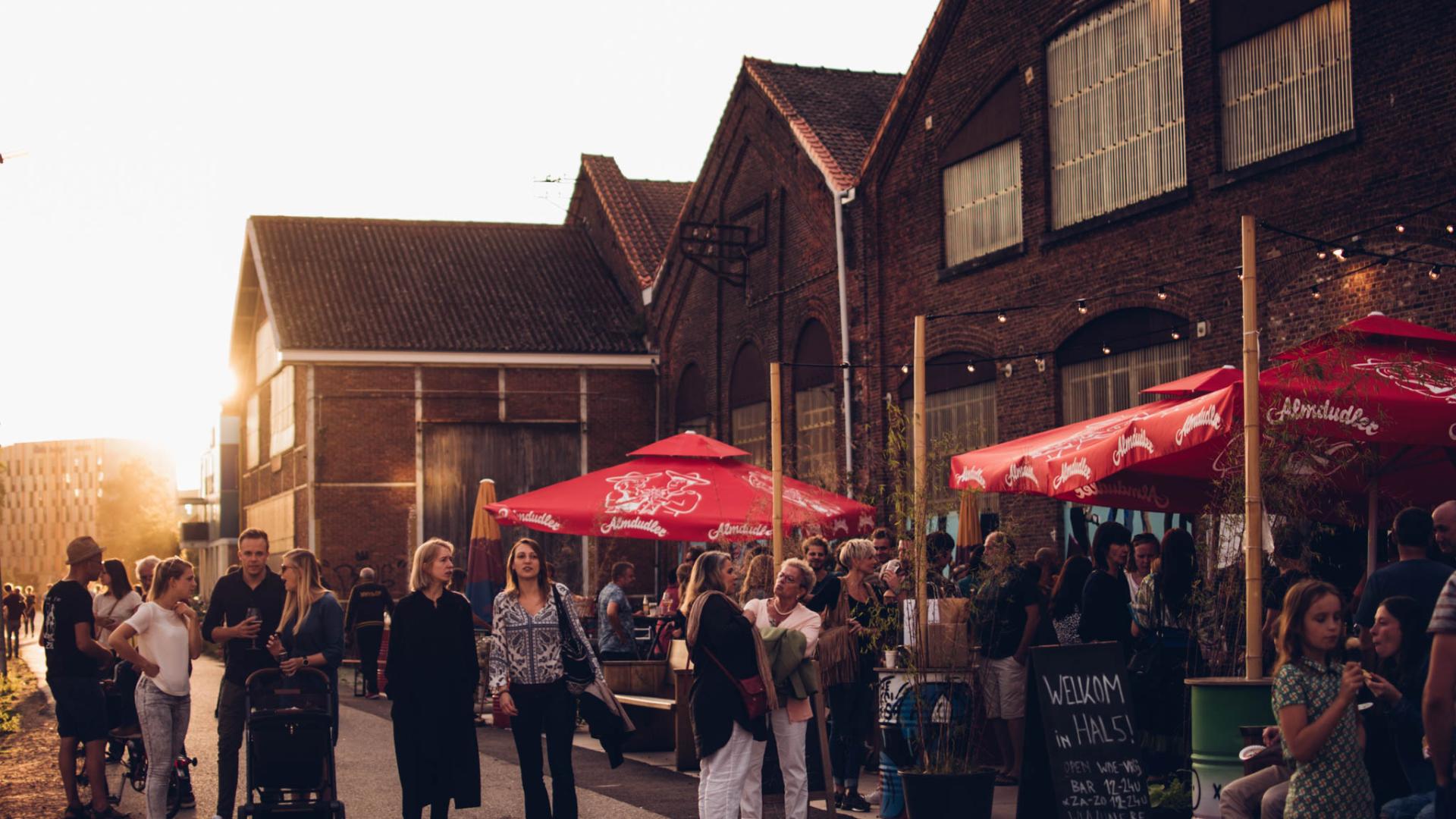
In terms of social development, Hal5 brings together an extremely divers mix of social income groups ranging for the double income hipsters to families in need, shopping at lowered rates in the social grocery store. Different weekly activities, engaging professionals and volunteers, try to bring these audiences together.
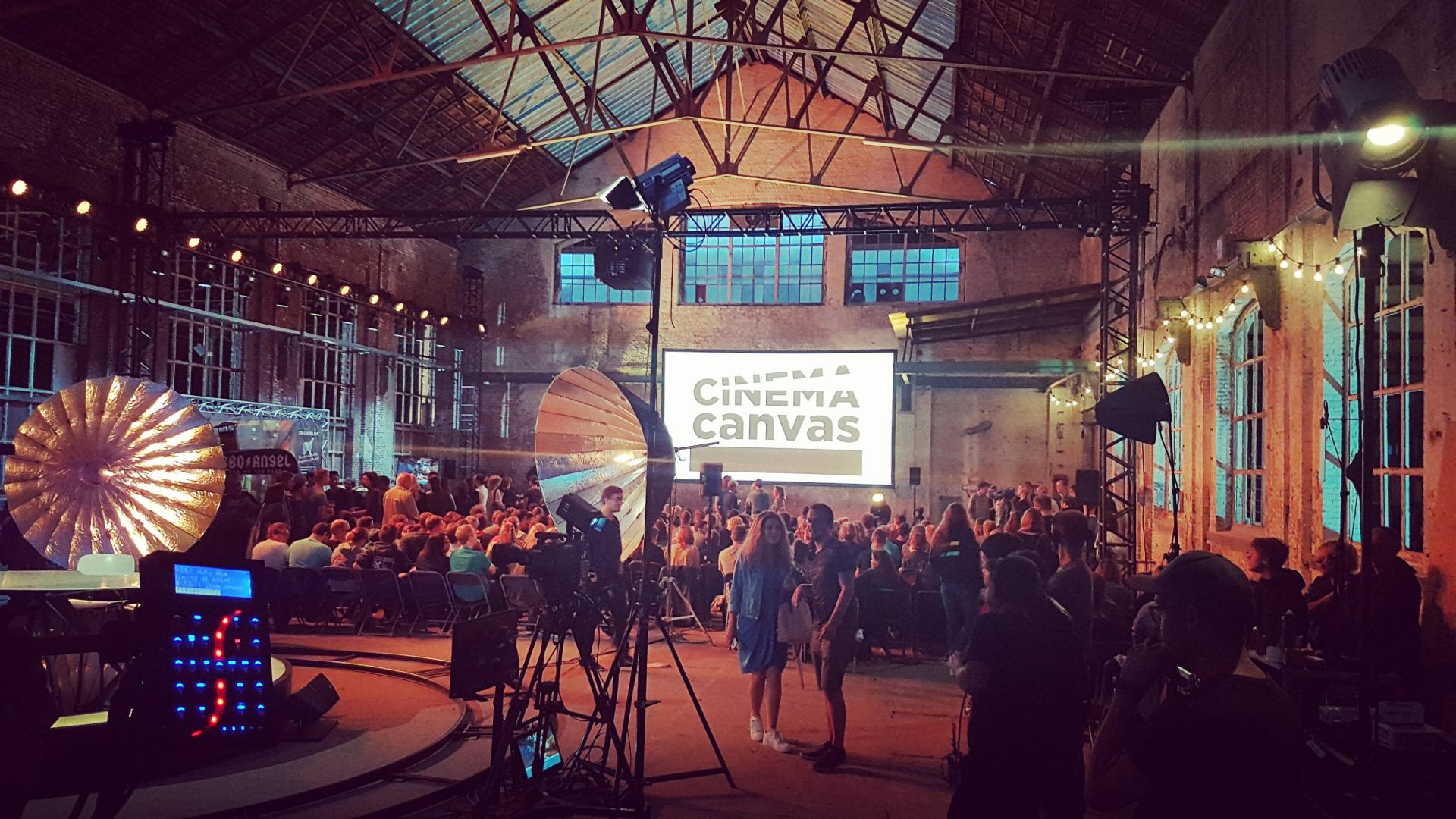
In term of cultural development, Hal5 and the City of Leuven partnered to provide affordable event space for local organisation (cultural organisations, local school displaying their annual musical, …). Together with its partners Hal5 also sets up own events like the award winning ‘Allez Chantez’ where >100 people sing together guided by professional musicians.
In terms of environmental development, the project was mainly build with re-used materials (bricks, containers, …). By using the box in box principle with new heat pumps, the overall usage of electricity and gas is lower than in an average 2000m² building. Additionaly, water of the roof is re-used in the biological urban agriculture and the flower picking garden. These two projects are also actively improving the biodiversity in the neighbourhood by building water ponds, choosing the right combination of vegetation…
Key objectives for aesthetics and quality
The project was built with very limited financial means (and partly by volunteers). Nevertheless, a limited amount of strategic interventions created a warm, welcoming and beautiful urban environment. We chose to work with a limited amount of re-used materials to (1) keep the cost low, (2) train volunteers to work with them, (3) clearly show what is ‘new ’ and what is ‘old’ and (4) create an harmonic aesthetic visual experience.
Against all expectations, the project won the prestigious local Architectural Award of Leuven 2016-2019.
Quote from the Jury;
“HAL 5 convinces as a particularly intelligent series of interventions that fully focus on the added value of a monument for the quality of urban life. The interventions have ensured that HAL 5 has not become a pathological monument, with a negative impact on its surroundings, but rather the beating heart of an urban district’
The role of architecture here is to provide space, to provide shelter, to identify and point out opportunities, to make a building habitable, to integrate it back into the city and to use it generously. Aspects that are mentioned in many projects, but simply take place here without words.
It is remarkable that a group of local residents, including three architects, started this process: they saw the potential of the place, they had the imagination, the design intelligence and the guiding capacity to bring residents, associations and authorities together. They themselves call it ‘city making’, and that is exactly what is happening here.
HAL 5's approach excels in terms of participation, recycling and flexibility – all qualities that are indispensable for sustainable architecture, even if in this case it is with an interpretation that is not 'permanent'. Their interventions ensure that the monumental properties of HAL 5 are permanently activated, and that is precisely where the sustainability of these interventions lies.”
Key objectives for inclusion
For the development of the project, a non profit organisation was created that unites the different tenants and other stakeholders (social and cultural partners, entrepreneurs, neighbourhood, …). This created a strong (juridical) network which has been extended and reinforced over the past years with investors, new partnerships with the local authority, various suppliers, … This network allows almost everybody to engage in this project in various different ways (as a tenant, as a visitor, as a volunteer, as an investor, …). This makes this project, in terms of participation, unique in its kind.
The specific focus on social inclusion is realised through partnerships with tenant / partners. Two social organisations have offices in Hal5, working with various different income and age groups. The opportunity for cross breeding between the different actors in the project creates various opportunities to connect people and cultures. Different activities are organised to enhance this:
- Every Thursday the bar is managed by a group of local volunteers and prices are reduced with 50%.
- Job programs are introduced to connect youngster with the local entrepreneurs in Hal5. This has led to different job contracts already.
- Cultural partners like the Circus School and the Free Running parkour allow underprivileged children at special conditions.
- The urban agriculture has ‘private – paid’ plots and ‘public – free’ plots.
- The social grocery store works with a double pricing systems. People with a low income pay less for the same product as regular clients.
- Different specific (free) events are organised monthly to connect people.
Results in relation to category
Hal5 is an experiment in city making. It creates affordable space for various valuable urban actors of which every body agrees that they are an important part of the urban ecosystem but nobody still seems to know how to cater for them. Hal5 provides this space in such a way that the whole transcends the sum of the parts. Hal5 is a community centre, an economical incubator, a biodiversity experiment, a cultural, social and sports school, a private and public space, a circular economy catalyst and a financially viable redevelopment strategy for a protected monument. All in one.
Quote of the jury :
“In its judgment, the jury was mainly guided by the question of which project is the most exemplary for tackling the urban challenges of the future. Where do we want to go with the city? Who belongs and where does it take place? What do we do together? Where and how do our daily urban rituals take place? If we ask ourselves that question, in the light of climate change and migration, if we think about the complexity of living in a city, exciting but not always easy, if we value the daily life full of surprises that we want as a challenge embrace, then one project stands out above the others and is nominated as the winner of the expert jury: it is about the transformation of HAL 5.
HAL 5 is a contemporary version of the commons, a small part of the city that is used together for everyday activities that seem to have disappeared more and more from the city: bakery, coffee roaster, circus, flower picking, small-scale farming. Indoor and outdoor spaces, engagement and relaxation, simplicity as luxury.
During this temporary development, the design and thinking process continues, providing a blueprint for the ambition that a 'longer-term' reuse of this heritage stands for: possibilities are explored, expectations are shaped, risks are mapped ... the tone for the future has been set. HALL 5 gives hope.”
How Citizens benefit
For the development of the project, a non profit organisation was created that unites the different tenants and other stakeholders (social and cultural partners, entrepreneurs, neighbourhood, …). This created a strong (juridical) network which has been extended and reinforced over the past years with investors, new partnerships with the local authority, various suppliers, … This networked basically allows almost everybody to engage in this project in various different was (as a tenant, as a user, as a volunteer, as an investor, …). This makes this project, in terms of participation, unique in its kind.
The result is a robust network of shareholders creating a continuously growing number of shared values and opportunities. In this way, it could well be a beautiful metaphor for the EU itself (possibly even a better version because less financially driven). The robustness of this network became very tangible during the Covid pandemic. All different stakeholders engaged to work together to keep the ship floating during this stormy year by organising covid proof events, working together on different recovery projects and subsidies, taking over tasks and responsibilities where possible. This resulted in – in contrast to other projects with events spaces and restaurants – a positive financial result for 2020.
The active engagement from the civic society (and the local government) also created a support and knowledge base for the permanent redevelopment of this protected monument.
Innovative character
As said, the project is an experiment in city making in all of its aspects: participation and co-creation, re-use of materials, financial model, programmatic mix, extremely short lead time… Also the strategy to look at a temporary use, not merely as a temporary use but as an innovative phased development strategy is exemplary.
Specific for the European Bauhaus, when we focus on the architectural project, we (and the jury of the Leuven Architectural award) believe that the development model is one of the main innovations.
Quote jury,
It is not only the role of architects to make design drawings for assignments that are defined by others (clients, authorities, developers, ...). It is part of their arsenal of tools to discover the spatial potential of places that are underused or otherwise problematic. The role of architecture here is to provide space, to provide shelter, to identify and point out opportunities, to make a building habitable, to integrate it back into the city and to use it generously. Aspects that are mentioned in many projects, but simply take place here without words.
Naming and acknowledging this as an architectural task opens up the architectural profession further. With HAL 5, the boundaries between architect, client and builder are blurring. Architecture will be a joint task in which numerous restrictions must be reconciled with the demand for space to make a city.