On the Move Together in the Aegean Sea
Basic information
Project Title
Full project title
Category
Project Description
It is a continuous discussion on refugee crisis with the voice of emerging materials in transforming artefacts as messages. It comprises 3 participatory recycled art installations.
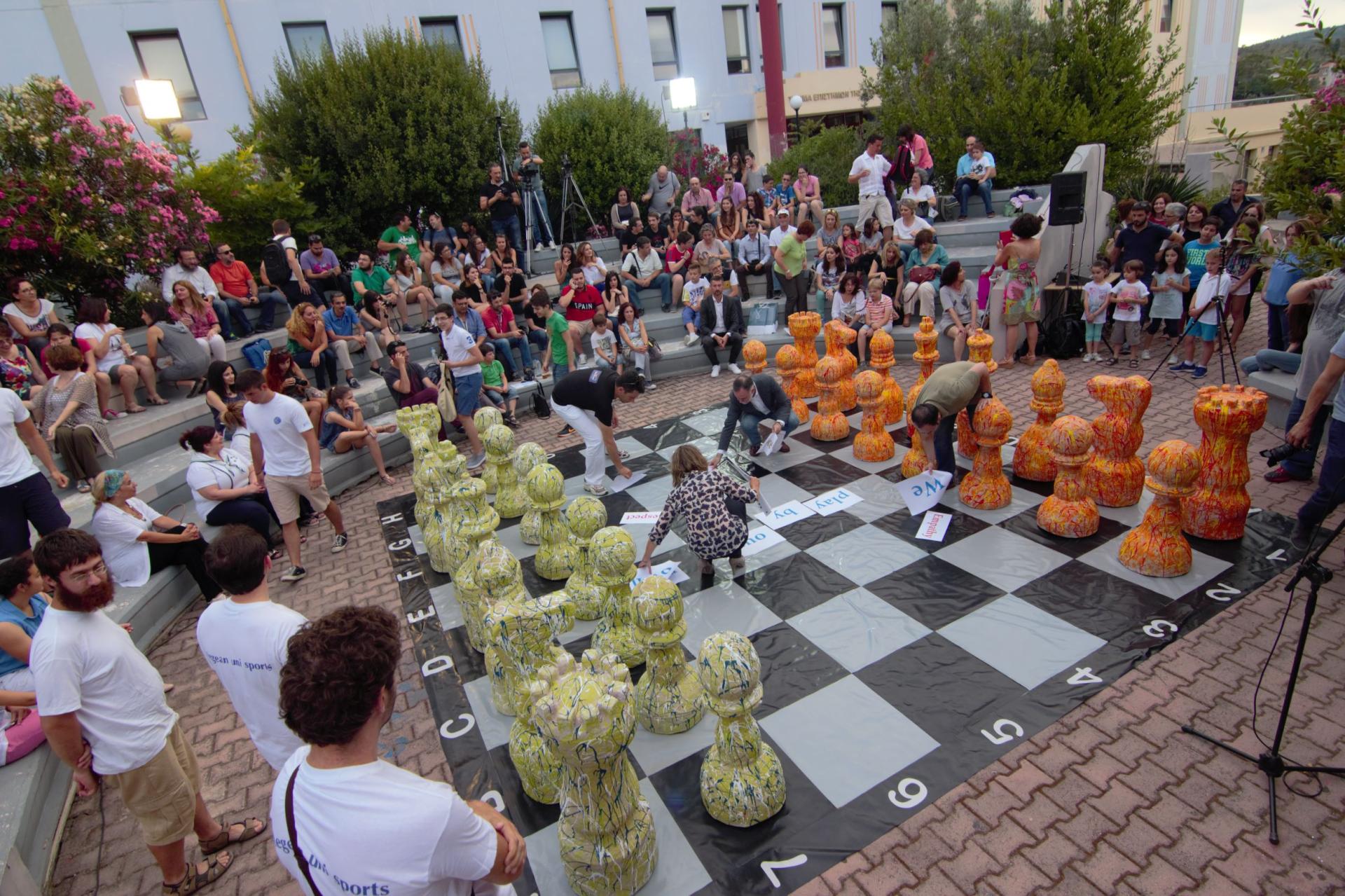
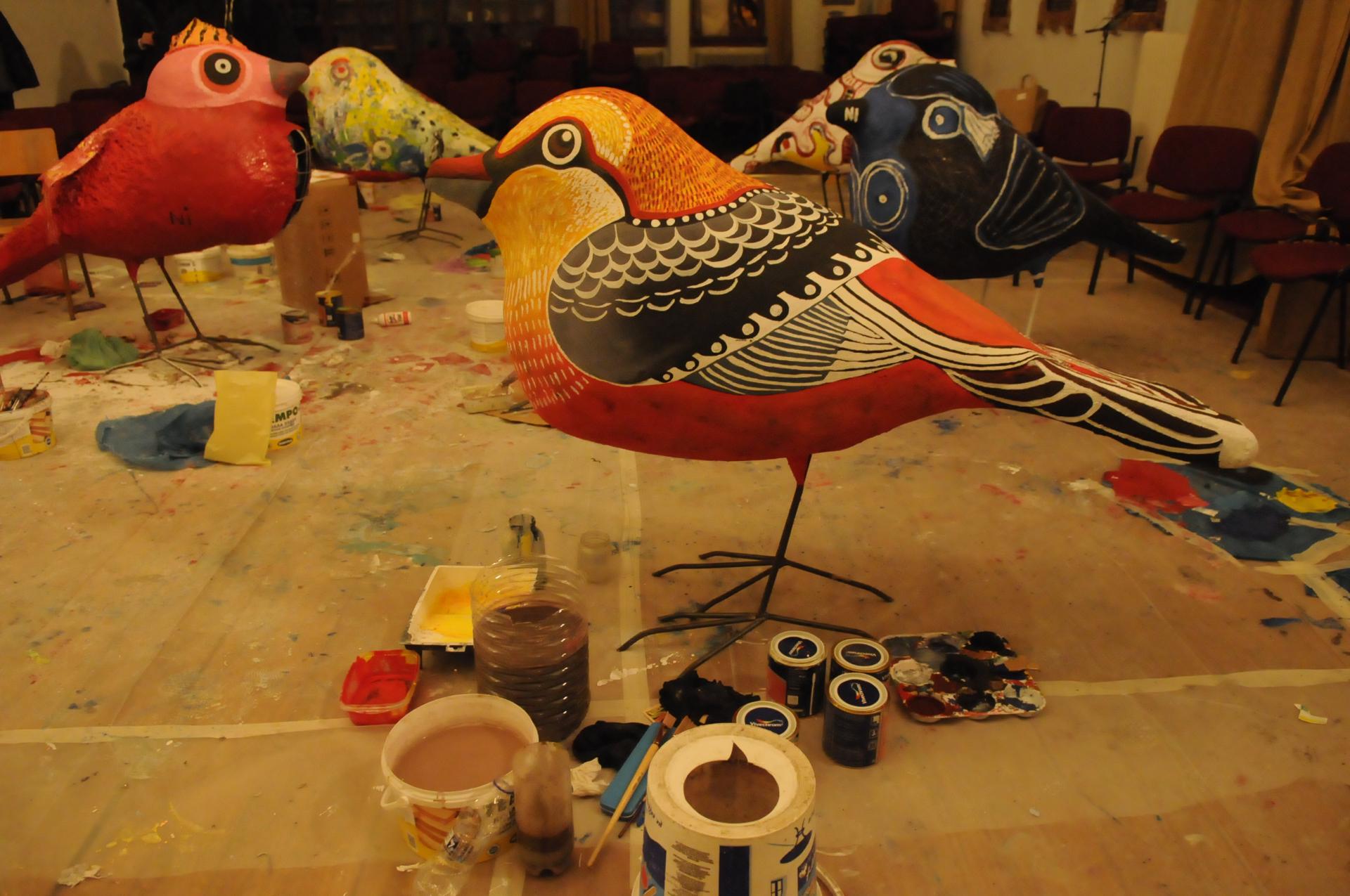
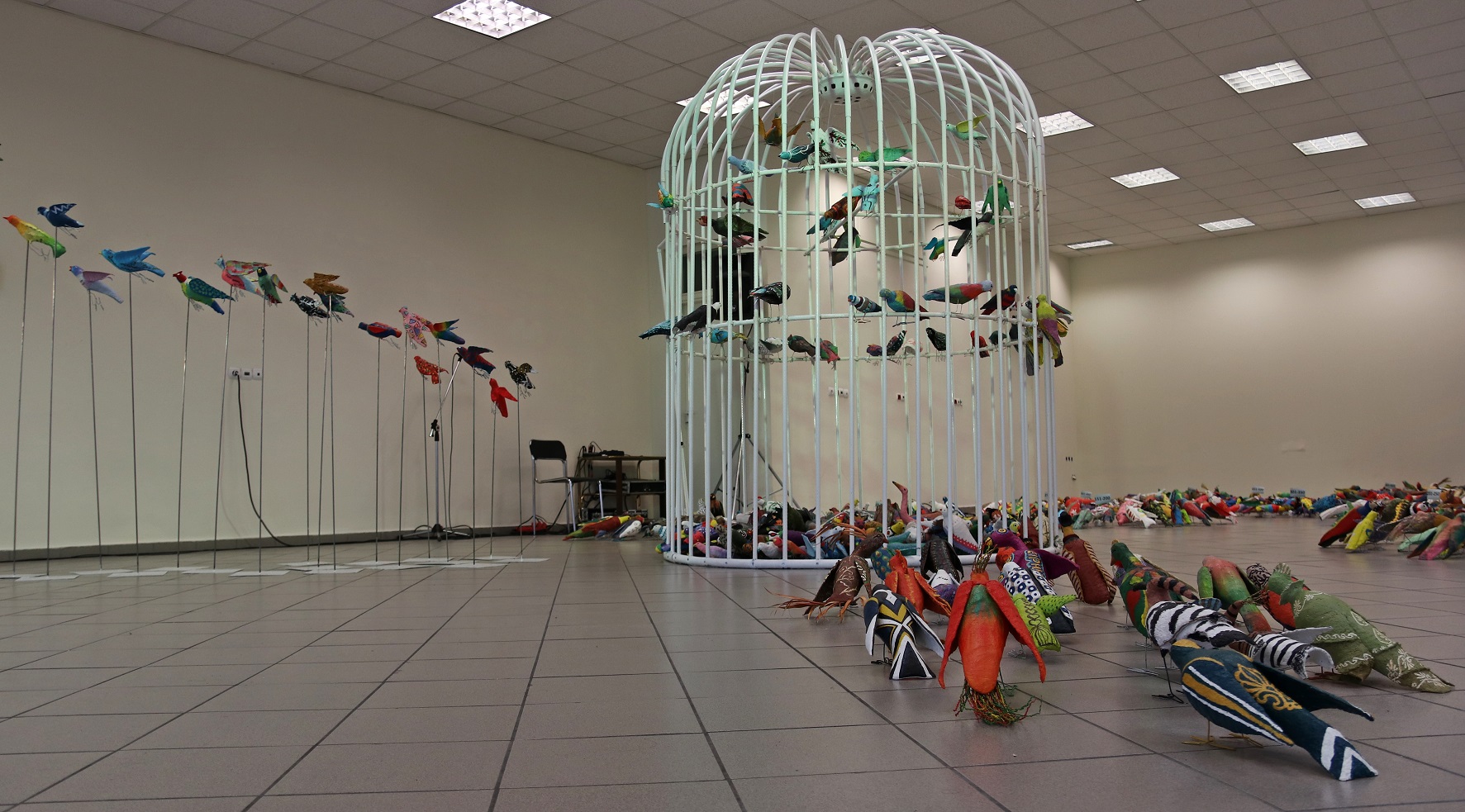
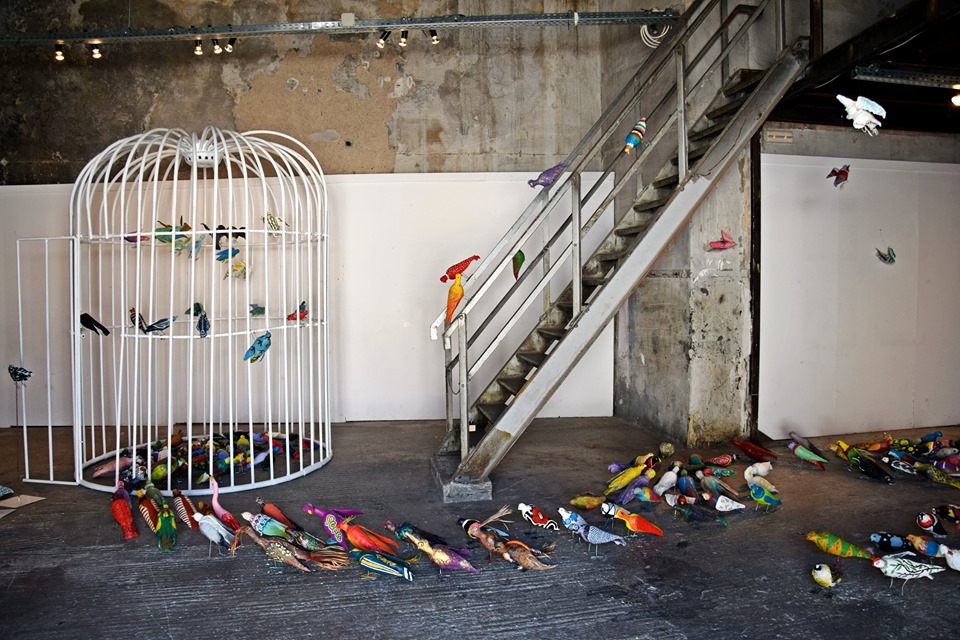
In The Chessboard of the World (2016), the materials transformed into a giant chessboard, as a static state on refugee movements. In The Birds (2017), 14 big birds are visiting places in the city of Mytilene, as a slight motion. In The Birds of Freedom (2018), 652 birds escaped from a cage and flown away from Lesvos
Project Region
EU Programme or fund
Description of the project
Summary
During 2015–2016, ‘forcibly displaced people worldwide’, refugees and migrants crossed the Mediterranean Sea to enter Europe and the Greek island of Lesvos was a main entry point for people who sought safety in the E.U. When people arrived at the shores of Lesvos they forced to leave their sea gear behind and their discarded items like life jackets and inflatable boats flood the beaches.
The Eco -Aesthetic Trilogy inspired by Fereniki Tsamparli from Refugee Crisis in the Aegean Islands and the threatened marine and coastal environment, as an activism initiative to manage the “waste” and to make, through art, “a political act” for the situation in which all these people were facing based on decisions they had not made themselves.
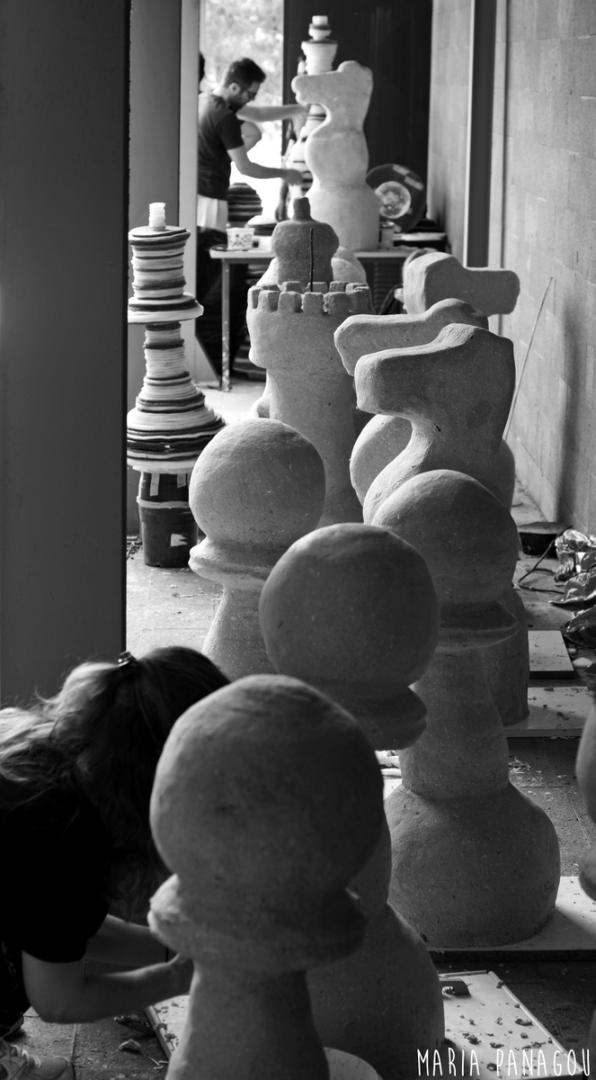
In The Chessboard of the World (June 2016), the lifejackets, lifeboats, recycled pulp, as materials transformed into a giant chessboard, representing the meaning of a static state on refugee movements. Students, staff and volunteers at University of the Aegean using refugees’ materials have created an outdoor giant installation located on campus. Also it was included the usage of discarded academic papers that act as a “fusion” between the students and the refugees and migrants.
In The Birds (2017), lifejackets, recycled pulp, as materials, transformed into 14 big birds, have been visited places in the city of Mytilene, as a slight refugee’s movement. The installation was created in the context of the "The island of Love" Fest, in cooperation with 'IDEA' NGO. Greek artists created bird sculptures and copies of them made by using recyclable materials.
In The Birds of Freedom (2018), plastic bottles recycled pulp, transformed into 652 birds which escaped from a large iron cage (Moria Campus) and flown away from the island of Lesvos. The experimental installation was a participatory work of art following the Fereniki Tsamparli’s, master thesis “Socially engaged art- circular economy and creative communities”.
Key objectives for sustainability
The Eco -Aesthetic Trilogy as installations/art-porjects, its a n Aesthetic Sustainability Initiative.All the 17 Sustainable Development Goals (SDGs) enclosed under these three installations.
POLYTROPON was the result of this initiative and has activated local communities of creative people and multicultural volunteer groups who are active at local, national and European level in the field of minimizing social inequalities, boost social solidarity and equality, qualitative creative training and lifelong learning, promote culture always respecting the cultural diversity and intercultural dialogue, environmental responsibility for a sustainable future in a fair, peaceful and prosperous world and a healthy planet.
The Charter of POLYTROPON
- Consistently and vigorously upholds the values and principles of the United Nations 2030 Agenda, with its 17 Sustainable Development Goals;
- Promotes the long-term development of culture (Creative Europe) through art, innovation & creation, artistic & cultural synergies, mobility of artists and professionals, to ensure the consolidation of European culture & identity and the creation of new jobs;
- Contributes to the implementation of the principles of the EU reflection paper "Towards a Sustainable Europe by 2030" and to the achievement of the objectives of the National Strategy for the Transition to a Circular Economy (Circular Entrepreneurship & Consumption) thanks to creative initiatives and activities;
- Acknowledges that education and lifelong learning contribute to the transition to the knowledge society, to personal development, and aims at providing students, young people & citizens with "green and culturally creative" skills and qualifications for developing flexible human resources.
Key objectives for aesthetics and quality
Addressing aesthetics is a process of Sustainable Development. The Eco Aesthetic Trilogy belongs in the sphere of ‘Aesthetic Sustainability’, which involves the factors of ‘living a naturally good life’, ‘culturally acceptable’& ‘aesthetic-communal traditions’ (Leist & Holland 2000). It is a procedure for ‘esthetical cultural recreational values’ (Steen 1999), based on local needs, cultural and environmental conditions.The trilogy's artworks reflect local aesthetic preferences, values, contributing to cultural, and community identity, which derive from diversity, place, local knowledge and cultural values, with many timeless aesthetic patterns The Eco-Aesthetic Trilogy takes an inter-disciplinary approach bridging the arts, humanities, social and nature sciences and explores the meaning of aesthetics today. It is a promoting debate, formulating alternative ways of thinking about art practice. The interconnected artworks with social and environmental spheres as channels through which the co-creators attempt to make sense of our world and our situation in it, making people conscious of how they enclosed within social issues and raising their consciousness. The ‘beautiful’ in trilogy’s artworks affecvts the individual experience, motivates ecological interest, and ecological training can deepen sensibility. This “beauty” is a quality, a combination of qualities that affords keen pleasure to other senses and charms the intellectual or moral faculties (Daniel, 2001). The Birds of Freedom is an aesthetic work that celebrates motion and change that encompasses dynamic process with static objects, demanding both continuity and revolution.The Trilogy as a collective procedure enclosed collective experience of collective intellectual content, feelings and thoughts, which has transformed into artworks, the content, structure of which contributes in developing critical thinking and realizing, and reassessing the stereotypic opinions and mental habits adopted over the&am
Key objectives for inclusion
The first 2 artworks, the 'Chessboard of the World' and the 'Birds' were global messages on Refugee and Migrant movements, stucked in the Aegean Sea.
Since 2015, the arrival of a large number of refugees/immigrants in Lesvos, the frequent arrivals, their “entrapment”, the lack of information and the fear about the unknown or alien generated a feeling of discomfort in the local community and the refugees/ immigrants of Lesvos, and so, on April 23, 2018, clashes broke out between the two groups which fought for the same thing: “freeing” and removing the refugees from Lesvos.
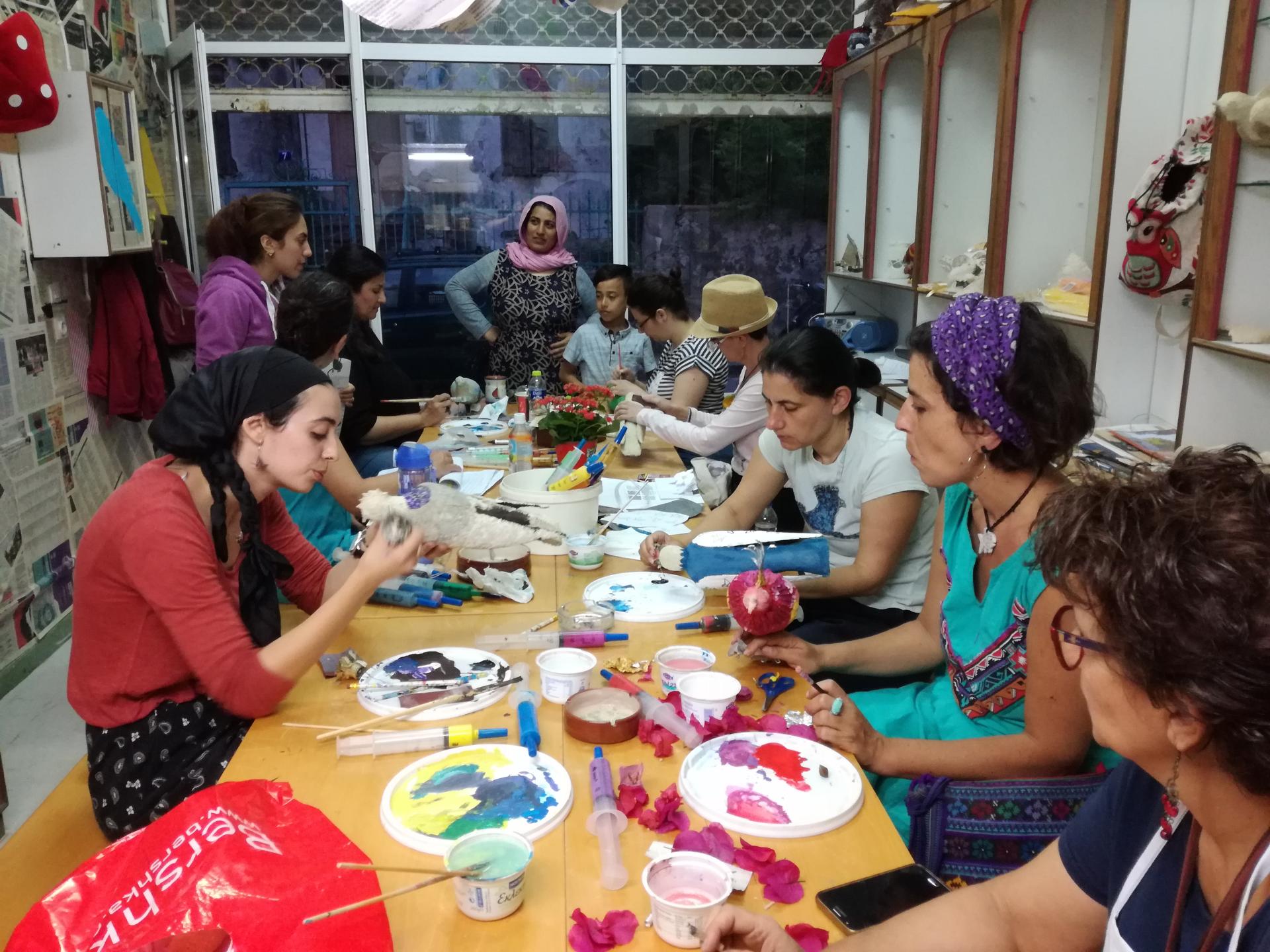
This was the occasion and the inspiration for designing and organizing an environment which could ensure the conditions for a “focused creative gathering” where the participants/co-creators could get to know each other and peacefully communicate their common claim thanks to an artistic piece of work ultimately called the Birds of Freedom. Within this context, 93 gatherings of 14 people (7 locals – 7 refugees) were organized with 652 participants (326 refugees and 326 locals) who created 652 birds (one for every 1,000 refugees that arrived in Lesvos from 2015 to November 2018), using plastic bottles of water, paper pulp and colors. Participants/co-creators could experience an unprecedented feeling: be with people of different worlds, cultures, languages, religions and try to turn an empty plastic bottle and some paper pulp of water into a sharing of joy and a feast of freedom.
After a first contact they manage to know each other and gradually to acknowledge and understand their diversity and modify their habits and practices that tied them to fear and insecurity, thus leading them into acquiring new habits and then to a peaceful coexistence with the other group.
The experimental installation was a participatory artwork following the Fereniki Tsamparli’s, master thesis “Socially engaged art- circular economy and creative communities
Results in relation to category
The Eco -Aesthetic Trilogy contributed to the social cohesion by bringing together the majority (locals) and the minority
(refugees/immigrants) groups.It helped creating strong bonds between important numbers of involved parties and generating the conditions that then allowed their peaceful coexistence and integration in the social tissue of Lesvos and also offered an experiential training in the field of creative recycling and circular economy, by training them in finding another way to exploit apparently useless materials.In these trilogy's artworks have an active participation more than 780 co-creators, as eco-artists.The establisment of the Polytropon Open Laboratory, is a result of the first two artworks.It was created under the development phase of the Birds of Freedom, where elderly women were asking to come and “make art”, their own birds.They have created birds sitting next to young men from the campus of Moria.The Polytropon as communal workshop, is contributing in promoting and applying innovative ideas as to the reuse of wastes and their artistic exploitation as raw materials or tools of action, intervention and dealing with the social and economic crisis focusing on vulnerable groups (communities receiving refugees, disabled people, drug addicts, elderly women etc). It also functioned, to a certain extent, as factor of social change, modification of people’s stances and behaviors, highlighted some of the problems these two groups face and how they do manage them. It involved bodies and people, refugees and locals in actively participating, both at personal and social level, focusing on interaction and active participation of everybody and it finally created a model or a protocol which could be used for other vulnerable social groups as well.The Birds of Freedom have participated in the European Clarinet Awards ( 3.500 votes, 5th place among 52 european participations) & in Port CERN 2017 humanitarian hackathon
How Citizens benefit
When we launched the Polytropon open laboratory, we initially had no idea that we were engaged in an important social capital building ‘project’. We were committed to promoting recycled art, the values of circular economy, to new audiences and our focus was, on how to exploit both the already existent and the newly acquired symbolic assets, how to obtain grant funding and sponsorship for our ambitious Creative Recycling Training/ Workshops. However, it quickly became clear to us that the success of this new laboratory depended entirely on the strength and commitment of its community.
During all these, year numerus of creative workshops has organized by Polytropon
For children and young students, and children with special needs and skills More than1500 children have participated in creative workshops such as:Recycling from Antiquity to Today, (recycling in ancient societies), Fairy tale doings (recycling and the art of bookbinding and illustration of a text), Tesserae-Mosaic and green (teaching the art of mosaic), The Recycling Puppet Theater (creative writing with theatrical education and recycling),I play and create a dream (Creative writing and creative recycling), Kite lines (making their own kite), Make carnival masks out of paper pulp (making their own Venetian mask)…
For elderly and people at risk or facing the risk of poverty and social exclusion More than 1000 people have participated in creative workshops such as: Creative Recycling Laboratory (creative recycling creation of various utilitarian, decorative objects, raising awareness), Autism & Creative Recycling (creative amusement and team empowerment), etc
Cooperation with theatrical teams (theatrical scenography, masks for the Birds of Aristophanes, costumes ), TEDxLesvos, museums, cultural foundations., social associations,municipalities, regional authorities, in Lesvos and other Aegean Islands, in Athens.
Innovative character
Recycled art is a creative and innovative work made from discarded materials. Discarded items or waste provide a bountiful resource for artists interested in appropriating found objects to give them a second life or share their story.
In The Chessboard of the World the large chess pieces (some up to 1.2 meters high) are made from paper discarded by students and researchers, and life jackets discarded by refugees. In The Birds of Freedom the body was made of an empty plastic bottle of water covered with paper pulp (recycled paper pulp) and used as a canvas on which participants as artists could express their inspiration and their feelings in the artwork. The installation artworks using common raw and natural materials create valuable objects with different messages directed to the viewers and the public audiences.
The participants as eco-artists and co -creators are turning recyclables into creative pieces of art and thereby contributing to the Green Movement. They are finding innovative ways to show their concern for the environment and society and thus encouraging communities to reuse, reduce and recycle, and to raise awareness on social issues for a better future, trying always to find innovative ways to inspire positive change.
In Polytropon as eco-artists and co -creators we use our skills to educate and influence the public to take steps towards positive change. We collect recyclable materials through public donations, collaboration with businesses or direct collection from solid waste stream. This innovative approach not only creates environmental awareness but also help in finding a good use for unwanted materials.