1000WB: Energy Efficient Housing
Basic information
Project Title
Full project title
Category
Project Description
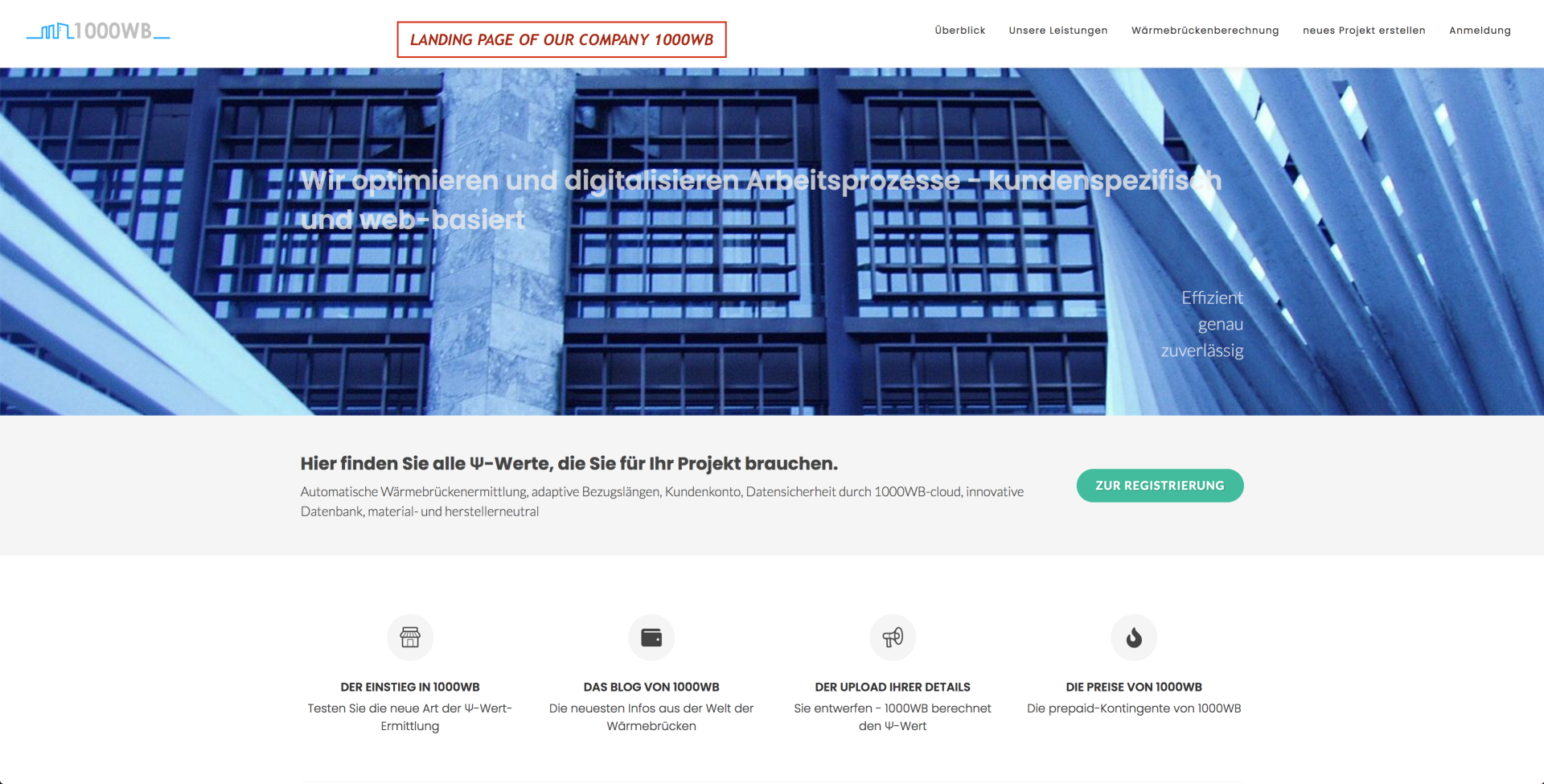
The demand for energy efficient and sustainable housing is continuously rising. The airtight construction model synonymous with the NZEB or Passive Houses offers a thermal bridge free design. 1000WB offers a centralised digital catalogue of architectural details applicable for all climates and construction types usable anywhere in the world. Our WebApp has digitalised the calculation of exact PSI values that has the potential to generate a disruptive change for heat demand calculation practices.
Project Region
EU Programme or fund
Which funds
Other Funds
In 2018, the German State of Thuringia awarded us with the European Social Fund that was aimed increasing the stability of commercial and freelance business start-ups within the region to promote sustainable and high-quality employment (Operational Program European Social Fund 2014 to 2020 in the Free State of Thuringia (Start-up Guideline) of July 10, 2017 (ThürStAnz No. 28/2017, pp. 930 - 935)).
Description of the project
Summary
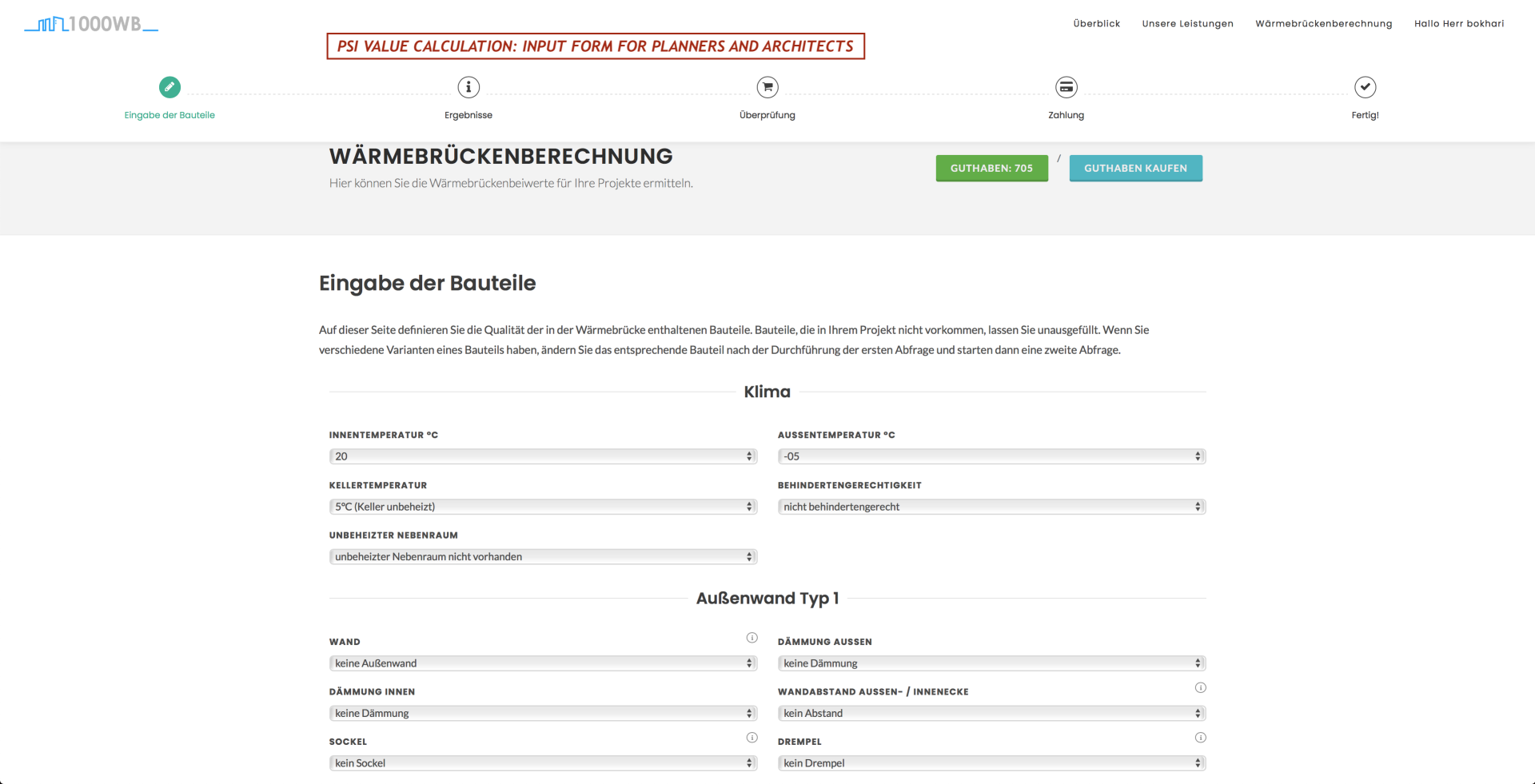
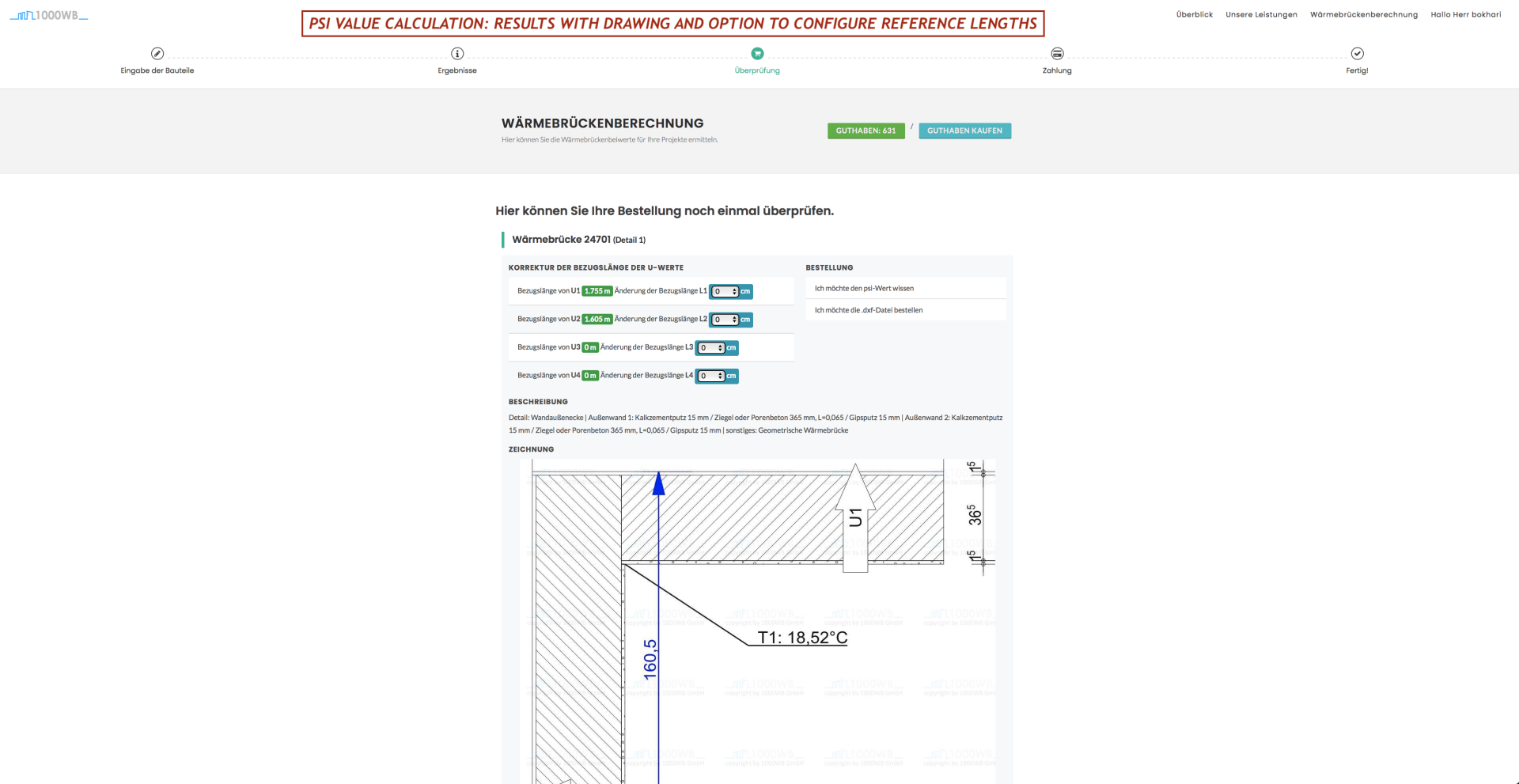
The demand for energy efficient and sustainable housing is continuously rising. The airtight construction model synonymous with the NZEB or passive houses offers a thermal bridge free design. The insulation quality of the components of the building envelope strongly impact its thermal bridges. Any heat loss through a thermal bridge (i.e. a PSI value), thus results in the increase in energy demand. Given the energy savings associated with NZEB houses, the statutory requisites in EU are increasing and favouring an efficacious construction. Nevertheless, calculation of the PSI values for an energy demand calculation is costly and time consuming and there seems to be a dearth of online solution for PSI value calculations. 1000WB offers architects, energy consultants and building physicists a swift and cost-effective B2B solution via webApp with energy-optimised architectural details needed for energy demand calculations. Among several ways to calculate PSI values in the energy demand calculation, the most accurate method is to calculate exact PSI values of each architectural detail. Generally a thermal bridge calculation for a building costs ca. 1400 - 3000 €. The entire process can often take several days. The 1000WB WebApp has digitalised the calculation of exact PSI values and it has the potential to generate a disruptive change for heat demand calculation practices. Our highly intuitive App guides in 3 steps of choosing the building elements that lead to appropriate architectural details that are automatically determined. User is provided with PSI values and their respective drawing and description along with a complete documentation of every PSI value. Each thermal bridge costs 2-4 € that reduces the total costs to 40-120 € per building whereas the time required is also reduced to 15 minutes. In a nutshell, our project offers a centralised digital catalogue of architectural details applicable for all climates and construction types usable anywhere in the world.
Key objectives for sustainability
The underlying concept of the product developed by the 1000WB is based on sustainable housing that is energy efficient and promotes carbon neutral neighbourhoods. The European Green Deal puts the EU in a highly challenging and ambitious position in becoming the first climate-neutral continent by 2050. These ambitions are well supported by the European Commission’s statutes to meet the 2030 greenhouse gas emission target, including the Energy Efficiency Directive. Therefore, energy efficiency is at the centre of the regional development policies and territorial cohesion of the EU. For typical central European buildings, the use of NZEB or passive house concept means an energy savings of up to 90%. Energy efficient house construction greatly reduces heating and cooling costs in buildings. Every cent saved on energy would not only result in reduced emissions but also on ungrudging use of energy reservoirs. The NZEB or passive house concept is thus a sustainable alternative to a conventional construction. The solution offered by 1000WB for improving the energy properties of the building envelope works directly on CO2 savings in the building sector. As the global community deals with the challenge of drastic reduction in CO2 emissions by 2050, it is the building sector that requires up to 40% of world’s total energy consumption. Our product provides a unique opportunity for new constructions as well as renovation projects to rely on low energy requirements of the building. The architectural details developed and optimized by 1000WB offer planners a possibility to optimize the energy quality of their individual projects efficiently and in real time. 1000WB simplifies planning and reduces costs both in new constructions and in the renovation of existing buildings. 1000WB is humbled to extend its strong and a necessary contribution to the UN SDG 11 (Sustainable Cities and Communities) as well as Paris Agreement.
Key objectives for aesthetics and quality
The purpose of our project is to provide digital solution in calculating exact PSI values based on the building components and their respective attributes. Our project for that matter is an intangible product nevertheless its outcome leads to some outstanding energy efficient structures. In terms of aesthetics, the outcome of our product is the very structural longevity that it brings to the buildings. For places such as museums, antique outlets or homes housed with vulnerable ornaments or decorative artefacts significantly benefit from the outcome of our product as it is the airtight building envelop and thermal bridge free design that reduces the risk of moisture damage or susceptibility to mould for an elaborate embellishment. Our project advocates for the provision of accurate airtight building envelop which directly influences the ventilation system responsible for high quality indoor air and automatic extraction of moisture. One of the most unique characteristics of our WebApp is that it walks the planners through very intuitively managed graphical user interface to provide a magnifying view of airtight envelops in the building as well as to help decide their location through a high-resolution visual aid. The planners and architects can choose from a wide variety of building components and our smart algorithm does the rest in providing a minute view about every architectural detail possible, based on the combinations planners provide to our system. Therefore, architectural details positively influence the aesthetics of the energy efficient buildings and this inspires in making the buildings and architectures appear attractive.
Key objectives for inclusion
Having limited or no-barrier has always remained a daunting task in the planning and construction process. Unfortunately, not all structures have been considerate or of inclusive nature towards our demography as a whole. NZEB or passive houses are of course no exception. As the coincidence would have it, the founders of 1000WB GmbH have remained colleagues with people with reduced mobility. Their day-to-day experiences and discriminate geographical access have constantly motivated us to keep and promote barrier-free architecture at the heart of 1000WB. Our product is proud to host and constantly work on producing architectural details specially focusing on barrier-free access. Our WebApp offers an exclusive search specifically aimed at barrier-free architectural details. What makes our product even more unique that it enables planners who are not specialized in barrier-free accessible construction to think about and plan for inclusive approaches towards people with remote and reduced mobility.
Results in relation to category
Thermal bridge coefficients are becoming increasingly important for the calculation of energy demand in a building as the European Union member states are progressively adapting to the legal requirements for the energy efficiency of buildings. For an effective energy efficient or NZEB construction, the building industry is rapidly moving towards the exact PSI values for each thermal bridge instead of a standard or lump sum value. Therefore, the number of energy demand calculations that use accurate PSI values for each thermal bridge will increase in the future. It is an untapped market that still relies on conventional methods of PSI value calculation. Considering the statutory obligations and realisation of climate goals, this market has the potential to grow exponentially along with the demand for accurate PSI values. At 1000WB our repository of PSI values and their respective high resolution architectural drawings and documentation are fastly approaching a 0.1 million mark. 1000WB aims to establish itself as a market leader in digitalisation of architectural details and thermal bridges. To put actual data in a numerical perspective, in 2017 for instance, ten European member states (D, CH, A, NL, N, F, GB, I, SE, PL) issued a total of 1,373,000 building permits. Assuming that only 75% of the building permits required an energy demand calculation would result in 1,030,000 calculations. To elaborate this scenario, if there are 2 million calculations a year and only 50% opt for exact PSI value then it would be 1 million calculations with exact PSI values. If each calculation needs around 20 PSI values and the cost of one PSI value is between 3-10 Euro then the market volume would lead to 60 to 200 million euro a year. In this scenario if 1000WB earns only 10% of market share then this results in annual sales of 6 – 20 million.
How Citizens benefit
NZEB or passive houses is all about knowing the right construction material and planning in advance and at greater depth as to how each and every PSI value is calculated. A detailed planning while on one hand leads to a resource efficient housing with lower utility costs but more importantly it also leads to a better lived experience with greater tenant outcomes (say in case of apartment complexes). Greening an existing building or ensuring energy efficient housing standards creates a healthier indoor environment for residents with few asthma and allergy reactions to say moulds or chemicals. As the passive houses are airtight by default, it is the mechanical ventilation that is critical to maintaining an indoor environment or air quality. Moisture, temperature and organic matters such as mould are primary precursors of indoor air quality. 1000WB's product assists planners with customisable and minute level details of every individual PSI value to ensure high energy standards that provide greater human comfort while lowering operating costs. Our product offers configurable outside and inside temperature values that helps planners in calculating the precise heat demand (see more on configuration of our product in Innovative Character section). The airtightness of a building is dependent on the precise planning of the airtight building envelop. This in turn positively influences the efficacy of ventilation that is generally achieved through a balanced system of extracting and supplying fresh air, which thus safeguard livelihoods in the long term.
Innovative character
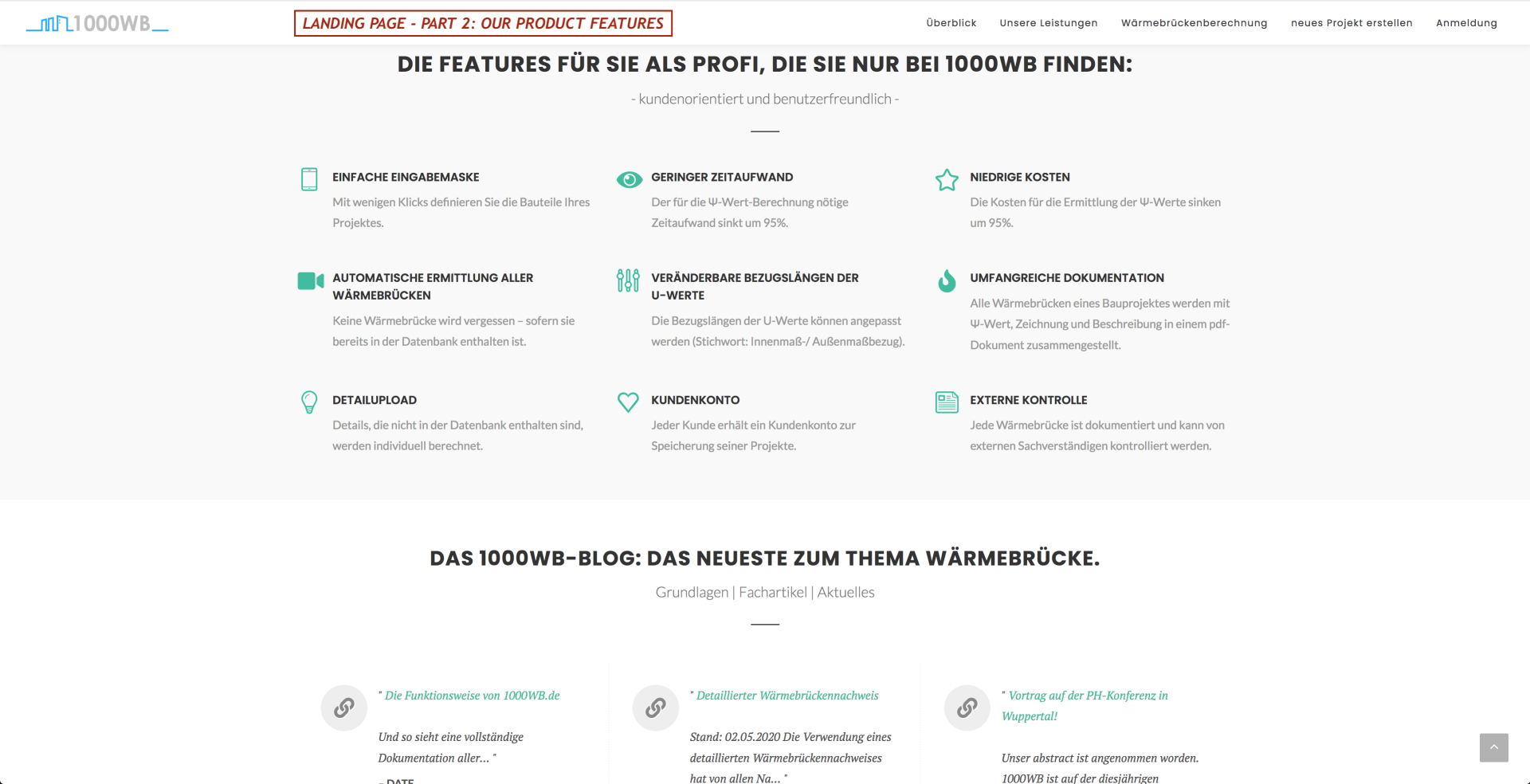
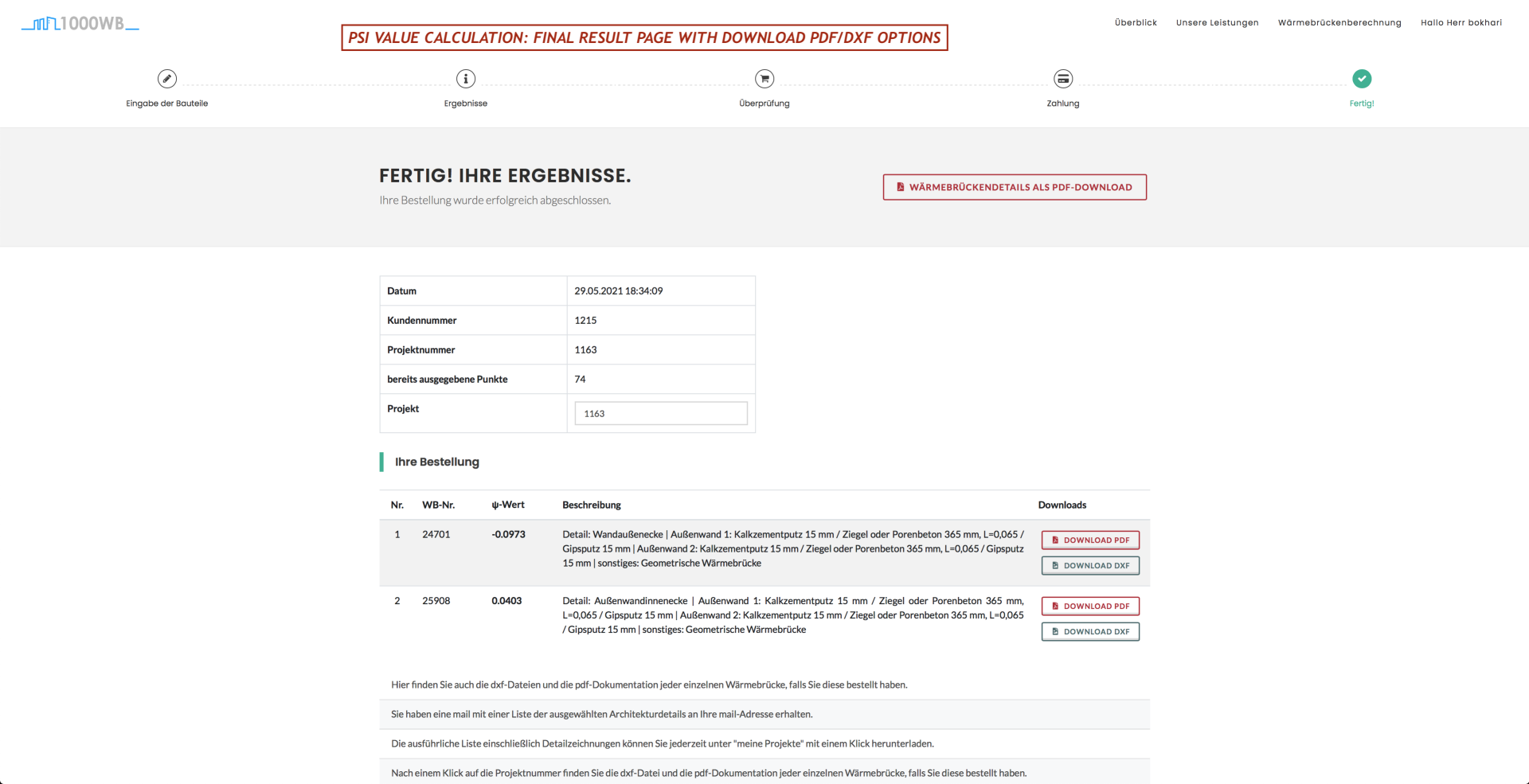
1000WB espouses to offer a world’s largest online PSI values database along with high resolution architectural drawings and in-depth documentation that will soon cross 0.1 million mark. The documentation carries extensive details on materials, component geometry, U-values and calculation path of each thermal bridge. The customer-centred algorithms are designed by keeping the requirements of construction physicists and architects. Our product offers maximum possible construction elements to choose from that range from inner/outer walls to pitched roof and from basement ceiling to base plates. In addition, the planners are offered a wide variety of over 150 building attributes. Planners have a choice to provide a variable temperature based on their climatic and constructional conditions. Even sophisticated softwares for PSI value calculations do not provide this level of climatic variations. What makes 1000WB product even more unique and highly innovative is its management of search results. Our product does not coerce planners into buying all PSI values, PDF documentation and DXF drawings generated as a part of user’s query. Through a highly intuitive graphical interface, users have an option to select or drop PSI values and/or buy corresponding DXFs and PDFs. What differentiates our product from other solutions is its customer-centrality at every step of the way. Our WebApp offers customisable reference lengths of the U-values that can be configured within the search results. Such level of customisation and configuration has not been achieved by any PSI value calculation platforms. The PSI value calculation eco system introduced by 1000WB is scalable and flexible that continues to produce additional details and components every day. 1000WB is material and manufacturer neutral and there is no restriction to certain building materials or companies. With its highly innovative design, our product has introduced a moment of digital disruption in the building industry.