Open Education for a Better World
Basic information
Project Title
Full project title
Category
Project Description
An international online mentoring programme Open Education for a Better World (OE4BW) has been developed to unlock the potential of open education in achieving the UN Sustainable Development Goals. The programme provides an innovative approach to building Open Educational Resources, connecting developers of educational materials with experts volunteering as mentors. Results have proved the model to be useful for building capacities in open education, while producing concrete educational material
Project Region
EU Programme or fund
Description of the project
Summary
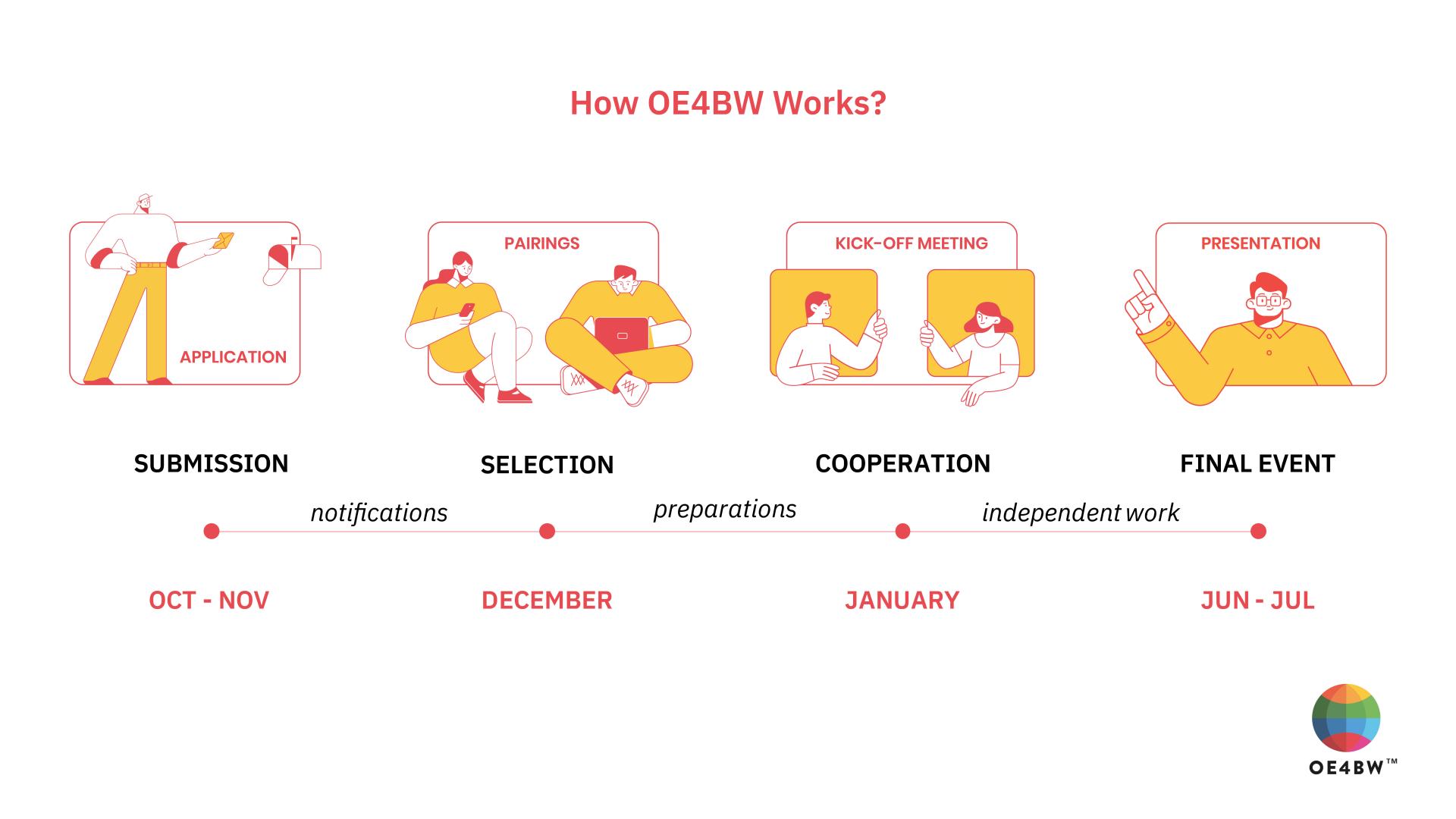
Open Education for a Better World (OE4BW) is an international mentoring program supporting the development and implementation of freely accessible modules and resources for online education on topics with social impact according to the UN Sustainable Development Goals (SDGs). It provides an innovative approach to building Open Educational Resources, connecting developers of educational materials with internationally recognized experts volunteering. The model of the programme has been carefully designed and tested in two subsequent implementations in years 2018, 2019, 2020 and has been in process in 2021. Proposals for the projects of OER development are collected with a global call. Accepted proposals are selected based on (1) their compatibility with SDGs, (2) social impact, (3) maturity of the idea, (4) capacity and commitment of the applicant to make the idea come true. In the continuation, selected applicants are supported on-line for six months by experts in OER design volunteering as mentors. Mentors are invited with a follow-up global call. During the project development, the progress is being regularly followed and advice is given if needed. Developers and mentors communicate online on a weekly (or bi-weekly) basis. There are also two interim checkpoints planned to provide information about the progress to the organizers of the program. At the end of the program, the participants are obliged to prepare a presentation for the final event. They are invited and supported to come to the closing event to attend a workshop on OER design, exchange ideas, meet other OER developers and establish potential future cooperation. Results have proved the model to be useful for building capacities in open education, while producing concrete educational materials with great potential for social impact.
Key objectives for sustainability
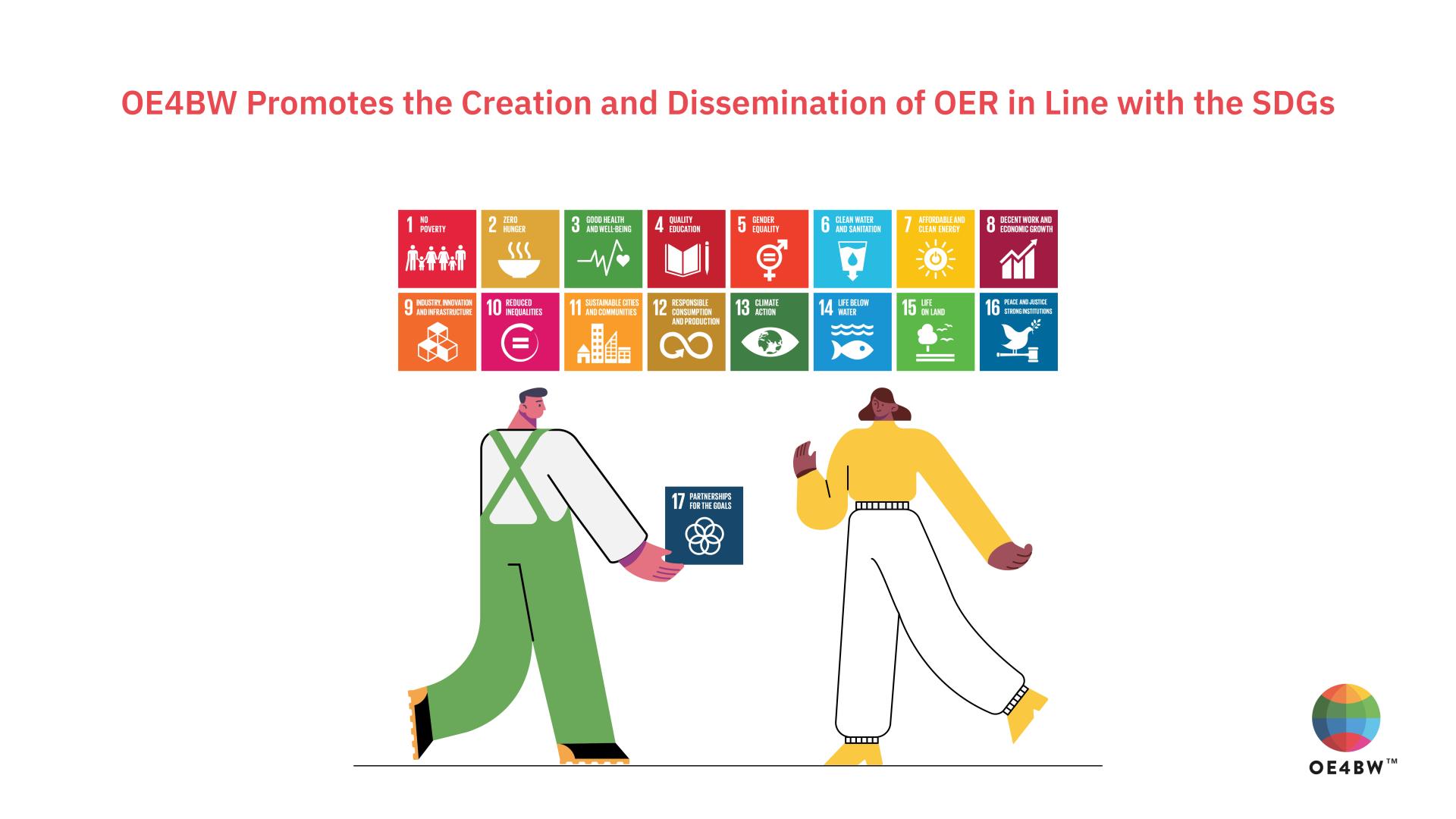
The OE4BW mentoring Programme is at the forefront of combining OER and SDGs and helping create a more personal approach towards building OER that can inform, educate and present value in new ways. The OERs have to address at least one of the 17 Sustainable Development Goals (SDGs), from ending poverty to a range of social needs including education, health, equality, and job opportunities, while tackling climate change and preserving our environment.
The UN SDGs point to substantial challenges in education, public health, energy and food sustainability, social justice, and climate change. Only an educated global citizenry can solve any of these. The OE movement with its advocacy for open, free, accessible, equitable education can play an important part. Building next-generation leadership and related networks aligned with UN SDGs is more urgent than ever.
It is a half-year-long program that is organized in a sustainable way as it takes place fully online for students from all backgrounds, regions, and continents with the potential and desire to employ Open Educational Resources to solve large scale and relevant problems important in relation to today’s global landscape. Many OERs developed in scope of OE4BW address also Sustainable Development education itself, namely Inquiry and Concept-Based Pedagogy in
Education for Sustainable Development (ESD) - https://oe4bw.org/project/education-for-sustainable-development/, Advancing Sustainable Energy - https://oe4bw.org/project/sustainable-energy/, Landscape Conservation, and Management: Towards a Sustainable View of the Territory (https://oe4bw.org/project/towards-a-sustainable-view-of-the-territory/), and many more.
OE4BW has developed a sustainable framework, its affordable online model and operation principles are encouraging new opportunities for people to form ties with others and create together; encouraging diversity of goals, backgrounds, and cultures.
Key objectives for aesthetics and quality
The OERs developed in the scope of OE4BW are required to use different types of visuals, while they have to follow the principles of aesthetics - e.g. publishing, photography, multimedia design, video, animations, audio, platforms. The reader is kindly invited to find more inspirational and instructive examples on the website http://oe4bw.ijs.si/projects/#2019 where all the projects are described.
Moreover, the program’s website is designed considering aesthetics as one of the core parts of the program. The website has been designed and maintained by a graphic designer, who is part of the OE4BW organizing team and has much experience in OER creation as well as OE policy. Every OER project is aesthetically presented including a cover photo that is carefully selected to fully represent the OER project.
The OE4BW platform, created by MiTeam had become available to the global OE4BW community, giving participants an integrated approach by accessing content, interacting through calls, conversations (chats), and webinars, and a structured library of open educational resources. OE4BW participants have access to the content, but they can also co-create and store text, audio, or video content in those virtual rooms to which they have access. At the end of the program, the participants are obliged to prepare a video presentation taking into account principles of aesthetics and upload it to the Exhibition section at the OE4BW platform. The OE4BW website is available here https://oe4bw.org/ and the OE4BW community platform here https://oe4bw.miteam.si/asset/evESDmFAsZLmAkfDA.
Key objectives for inclusion
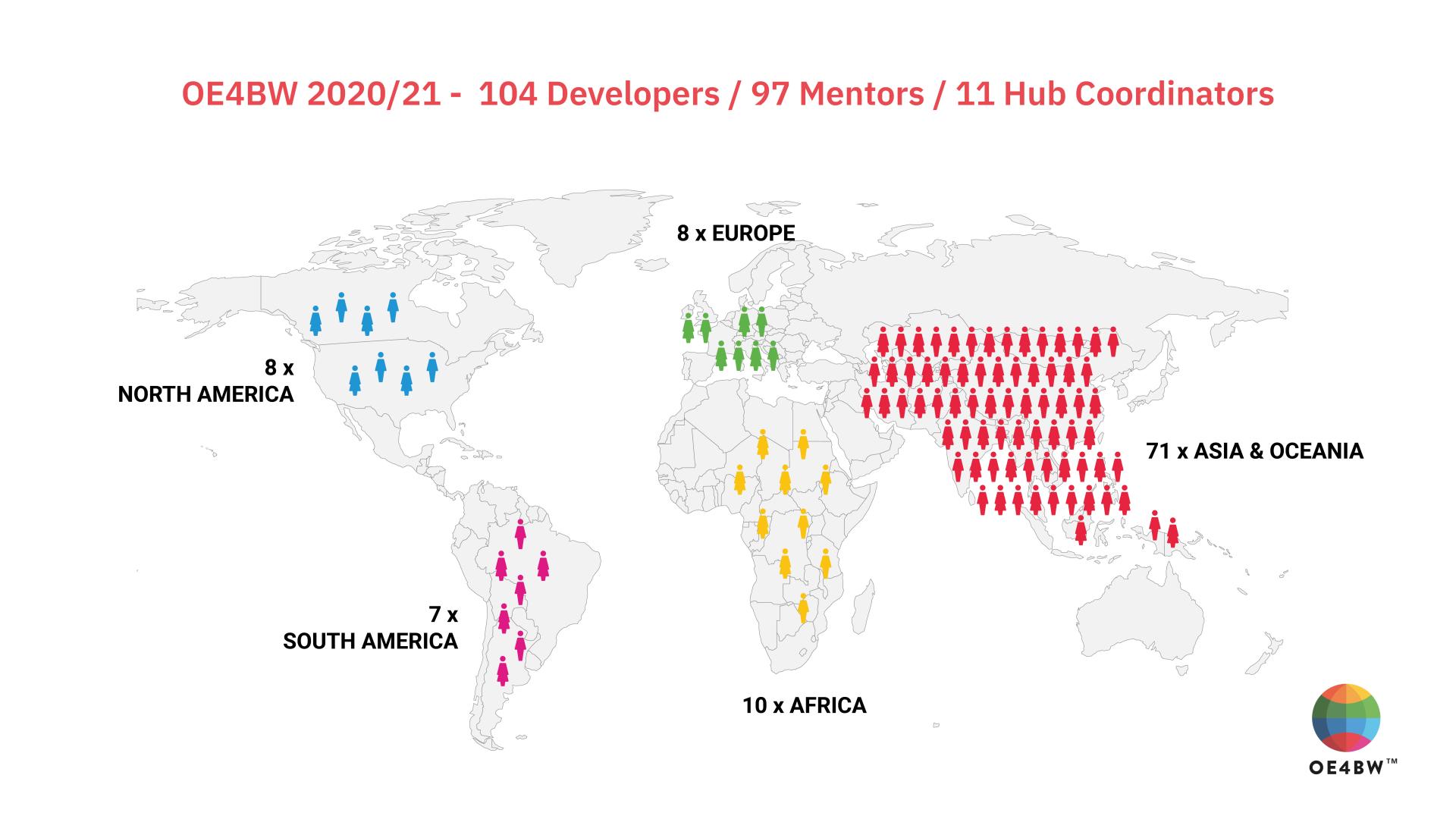
OE4BW has mechanisms for enhancing inclusivity and diversity. OE4BW serves as an entry point to OE communities, thereby permitting projects that serve specific underserved communities to occur. Whenever possible, materials created in the scope of OE4BW shall be open and accessible to a variety of learners. Learning needs are affected by sensory, motor, cognitive, emotional, and social constraints, learning styles, linguistic and cultural backgrounds, and technical, financial, and environmental constraints. We encourage all works to meet minimal accessibility design requirements. The program is open to all applicants regardless of their professional background, education, origin or any other limiting factor. The scope and the final form of the developed OER are not prescribed, nor is the platform to be used. This is to encourage participants to find the best solution for their target audience and their specific situation. The only request is for the developed educational material to be publicly accessible and to be specified as such by using an appropriate open license. There is no participation fee. During the 3 years of the program 250 participants (developers, mentors), among them, two-thirds were women, from 40 states from 6 continents took part in the program resulting in 131 Open Educational Resources addressing Sustainable Development Goals, available to everyone around the globe. Interactive community platform contributes to encouraging new opportunities for people from all over the world to form ties with others and create together and promoting equitable access to reusable and shareable materials encouraging diversity of goals, backgrounds, and cultures. Through the OE4BW Advisory Board, we bring together yet another layer to ensure optimal collaboration with the OE movement globally. Two-thirds of the advisors are from the global South, with strong representation in the component regions: Asia, Africa, MENA.
Results in relation to category
In the OE4BW mentoring program professionals of different backgrounds are guided by volunteering mentors as they upgrade their skills needed to design, implement and deploy OER by actually implementing their OER in a very personalized process of learning-by-doing. Through the three implementations, in 2018, 2019 and 2020 respectively, the model of the program has evolved and the progress in terms of increased technical knowledge of participants was evident. Results have proved the model to be useful for building capacities in open education while producing concrete educational materials with great potential for social impact.
In the scope of 3 years, in most of the projects, the initial idea presented in the application evolved into concrete educational materials with social impact available to everyone. The reader is kindly invited to find more inspirational and instructive examples on the website http://oe4bw.ijs.si/projects/#2019 where all the projects are described.
How Citizens benefit
The program is open to all candidates with a concrete idea, clear motivation, and strong commitment to develop and deliver an open online course or other large-scale open resource (e.g., an open textbook) aligned with the SDGs. There are no limitations regarding the education or professional background of candidates.Due to OER’s nature, everyone can also be involved as a user of OER as a learner, which has to be publicly accessible and to be specified as such by using an appropriate open license enabling to retain, reuse, revise, remix and redistribute content for educational purposes. Everyone can be actively involved in OE4BW as a developer of OER or a mentor as the program is free of charge, open to all applicants regardless of their professional background, education, origin, or any other limiting factor.
In the three years, 131 Open educational resources were developed and many of them were even tested by up to a hundred online learners already during the time planned for the implementation. The developed materials were very relevant and in compliance with SDGs, covering titles like Booklets for midwifery developers in Low and Medium Resources Countries and Catalyzing Change: Diversity, Equity, and Inclusion in a Global Perspective, to mention just a few. Again, most of the developed projects finished with perfect examples of relevant OER prepared to empower a broad audience for the implementation of SDGs, such as Playwriting for Children: A Participative and Creative Approach, Supporting Refugees and Immigrant Students in Higher Education, and Climate change Education, Creating Inclusive Society for Peace and Justice (CISPJ), Alquimétricos: Open Source Building Blocks for an Affordable STEAM Education, Role of Human Rights Education in Social Justice, MỌ̀ Ọ́ KỌ MỌ̀ Ọ́ KÀ: A Literacy Course for Non-English Speakers of Yorùbá Origin and many more.
Innovative character
The authors from the University of Nova Gorica and a UNESCO Chair on Open Technologies for Open Educational Resources and Open Learning have developed an innovative model of an online mentoring program, based on a hypothesis that there is a big not yet explored potential in connecting concrete ideas and needs at one side with know-how about OER development and deployment at the other.
Since there is a lack of formal educational programs dealing holistically and interdisciplinary with open education available at the moment, the goal of OE4BW was to show that the need and motivation for progress in this field have enough potential to start a bottom-up movement, which – carefully guided so as to be in accordance with the top-down visions - can result in a critical mass of people and projects connecting open education and SDGs, justifying future investments into this area. Since there have been no funds allocated to the presented program so far, we decided to bring together developers of OER in various topics related to SDGs and experts in OER, willing to volunteer as mentors, highly motivated by the importance of SDGs being approached by as many people as possible through the design, use and reuse of OER.
The mentoring program addresses the problem of building capacity to use, reuse and deploy OER and presents the OE4BW model of online mentoring as one of the ways for improvement in this area. In this program, professionals of different backgrounds are guided by volunteering mentors as they upgrade their skills needed to design, implement and deploy OER by actually implementing their OER in a very personalized process of learning-by-doing. Through the four implementations, in 2018, 2019, and 2020 respectively, the model of the program has evolved and the progress in terms of increased technical knowledge of participants was evident.