Sneature
Basic information
Project Title
Full project title
Category
Project Description
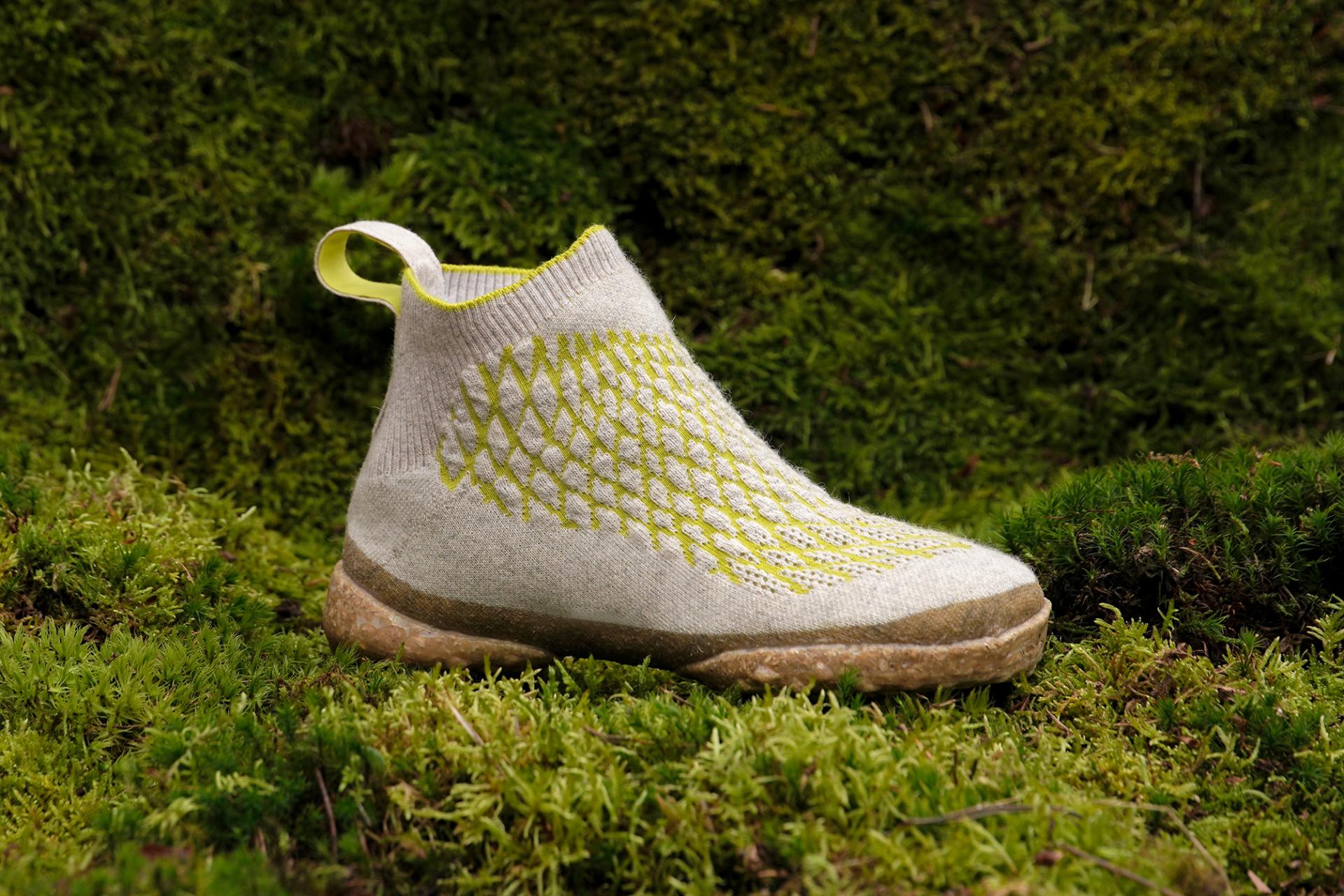
Sneature is the design of a waste-based sneaker embedded in a resilient production concept.
Upcycled waste- and raw materials are integrated in a biological material cycle that enables both individualization and on-demand production with the lowest possible energy consumption.
After use, Sneature is biodegradable and can be returned as nutrients to the natural material cycle.
Project Region
EU Programme or fund
Description of the project
Summary
At present we live in a time when the resources of our planet are being transformed into products at a speed far exceeding the natural rate of self-renewal of the biosphere. Consequences of excessive production and consumption can be seen in the impact on our global climate.
The development of ecologically responsible and resilient material concepts is essential for the design of material products. The „European Green Deal“ lists the development of circular product concepts as a central point for sustainable production and conscious consumption.
Sneakers are also among the clothing products that are often discarded after a short lifespan. The complicated construction and the use of different materials makes it almost impossible and unprofitable to disassemble and recycle a pair of trainers after use.
Therefore, materials, design tools, but also manufacturing processes where examined and implemented in the design of a sustainable sneaker. The result of the product concept is „Sneature“, which is a portmanteau of the terms „Sneaker“ and „Nature“. Biological raw and waste materials are integrated in a holistic design and production process that meet functional requirements for a shoe, the possibility of individual customization (through parametric design) and engaging the user in the design process within the developed framework. The digital manufacturing processes such as 3D knitting or 3D printing enable an integration into local production processes („Microfactories“) with the lowest possible energy consumption. This also allows a scalable production on demand. After its use, Sneature can be easily disassembled, repaired or industrially decomposed andand returned as nutrients to the natural material cycle.
Sneature represents a comprehensive design and production concept that aims to promote sustainable consumption and production of trainers in Europe as a locally implementable, resilient product concept.
Key objectives for sustainability
Against the backdrop of climate change, the question arises how renewable resources can be part of a circular material cycle for shoes. That takes in all the factors of this process starting from design to utilisation by the user and the recirculation of the resources back into a biological material flow.
That is why we have developed with Sneature a concept where biological raw and waste materials can be integrated in the realisation of a sustainable sneaker. The simple construction of Sneature (upper material, transition area, membrane) was realised by testing different materials for the application in the shoe. The selection of the materials was based on the necessity of being able to implement them in locally applicable additive manufacturing processes as well as functional and ecological properties. The materials used in Sneature are biological raw and waste materials, such as dog hair, which is upcycled into industrially processable yarn (crowdsourced and supplied by company Modus Intarsia), a transitional area made of natural rubber and mushroom mycelium, which is turned into a stable composite material with the help of plant waste materials used in the sole. For each of the three raw materials used, a processing method was developed that incorporates a low energy input in the production and a biodegradation of the sneaker after its use.
For us, creating a sustainable product means taking into account all ecological factors involved in its realisation. On the one hand, this means the innovative use of upcycled waste materials, but on the other hand, it also means being able to implement the manufacturing process in a way that minimises the use of resources. With an on-demand production in Europe, the emissions caused by the production and logistics are kept as low as possible.
Key objectives for aesthetics and quality
Sneature is built as an alogorithm-based framework that covers not only the functional properties of a sneaker, for example by transferring the anatomical requirements of the user. It also acts as a tool that allows us to manufacture a product in such a way that it can be customised. For example, the 3D-knitted upper material is based on a diamondgrid that encompasses the shape of the foot and is divided into different zones that enable different functions such as air permeability, elasticity or strength in defined areas. On this functional basis, individual adjustments can now be made by the user within certain framework conditions. Since the previous pattern design of Sneature is based on the Fibonacci series, the theme of natural structures is also intended to convey the sustainable concept on the formal aesthetic level in further variants within which the user can select and modify.
In modern times, the consumption of goods is not primarily a matter of the functionality of the product, but they are rather valuated according to subjective, individual characteristics. In the case of our product, for example, this includes the ethical, but also the narrative value of Sneature. The ethical value is integrated into the concept through the material composition and the circular use of resources. Involving the user in the production process integrates a narrative value that is created through the experience arising in the design process.
This is why a central point in Sneature is customisation. Within predetermined parameters, Sneature is customised by the user via a website and produced on demand. The purpose of making an individually designed product available is thus to create a stronger bond between the object and the user, which should lead to the product being repaired and used over a long period of time. In this way, the aesthetic framework can be oriented on natural, mathematically constructed patterns, but can be individually adjusted by the user.
Key objectives for inclusion
Our design is based on the idea of encouraging diversity. By this we mean that the very different requirements and needs can be adapted by the user within flexibly designed frameworks. This implies that there is a choice of basic shapes, colours and patterns that can be adapted to the user. This includes, for example, that individual, anatomical requirements can be taken into account. Also in terms of personal preferences, the user can choose between given patterns and implement them with preferred colours. User interfaces are designed in this context so that they are easy to use. In this way, our product will be equally usable by everyone.
For the mid-term future, we will explore whether there are possibilities, for example, to produce the shoes in cooperation with workshops for the disabled. This would be an exciting opportunity for us to actively integrate people into the production process and thus enable them to participate in working life.
Innovative character
Unlike conventional shoes, which are complicated in their construction and difficult or impossible to recycle, our product is biodegradable. It is reduced to minimal components and consists only of a membrane, a transition area and a sole. The materials used in Sneature are biological raw and waste materials such as plant waste or dog hair. For each of the three areas, a material cycle was developed that allows the biological raw materials to be processed with low energy input. Additive manufacturing processes such as 3D printing or 3D knitting thus make it possible to produce even small quantities of shoes decentrally and on demand.
Since the sneaker is designed parametrically, it will be possible to customise it individually for the user via a website. For this purpose, various parameters regarding the fit as well as pattern and colour choices are to be adjusted, which can be made via an easy-to-use interface. In this way, customisations made by the user can be automatically transmitted to the additive fabrication (3D-Printing, 3D-Knitting). In this way, we create not only a functional but also a personal product that can be used for a long time and, if necessary, repaired in between. In order to ensure an easy disassembly of the components, a plug-in connection between the sole and the upper material has been engineered.
With our product Sneature, our aim is to address the Sustainable Development Goals „Sustainable Consumption and Production“ and provide a sustainable alternative for footwear. We want to show the feasibility of manufacturing products that are made of renewable raw materials, that can be produced locally and that are part of a biological material cycle. According to the principle „from nature - back to nature“, the responsible use of the resources available to us will not only be thematised but also put into practice. That‘s why sneatures can either be taken apart after use and worn out parts replaced, or the shoe can be composted industrially.