Emergency housing in empty building
Basic information
Project Title
Full project title
Category
Project Description
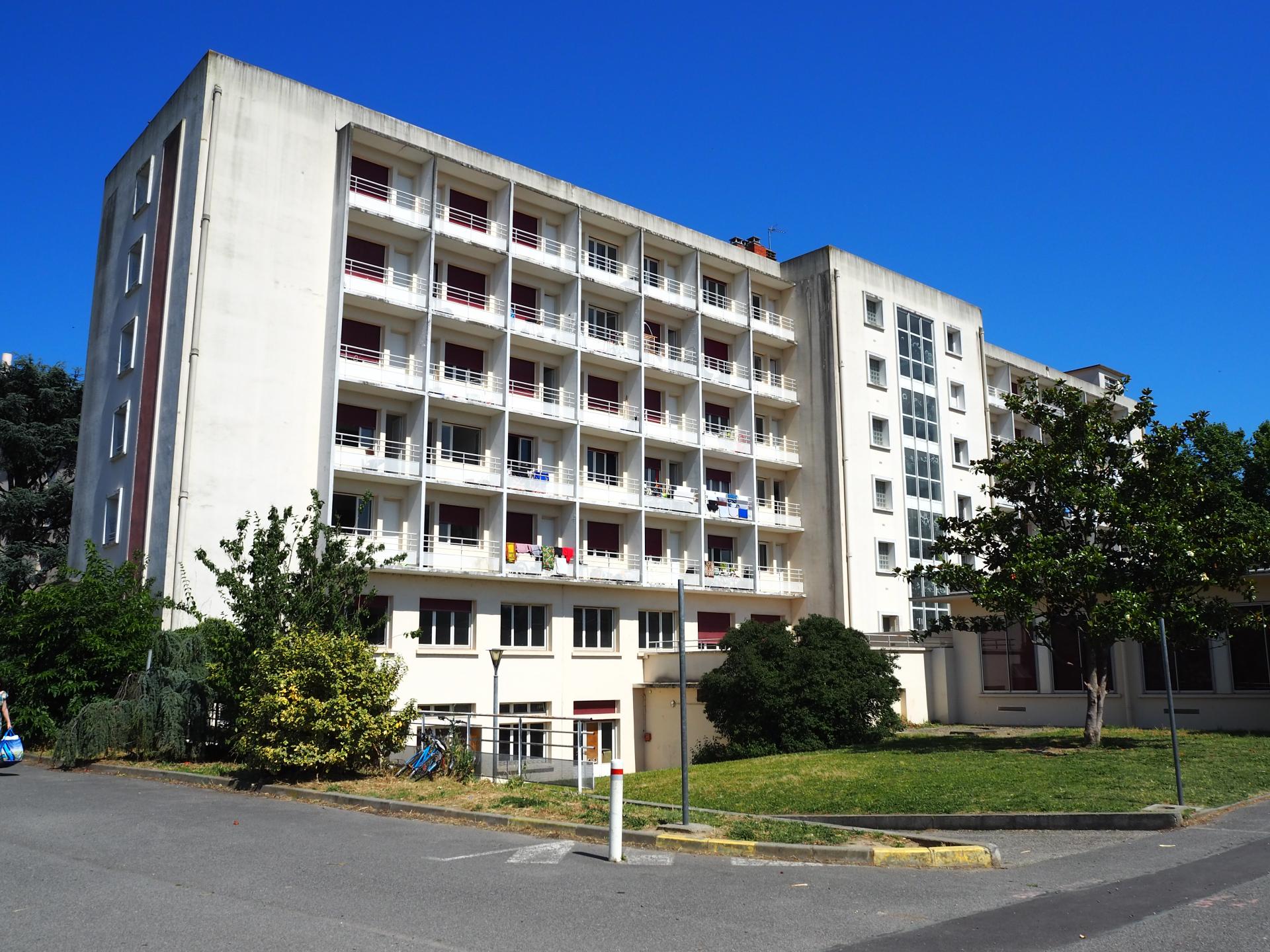
Our modern society is facing a deep housing crisis while our current development model generates a large stock of vacant buildings. In France, more than 3 million homes and 5 million square meters of offices are empty. Our ambition is to create new housing models and to help owners and authorities to mobilize these abandoned spaces to offer temporary accommodation. In this project we created 220 temporary emergency accommodations in a former student residence that had been abandoned for 4 years.
Project Region
EU Programme or fund
Description of the project
Summary
The concentration of jobs and resources in cities is amplifying the housing crisis. The demand for dwellings is still growing in cities, while land is becoming scarce and its cost is constantly increasing, making difficult to build new affordable housing. People’s mobility is changing our lifestyles and requesting new forms of housing, more flexible, adaptable and affordable. The need for emergency accommodation due to migration and increasing poverty is also an issue.
Our current development model is literally wasting all our resources, available land and excluding more and more vulnerable people. The current real estate development, where buildings are just real estate products, generates a significant structural real estate vacancy. Indeed, in 2018 in France, the INSE counts more than 3 million vacant dwellings and the service sector in France count 5 million square meters of available space (source: ORIE). Many of these buildings remain empty for months or even years before finding new occupants or being demolished or renovated.
The answer to today’s housing problem cannot be found in another revolutionary technical solution to build faster and cheaper. We need to support governments in making the best re-use of existing empty spaces. By optimizing and adapting them, we can create low-cost temporary housings, close to public transport, shops and facilities.
This project in Toulouse, France, is a good example of what we can do. Facilitate the transition by providing architectural and legal support. The re-use of this public building-a former college dormitory-that has been empty since 2015. After only one month of renovations, we transformed the space into emergency housing for 220 people with 95 children in total. This emergency housing was initially scheduled to close after 4 months only but the project has been a real success with the people inside and the neighborhood. The government decided to extend for another 24 months the experiment.
Key objectives for sustainability
The most ecological building is the one that is not built. Our first eco-objective is to avoid wasting the land available in the city while thousands of square meters of buildings are still available. This means offering housing by adapting and renovating existing buildings to limit their vacancy as much as possible. We support owners and municipalities to reuse these empty buildings in the best way, firstly in a light and economical way, and secondly by working on a long-term rehabilitation project for these buildings.
We are using reused materials as much as possible. In this way, we have drastically reduced costs by reusing second-hand equipment, repairing the building and employing social workers. For a budget of €170,000, we reopened this abandoned building and created 220 temporary accommodation places, compared to a budget of several hundred thousand euros for a modular solution or the costs of guarding the building. This cost saving in the accommodation solution has made it possible to finance social support for the people housed, which has improved their integration. Residents stayed in the residence for an average of four months before moving on to more suitable traditional housing solutions. More than 600 different people have been accommodated thanks to this project.
The sharing of resources through the use of common spaces such as kitchens has enabled a real community to emerge, facilitating mutual help and support on a daily basis, both internally and with the neighbors. By taking care of an abandoned building and creating a link with the neighborhood, we were able to generate a significant neighborhood life of sharing, while avoiding conflicts and major damage to an abandoned site.
Emergency accommodations are often located on the edges of towns, where land is cheapest, making it difficult for the people housed to move around. Here, the proximity of public transport has made it possible to get away from the use of cars.
Key objectives for aesthetics and quality
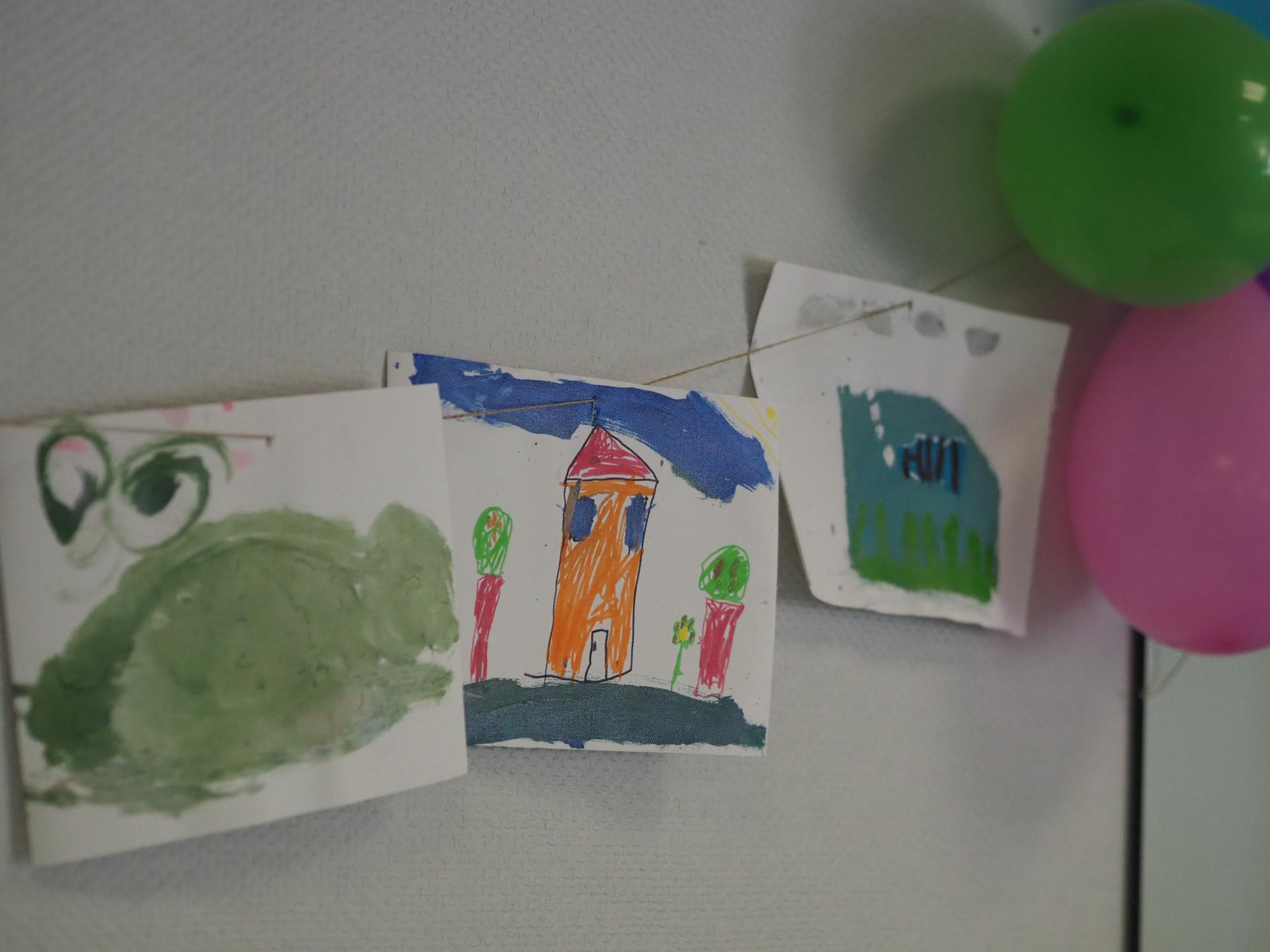
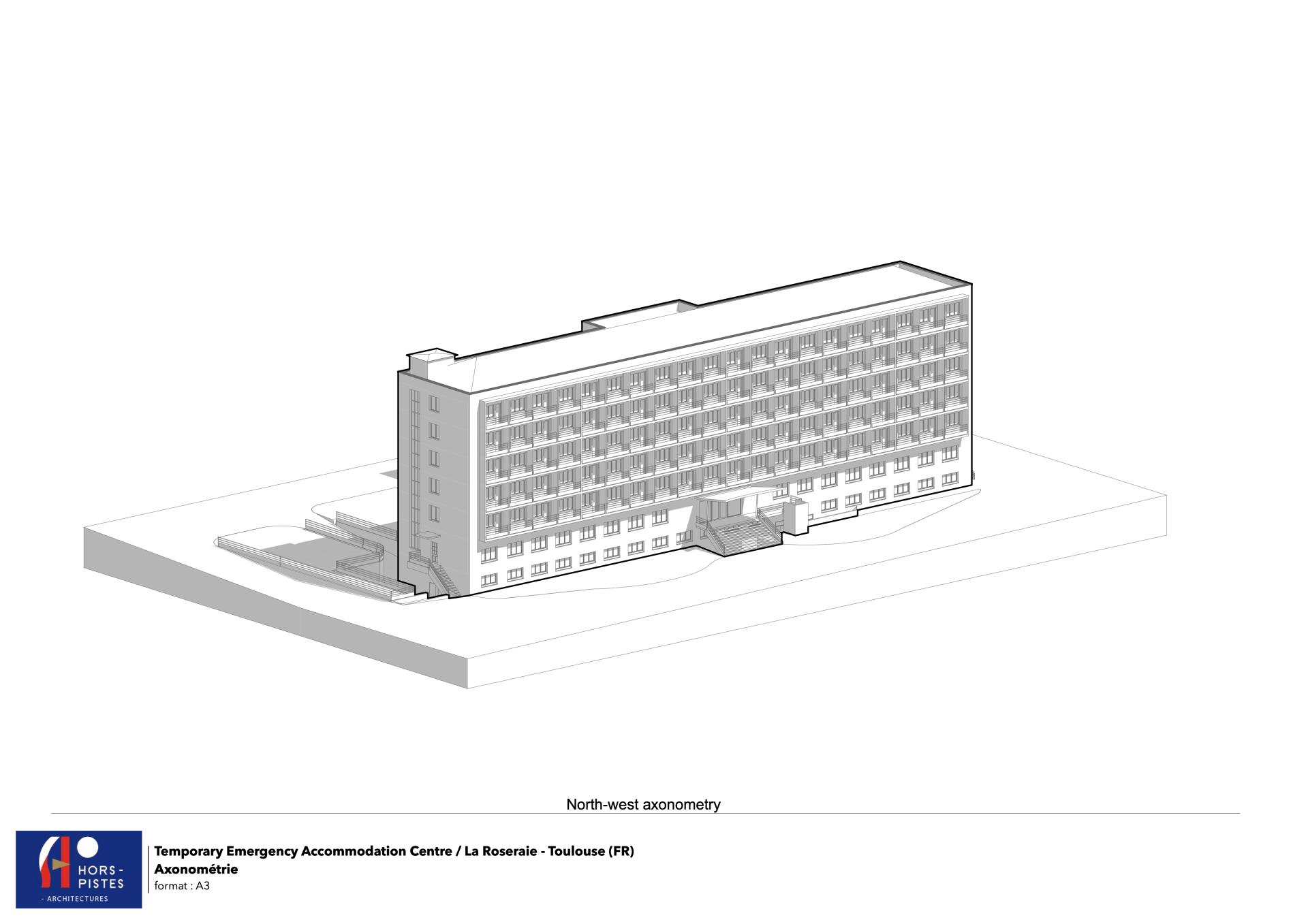
The aesthetics of this abandoned building, initially destined for demolition, was just waiting to be revealed. The architecture of these extremely well-drawn façades brings together on the first two floors the common spaces, offices and activities and on the five upper floors, behind the balconies, all the accommodations and private areas. In order to make the residents aware of their environment, an artistic project involving a photography workshop has been set up by volunteer art students, as well as drawing and painting activities for the children.
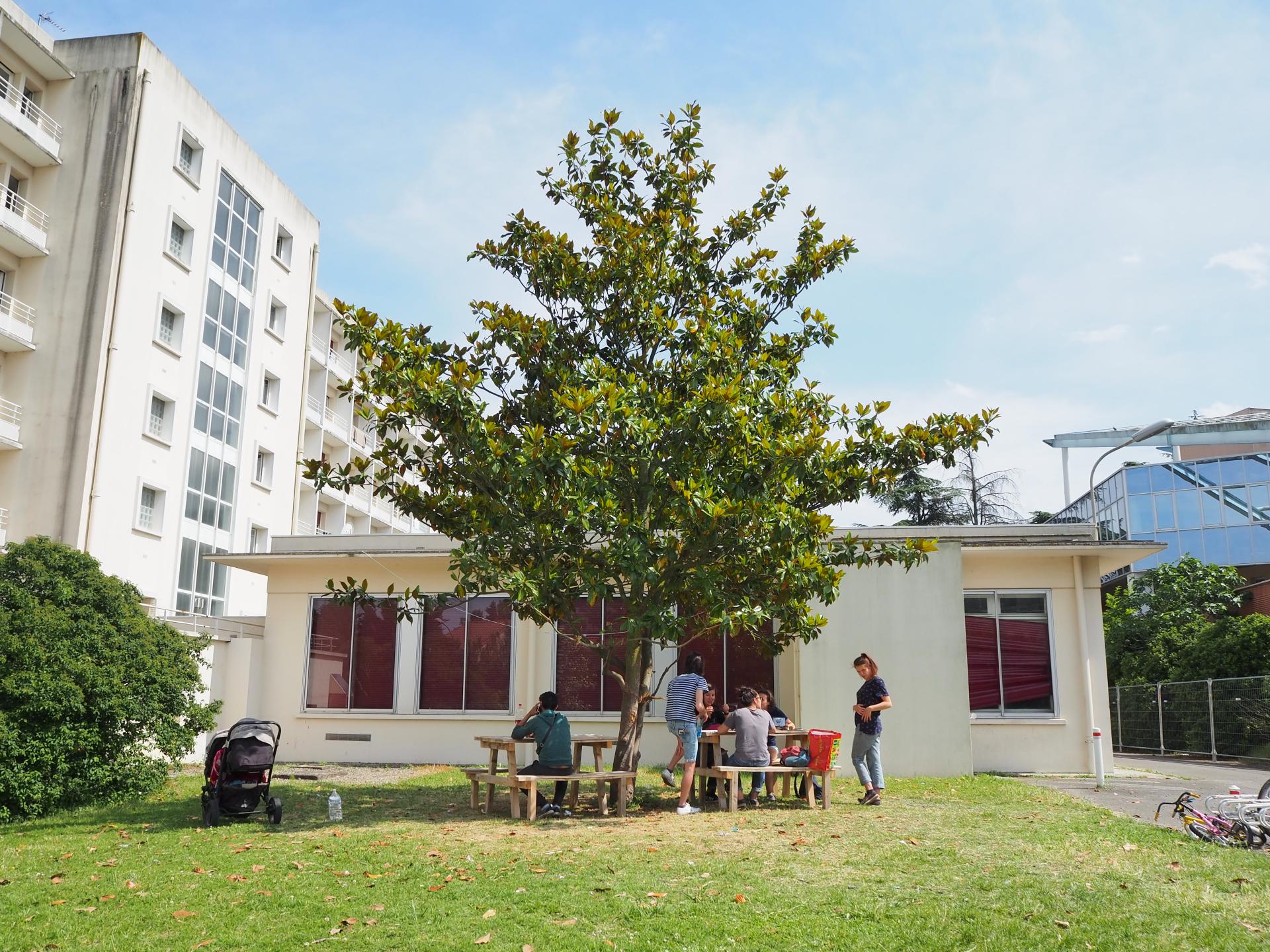
The embellishment of the existing space with the residents, through their involvement as well as the social workers, has led to the improvement of the common areas. A team of volunteer carpenters helped residents to create outdoor furniture with recycled materials and made the garden more enjoyable.
Making the beautiful and the useful a reality was also achieved by giving new life to old abandoned bicycles, through the organization of bicycle repair workshops to enable residents to build their own mode of transportation.
Key objectives for inclusion
This innovative emergency accommodation project was set up for homeless people of all nationalities, with priority given to families with children.
The involvement of local voluntary associations in the residence has enabled many social links to be established in the residence and in the district. Workshops for children to complement their extracurricular activities were offered by various associations, such as visits to museums and sports, artistic and cultural activities.
Volunteer residents were able to offer cooking, tutoring and music activities to help the residents integration.
The availability of offices in the residence of neighborhood associations has helped to create a direct link with them and to include the residents and the project in its urban context. This success has allowed the project to be extended for 2 years.
The reactivation of the lift has also made it possible to welcome all people with disabilities, the elderly and pregnant women.
Results in relation to category
The budget for reusing this former student residence and accommodating these 220 people daily, for 28 months, is €170,000, i.e. less than €28/m/p. And this occupation could be set up in barely a month from the moment the owner of the residence, the Ministry of the Army, and the State validated the project.
This low cost made it easier to finance social support of people who were able to move on to other housing solutions faster. More than 600 people have been helped in 28 months. All of the 95 children sheltered daily were enrolled in local schools thanks to the strong presence of social workers who were able to quickly and easily assist the families in their applications.
The future urban project on this building was not yet defined at the time of the occupation. It was destined to be demolished because it is easier for the developers to demolish and rebuild rather than renovate the building. However, it is important to remember that renovation is much more sustainable in this kind of context and if it allows to propose accommodations during the long design period required for a renovation project.
The reproducibility of this type of project is essential to confirm the viability of this kind of solution. We have been able to develop a precise method that can be adapted to each case. For example, in March 2020, at the beginning of the pandemic, the government asked us to reopen an abandoned building and design a new emergency accommodation for homeless people contaminated by COVID-19 but not requiring hospitalization. So, for less than €55,000, in 10 days, we reopened an existing building and housed 45 patients daily for over a year. This allowed us to give a new life to a building that was also abandoned. For the past two years, we have been helping the municipality of Toulouse to reuse the houses that the city buys in anticipation of future urban projects in order to open new emergency accommodations.
How Citizens benefit
Social workers were involved in the design of the occupancy project in order to respond to the needs of the residents. For example, office space in the residence was kept available for citizens who wanted to propose projects for the residents and get involved in the life of the residence.
The citizens could also benefit from the project by having access to the garden areas, but also to the available offices to develop social projects in relation to the residents.
Several activities were offered by the citizens to animate bicycle repairs and workshops on photography, drawing, painting, cooking, reading and writing, school support, theater, music and cinema.
A residence party was held to open the community to the citizens and to integrate the residence into the neighborhood. These spaces of joy and freedom in the city are terribly needed and are much more beneficial to the city than completely abandoned buildings.
Innovative character
Setting up this kind of temporary emergency accommodation project in empty buildings remains complex. This is the first time in France that emergency accommodation has been provided so quickly and in such a short time. The systematic implementation of a temporary occupation project, between two classic occupations of a building, makes it possible to optimise the existing situation and to offer new spaces in the city. This is what is currently being developed in Toulouse.
This temporary housing offer is complementary to classic housing and allows us to respond to new challenges of ephemeral housing in the city.
This project makes it possible to give new life to abandoned spaces in the city, to give a use and social value to abandoned spaces.
The programmatic mix with the reception of lodged persons and offices for associations has allowed to build a community and a well-being in the residence which is essential to us.
The important involvement of social actors, citizens and residents in the project is also essential for the success of such a project.