(Eco)nnection
Basic information
Project Title
Full project title
Category
Project Description
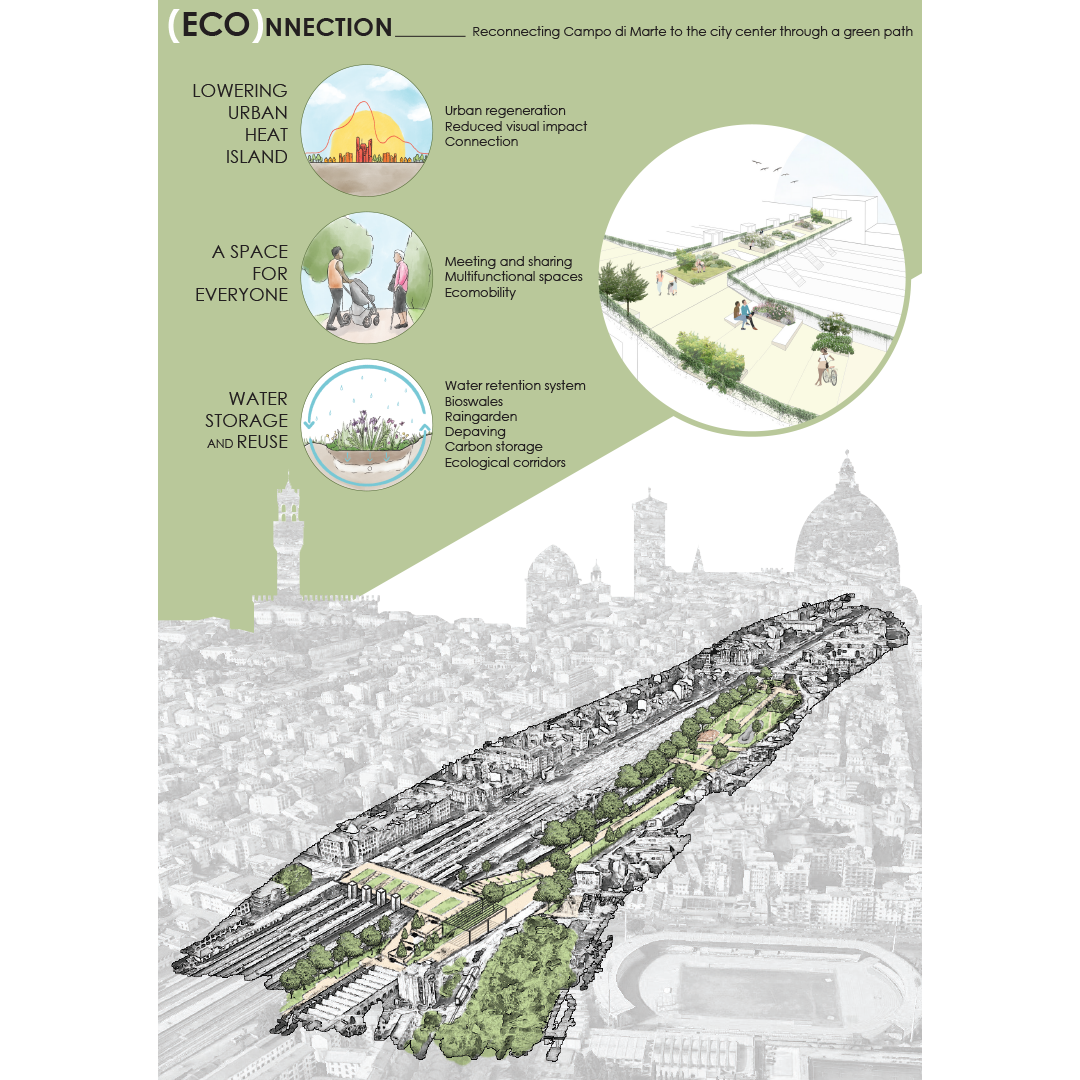
The concept aims to mend Florence’s urban structure, reconnecting the historic center with Campo di Marte's neighborhood, which are now separated by the homonymous train station.
The urban regeneration project aims to create a large pedestrian area by reusing the structures and spaces of the railway - currently no longer in use - in order to give back space to pedestrians and creating ecological connections with the surrounding green areas and the hillside behind.
Project Region
EU Programme or fund
Description of the project
Summary
The concept was developed by the following team of students of the University of Florence: Chiara Dolcini, Gaetano Calise, Silvia Ielmini, Ludovico Meneghel, Giulia Sciortino.
The urban regeneration project aims to make structural and functional changes to Campo di Marte’s railway station and the related overpass, which represents a fundamental and primary link between the historical city center and Campo di Marte's district.
The crossing is currently out of reach for people with limited mobility and for those who carry bicycles or other light vehicles. The goal is to break down the architectural barriers and make it easy for anyone to cross the overpass: it will be transformed in a multifunctional structure that will have both a connecting and recreational function, creating meet and share spaces, allowing anyone near the station to experience a green, nourishing area and to detach themselves from the chaos of the surrounding city.
In the next few years, the station and its surrounding will become a key point in Campo di Marte’s area thanks to the implementation of public transport.
Furthermore, the new green hub will represent a pleasant place for the travellers, giving them the opportunity to choose between different means of transportation.
Another turning point will be the transformation of the area below the overpass (nowadays not a safe and pleasant area), that will become a pedestrian area filled with gardens, rest areas, urban parks etc. usable by all citizens. The whole project is based on sustainable criteria.
Key objectives for sustainability
The concept of sustainability is, and must be, an intrinsic feature of any urban transformation process.
For this reason, our concept is based on the 17 Sustainable Development Goals or SDGs (point 9; 11; 13), which constitute the vital core of the 2030 Agenda for Sustainable Development.
The project aims to provide different solutions to improve not only the quality of citizens’ life but also the quality of the entire urban ecosystem.
The de-paving and replacement with permeable pavements, instead of the widely used concrete, will limit the formation of urban heat islands during the hottest seasons, providing the citizen with a cooler place and lowering the temperature by a few degrees.
Furthermore, the presence of permeable pavement, in addition to mindful design choices (such as rain gardens, bioswales, tree box filters) will allow the storage and reuse of rainwater for the irrigation of the green areas, with the aim of recovering, recycling and limiting water consumption.
The sustainable perspective is also highlighted through the idea of reusing the pre-existing railway and related buildings, to provide new aggregation space for citizens.
As for the ecosystem, the new added vegetation will allow the creation of ecological corridors, supported by interventions in the same neighbourhood, providing a green system that connects the hillside to the urban context.
Key objectives for aesthetics and quality
The project area currently presents unpleasant aesthetic conditions which make the users perceive the place as uncomfortable and unsafe. The goal is to improve the aesthetics of the area, reusing the residual buildings, giving them a new look and a new function, revitalising the entire area.
When an urban project is carried out, not only its aesthetics are important but also its harmonious insertion within the urban fabric. For this reason, the lines that create the design of the pedestrian area are generated by the extension of the existing roads, creating continuity between the intervention and the pre-existing building.
Furthermore, the careful planning of the type of vegetation to be used, in terms of color, shape, texture and sound, will create effects that are not only pleasing to the eye, but capable of stimulating all five main senses, as well as secondary ones such as kinaesthesia and proprioception, providing citizens with an overall feeling of well-being.
Key objectives for inclusion
For anyone passing by Campo di Marte’s railway station and its surroundings, it is clear that inclusion is not part of the character of the area. The railway creates a sharp cut that separates the city of Florence into two distinct parts, connected by a few, poorly planned, passages. These crossings are in fact dangerous or difficult to use by people with limited mobility and for those who use and carry bicycles, strollers, wheelchairs etc. Furthermore, the presence of a narrow sidewalk in the busy street Via Campo D'Arrigo makes it difficult and equally unsafe for pedestrians to reach the station.
The design aims to solve these problems with a multifunctional ramp that will make it easier to cross the gap to any type of pedestrian, regardless of age and physical skills.
This structure provides not only a wide range of solutions in terms of stairs or ramps, but also new designs to ensure that those with mobility issues can have a place to rest without their problems being evident, therefore avoiding them to experience vulnerability and discomfort.
Finall relying on the 17 Sustainable Development Goals or SDGs (points 3; 10), the elements that compose the pedestrian area below, will have different functions (common gardens, places to practice sports, places to hold conferences, meetings or outdoor lessons).
They will as well implement the connection, sharing and meeting between different cultures living in the neighbourhood thus allowing the overcoming of preconceptions and distrust among citizens, promoting the inclusion in the society of the most marginalised ones.
Innovative character
The project is innovative because it uses practices and design actions which are uncommon on the Italian territory.
Strong point is the creation of an urban scale project not intended for economic purposes or addressed to vehicular mobility, but willing to give back to pedestrians a part of the city, improving their living conditions, as well as the space in which they move.
This improvement is implemented through the use of permeable pavements, useful for stocking rainwater; introduction of more vegetation coverage, green roofs and walls; removal of architectural barriers and promotion of inclusion in society of the most marginalised categories.
All these good practices make our concept innovative because to date, most of the projects carried out in the cities lack an all-round vision, as well as sensitivity to the concepts of sustainability and inclusion.