Venice Aqua Granda Community Memory
Basic information
Project Title
Full project title
Category
Project Description
How can communities cope with the devastating effects of climate change and build a new future? The Aqua Granda project has allowed Venetian citizens to jointly build a digital memory from social media and other sources about the devastating floods of November 2019, Artists and scientists have created powerful art works to unlock meanings from these archives and results are being shown in a hybrid exhibition distributed throughout the city using augmented reality on mobile devices.
Project Region
EU Programme or fund
Which funds
Other Funds
- EU H2020 FETPROACT-01-2016 - FET Proactive: emerging themes and communities: ODYCCEUS - Opinion Dynamics and Cultural Conflict in European Spaces (732942) [2019-2020]
- EU H2020 FETPROACT-EIC-05-2019 - FET Proactive: emerging paradigms and communities: MUHAI - Meaning and Understanding in Human-centric AI (951846) [2020-2021]
- EU H2020 ICT-26-2018-2020 - Artificial Intelligence AI4EU - A European AI on-demand platform and ecosystem (825619) [2021]
Description of the project
Summary
In November 2019 the historical city of Venice, which had already been suffering from an increasing number of high waters and storms, was hit by a mega flood known as an Aqua Granda. It had a devastating impact, not only on historical buildings - like the San Marco basilica, but above all on the living spaces of Venetian citizens and the shops, institutions and industrial infrastructure on which the local economy rests. The disastrous flooding was partly caused by climate change, which is inducing more violent weather phenomena, and partly by increased stress on the fragile lagoon ecosystem due to over-tourism (such as brought about by giant cruise ships) and industrial exploitation.
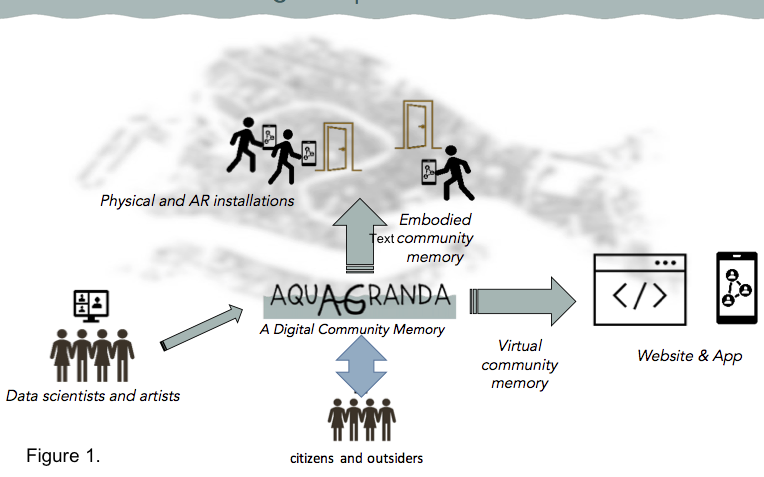
In response to this event, a project was set up to bring together Science Gallery Venice, the Ca'Foscari University of Venice and many other actors in the scientific, cultural and social sphere, in order to co-create a memorial and a resource for shaping the future in the form of a digital community memory (Figure 1). It archives data from meteorological measurements, from social media (Twitter, Facebook, reddit, Whatsapp, Youtube, etc.) and from many other sources (for example damage reports from insurance companies). The community memory employed leading-edge web technologies, data analysis, augmented reality and AI tools in order to gather, store, process and display the reactions and proposals of citizens, visitors, and experts. The project had also an important artistic component. A dozen artists realized art works for unlocking the many meanings hidden in the rich archive. Due to the pandemic, these art works had to be conceived to function in an on-line exhibition with anchor points distributed throughout the city. Due to the involvement of the whole Venetian community and to this artistic input, the Aqua Granda Digital Community Memory has become a tremendous resource for coping and raising awareness about the need for a more sustainable world.
Key objectives for sustainability
This project has two objectives from the viewpoint of sustainability: raise awareness locally and internationally and help the community to self-organise.
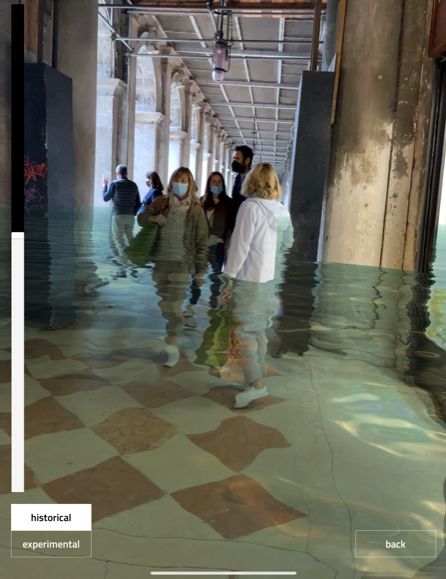
Awareness raising is addressed by documenting the fear and devastation of the Aqua Granda flooding. This is important as a collective memory of the events and as a way to transmit this memory to future generations and newcomers. It is important to show non-citizens how dire the situation is, often denied by companies profiting from the exploitation of Venice, and to stimulate respect for the city, the lagoon and its inhabitants. The project has raised awareness for local citizens by making the memory accessible freely to all citizens on-line and publishing the catalogue in open access in Italian. With geolocation, sounds, images and videos can be mapped to the locations in Venice where they occurred. For example, Figure 2 shows how the art work Torrents (by Joeri Bultheel) visualizes through augmented reality (AR) the water levels during the Aqua Granda in San Marco square, which had waist-high water.
The lagoon ecosystem and the urban environment of the historical centre constitute a shared commons that needs to be protected and managed properly to allow it to be sustainable for human life. Nobel economist Elinor Orstrom has argued that healthy management of the commons requires that all stakeholders have access to information and have a vehicle for discussion and decision-making. The Aqua Granda Digital Community Memory supports self-organisation of the community by recording memories of the events and by showing how citizens have been cooperating. It brings out the dialogs that have taken place through social media, raising political issues about who owns the city, arguing about the tension between tourism and habitation, etc. It brings out the dialogs that have taken place through social media and makes the scientific data of the weather systems visible and understandable.
Key objectives for aesthetics and quality
The artists in the project have sought new aesthetics for digital media by using advanced techniques in computer vision, computer graphics, audio synthesis, AI, geolocation and augmented reality.
- For example, one art work (The Old is Dying and the New Can't Be Born, by Tuters et al., Figure 3) has used computer vision techniques for segmentation, object detection and object classification on the found video footage of Aqua Granda to create a mashup that emphasizes the chaos of the Aqua Granda flooding. The restlessness of the objects and people depicted in the videos, paired with the floating movement of the camera, stage a growing sense of anxiety, with the rising water in the foreground of the scene.
- The art work Playful Waters (by Fabian Kuhlein) is a radio play to be heard while walking through the city, mingling the background noises with sounds taken from social media, mixed and juxtaposed together. Using spatial narrative and personalisation, the radio play creates a novel personal auditory experience grounded in reality and in the auditory imagination of the artist.
The exhibition itself was implemented as an augmented reality environment accessible via mobile phones or tablets. Video art works are projected on screens located in the augmented reality environment. Innovative immersive art works could be created and shown as well. For example the work Torrents (by Joeri Bultheel, figure 2) showed in situ the level of the water superimposed on the objects and spaces in the environment of the viewer, including one's own living room. The art work Voicing Conflict (by Tom Willaert) shows text messages and makes them audible. It thus exposes dialogs between citizens taking place on Twitter, Whatsapp, reddit and other social media. These dialogs are projected through AR onto your location in Venice but can also be listened to remotely.
Key objectives for inclusion
Thousands of citizens, young and old, native or migrant, have already been very actively involved as contributors and users of the Aqua Granda Digital Community Memory and this has given them a much needed way to share trauma, cooperate, express anger, and work out ways of coping with the future. Because the Community Memory is intended to stay live for a long time, eventually becoming part of the city or university archives, this impact is expected to grow substantially in the coming years.
More concretely, citizens have been involved in the following ways:
1. Recording and telling of oral histories: This happened in a series of workshops that is still ongoing. The recording were made by high school students and addressed in particular older generations, often among the poorer population segments of the city, that had experienced the previous Aqua Granda in 1966. Close to a hundred stories have already been collected.
2. Citizens have been providing data from their social media, data that could not be obtained by scraping the social media algorithmically (which happened also) and they have uploaded additional multi-media materials. So far close to 15.000 individuals have thus contributed 50.000 items.
3. Citizens are continuing to help annotate data by tagging and location information. We have particularly called upon garbage collectors, postal workers, fire fighters, etc. who have intimate knowledge of the city.
These engagements have raised widespread interest in the Community Memory so that citizens feel they own it. Everybody has free access to all its materials. Moreover the exhibition is free and the catalogue, web materials and social media information is available in open access. Campaigns have been organized to spread the news and they received a strong response from all corners of Venetian society as well as the international community who cares about the city and the lagoon
Results in relation to category
This initiative is clearly about mobilising culture, art and community. The main objective is to give the Venetian community the tools to express the problems they encounter with respect to climate change, over-exploitation, and stress on housing and urban infrastructure and to help seek and implement solutions. Venice is an iconic city where sustainability issues have reached a climax and it is therefore an appropriate laboratory for the New European Bauhaus initiative. The project has not only shown how to mobilize culture and the arts, but most importantly the community of citizens who feel that sustainability is destroying in a catastrophic way their environment.
The project is deeply embedded in the socio-cultural fabric of networks and institutions of the city. Although the initiative started with university institutions it has spread to other prominent cultural institutions that hosted physical entry points into the online exhibition and workshops to shape the development of the project. The project has included a dozen artistic projects to bring out meanings from the archive. These art works are themselves highly innovative by their novel use of digital media creating a new aesthetics and pioneering new production methods but their main role here is to bring a community together.
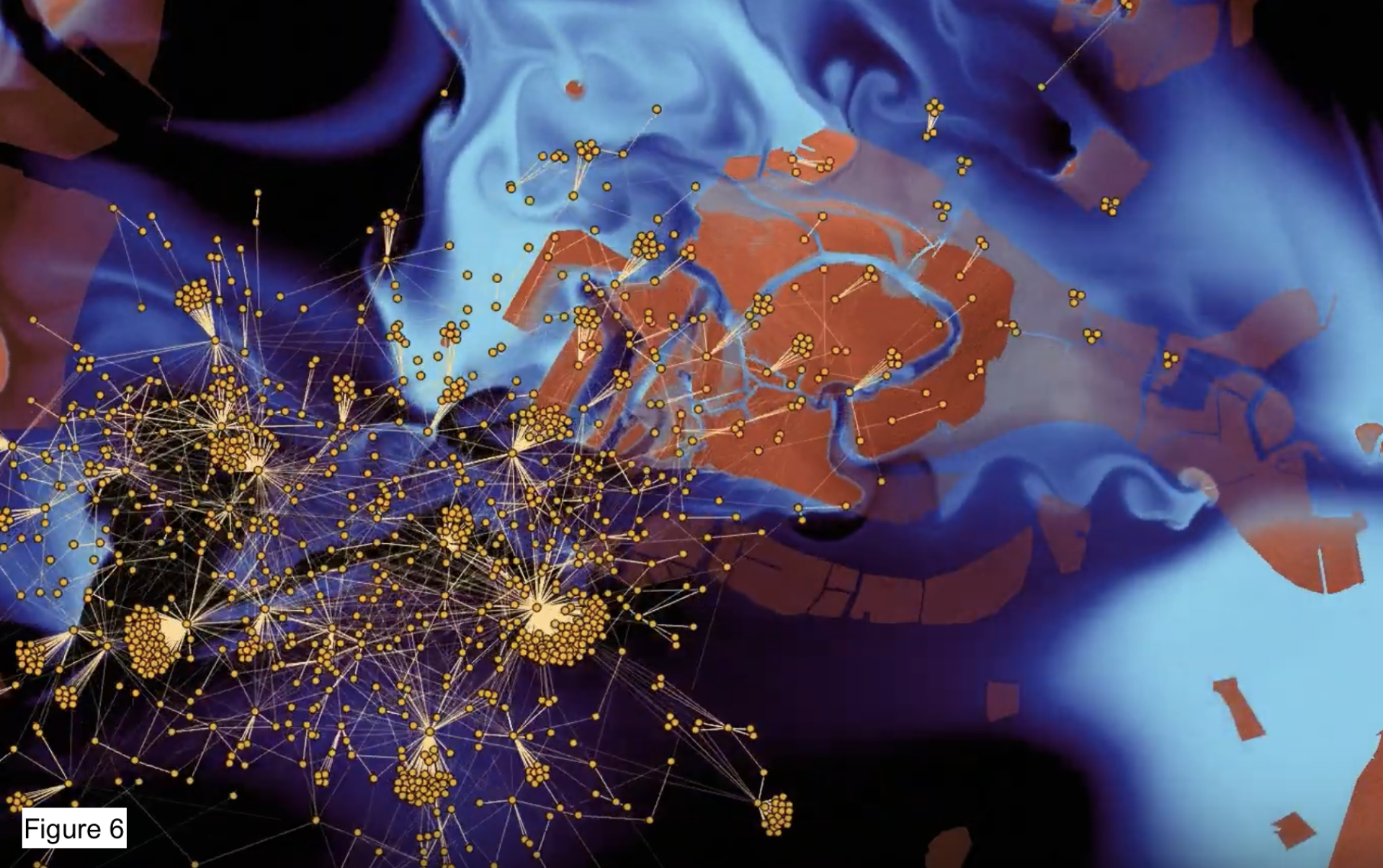
The project is a great example of interdisciplinarity. It draws on the physical sciences to provide data and theoretical insights and on social sciences for digital methods to analyze social media data from a sociological perspective. All this comes together in the art work Dispersione (by Armin Pournaki and Robin Lamarche-Perrin), which juxtaposes images from a physical simulation of the weather system based on the Navier-Stokes equations and actual data from weather stations in the lagoon with an analysis and visualization of the retweet networks on Twitter during the time of the Aqua Granda, thus making the interaction between the social and the physical visible (Figure 6).
How Citizens benefit
As mentioned earlier, citizens have been strongly involved and affected by the Aqua Granda Community memory project. But also civil society at large has been implicated. The original initiative has come from a European H2020 project Odycceus which has developed various tools for getting data from social media and for analyzing these data based on data science and artificial intelligence. One main partner in this project is the Management Department of Ca' Foscari University of Venice. Prof. Warglien has been the scientific director of the archive and the exhibition and many researchers and students from Ca'Foscari have contributed at a scientific, technical and community organisation perspective. The second main partner is Science Gallery Venice (SGV), which is also an international network so that the outcome of this project can have an impact beyond Venice. The director of SGV, Neal Hartman, is one of the curators of the exhibition. His team has made an enormous effort to produce the exhibition and to organise intense community engagement. A third partner is Venice International University and the H2020 EU project MUHAI. It has particularly focused on the catalogue and on the organisation of the scientific discussions during workshops which involved artists as well as social scientists and AI experts, organized by Prof. Steels who is co-curator of the exhibition and co-editor of the catalogue.
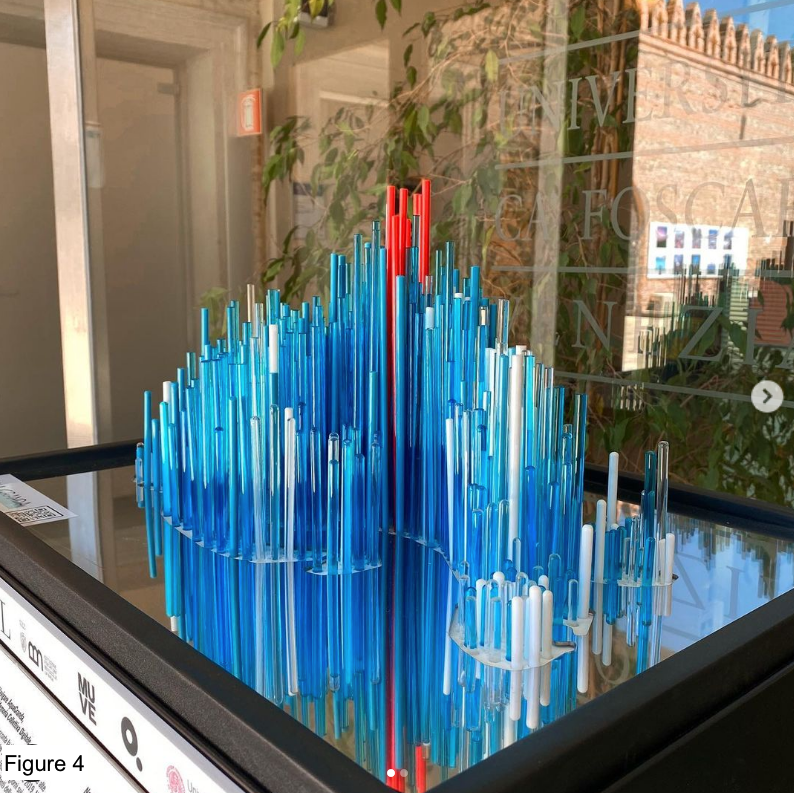
In addition, more than a dozen institutions and organisations active in the socio-cultural sector have been implicated. Some of them have installed the artistic totems (Figure 4) that are physical entry points into the archive and the exhibition. Others have organized sessions to record experiences of the events or provided additional data. The institutions studying the lagoon from a scientific point of view have provided additional data and knowledge. These institutions have all seen increased impact and new forms of interaction with citizens.
Innovative character
The project breaks new ground on two levels: the social and the technological. At a social level, citizens living in the historical city centre of Venice feel underrepresented politically because they are a minority in the city government based in Mestre and governed by decisions (such as about access of cruise ships to the lagoon) made by the central government in Rome. The Aqua Granda Digital Community Memory project is a novel vehicle for giving a voice to Venetian citizens. It creates a new kind of agora in which opinions can be expressed, aggregated and communicated. This new vehicle can increase the democratic power of citizens needed to regain control over their own living conditions.
Here are some more examples of how the project breaks new technological ground:
- The art work called Sky Tide by glass artist and designer Matteo Silveiro (Figure 4) transforms scientific data of water levels and altrimetric data of the city to represent the water levels at different points in the city in terms of glass rods fabricated using a mixture of digital fabrication and ancient glass blowing techniques in Murano. This work gives a novel impetus to an artisanal industry at risk of disappearance. This project therefore fits with the original Bauhaus objective, as expressed in the Gropius manifesto, to revitalize craftsmanship.
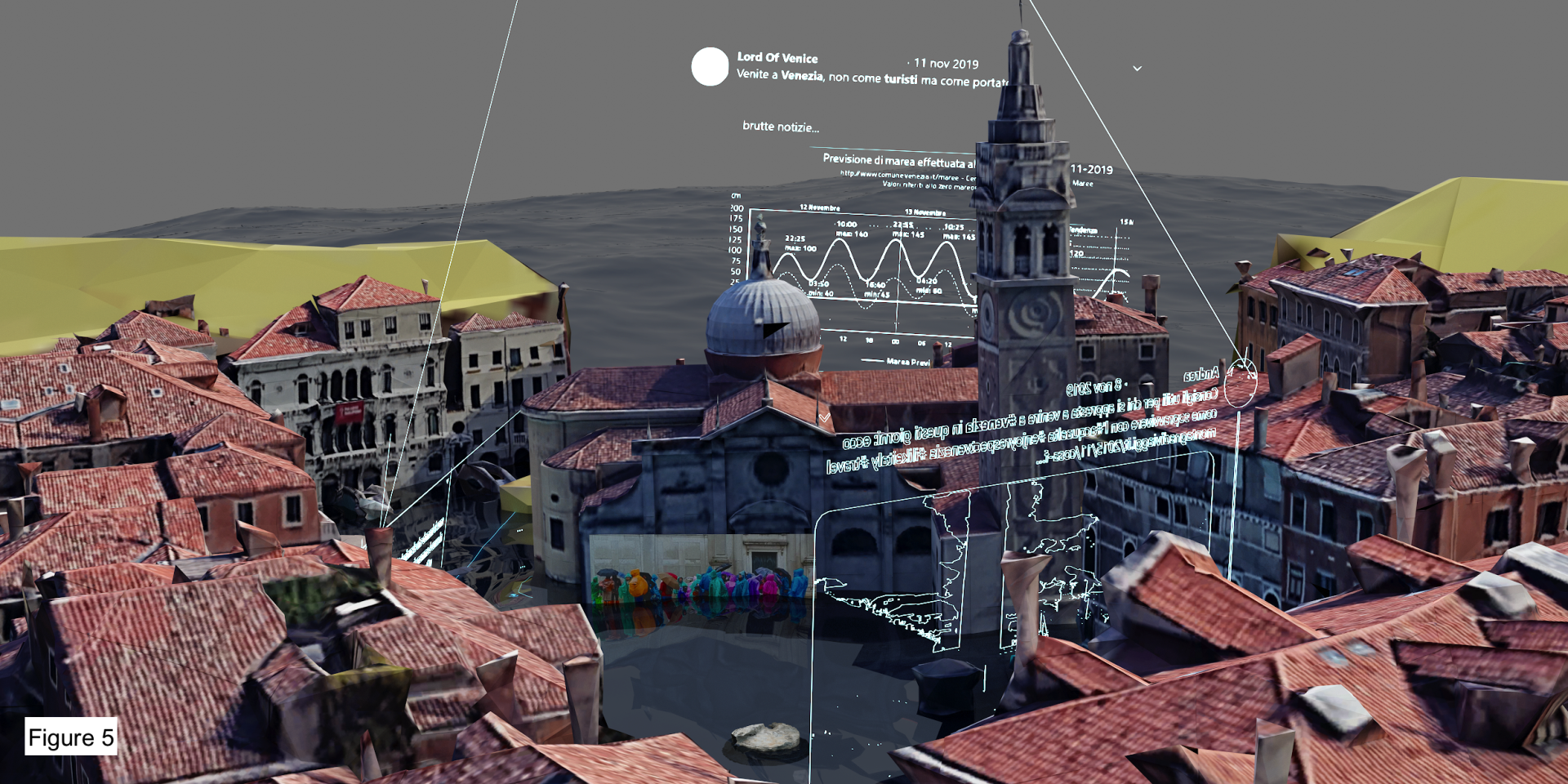
- The art work Metamorphosis (by Carlo Santagiustina) uses a whole series of very advanced tools in computer graphics to make a 3d model of the city on which social media images, scientific data, images of the MOSE flood protection and water levels are projected to create a multi-media collage (Figure 5). These innovative technologies were put at the service of a figurative artwork that narrates the different phases in the Aqua Granda event, going from preparation, concern, anxiety to frustration and despair. It can be experienced in 3d through mobile media.