Settlers of Change
Basic information
Project Title
Full project title
Category
Project Description
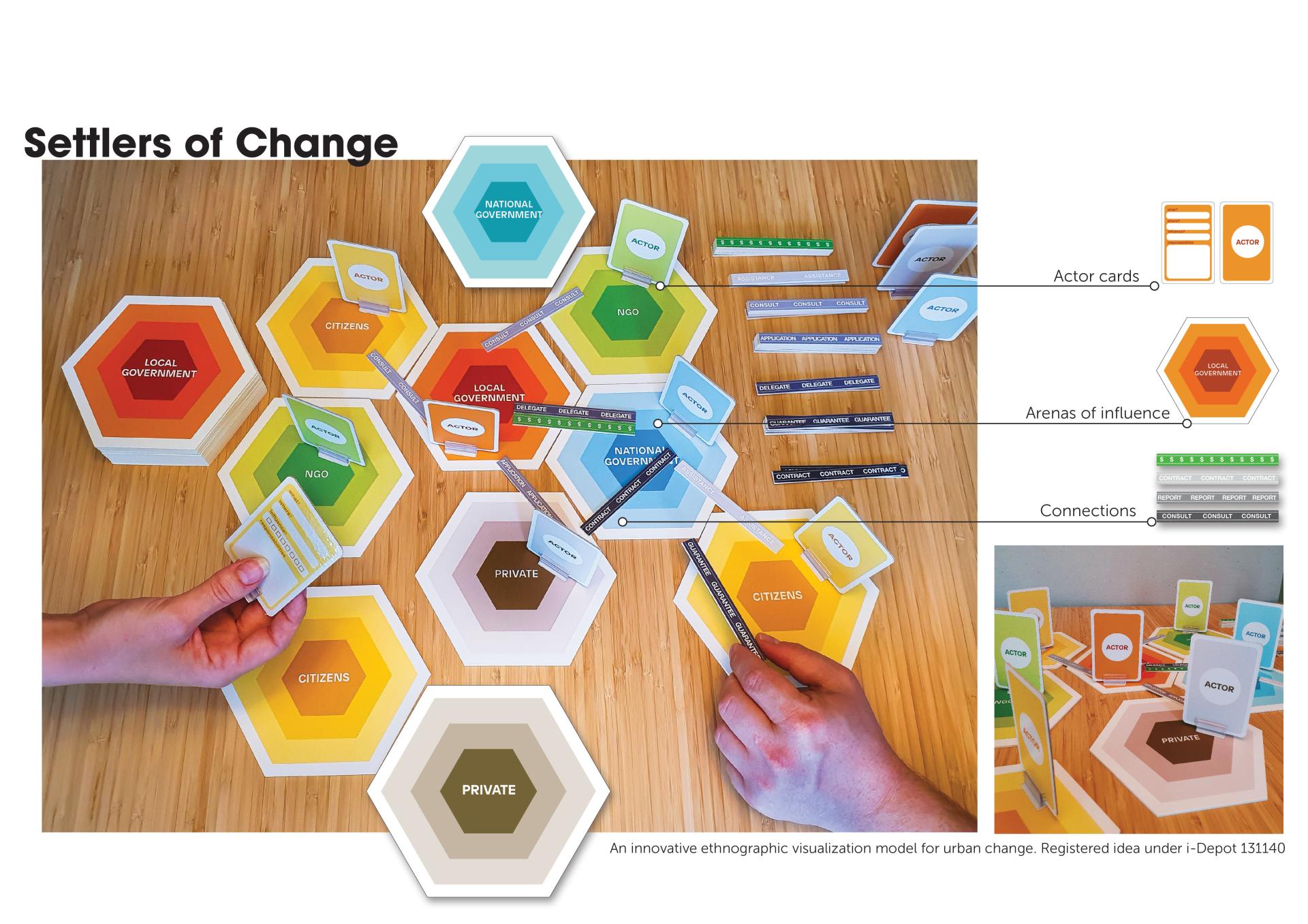
An innovative ethnographic visualization model where different participants jointly learn through building and altering the urban planning governance process to achieve change, with focus on sustainable transitions. The interdisciplinary model is based on management, design and urban planning and allows for a physical learning experience of arranging pieces as to mimic the urban governance networks, with its arenas of influence, actors and relationships.
Project Region
EU Programme or fund
Description of the project
Summary
In recent years, forms of governance are being transformed towards processes of negotiation and contracts. Which has increased the complexity of governance arrangements through an expanding landscape of actors involved and fragmentation of the decision-making process, requiring increased coordination and consensus building in non-hierarchical forms. This complexifying landscape demands distinct approaches to change.
Settlers of Change's first spark emerged from the author's process of mapping institutional urban planning governance in different countries: Brazil, United Kingdom and the Netherlands. Visualizing infographics which summarized the relationships between different arenas and actors was eye-opening for the involved civil servants. A budget officer of the Municipality of São Paulo commented "This is the sort of work that public service needs".
However, seeing the finished product was only part of the experience. The process of building it and cross-checking it with policy pieces and civil servants was even more rich than being presented to the resulting infographic. The research methodology used to build these infographics by the author was adapted into Settlers of Change: an open network visualizer model, where people can physically discuss and map how decisions are made, and collaborative discuss how to change it.
Based on systems mapping and on theory of change, the model works on the boundaries of management, design and urban planning to direct complex systems in their transition, in a process that at times can be messy and challenging. But how? First, through visualizing the very thing that often goes unnoticed: the governance stakeholder networks and their opportunities and bottlenecks. Second, allowing the discussion for change to take place with the stakeholders and with a palpable way of redesigning for transition.
Key objectives for sustainability
The European Environment Agency discusses that "(...) in exposing the complexity, uncertainty and no-linearity that arise from interactions between multiple actors and scales, transitions frameworks such as the multilevel perspective make it clear that transitions towards particular sustainability outcomes cannot simply be planned and implemented." (Geels et al., 2019, p. 39)
Settlers of Change aims to enable local governments to establish processes of innovation by understanding their own institutional infrastructure in relation to the demand of markets and communities and connecting them to these processes to co-produce knowledge on how to adapt to this transition.
Transitions only happen when they are collaboratively made and change is applied on key points with key actors. Understanding the relationships between these actors trains participants to be able to re-design networks to advance sustainable transitions in their organizations. Moreover, mapping these relationships also allows participants to discover possible synergetic initiatives that go unseen in the lack of overview.
The new Environment Act of the Netherlands (Omgevingswet) reinforces the need for collaboration and combination of goals from different disciplines in the built environment: Nature, Water, Urban Planning and Underground. It combines these layers into a complex landscape that allows for innovative transitions to take place, and can serve as breeding ground for sustainable transitions and inspire ways in which others can flourish. And it is therefore, a good case to pilot Settlers of Change in the Netherlands to reach its maturity.
Key objectives for aesthetics and quality
Settlers of Change makes learning a complicated topic accessible and playful. By turning spaces, actors, and relationships of governance networks into pieces that can be arranged, it lowers the threshold for conversation. This allows participants to engage into difficult topics and discussions within a physical space that is distraction free.
It moves the governance relationships from an unspoken topic towards a visualized reality, made by the participants for themselves in a safe space. From previous experience with serious games, the visualization experience is highly instructive, which is appreciated by participants and sparks collaborations and discussions that move into other spaces.
In terms of aesthetics, Settlers of Change is graphically designed to invite collaboration similar to a playing a game. The hexagons represent Arenas of influence as National Government, Municipalities, Private Sector, NGO's, etc. The colours present in the pieces change from the centre outwards to demonstrate the influence levels. The Actor cards match the colours of the arenas and can be written to describe the functions, and levels of influence of individuals within the system. They are erasable, re-usable and can be placed within the system accordingly. The connections represent the relationship of actors with one another: contract, report, payment, consult, etc.
The model also allows for an incremental and open practice, where sequential workshops can be held to improve and further develop the discussion with input from other groups.
Key objectives for inclusion
Governance networks are often a sensitive topic as they allow for a deep of understanding of politics and relationships between actors. More often than not, they are not avoided as they can expose the lack of accountability and participation in some processes of decision-making.
Participation is sometimes side-tracked through close bonds between specific actors which play into their agendas and reduce the level of democracy of the process. It also reduces the accountability of actors to citizens and to some of their peers by keeping processes of decision-making hidden and only presenting results. However, the process of reaching the results is sometimes even more important for citizens to feel heard, and to see the results as being fair.
In that sense, Settlers of Change allows for more knowledge of these processes within organizations and in correlation with others. By clearly stating the existing and possible relationships there is more certainty in the process, the ability to visualize those who are not being included, and allow more voices to be heard.
Innovative character
In Settlers of Change, different stakeholders will be invited to jointly build the urban planning governance process in the different government levels, private and third-sector. They will be asked to determine actors, their roles, relationships, and proximity. The sessions will be recorded, and reported with the help of visualization tools. Knowledge of patterns is the first step towards change, and participants can map bottlenecks and opportunities and develop possible roadmaps for transitions.
The model combines visualization tools and ethnography methodology towards system change. The value of the visualization is twofold. First, it allows actors to possibly for the first time understand the intricacy of the networks they are embedded. And secondly, it inspires discussions of the institutional patterns and ways towards change.
As an open model that can be expanded, it is adaptable for different systems and goals. If there are more actors, or different arenas involved, the pieces can be added to the stack to mirror the reality and enable further discussion.
Settlers of Change is also registered as an idea at the Benelux Office for intellectual property under i-Depot number 131140.