Dance is Politics.
Basic information
Project Title
Full project title
Category
Project Description
The project reclaims the appropriation of the public space through 'the party' and dancing as a social catalyzer during -and after- the pandemic, establishing a new paradigm in which technology, environment, and social encounter merge in a single reproducible architectural strategy.
Project Region
EU Programme or fund
Description of the project
Summary
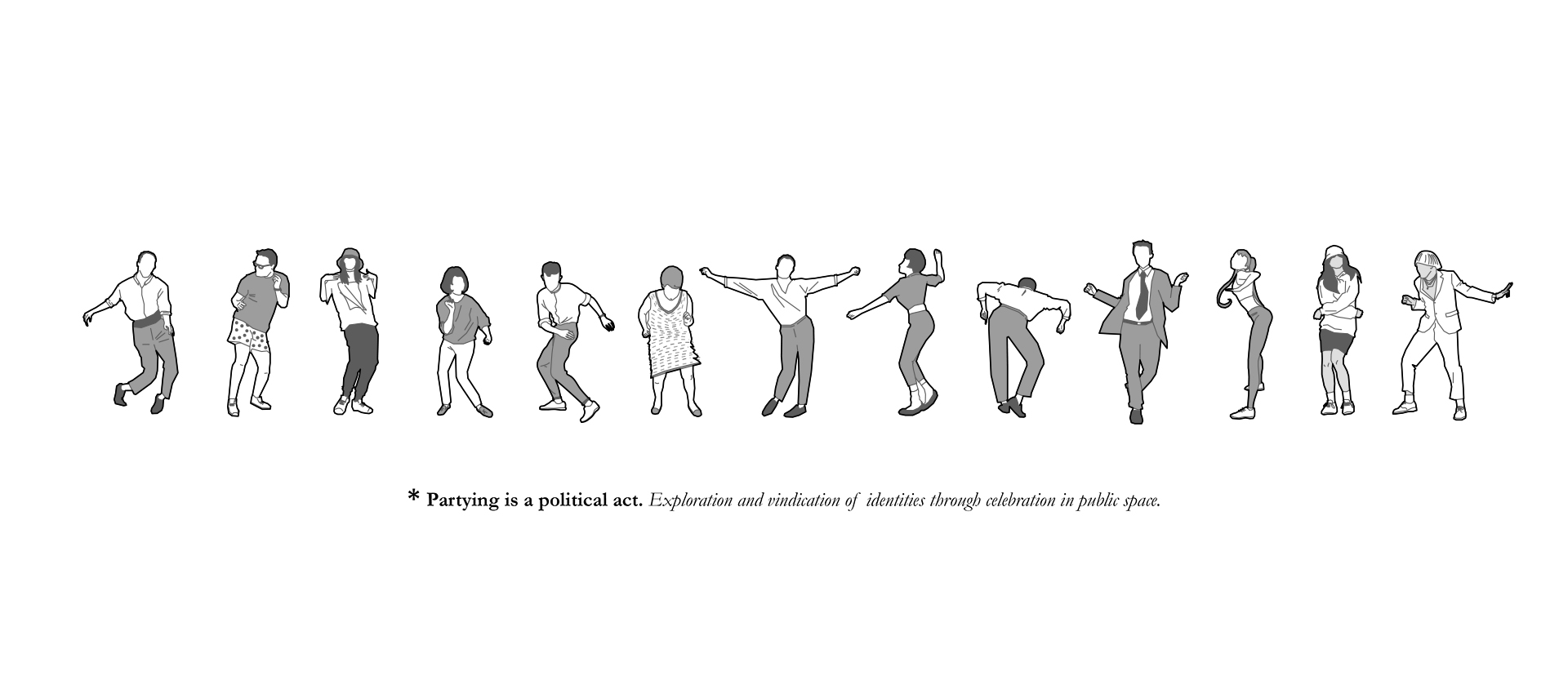
Parties or celebrations of any kind are a backbone for identity claim and public representation for communities of different sizes and nature, becoming an essential political tool for visibility and a driving force for social change. Not as a frivolous gimmick, but being aware of the crucial role of partying and dancing in expressing and reaffirming community identities through collective celebration and occupation of the public space. We understand partying in public space as a political act.
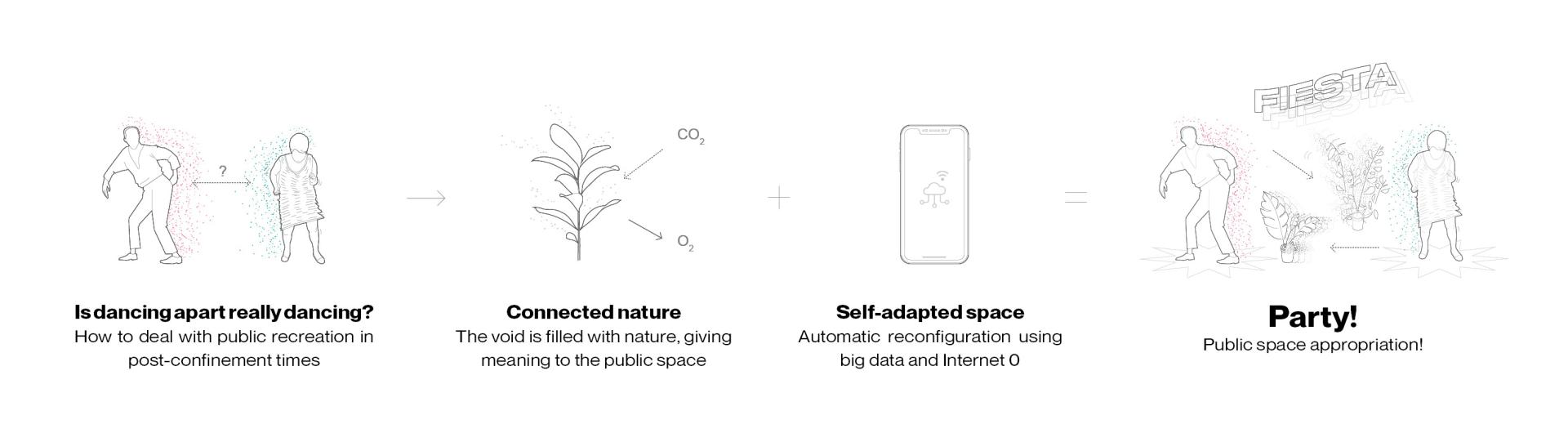
But, in the ongoing health crisis, what happens to an activity based on agglomeration? We must find a party model compatible with a delicate social and sanitary situation. Social distancing creates a void between us destined to be unused, but why not take advantage of it to fill it with nature? We are given the opportunity to shape the future, and we cannot imagine one that does not go hand in hand with technology and nature.
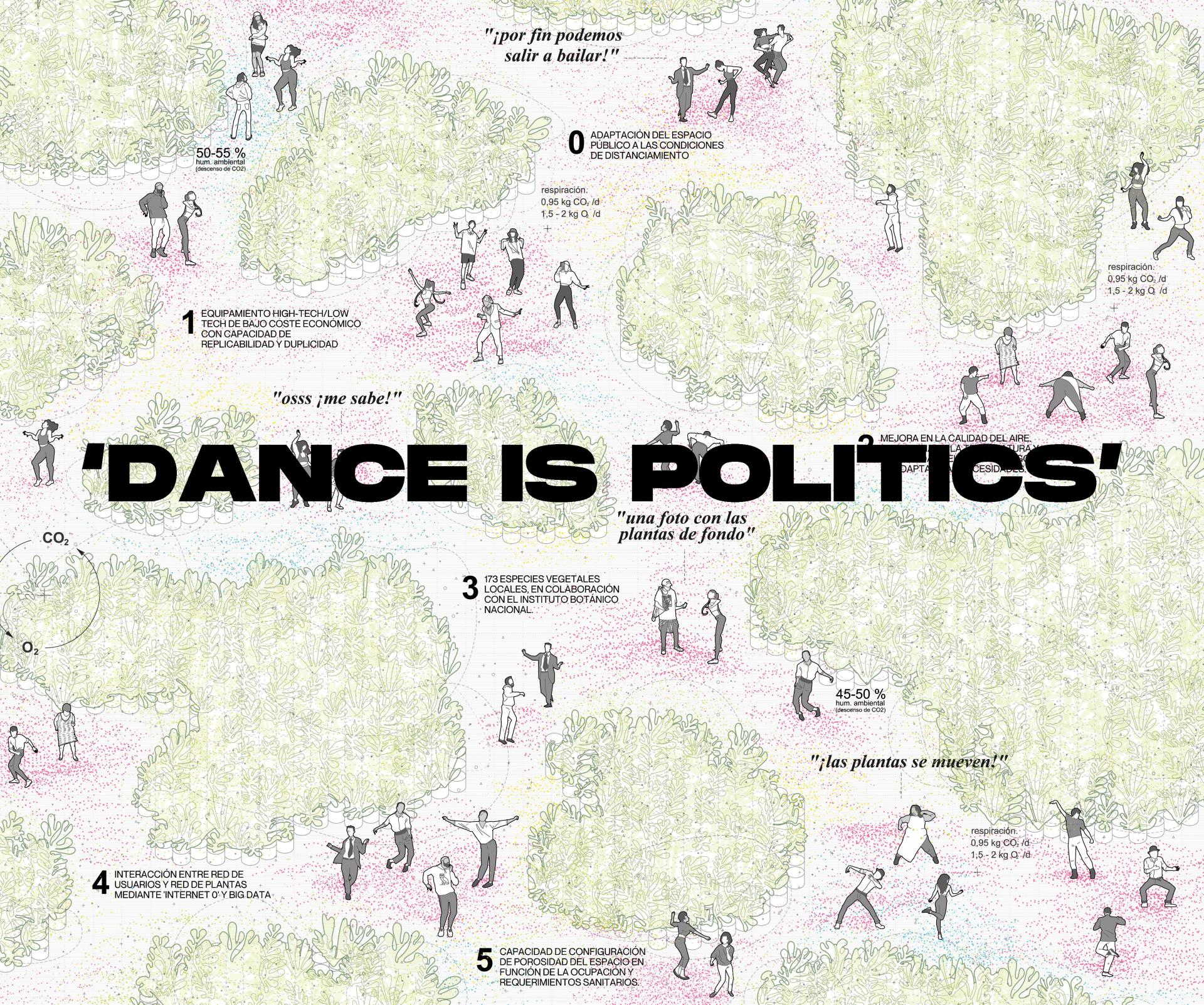
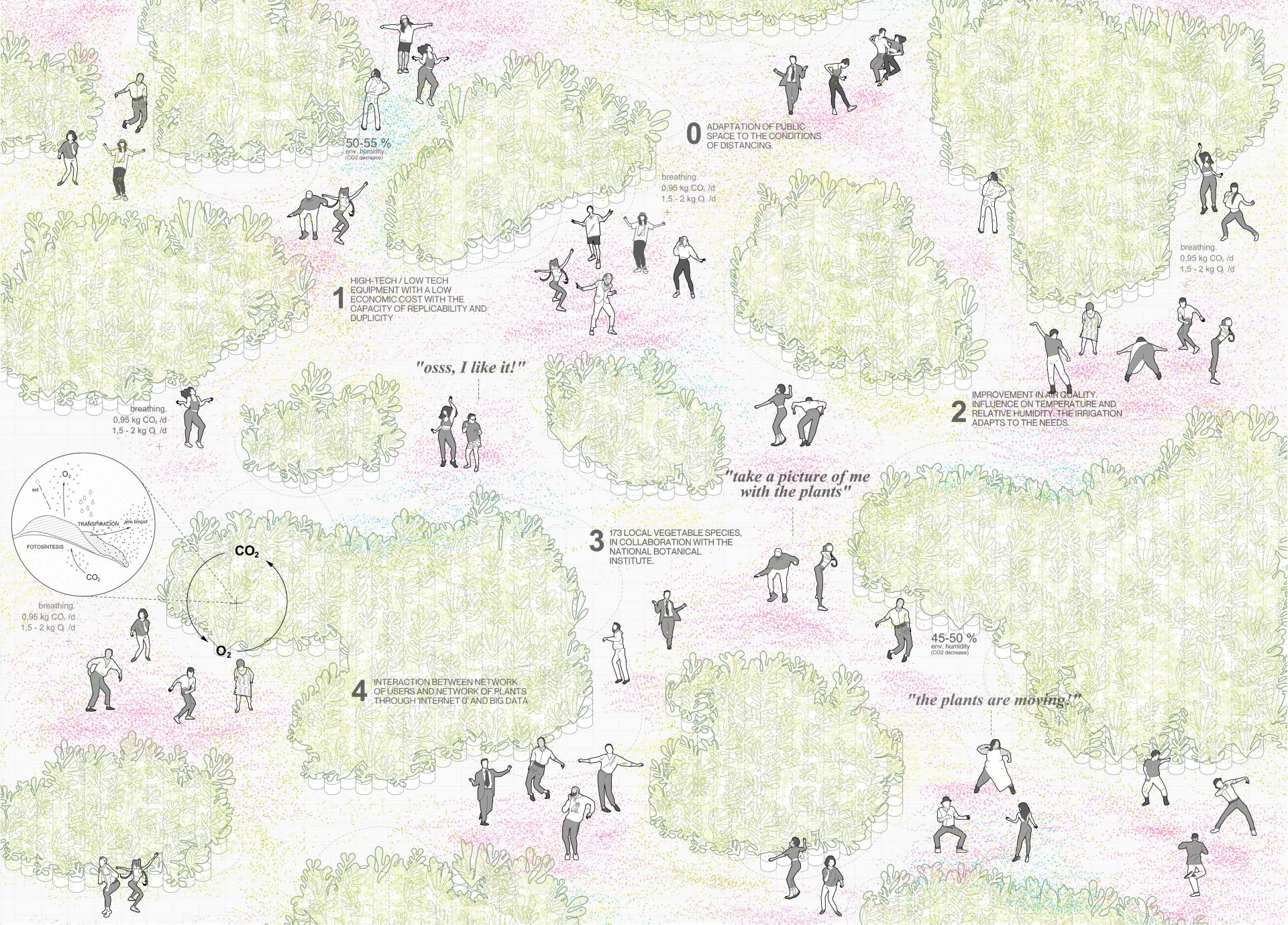
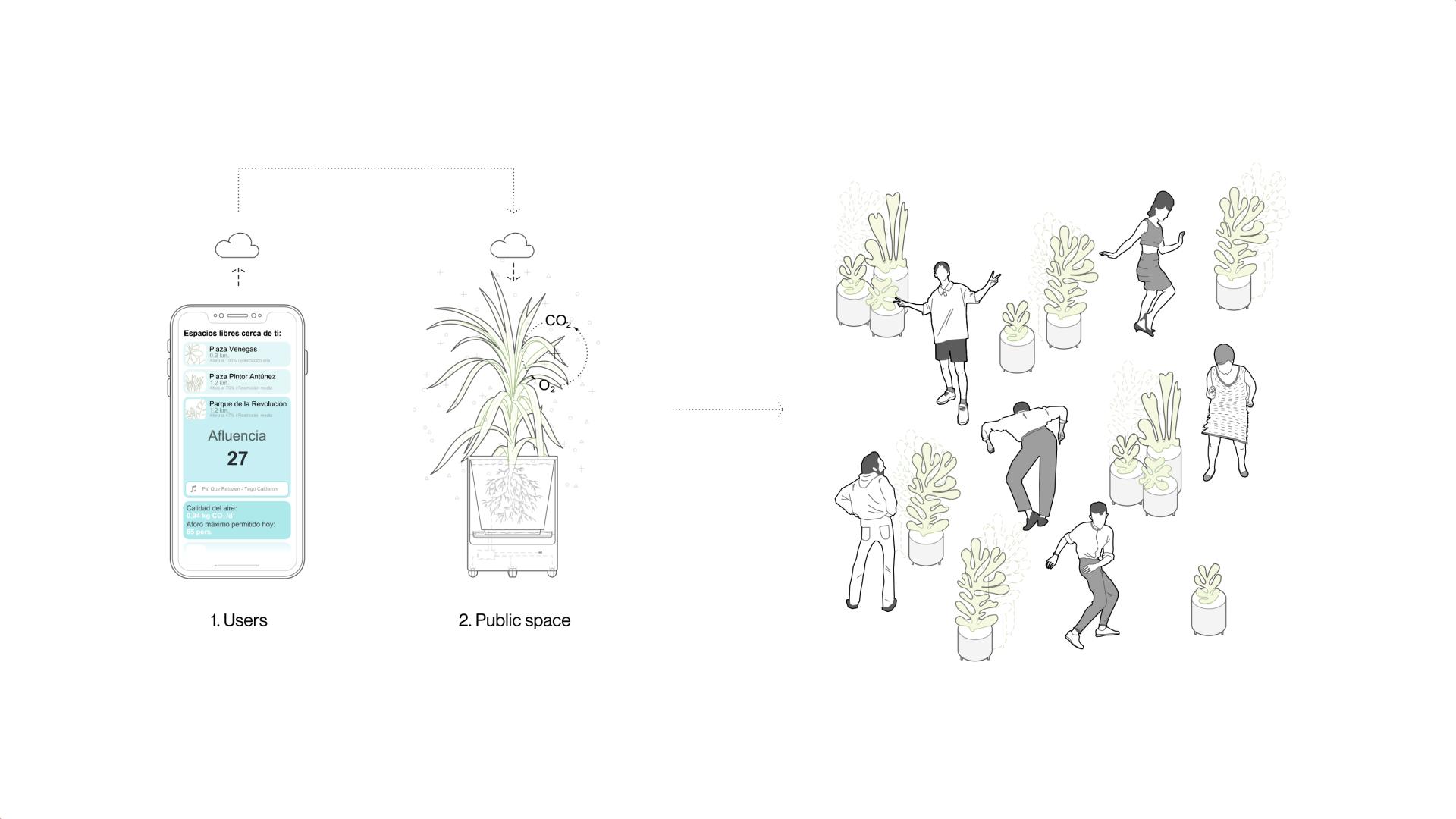
DANCE IS POLITICS is an idea easy to build, with just a few components: people, music, plants, and the desire to dance. We propose a system made of a physical component and a virtual one in continuous feedback. The physical part is a system of pots that move automatically to create various groupings of vegetation to limit agglomerations and ensure social distancing. The virtual component consists of a central system for analyizng and managing the data collected through sensors, which transmits information in real-time to each pot on where to move in the urban space. The units that comprise the system are flowerpots: mobile elements that consist of vegetation, wheels, and a micro-computer, which allows their automation and directs their movement, following the central system's orders to which they are connected wirelessly. The information generated and collected in each of the public spaces creates an open-knowledge network, enabling the system to adapt to any public space and to any budge
Key objectives for sustainability
Rather than tackling sustainability from a material point of view, we tackle it from its basis; we do not build. However, we propose an infrastructure that allows building communities through the use of vegetation. Through the inclusion of plants in our project, we provide the necessary elements to foster new social encounters and experiences.
Additionally, we believe in a broader meaning of sustainability. Sustainability for us means also care and a sense of community. It means creating inclusive environments for all forms of life, in which the ecologic part is, of course, a cornerstone.
Key objectives for aesthetics and quality
The idea of DANCE IS POLITICS is about enhancing the urban space through nature and experience. The flooding of public spaces with nature to enable social encounter aims, on the one hand, to include vegetation in the cities, in order to create a greener and kinder environment. This concept is adaptable to any city and its local vegetation, generating an idea that is adaptable to any situation. The aesthetic value of vegetation in cities and public spaces blends with the experiential idea of the party as a social catalizer. On the other hand, celebrations in public spaces aim to permit anybody to express themselves freely through the experience of party and the occupation of the public space as a method for reclaiming rights and identities. As Victor Turner puts it, to enter a party is to enter "into a collective, creative transformation of identity, time and space separated from everyday reality." This experience opens the possibilities to a parallel world that allows for the subversion of hegemonic social conventions.
We also believe that a key feature of the project is that it does not limit its operation to a single type of ‘experience’ but allows adapting the public space to different audiences and needs.
Dancing and partying are carried out as an act of corporal expression, almost as a way of liberation. That is something that seems complicated to do safely in the current situation. We emphasize that because, at different times in history, it meant an act of social claim even though, a priori, it might seem somewhat naive.
The relation between music, body, and dance creates a communal experience that allows for exploring multiple alternative models to those socially established.
Key objectives for inclusion
‘The party’ especially those discordant with the established leisure model - has always been used as a tool for protest and to reclaim rights and public spaces. Block parties, raves, carnivals, or popular celebrations of any kind are an example of that.
The origins of house music represent this idea. As has happened with other music and festive movements — such as rap, reggaeton, or funk carioca — the same pattern repeated itself. These movements were first ignored or directly repressed, then claimed, and later used or absorbed by large-scale popular movements. In the absence of 'official' leisure and recreation circuits that would welcome them, many self-organized celebrations originally served as an escape valve.
We aim for a system that permits the use of public space for creating. The project creates an infrastructure that would enable these encounters to happen, despite the sociosanitary situation. We aim for a recreational model in which anybody can be represented, a new model of celebration in public space in which the interaction of humans and nonhumans establish a new way of celebrating. "By claiming space in public, by creating public spaces, social groups themselves become public.” (Don Mitchel, 2003)
Like Nancy Fraser, we argue that the notion of a singular universal public sphere needs to be replaced with a theory of multiple, contending, often mutually exclusive public spheres. Our idea accommodates this multiplicity through its flexible and adaptable system.
Also, representation, whether of oneself or of a group, demands space. In public space political organizations can represent themselves to a larger population. By claiming space in public, social groups themselves become public. Our project acts as a mechanism of enabling people to make themselves visible on the streets.
Innovative character
The project establishes a new paradigm in which technology, environment, and social encounter merge in a single reproducible architectural strategy.
The innovative character of the concept lies upon the fact that, with minimal elements; nature, and technology, we create a suitable environment for public celebration, taking into consideration its social implications. With these elements, we create a greener urban environment and a sustainable and inclusive community. The prototype, a network of interconnected nature, - which is in itself, an innovative concept- allows for the creation of cities without building, and creates stronger human and non-human networks. After all, that is what we understand about sustainable architecture; it has potential to make a change on the cities and the beings that inhabit them.