Das Grüne Labor
Basic information
Project Title
Full project title
Category
Project Description
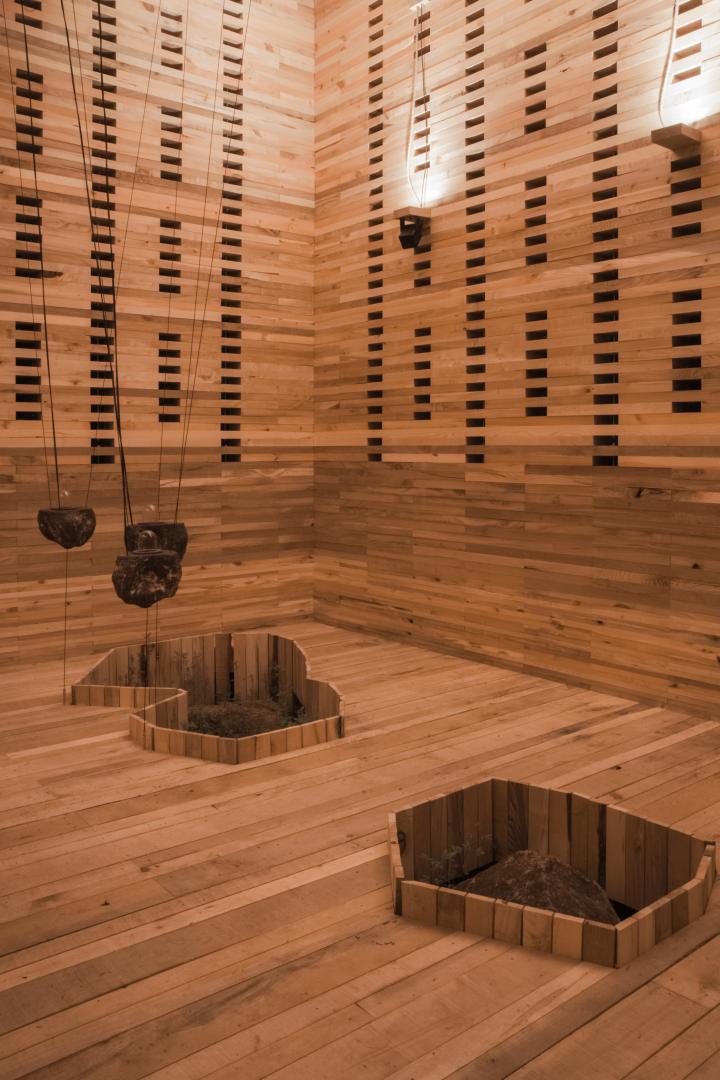
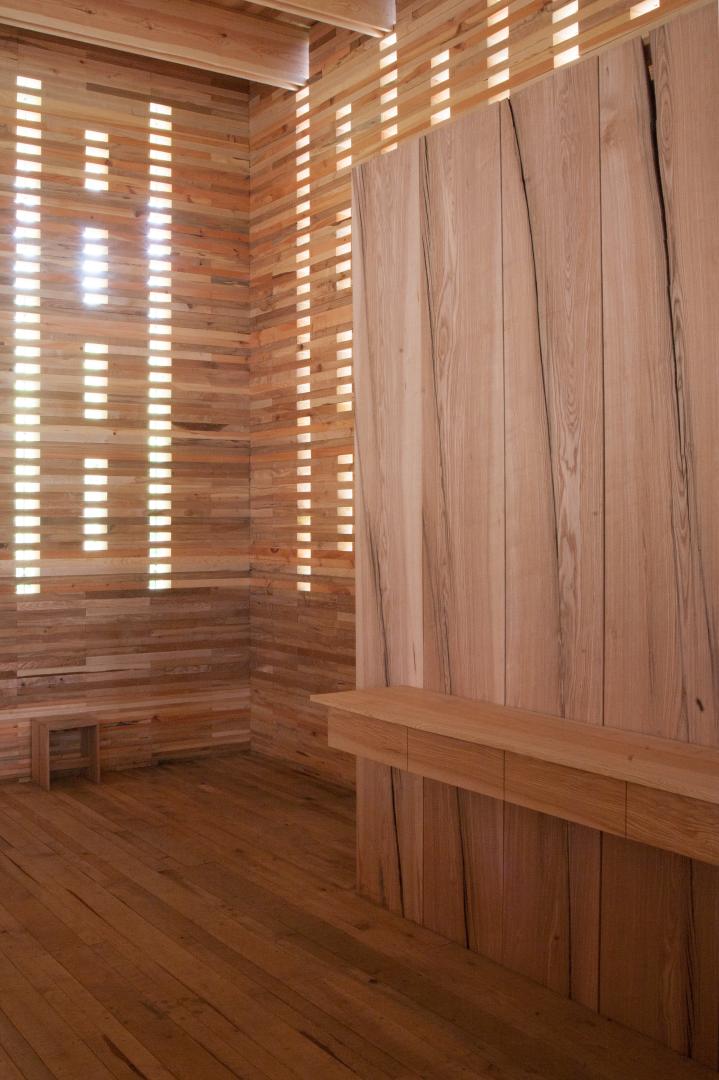
Das Grüne Labor is a public platform for encounter and environmental mediation in the heart of a historic park in Weimar. This pavilion is made from park trees, that needed to be cut down due to climate change induced damages giving this special wood a new purpose. First processed into blocks, that are based on a modular system and contain knotholes, cracks, fungi and vermin marks, they were stacked and strained together by a detachable connection – making the assembly set reusable and flexible
Project Region
EU Programme or fund
Description of the project
Summary
Das Grüne Labor (further green lab) was built for the theme year “Neue Natur” that is initiated and hosted by Klassik Stiftung Weimar. The theme year, as part of the Bundesgartenschau, an interregional Garden and Landscape exhibition attempts to discuss our understanding of nature on a broad public level.
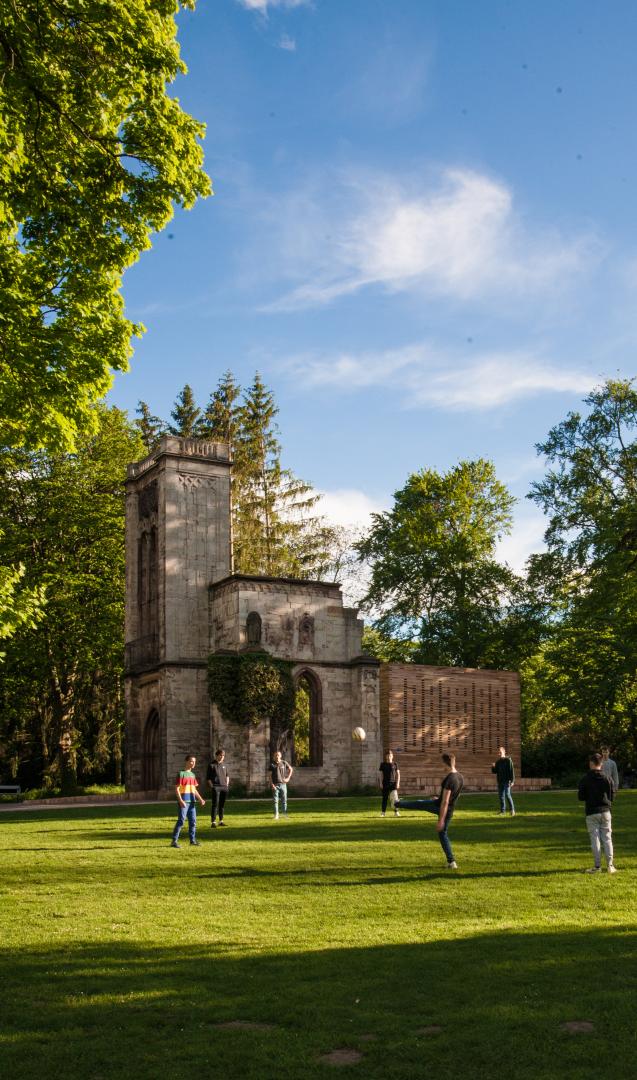
As a temporary pavilion the Green Lab is placed at the “Park an der Ilm” in Weimar on the site of the Ruin of the Tempelherrenhaus, a representative park building that was destroyed during the Second World War
The Green Lab serves as a place for encounter, as occasional venue and as a workshop for mediation on the subject of humans and nature.
The historic parks in Weimar are part of Unesco World Heritage and their botanic and aesthetic qualities are taken care of on a daily basis. The park itself produces a large amount of biomass, that usually ends up as compost or firewood. The Idea of using these materials for the building, to bring the garden maintenance and park resources to a greater visible attention to visitors as well as the usage of ecological construction materials were key to our concept.
“Park wood” was chosen as structural material. Many park trees experience a lot of stress caused by drought periods, storms and rising temperatures leading to a longer reproduction time for bugs and fungi. Therefor a noticeable amount of trees need to be cut down to guarantee safety for the public. As these trees are not grown as lumber, a form of construction to obstruct it as a “wood masonry” was developed. A large part of this wood can only be used in unusually small formats and seem not to be of economic value. The structure of the pavilion works as a kit of wood blocks, that are stacked and strained together. All parts are detachable, the pavilion can be disassembled and rebuild in a different shape. The pavilion is accessible to everyone and is an ambassador for a controversy of our perspective on nature and its cultivation.
Key objectives for sustainability
Park Wood (and also city wood) – as a new category needs a new way of evaluation and utilization to serve as construction material. The concept of integral usage of “difficult” wood also applies to industrial raised trees, that experienced damages or peculiarities in growth. All in favor of retaining 1 ton of CO2 in 1m³ of wood.
The Pavilion accomplishes this goal by implementing a construction that is designed for disassembly and reassembly, enabling the separation of all components, reparation of parts and rebuilding it in variations for different requirements. Because of the masonry, defective parts of the tree can be used as well, making a maximum use of it. Wood is a renewable resource and takes a significant role as a sustainable regional building material, as a large amount of CO2 pollution results from the building industry.
Experiencing and analyzing a place, that produces a lot of material itself avoids long transportation routes and reduces the carbon footprint by using a local resource.
As forests suffer from dry periods and rising temperatures, monocultures, for example spruce forests in Germany, die off to a dramatic extent. Reforestation aims for resilient forests by planting softwood and hardwood in mixed cultures, meaning a larger future share of hardwood lumber, resulting in the necessity for development of processing and construction of hardwood logs. The Pavilion makes its contribution to this progress by functioning as a model experiment testing the capabilities of hardwood in this particular modular brick system.
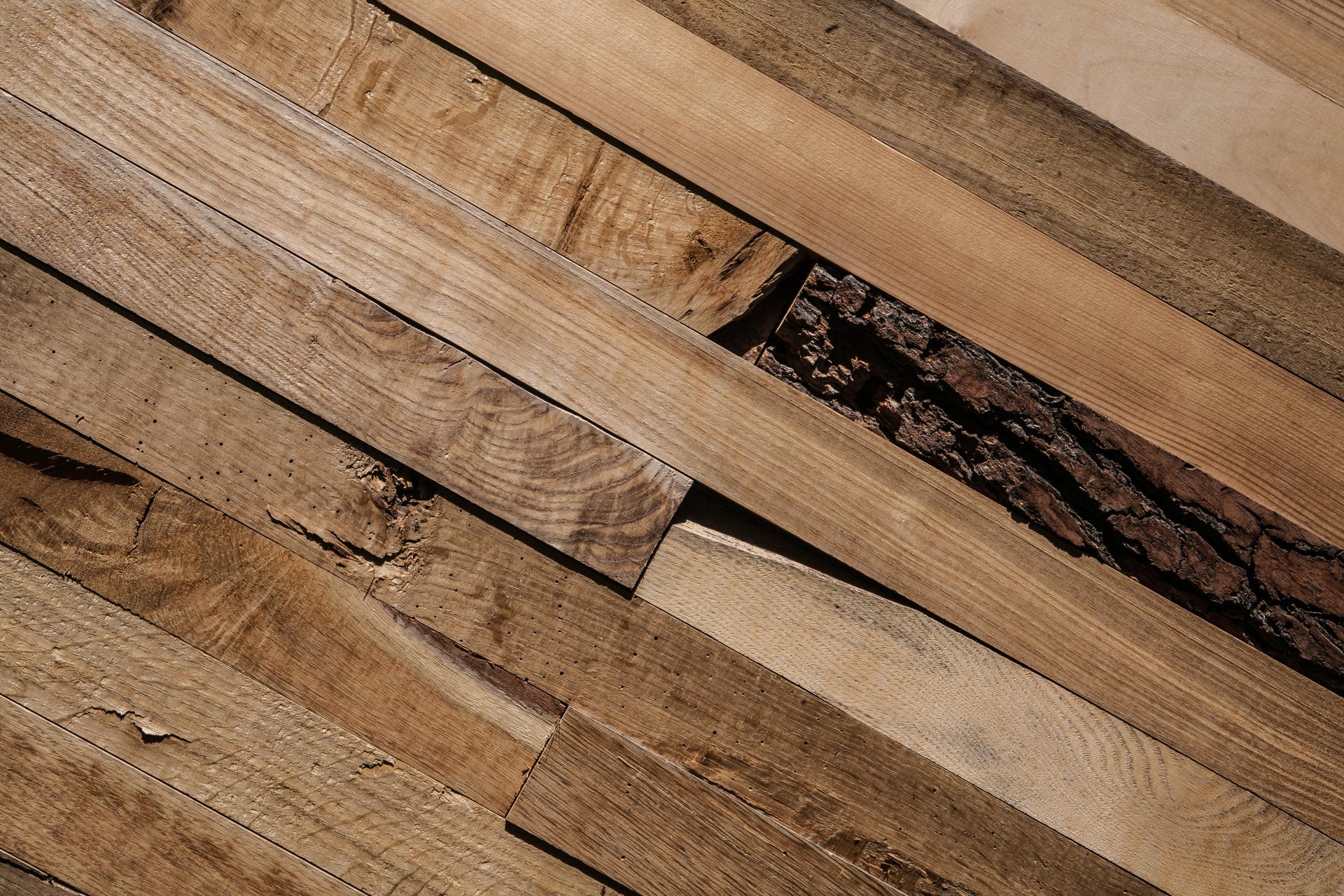
On a communicative level, the wood bricks show the natural characteristics of trees, that create acceptance for deviation from industrial standards. Some of those characteristics result from stress caused by climate change and make the necessity to change our way of building, consuming and living directly visible and tangible in a sensual experience.
Key objectives for aesthetics and quality
The appearance of the pavilion is influenced by the planned cubature in relation to the Tempelherrenhaus and by the diverse qualities of the wood and the process of the buildup, that was open to non-deterministic aesthetics. That means, that the rhythm of wood levels is dependent on some static determinations and coincidence. The combinations of clean bricks and those, that show rather phenomena than defects, was not simulated beforehand and work as a material archive for the six wood sorts birch, book, maple, pine, ash and oak in their diversity in textures and colors. The façade will change during the seasons in an analogy to natural processes – growth and decay, transformation and constancy.
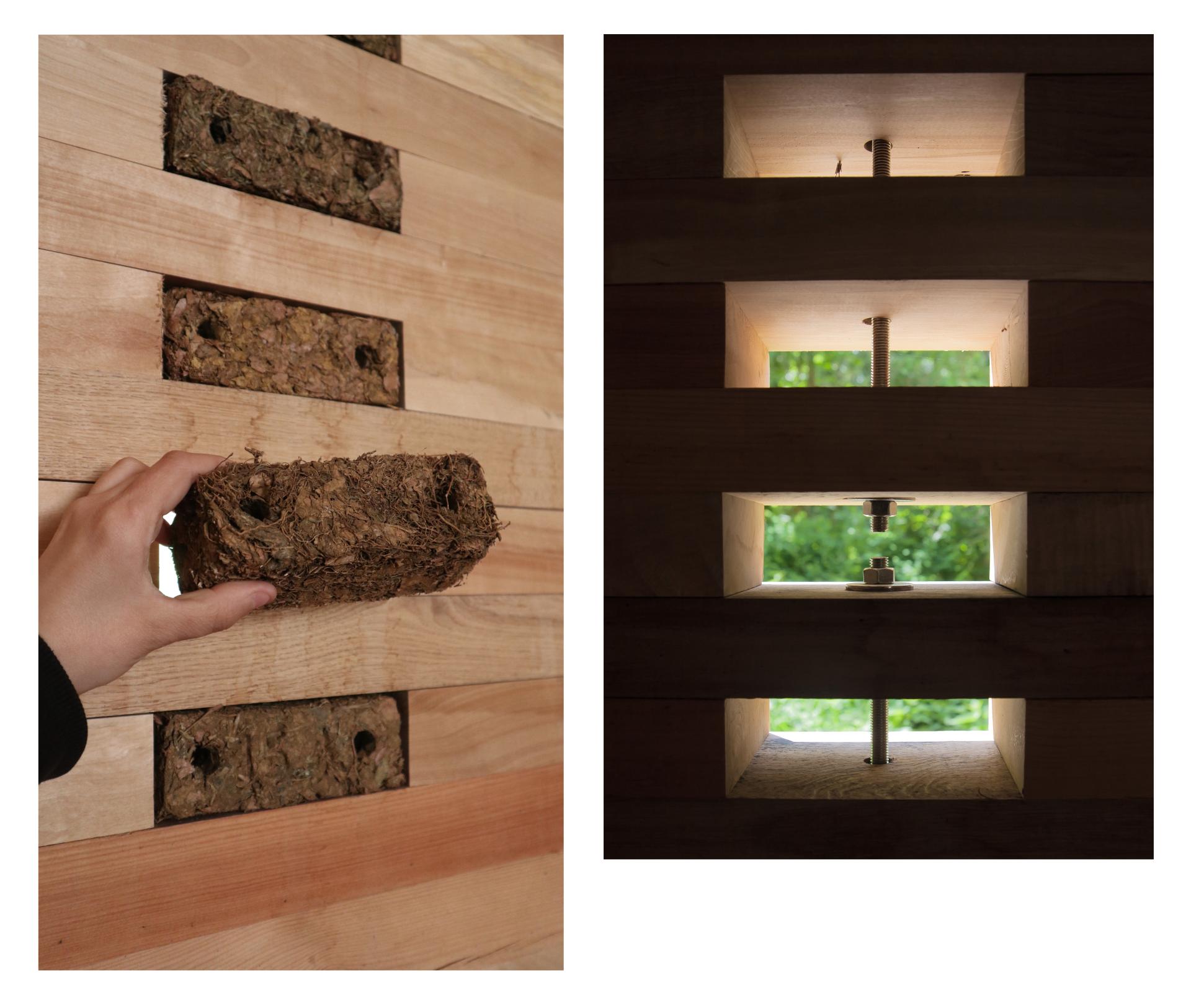
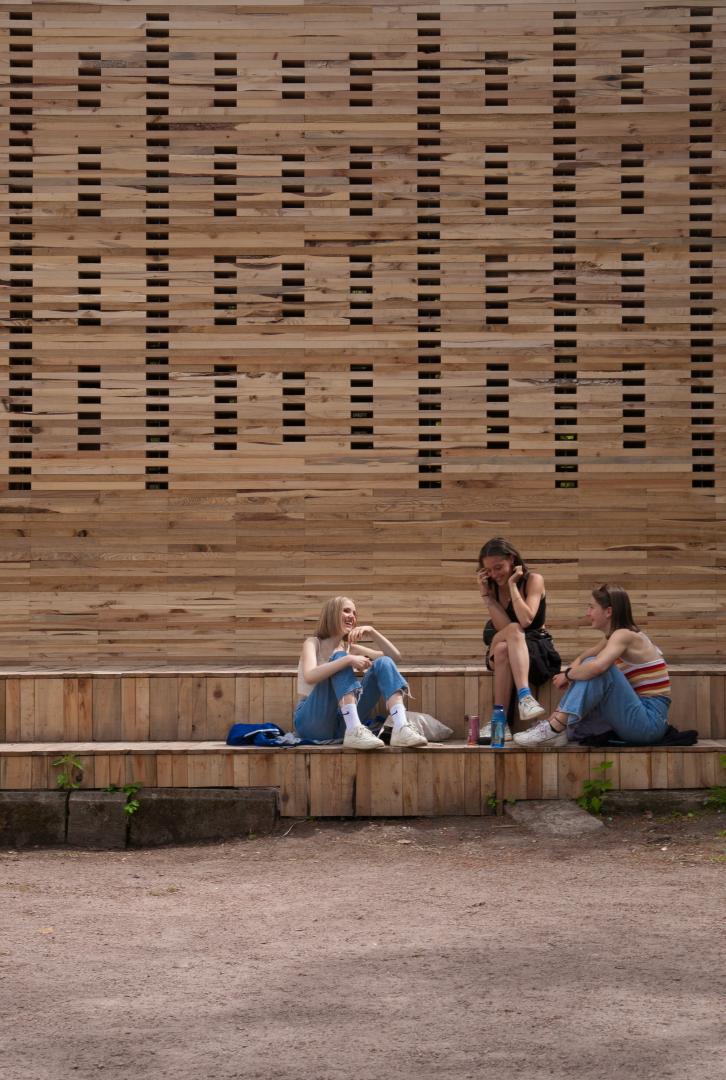
The masonry was designed to leave as many openings as possible. The compactness of the walls is contrasted by hundreds of small cut-outs that transmit light, air, smell and curious views from outdoor to indoor and vice versa. In the course of seasons and the day, the light atmosphere changes constantly e.g. from green daylight that is reflected by surrounding bushes and trees to direct sunlight occurring as many square light spots on the walls to twilight announcing the end of the day. The cut-outs also function as a collectors case for seasonal park material, such as grass and leaves which will be compressed to bricks throughout the year - an ephemeral and tender addition to the solid wood - that rejoins its park cycle as manure after the time of exhibition.
The resting and massive cube, visible from afar, houses a calming inside, connecting with the outside through the openings and the wreckage stones of the adjacent ruin scattered on the site which were partially not overbuilt by the floor.
Visitors experience the dignity and usability of wood sensually – by smelling and touching the very present material, that exhibits a lot a different conditions, views and moods like the immersive interior and the monumental wood archive in which there is not only wood to discover.
Key objectives for inclusion
As the building is sensually tangible everyone is able to perceive it in one or another way and can create an individual reference to material and message. Therefor it creates a space, where people are enabled to see, feel and experience, if this physical proposal is an imaginable concept for material use, construction and ambience in other contexts and living conditions.
In addition to mediation of park wood as a resource, the cut-outs will be filled over time by other compressed park material. Groups of students of varying ages participate in workshops where they collect grass, foliage, roots, hay and so on that was cut by gardeners and press it into “park bricks”. They act as another form of material archive for different activities and seasons of garden maintenance and vegetation itself. The haptic and sensual contact with material and making a contribution to a growing public archive create connection and involvement for young people with their environment.
Results in relation to category
The Green Lab will deliver knowledge on how the facade will change, how the blocks withstand changing weather conditions in their dimensional accuracy. We will learn how much the “special” blocks can take, whether people agree to this aesthetic dimension of wood beyond industrial standards and if this kind of wood can be a real extension to timber products. If so, the wood exploitation per stem increases and noticeable amounts stay in the first cycle of use, instead of ending up in the last cycle of thermal recovery. The process of designing and building this pavilion shows, that a local resource like park wood offers special qualities, that require considerate manufacturing techniques. It’s worth to look for local material, that might not have been seen as a resource beforehand as it might challenge for new ways of using it. In this case the “defected” wood led to the necessity to invent the wooden masonry to make a use of it – mistakes were transferred into possibilities. This way of building is open to extension and improvement and can be further developed for permanent buildings. But the modularity of the system qualifies it for changing situations and needs: an assembly set that is easy to build up under different conditions. Flexibility and the ability for a material-separating disassembly, react to decreasing life span of buildings, whose purpose and/or architectonic topicality had expired, leaving us with special waste that was produced under energy expenditure. An integral work method led to the findings of connections between place, message, material and construction: research, interviews and being part of the daily work of people involved (park staff) were essential to designing a concept. The process was based on honest exploration, which resources the park has to offer. Hence the concept phase took more time than usual. But we saved time, because we didn't just plan but also produce and built up the pavilion ourselves making it one wholesome work of art
How Citizens benefit
During the analyzation process of the park conflicts based on both lack of information and different needs became obvious. The park as part of Unesco world heritage is supposed to meet requirements of historic preservation to remain its status. The needs of people changed since the park was created by duke Carl August - today nobody needs to be privileged to enjoy the park, e.g. for sports, as part of daily infrastructure, children like to play, students like to spend their free time together on the perfectly trimmed lawn. The gardeners receive more complaints than compliments, sometimes people react with strong incomprehension when tress need to be cut to ensure the visitors safety. The park is perceived as “nature” and recreational space in balance to urban areas, but it is highly cultivated and not comparable to a forest. The pavilion - combining the rawness of nature in its wood diversities and the progress of culture in its strict geometric shape of wooden blocks and cubature - gives these conflicts space and a platform to communicate and debate, on how to deal with different needs and duties. Citizen are invited to address needs and wishes, to gather information and understand the connections between garden maintenance, historic preservation and climate change related consequences. The spoken and written language based mediation is strongly supported by tangible access. Understanding and physical experience lead to individual relations which lead to empathy, mindfulness and a considerate living together.
The two topics of consequences of climate change and resource-conserving ways of building which determine this project, go beyond the connections and conflicts in this particular park and are also addressed towards every citizen outside this city. The pavilion emphasizes those complexes of problems in an open minded and friendly way – as an experimental platform for building spaces and ideas for the future.
Innovative character
The principle of a masonry presents the possibility to use as much wood as possible, that reduces the amount of wood and bark that goes to waste. The blocks are stacked under pressure load and stabilize each other, even the quite inhomogeneous pieces. Every piece of wood contains CO2 and is worth saving. Thick boards with a lot of natural phenomena from growth and environmental influence are normally classified as defected and used for non-visible parts or shredded for thermal energy recovery or production of chipboard, that require addition of adhesives, making material recycling difficult. To use the maximum of park wood, a construction was required to obstruct shorter pieces, than regular industrial standard formats. This construction of a masonry allows the blocks to differ in their load values, when laid as one wood type on one level. Statically relevant circular beams are made of longer pieces, strained together by threaded rods and nuts. The space between the beams are filled with wooden brick work of shorter pieces. The beams are connected with each other by rods and nuts as well, stabilizing the walls up to 5,40 m. All wooden parts are based on a grid, that allows a modular construction technique and other architectural forms for future scenarios and purposes. The system was designed for disassembly, all parts can be separated, repaired or replaced if necessary. In case of heavy defects, all components can return to their regular material cycle. Concerning regular cycles: the temporary groundwork is made of sandbags, filled with split borrowed from garden maintenance, that will fill the holes in the paths of the parks after the exhibition. Local material search and temporary utilization result in short transportation routes and multiple use of a resource.