Living side by size
Basic information
Project Title
Full project title
Category
Project Description
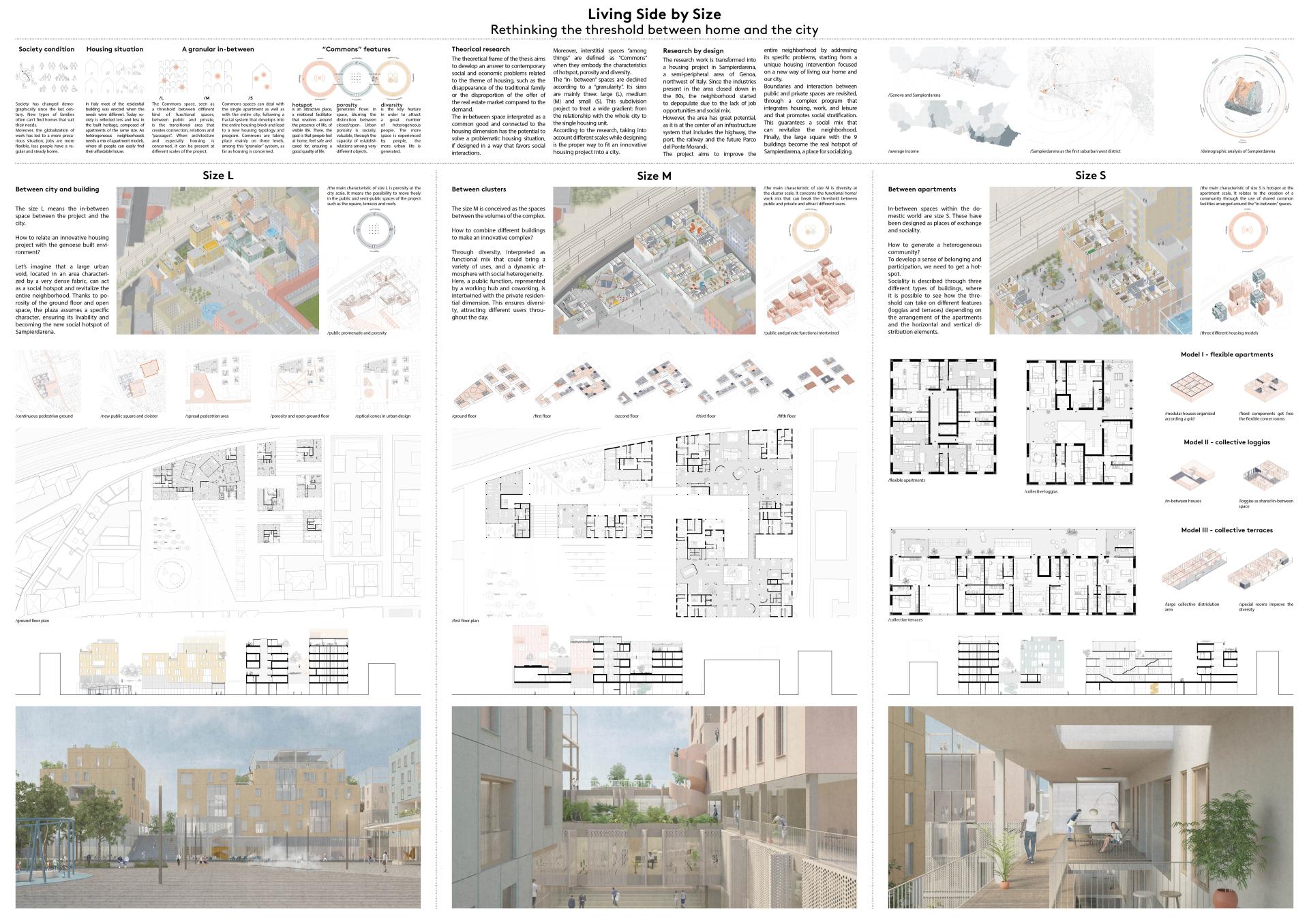
What does the contemporary city offer in order to respond to the needs of the human being from the private to the public sphere? Where do these dimensions meet? How can one dimension penetrate the others? To answer all these questions, the design focuses on space intended as a common good, which is defined by the term “Commons”. As far as architecture is concerned they appear as places conducive to cohesion and solidarity, from the urban dimension to the more intimate and domestic one.
Project Region
EU Programme or fund
Description of the project
Summary
The theoretical frame of the project aims to develop an answer to contemporary social and economic problems related to the theme of housing, such as the disappearance of the traditional family or the disproportion of the offer of the real estate market compared to the demand.
The in-between space interpreted as a common good and connected to the housing dimension has the potential to solve a problematic housing situation, if designed in a way that favors social interactions.
Moreover, interstitial spaces “among things” are defined as “Commons” when they embody the characteristics of hotspot, porosity and diversity.
The “in- between” spaces are declined according to a “granularity”. Its sizes are mainly three: large (L), medium (M) and small (S). This subdivision project to treat a wide gradient: from the relationship with the whole city to the single housing unit.
According to the research, taking into account different scales while designing is the proper way to fit an innovative housing project into a city.
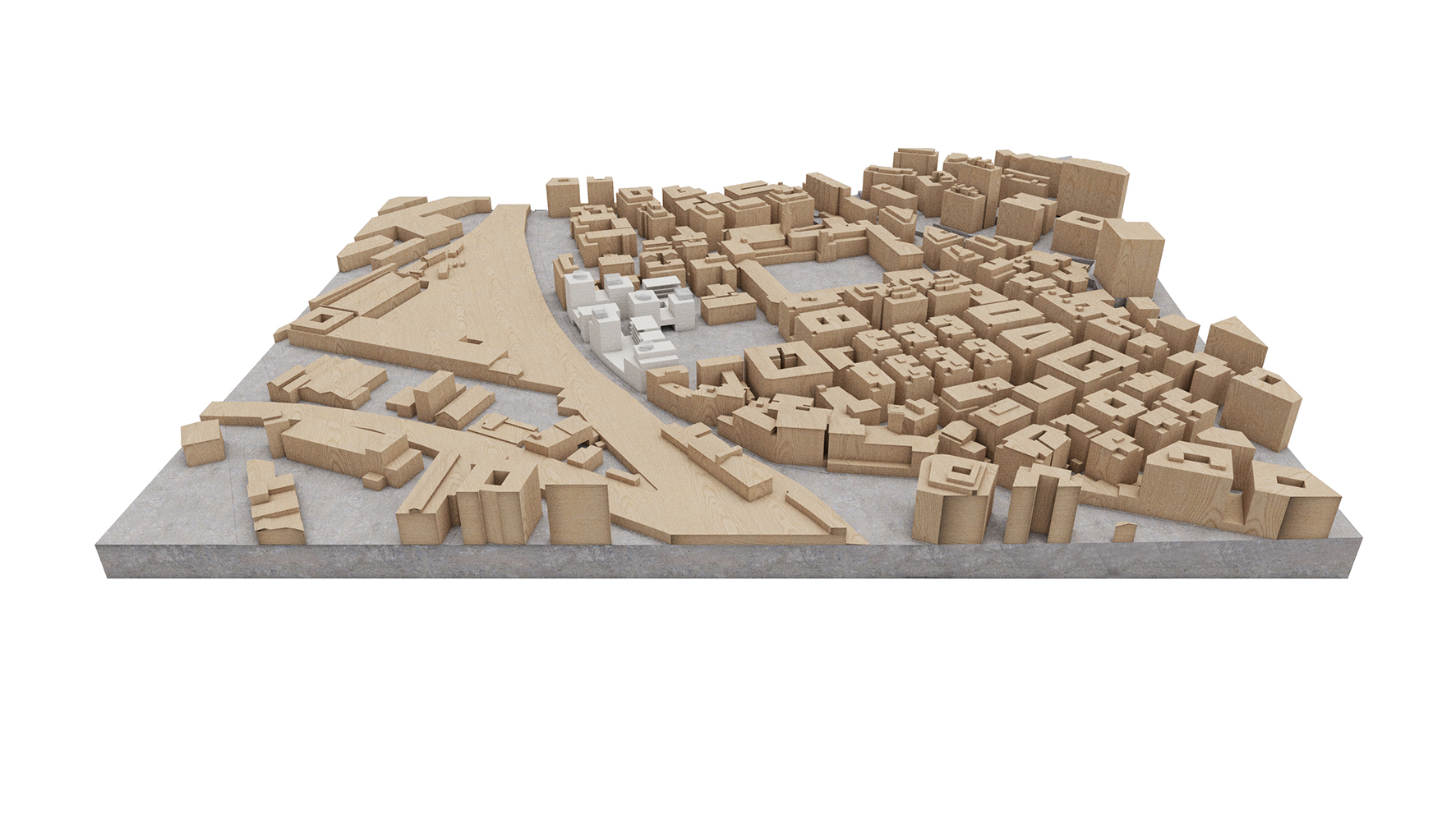
The research work is transformed into a housing project in Sampierdarena, a semi-peripheral area of Genoa, northwest of Italy. Since the industries present in the area closed down in the 80s, the neighborhood started to depopulate due to the lack of job opportunities and social mix.
However, the area has great potential, as it is at the center of an infrastructure system that includes the highway, the port, the railway and the future Parco del Ponte Morandi.
The project aims to improve the entire neighborhood by addressing its specific problems, starting from a unique housing intervention focused on a new way of living our home and our city.
Boundaries and interaction between public and private spaces are revisited, through a complex program that integrates housing, work, and leisure and that promotes social stratification. This guarantees a social mix that can revitalize the neighborhood.
Key objectives for sustainability
The project represents a version of "social" sustainability, aiming to regenerate the surrounding neighbourhood through an innovative housing project in which a large number of different realities coexist. Moreover, by sharing spaces and facilities, a certain level of affordability is guaranteed, which is not easy to find nowadays in big cities like Genoa.
Nowadays there are many cities in continuous growth where the number of inhabitants is drastically increasing and, on the contrary, others that are depopulating. On the one hand, the sudden increase in population leads to a quick construction of residential complexes where the quality of spaces and neighborhood services is always less and less important. On the other, the decrease in population leads to the closure and abandonment of the activities located in the neighbourhood. In both cases, the main consequence is the deterioration of the quality of urban life.
It becomes interesting to reflect about the way the changing condition of the contemporary city is shaping and articulating our existence. In particular, some concepts and activities, such as living and human interactions, have always been present to variable conditions over time but never remained unchanged, just adapted to the evolution of the city and the context.
The real objective of the project is to create a community that takes care of the place where it lives and consequently regenerates its urban surroundings. This is the sustainability the project is aiming for.
The focus on the ground as a common good is centered on the urban point of view, dealing with the relationship between home and city. This residual space, defined as in-between, assumes different scales into the architecture. It is based on three characteristics, hotspot porosity, and diversity, necessary to define the in-between as Commons, in other words, generator of relationships.
Key objectives for aesthetics and quality
Quality of experience, aesthetics and functionality meet in the characteristic of porosity.
It is declined in the public, semi-public and private pathways on all floors of the complex and defines the shape of the building. Porosity allows the possibility to see and move freely within the building, limiting the barriers of privacy. In this way, it is possible to experience the whole project without boundaries, from public spaces such as the square or the public promenade to semi-public spaces such as coworking and then private apartments. The distributive space, usually interpreted as a waste space, becomes the added value of the project as they are lived as spaces of encounters and interaction. Porosity is thus a spatial notion that blurs traditional distinction between closed and open, mass and void. But porous architecture is not just an attempt to open up the built environment; it has social, environmental and economical value, through the capacity of establishing relations among things.
Key objectives for inclusion
The in-between spaces are the protagonist of the project and they are generators of quality of life when they embody the characteristics of hotspot, porosity and diversity. In terms of inclusion the key objective is to guarantee the ones of hotspot and diversity.
Hotspot means an attractive place, a relational facilitator that revolves around the presence of life and visible life. Concepts such as community, aggregation, belonging, personalization, participation and security serve to create a hotspot and to defeat the generic nature of new contemporary cities. In fact, people come together, live the place, and experience it through aggregation.
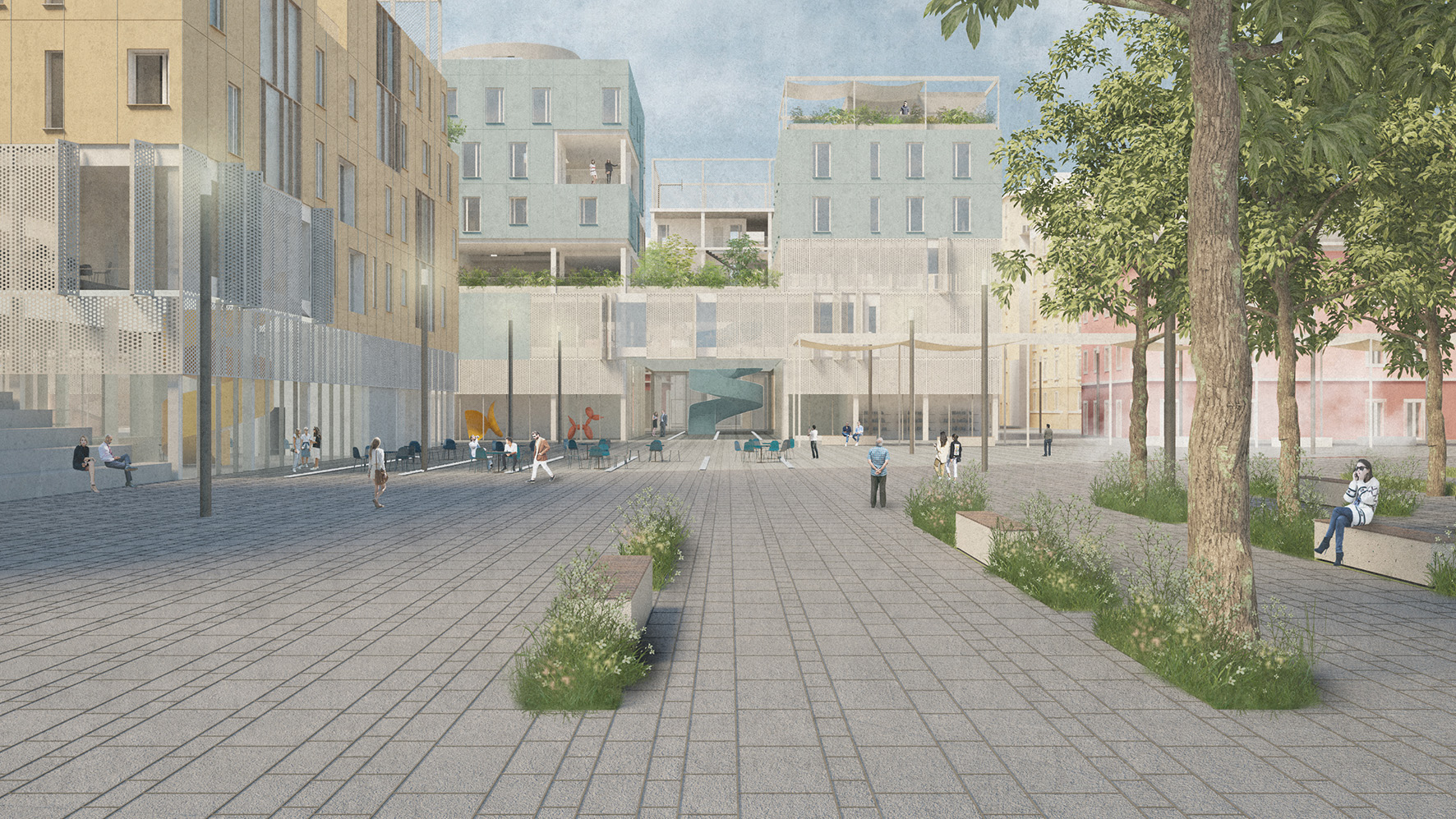
These hotspot spaces, seen as a threshold between different kind of functional spaces, are the transitional area that creates connection, relations and community. They are present at different scale in the project. From a large plaza for the entire community of the city, to semi-public terraces or shared rooms and roofs inside the buildings.
In order to achieve inclusion a space must respond not only to the characteristics of hotspot but also to the one of diversity, which is the fundamental characteristic for the space to be lived. The aim is to understand how a space can be used at every moment of the day by different kinds of people who carry out different activities. The more varied and complex the functions and the uses are, the more likely it is that they will attract a greater number of people, especially of different ages and backgrounds. The more space is experienced by people, the more urban life is generated.
A public function, represented by a working hub and coworking, is intertwined with the private residential dimension. This ensures what we call diversity, attracting different users throughout the day. In addition, the size variation of the flats reflects the concept of diversification in order to attract as many users as possible (singles, families, elderly, students...).
Innovative character
The real innovation presented by the project is the way of interpreting the spaces between the built environment (in-between) in a way that generates social inclusion and creates a community, if interpreted as a common good. This, linked to the housing dimension, has the potential to solve a problematic housing situation, if designed in a way that encourages social interactions.
In order to better analyse the characteristics of these in-betweens, they were declined in 3 different scales according to the relationship with the city (size L), between clusters (size M) and between flats (size S).
In particular, the main characteristic of the L-dimension is porosity at the city scale. It means the possibility to move freely in the public and semi-public spaces of the project such as the square, the terraces and the roofs.
The M-dimension is diversity at the cluster scale. It concerns the functional home/work mix that can break the threshold between public and private and attract different users.
The S-dimension is the hotspot at the flat scale. It refers to the creation of a community through the use of shared common facilities arranged around in-between spaces.