PLATTENBAU - a holistic pedagogical mean
Basic information
Project Title
Full project title
Category
Project Description
PLATTENBAU sees itself on the one hand as a homage to the spatial concept of the young Bauhaus, and on the other hand as a universal learning and teaching aid that serves to understand complex topics and helps to communicate by using space relations and abstraction.
The ability to imagine is trained on abstract elements as relations in space and can as principle, be applied to any scale and complex of themes. This stimulates holistic thinking and makes it tangible and by this thinkable.
Project Region
EU Programme or fund
Description of the project
Summary
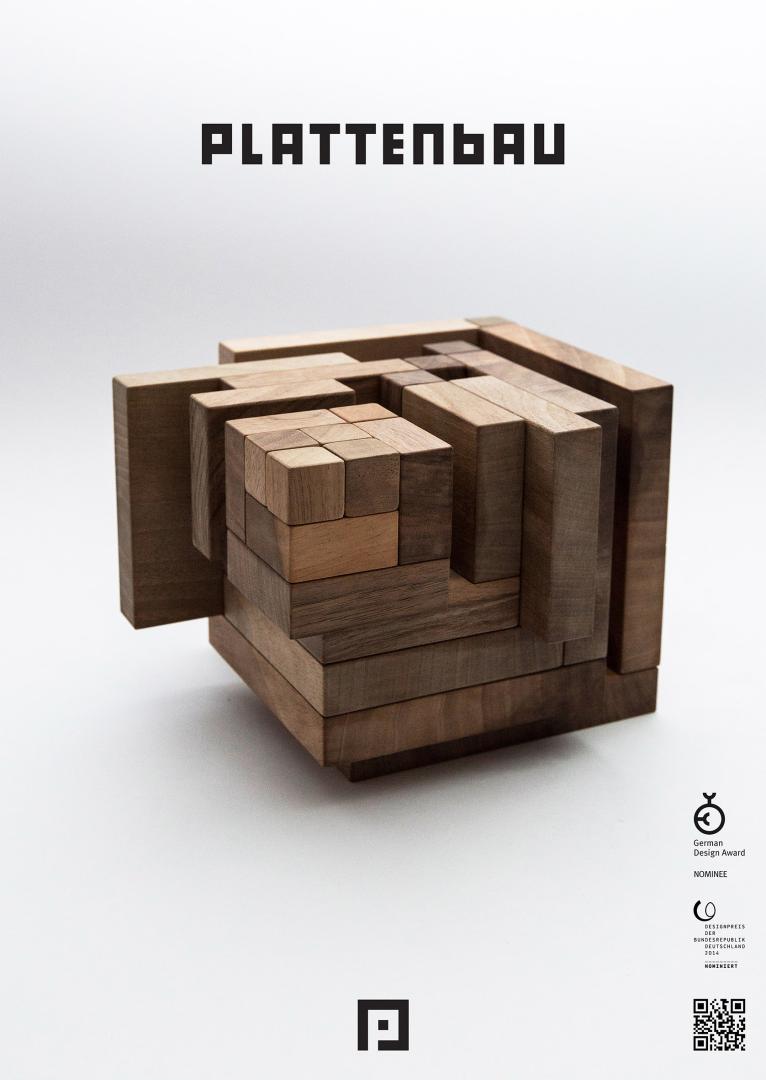
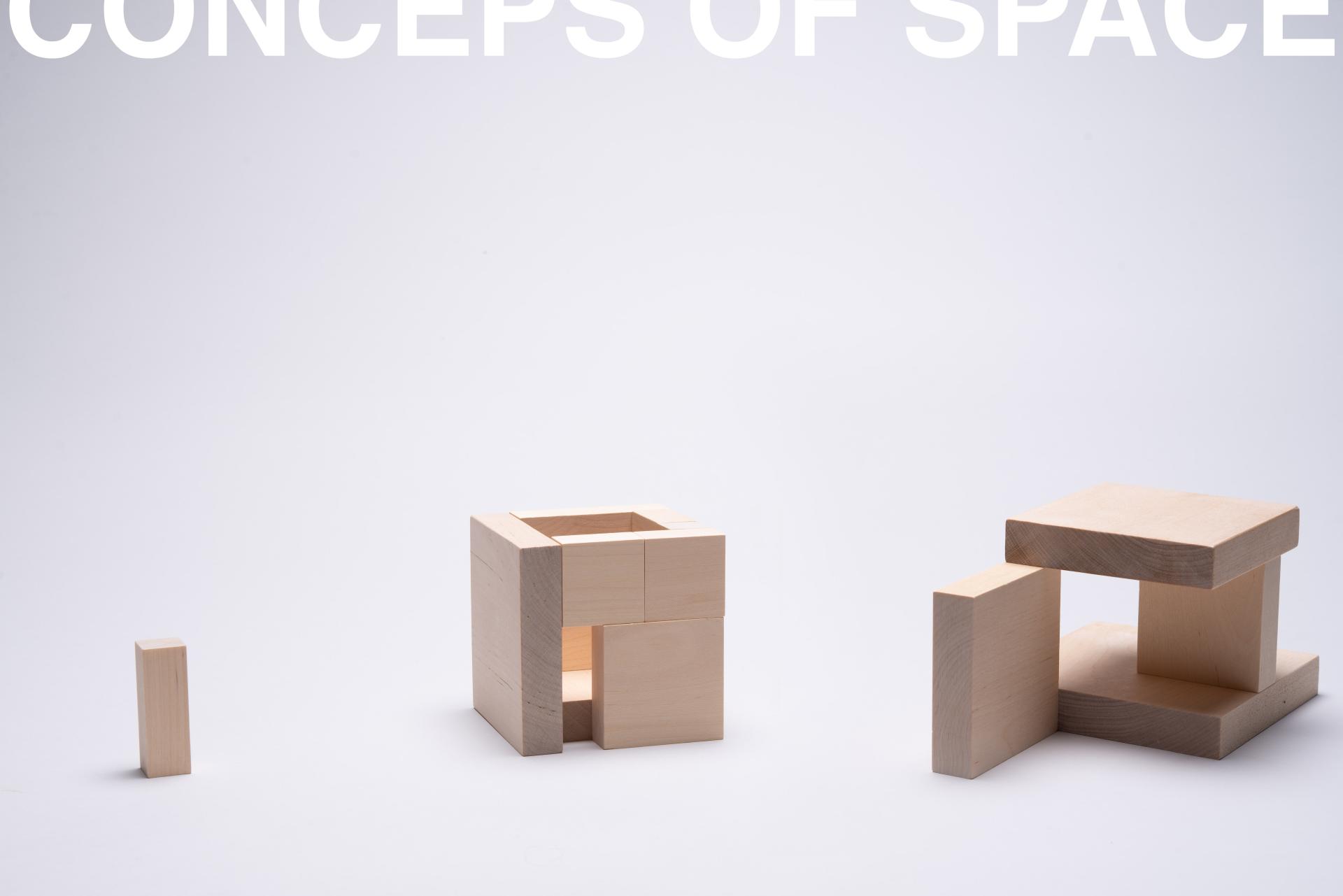
PLATTENBAU is a red dot award-winning design object. It consists of 25 ashlars which, when put together in the three spatial axes, form the shape of a cube. The modular system PLATTENBAU is to be understood as hardware for a holistic pedagogical concept that can be used in all phases of education and in all disciplines. A communication tool that expands understanding by the dimension of space - as a universal language. The pedagogical concept around the work- and visual tool PLATTENBAU is based on the constant reinterpretation and reassembly of abstract ashlars in a spatial structure and an imagination gained from aesthetic experience.
From early childhood onwards, and building on all further development phases, an aesthetic understanding of the laws and geometries underlying the phenomena is trained.
Where imagination is lacking, insight is also lacking.
As a teaching and learning tool, the aim is not only to represent one's own thought processes and to communicate about them with others, but also to create open intellectual space. Through the concrete location of the ashlars in the room, the facts are illustrated, but remain open for all recipients to develop their thoughts. Depending on the topic, the participants in the "discussion" actively intervene in the "space of thought" and thus find a construct that reflects the commonsense in a processual and open-ended way. In this way, the kit functions as a kind of thought vehicle that is loaded by the recipients with their own ideas and thus opens up a common thinking space.
So far, 36 learning modules have been mapped in a user-friendly way: e.g. algebra, fractions, urban planning and architecture, history, politics, resources, economic cycles, and many more. Further applications are in preparation.
With abstraction and interaction as well as the universal possibility of implementing very concrete problems and solution approaches, PLATTENBAU leads to spatial solutions that can be experienced again and again
Key objectives for sustainability
If the call for a NEW European Bauhaus can save the world, then only with an insightful sense of responsibility and an understanding of complex interrelationships and the insight into the necessity of a principled rethinking and action.
PLATTENBAU is a play, teaching and learning tool that, in addition to conveying teaching content in a vivid way, above all trains the holistic view and understanding of complex interrelationships through abstraction and relations.
An understanding of sustainability is also conveyed through the kit itself. Through the aesthetic clarity and purism and the use of the same working and visual model for the most diverse contents, the appreciation for reduction to the essential and simple is implemented.
Furthermore, untreated, polished wood is one of the most sensual, durable, natural and sustainable materials of all.
PLATTENBAU is sustainable on all three dimensions:
1. the teaching concept creates awareness for sustainability.
2. sustainable in its use, as one and the same object is used for a wide variety of teaching contents from early childhood to old age and is also inherited.
3. sustainable in material, as it is made of polished, unsealed FSC solid wood, which still has a high calorific value if it is not inherited.
(In 2018, PLATTENBAU was newcomer by the Green Product Award.)
Key objectives for aesthetics and quality
The appearance of our built environment is the result of our mental state and reflects cultural thought patterns.
An open, creative mindset is a prerequisite for an open, democratic society in which as many points of view as possible can be grasped and thus taken into account.
This mindset leads to livable, sustainable, social and aesthetically designed living spaces that offer inspiration and space for development.
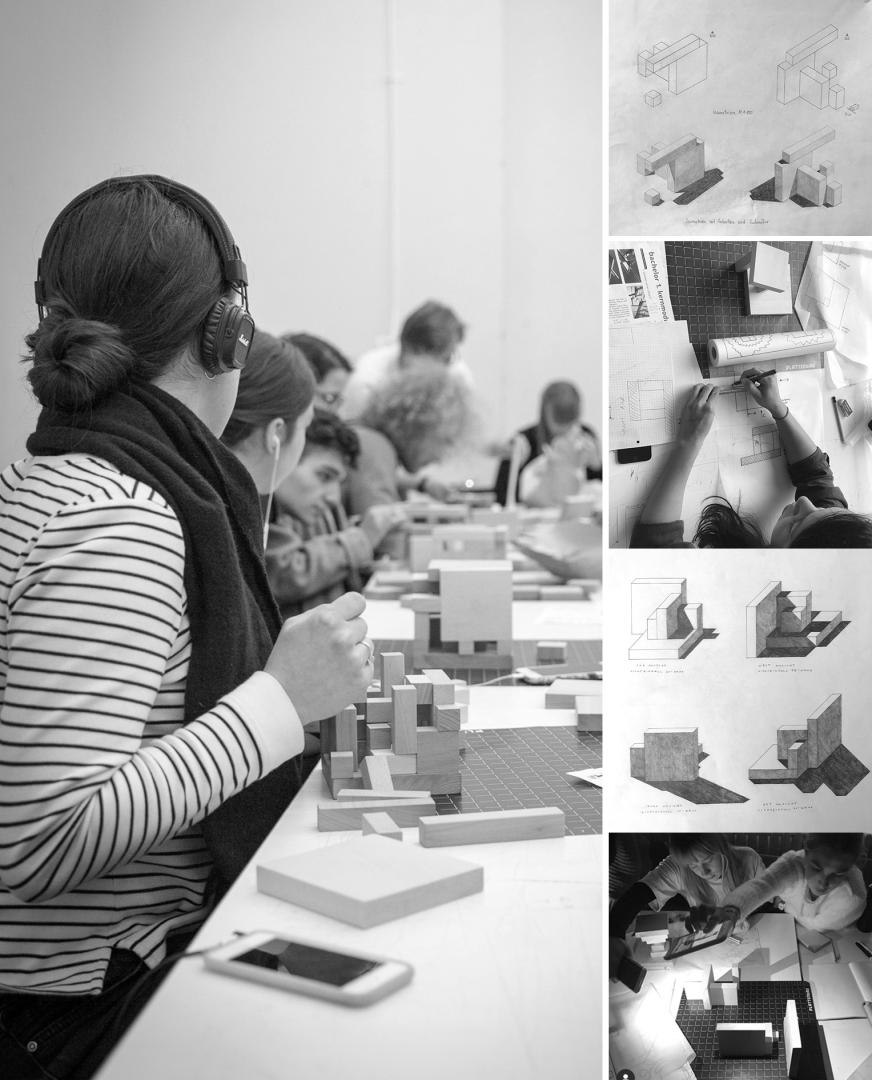
In design projects, this connection of design quality and design process with the kit becomes clear. The internalised understanding of the inherent laws of meaning, similar to a DNA that gives the design aesthetic clarity and character, can be read from the designs. Architecture students report a supportive and interactive design process in which sensual bodily experience provides an important sphere of experience.
The puristic feel of the velvety-soft polished natural precious wood stones invites the senses to touch them and, through the inherent geometric regularity, leads to a stimulating confrontation.
From 7 different slab sizes, all with the same common denominator, not only the elementary of the original cube can be conceived, but also a great variety of rooms can be formed from this forming principle, all of which belong to the addition principle of modern building, as they can always be placed in a harmonious relationship of proportions to each other.
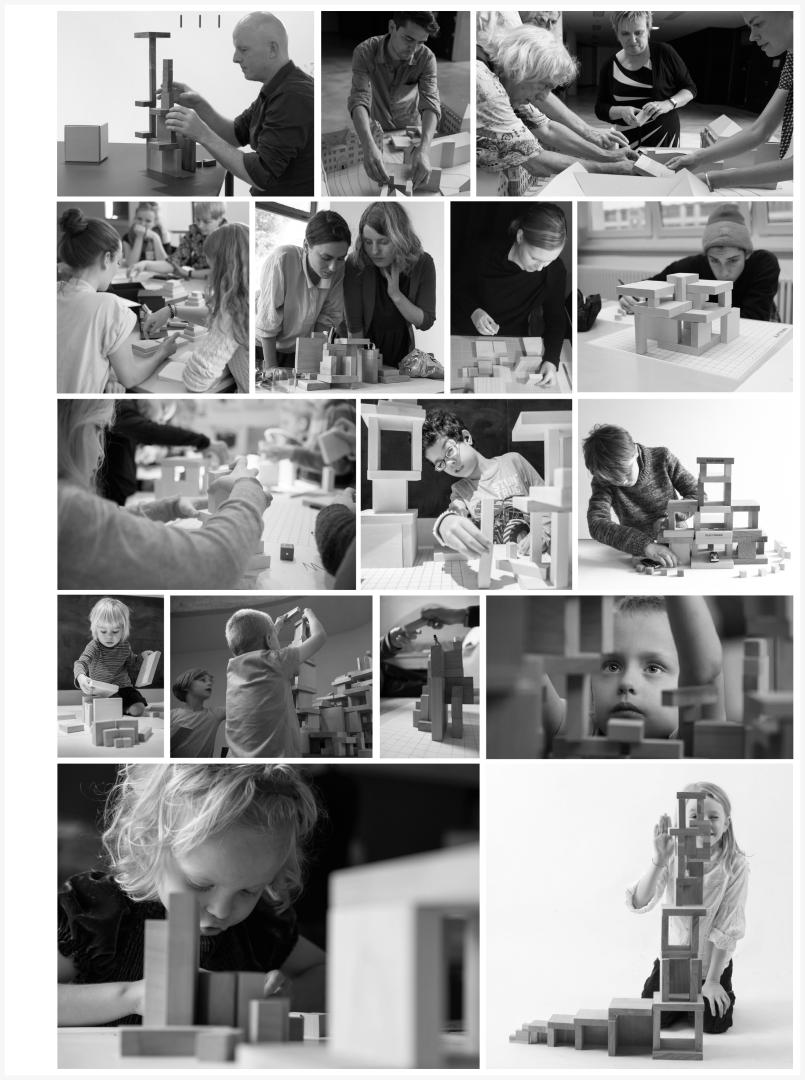
Already children develop their sensory-motor skills and a feeling for statics and spatial imagination when playing / building. They develop their imagination through ever new applications and ideas. In the process, they experience different spatial effects and learn to form within a basic mathematical principle.
The combination of haptic, sensual experience enables mental construction and mobile thinking as well as orientation skills in complex spatial structures.
Key objectives for inclusion
The kit is an intuitively usable communication tool.
Abstraction and interaction lead to a new universal language that can be experienced directly:
PLATTENBAU is the natural hardware for holistic sustainable learning concepts. It includes all pedagogical phases and subject areas. Via spatial abstractions, almost any understanding and a universal approach to solving problems succeeds: analogue, haptic, intuitive and interactive.
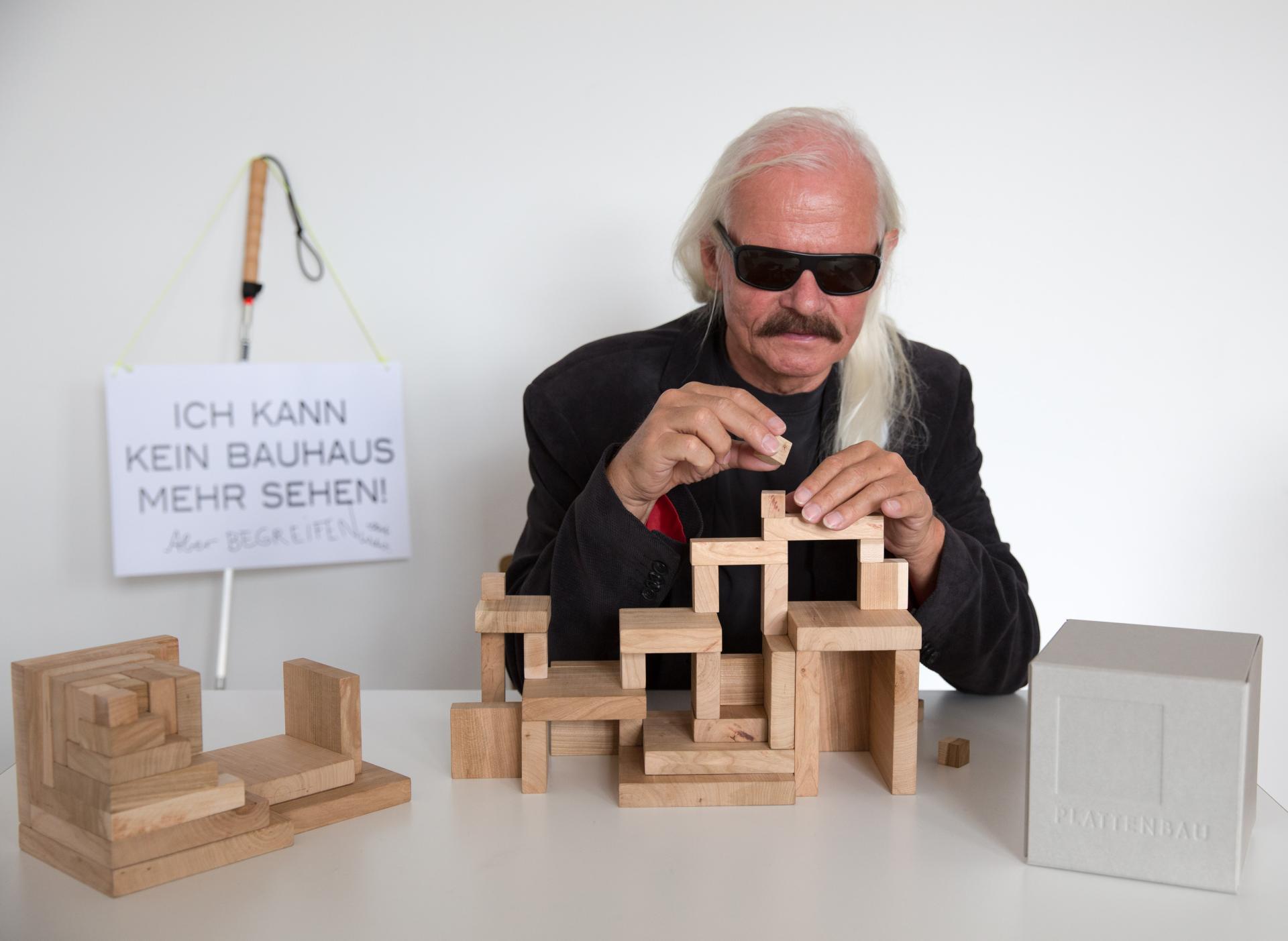
Not only the teaching concept but also the object itself is embodied inclusion.
Usable and applicable by everyone for the most diverse and individual intentions. Gender neutral. Supporting mediation in a sensual and concrete way. Mediating not only between cultural, linguistic and professional barriers, but also between generations. A means of mediation at all levels.
Results in relation to category
Educational processes take place against a background of rapid social change.
Learners and educators alike are faced with the challenge of understanding and responding meaningfully to increasingly complex and constantly changing structures. Due to the increasing abundance of information, more information has to be filtered and mentally classified into contexts in an ever shorter time. The abundance of information is worthless if data and facts cannot be related to previously acquired knowledge.
Accordingly, the ability to understand complex contexts must be part of basic education, because this is the only way to ensure the development of rational self-determination.
The pedagogical concept includes a variety of applications as well as interdisciplinary and inter-year teaching designs. The primary aim of the teaching and learning tool is to develop the imagination on the basis of substantial processes before it is fooled in cyberspace.
Here, a tool is given to playfully acquire an understanding of structures, aesthetics, proportionalities. In addition, the ability to imagine complex contexts, analytical thinking, analogy building, critical thinking and thinking in models is trained.
In this way, cognitive schemata are created in which sensory experiences and mental processes (ideas) are linked. These schemata in turn form the framework against which other complex issues can then be grasped and solved.
The method thus helps to transport teaching content, i.e. WHAT is learned, as well as to put this learning content into relation _ i.e. HOW one learns. Human consciousness is quantitatively insufficient for understanding the complex world. Circumstances whose complexity exceeds a certain level can no longer be grasped by the mind. The solution is to replace parts of reality with models of thought. Here, PLATTENBAU offers the tangible analogy to the chosen "conceptualisations".
The haptic encounter helps to get things under control. (Soothing effect of touch)
How Citizens benefit
In various participation formats, where the aim was to practice design processes more democratically, the use of the kit offered a quick and intuitive access for all participants to explain their wishes and ideas on the model and to show the associated added value.
Example: Space for Democracy (see website Events)
In general, the kit makes the involvement of lay people and users in the design process much more inviting.
The symbolic opening up of a generally comprehensible thinking space by means of the building blocks on a specific topic / issue in which the most diverse experts and laypersons have easy access due to the simplicity of the presentation. The degree of abstraction remains intact when transferred to other scales, so that the scope for interpretation remains open and provides inspiration for further aspects through new experience / impact at the location. (see website: Event: Locomotion)
In this way, design processes enable more participation, are more comprehensible to outsiders and invite interaction, remain open to results through the transfer to different scales and environments and enrich the design stages through new associative and creative impulses from the disciplines involved.
In this way, design processes concerning public space, for example, can be more social, innovative, aesthetic, inspiring, invigorating, flexible, multifunctional, using resources (and thus saving them) and, above all, adapted to the actual needs, and above all designed by the users WITH.
Low-threshold access and the inclusion of a broad expert and user community in the design process creates understanding and willingness to support and contribute ideas. Entering a common space of thought and understanding and shaping / formulating a desirable future creates confidence and turns people into responsible co-designers of our future.
Innovative character
The unique selling point is the combination of ONE teaching and learning tool with a comprehensive pedagogical concept that covers all phases of development.
"The innovation consists of the perception-promoting illustration of knowledge-relevant relations on the object side and the related pedagogical concept of deep knowledge structures. The strength of the special object is its diversity and completeness of the relations it contains, which makes it the image of many, if not most, possible relational knowledge structures. These, in turn, are all those contents that do not represent pure individual facts, but rather networked and thus usable knowledge. The complete path from the concrete view to the abstraction is mapped. The approach is also completely cross-domain, cross-target and cross-subject. It can therefore be used in any subject area, with any question and at any level of abstraction." Prof. Dr. Andrea Dreyer; Art and its Didactics; Bauhaus University Weimar
"Currently there is no other method that can mediate between concrete observation and abstraction in such a targeted and simultaneously learner-centred way." PD Dr. Pablo Pirnay-Dummer Educational Psychology Martin Luther University Halle-Wittenberg;