Responsive Tile
Basic information
Project Title
Full project title
Category
Project Description
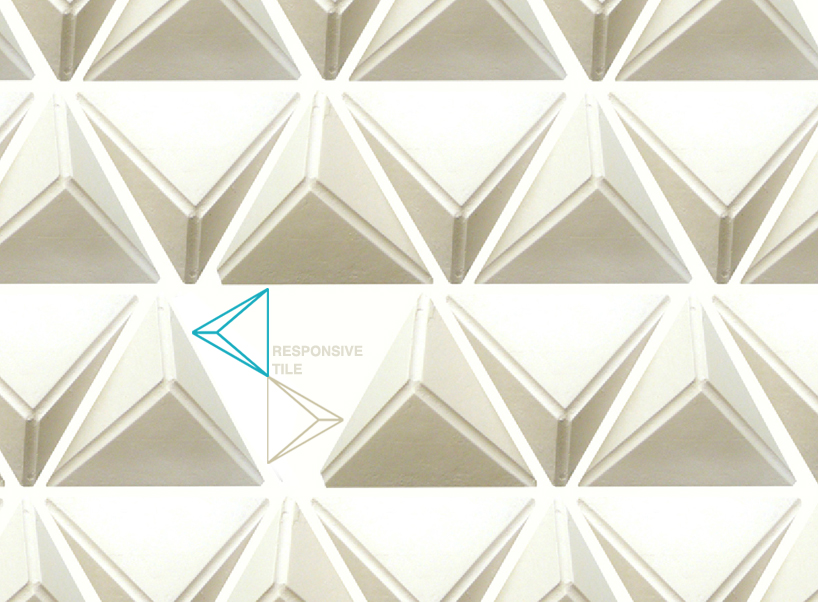
Responsive tile is a ceramic module that changes color according to weather conditions, specifically temperature variation. The tile is a low-tech/high tech-sensing artifact, which aims to convey awareness of water scarcity in urban contexts. This information is given in a playful manner, using reversible properties of thermochromic inks to convey content. The tile is module that behaves like a physical interactive device that can be assembled as a wall.
Project Region
EU Programme or fund
Which funds
Other Funds
Portuguese Science and Technology Foundation (2010)
Description of the project
Summary
Responsive tile is a ceramic module that changes color according to weather conditions, specifically temperature variation. The tile is a low-tech/high tech-sensing artifact, which aims to convey awareness of water scarcity in urban contexts. This information is given in a playful manner, using reversible properties of thermochromic inks to convey meaning. The tile is module that behaves like a physical interactive device that can be assembled as a wall.
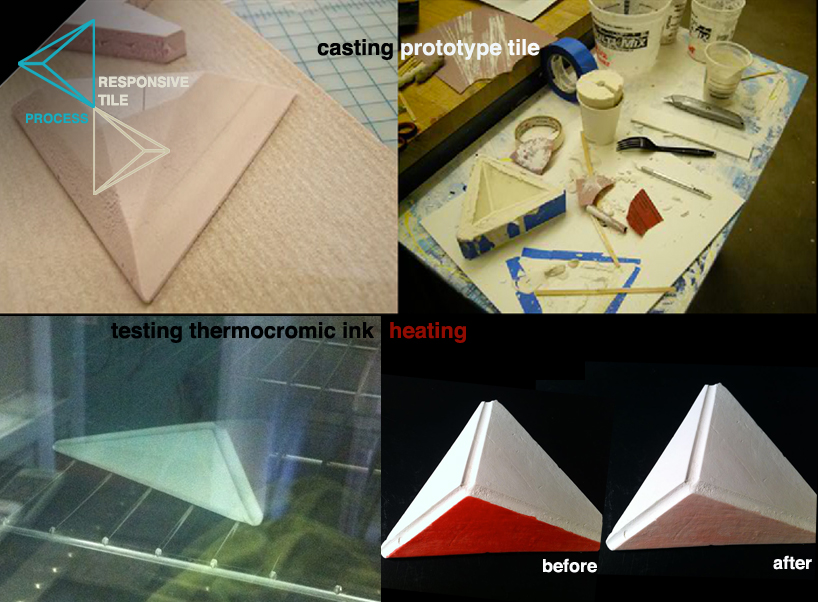
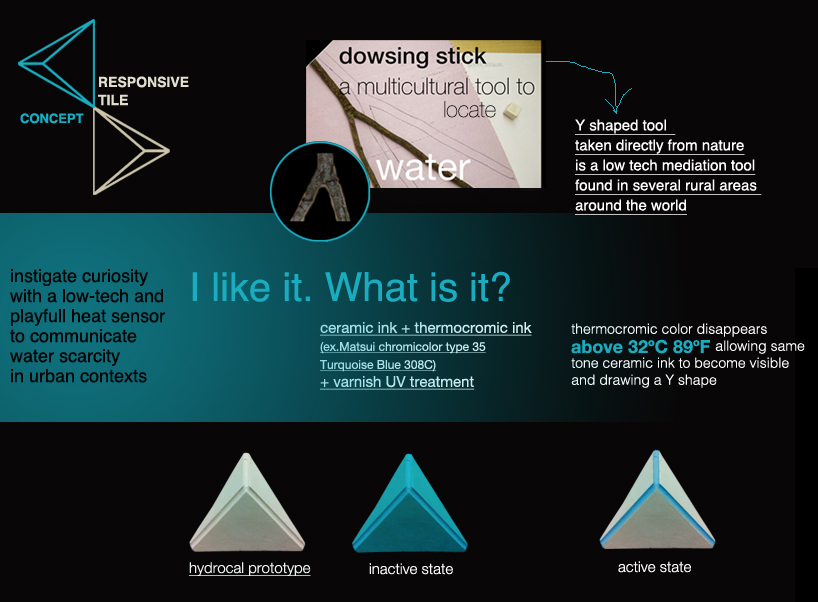
Each tile combines thermochromic and ceramic inks. The smart ink will respond to temperature variations. Thermocromic inks change color, and permits to display visual, dynamic and symbolic information that transforms a common tile in a responsive and communication device. The particular ink chosen in this project disappears above 32 ºC, and makes a Y shape visible. This is as a reference to a dowsing stick shape, the magic tool to find underground water. Thus, using symbolic cues, aims to convey a universal significance instead of referencing to a particular cultural view or language.
Key objectives for sustainability
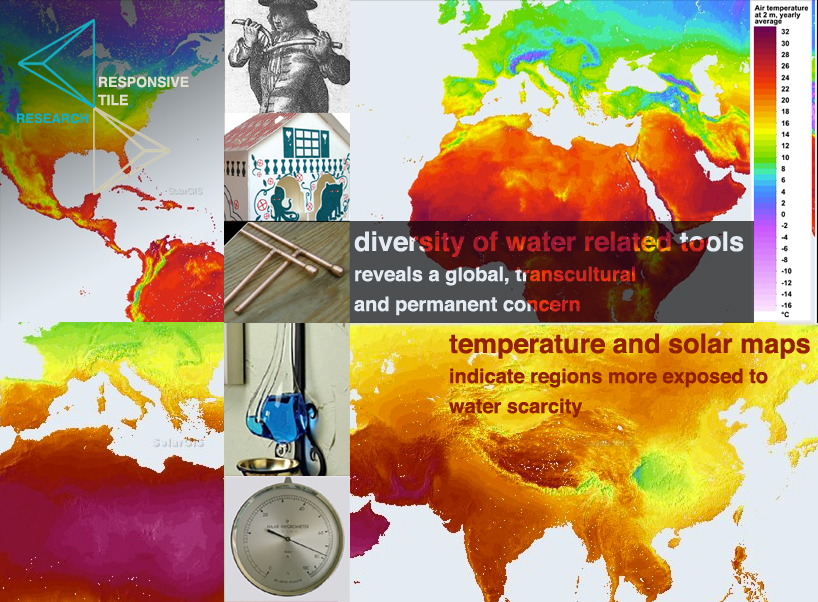
This projects builds unpon on the idea that sustainability extend beyond borders. This fact, drove research beyond a particular geography or culture. A irradiation, and temperature average maps identifyed where drought could be more prevalent and clearly located the problem as worldwide. Under this light, this project is thought as site-specific, designed according to weather patterns and geographic variation.
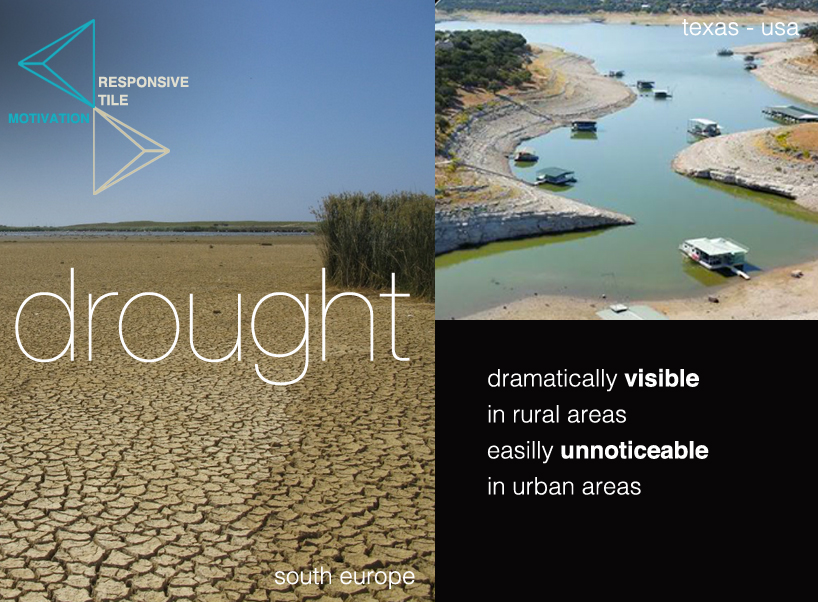
A closer analyzes reveals that, despite drought being a problem with great economical and humanitarian impact is only visible locally, as dramatically changes occur in natural landscapes, in rural areas. Therefore, water scarcity has a problem of scale and invisibility. Indeed, drought visible effects in the landscape are somehow inexistent in urban contexts. This common invisibility on urban environments creates a sense of distance and disconnection from the problem.
Key objectives for aesthetics and quality
From observing qualities on the objects related to water, the dowsing stick shape was chosen as inspiration. Indeed, a multicultural focus group recognized the dowsing sticks worldwide, and therefore widely accepted as a trans-cultural tool.
Placing an interactive device in public spaces aims to promote awareness in a playful and non-intrusive manner. . Thus, this object would not use direct textual messages, but innuendos and a symbolic language. The use of graphical information (e.g. drawing of a Y) allows the level of communication to become international.
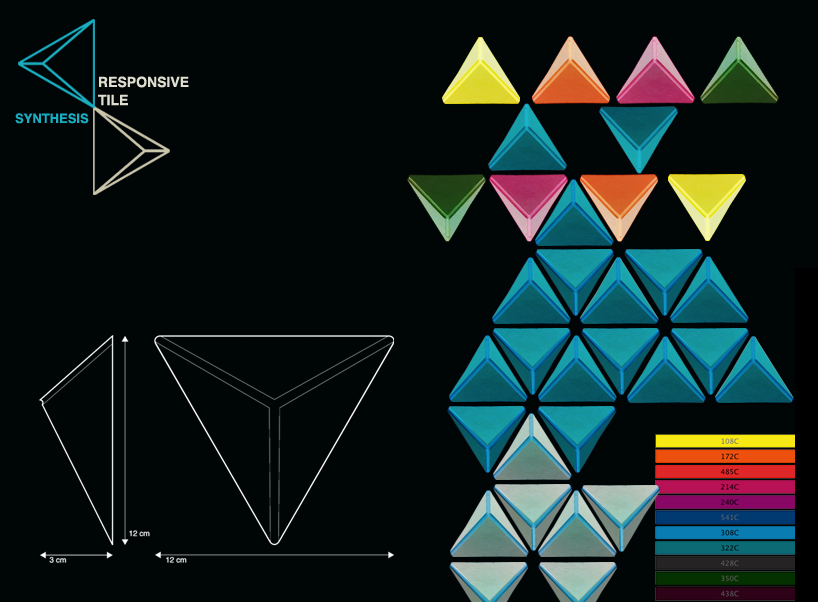
The adopted final design took the shape of a triangular base pyramid (12cm x 12cm x 3cm). The tile was sketched from the Y shape. The 3d pyramidal shape was designed to better drive water to the soil though. Also the Y, which is embossed in a negative space, is designed to drive water.
Responsive tile is a communication device that conveys invisibilities. In particular, the waste of water. Therefore, this project would refer to water scarcity, suggesting people to save water. The object would emulate nature response to drought; this is, by giving visual cues. Therefore, shape and color change according to the environment. Furthermore, this project presents the potential of materials to tell a story.
Temperature serves as a marker, according with environmental variation. Thus, high temperatures are signalized by the Y shapes. Thus, creating a visual sign and informing people to be aware and to save water. The communication strategy aimed to add surprising behaviors to a common object, in this case by placing it in the public sphere. In sum, the object interacts with the environment and acquires meaning complying with a sustainable narrative.
Key objectives for inclusion
Responsive tile results from collaborative design between Lindsey Culpepper and Isabel Paiva. The engineer Rita Pontes contributed with technical data, concerning implementation of the concept, materials and prototype testing.
The meeting between a Portuguese and American designer revealed that environmental issues was a problem of mutual concern. In particular water scarcity was visible both in Texas (and southern states of USA) and in Southern Europe.
The project methods in use, reply to an initial challenge on “practical as research” collaboration that would be inclusive and transnational.
Results in relation to category
As product design responsive tile revisits tile surfacing traditions. It is inspired in Mediterranean countries, were tiling is a architectural cultural heritage. In this context, ceramic tiles can be used as particular weather sensor built into buildings. Moreover, tiles beyond having endless aesthetical potential, have isolation properties, and can refresh environments. Therefore, ceramics is a comfortable material in places where high temperatures are common.
How Citizens benefit
The challenge of designing cross-culturally, resides in connecting cultures, considering their difference, and political divisions.The base inspiration for this project resolution is storytelling tackling a global identity and concern for our planet. From observing qualities on the objects related to water, the dowsing stick rose as an inspiration. Dowsing sticks can be found in USA, Portugal, China or Iran.
The discussion on its real utility as a measurement tool, and accuracy was secondary. More prevalent was considering its magical function, as a mediation tool, that stimulates imagination, and having the potential to inspire re-linking concepts (as art and science). The object synthetizes the basic value that water has to life.
Responsive Tile performance depends on external factors. Therefore, these conditions have to be determined firsthand, in order to devise the placing for the product.
For instance, focusing only in Europe, according to a solar map, is made evident that countries in southern Europe have higher irradiation during the year and, consequently, higher air temperatures than other countries Average temperatures in Portugal during the year vary from 14ºC, to maximum temperatures near the 40ºC in summer. Therefore, a thermochromic ink with a transition temperature of 32ºC would operate perfectly to indicate high values of temperature.
In contrast, in northern countries, for instance, Finland has the maximum value of 30ºC during summer therefore, a thermochromic ink with transition at 32ºC would not convey the concept. These two examples demonstrate a relation between placement of the final product, and the need to chose the thermochromic ink accordingly.
Innovative character
Resposive tile is an innovative concept. The tile interacts with the environment and gives information visually, by color changes. This is made possible using a combination of thermochromic and ceramics inks.
The visual effect is allowed by a thermocromic ink that change from a color to invisible or lighter color, reacting to temperature. The ink temperature threshold can vary.
For this project purpose it was determined that ink threshold temperature would be 32 C. In order to get a two-ways combined information device, the Y is painted with ceramic ink, and the side of the tile is painted in the same color but with a thermocromic ink.
Therefore, the design experience is defined by having the thermocromic ink disappearing above 32 C. This becomes the only moment that the Y (the dowsing stick shape) would be visible. Thus, responsive tile works as a low tech sensor, combining aesthetical shifting properties.
Responsive Tile demonstrate how a common day object that give calm and subtle cues on sustainability. But is also, a contribution ubiquitous computing research. This is creating intelligent objects that are not intrusive or requiring full attention for the user.
The advantages of a reactive surface made from chemical reactions is that they do not require a power supply.