Adjustable hydroponic pergolas
Basic information
Project Title
Full project title
Category
Project Description
Our adjustable hydroponic pergolas provide firms, households, schools and municipalities with autonomous food production units. These low-energy consuming structures function in closed loop regarding water and nutrients and can be easily installed or dismantled.
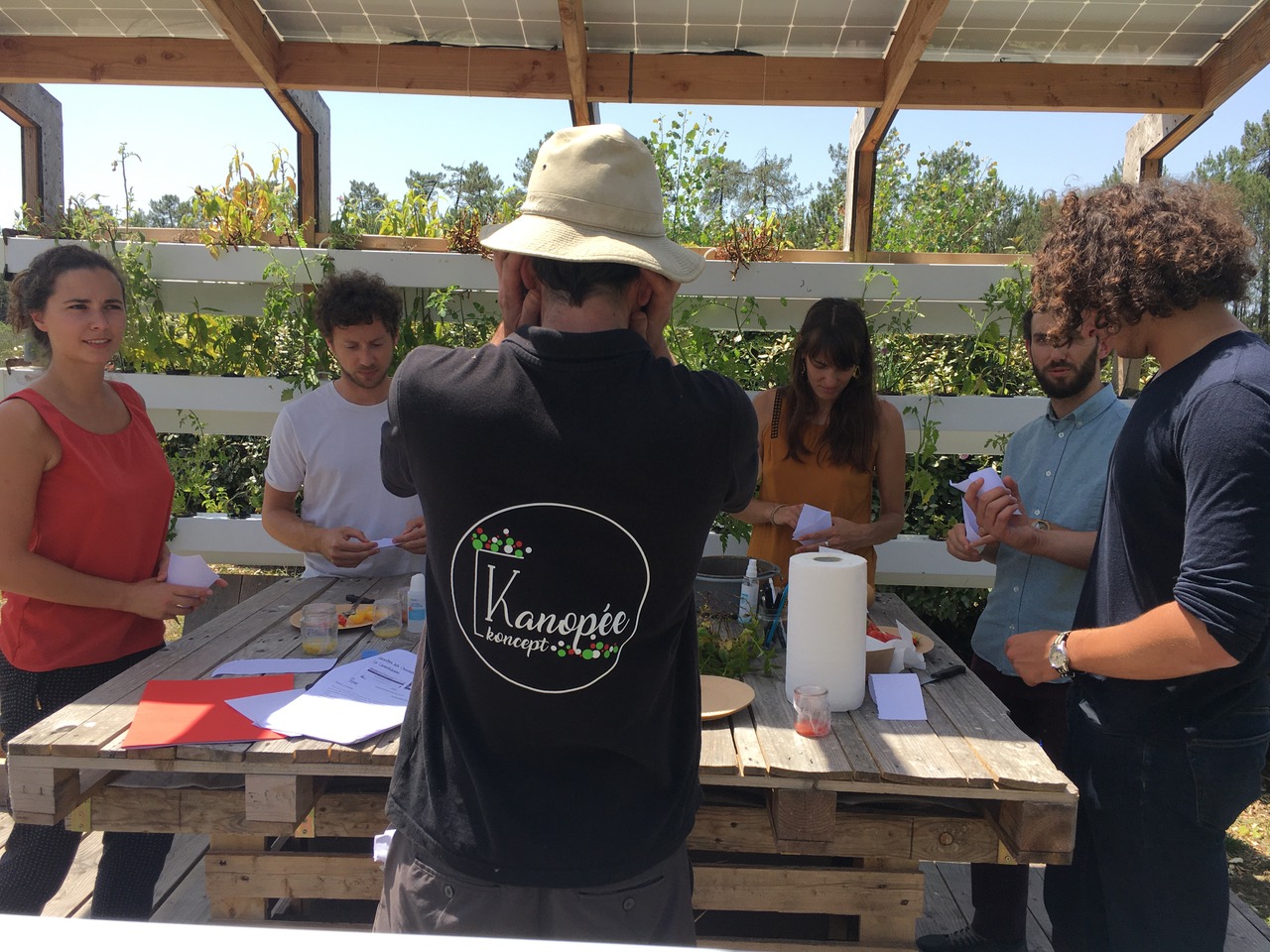
Their set is accompanied by a regular follow-up from our employees, who also give educational sessions about growing fuits and vegetables so that the beneficiaries increase their control of the unit and their agricultural knowledge.
Project Region
EU Programme or fund
Description of the project
Summary
Our project was designed to tackle nature presence in cities and urban alimentation issues by providing the means to a sustainable and circular food production in the city.
Three complementary activities make this project :
- two services : (1) installing and taking care of urban ferms and productive pergolas that we set up for companies, housing structures or municipalities ; (2) providing the workers or residents of these entities with training courses and awareness-raising sessions ;
- and a sale : (3) selling the fruits and vegetables produced in these structures but also, organic fruits and vegetables of hyper local farmers which are delivered directly at the abovementioned sites.
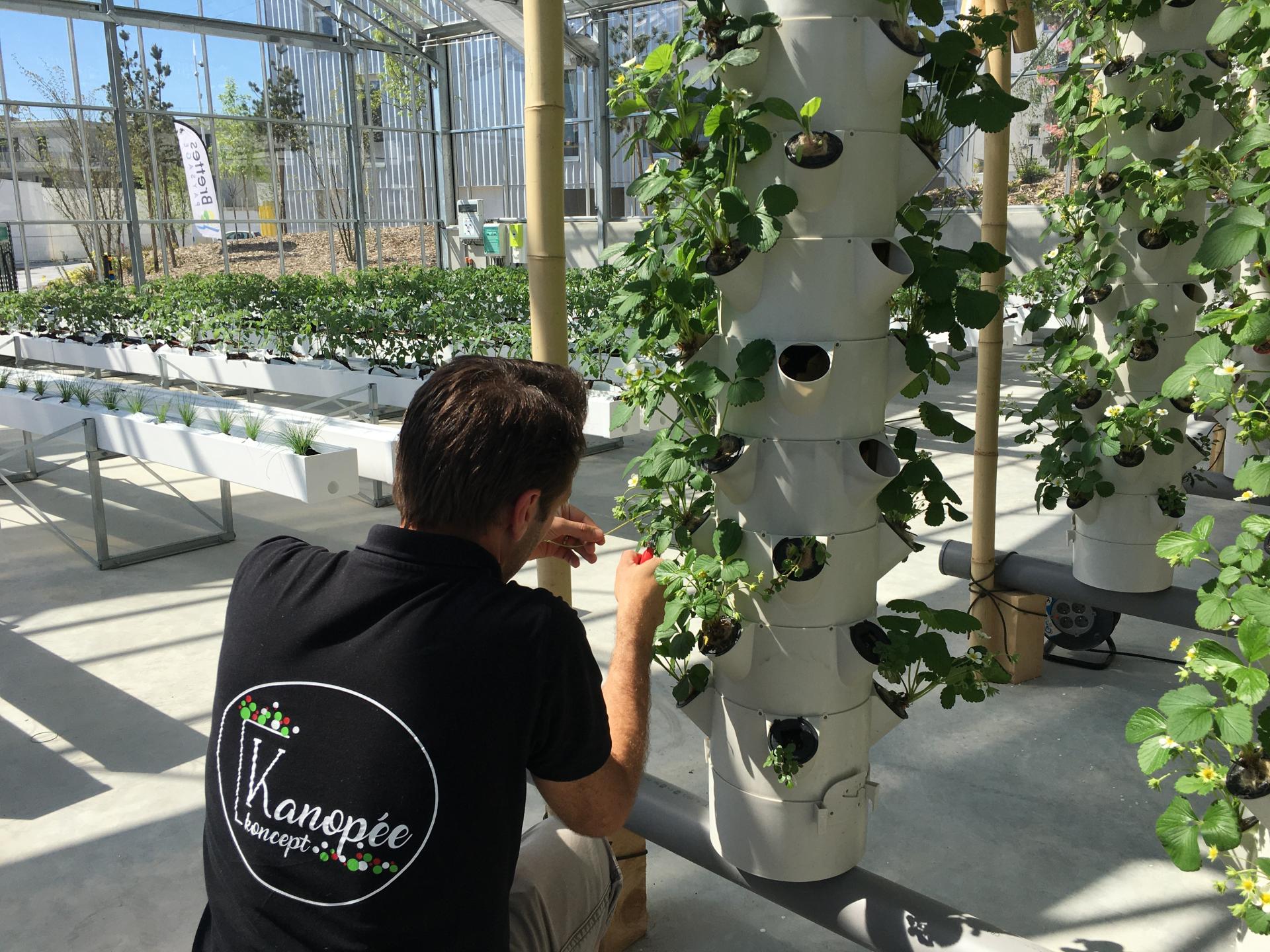
Our greenhouse in Floirac serves as showcase for the different structures we build.
The agricultural units are based on hydroponic and bioponic practices so that we have a low-water and energy consumption, that it is easily replicable in any structure, that there is no need to rely on soil quality, and that the unit is not directly fixed to the building and does not affect it.
Our objective is to optimize at its best the project, and save every piece of resource we can by creating a virtuous and closed loop that also proves to be self-suficient. The closed loop should be enabled by the collection of compost tea coming from the organic waste of urban households that have bought, in the first place, the fruits and vegetables of the units and of the additional supply of local and organic farms.
The implementation of a digital tool enables to link the three activities and to streamline the tasks of the employees and logistics, and allows better control on energy/wtaer/nutrients consumption, but also having a follow-up of all his actions on the units, and be updated on vegetables growth, availability as well as data registering that will optimize cultivation for every new "round of cultivation" by adapting to previous results.
Key objectives for sustainability
Every aspect of our project has been studied to favour environmental well-being.
Firstly, we designed production units leaning towards respectful practices : (1) low-energy consumption and water recycling : with the urban ferms/production units based on hydropony, the water is used in a closed loop, from the substact to the plants, and from the plants to the substract with the evapotransportation ; (2) closed loop in regards to nutrients contributions by extracting compost tea, that was made out of waste generated by the consumption of fruits and vegetables from our units and our farming partners ; (3) implementation of a digital tool, allowing an optimization of the production units, and thus, a better control over energy and water consumption.
Our sale sector relies entirely on local farmers, all working without chemicals and respecting the organic label. Thus, we promote a sustainable local agriculture, but also limiting carbon emissions by streamlining the fruits and vegetables route to the the employees/residents, as it is all centralized in the same place, where the customers already are.
As it is partly directed towards firms and their workspace, the project clearly matches CSR objectives : improving working conditions for the employees by creating an enjoyable break space, and connecting them to nature ; protecting the environment with low-consumption production units and partnership with hyper local organic farmers ; promoting local development.
The project ambitions were also to raise awareness, sensitize and teach about sustainable food production. Its beneficiaries are mainly urban citizens, which have been too disconnected to their food and have too few knowledge about how it is produced.
Finally, installing urban ferms troughout the whole city, and revegetating urban areas contributing to lower temperatures and bring back biodiversity.
Key objectives for aesthetics and quality
One of the main objectives of the project regarding quality of experience was using those pergolas units to turn under-valued and under-used places into living places, to implement a living quality that concurrs to global well-being.
To reach this objective, you have to give greater importance to aesthetics, but also to nature. As well as chosing the vegetables species with consideration to their physical and visual aspects, we tried to install an apeasing and therapeutic atmosphere, in every building hosting our production units.
To this matter, the pergolas we propose offer a reconnection to nature through other senses than sight, they also involve taste, and greater environmental concepts like seasonnality. We believe in the concept of ecotherapy which implies that being in a natural place, surrounded by vegetation is an effective boost to mental and physical health and well-being.
Key objectives for inclusion
One of the main objectives of the project regarding quality of experience was turning under-valued and under-used places into living places, where people feel positive.
To reach this objective, you have to give greater importance to aesthetics, but also to nature. As well as chosing the vegetables species with consideration to their physical and visual aspects, we tried to install an apeasing and therapeutic atmosphere, in every building hosting our production units.
To this matter, the pergolas we propose offer a reconnection to nature through other senses than sight, they also involve taste, and greater environmental concepts like seasonnality. We believe in the concept of ecotherapy which implies that being in a natural place, surrounded by vegetation is an effective boost to mental and physical health and well-being.
This is all the more true regarding our small ferms in urban areas, that contribute to the return of biodiversity in cities, to lower the temperature of very mineral places like in Bordeaux, and thus enhance the cooling effect on people.
Results in relation to category
Our pergolas exactly correspond to the objectives of the category. As a totally autonomous structure, it does not need any specific set up conditions. It can be built and dismantled easily, and placed in any kind of areas.
The hydroponic system as a closed loop does not rely on water from outside, and the amount of energy consumed is too low to require special outlets and connections. The plants are planted on a special substract that does not need contact with the ground, which make it adjustable for any kind of situation.
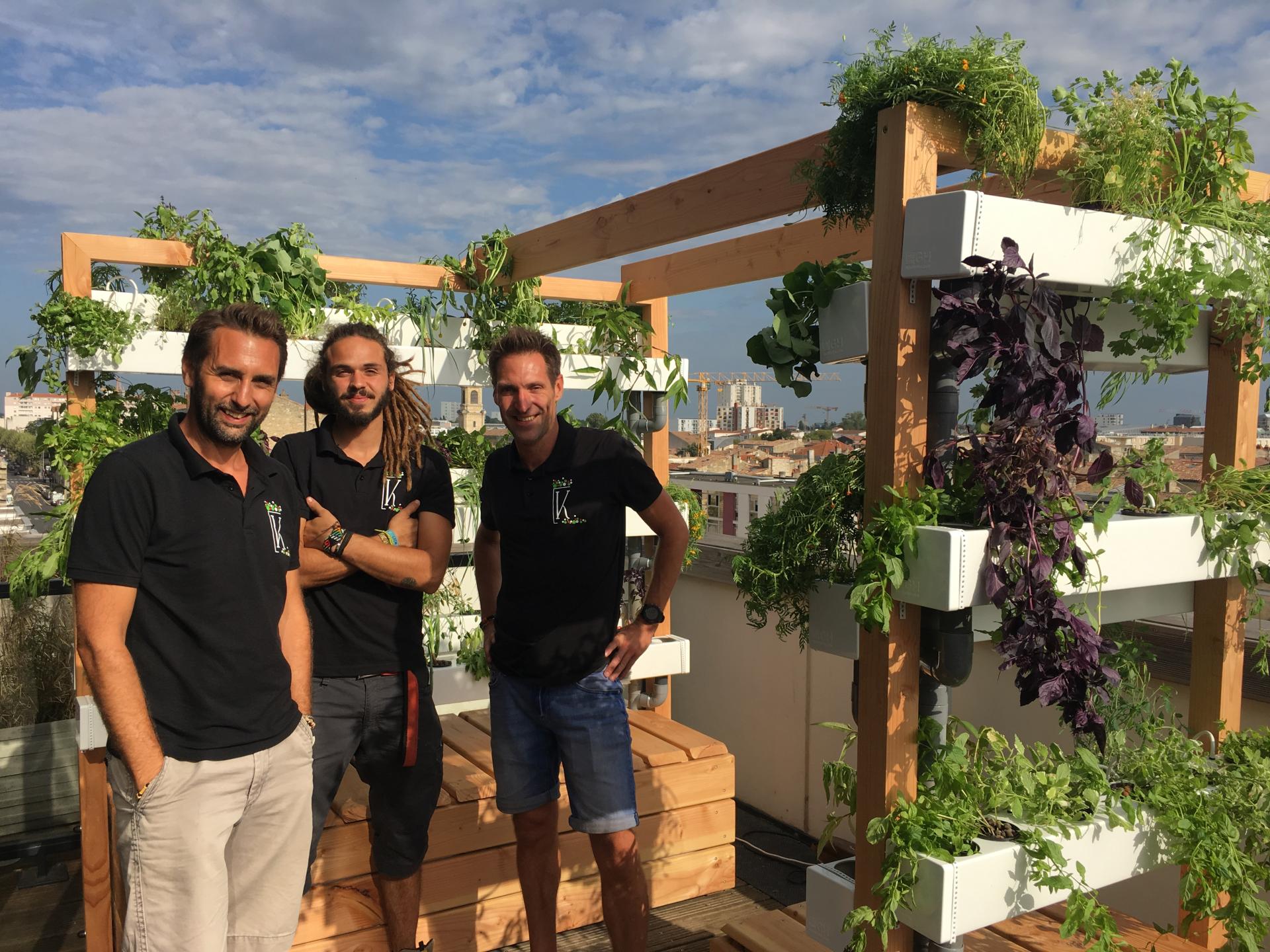
As an example, in Bordeaux, the pergolas were set up on a hotel roof (Vattel), but also in industrial areas at Unikalo and Ariane.
Sustainability is at the core of their design, and the follow up and educational sessions provided by our employee ensures that people around can take care of it easily when needed.
As a complement, our fruits and vegetables delivery system guarantee a local, organic, regular supply of food in the places where the pergolas are installed.
Last but not least, aesthetic is favored by the presence of plants and nature, in the very best tradition of ecotherapy contributing very quickly to an enhanced well-being and mental health for persons visiting the pergolas on a regular bases.
How Citizens benefit
As said before, one of our main objectives was to reconnect urban citizens to their food and subsequently to nature, by focusing on accessibility for every profile. We reached that objective in two main ways:
(1) bringing people from outside the agricultural sector to become our "Kanopée Kulteur", the new farmer in charge of managing and supporting the production units in their differents buildings, of presneting the awareness and workshops sessions and of handling the sales partnerships and processes.
(2) being present at the earliest level of learning so that the coming generations know since their school days the whereabouts of what they are eating and its importance within the current environmental issues at stake.
The following actions where thus implemented:
(1) in our recruiting process, we established that all employees should be in a situation of vocational retraining, and not mandatorily having worked in agriculture before. To go further, we started working with Pôle Emploi (French Employment Agency) through a program that facilitates professional formations, but also by becoming ourselves an official training organization for the agency.
(2) we led many activities towards schools and high schools in order to vegetate playgrounds, to organize workshops directly on site, workshops specifically designed for young audiences, and to bring our contribution to the national learning program through our senses development classes.
Innovative character
The market in which we are present is the one of urban agriculture, a market developing fast in the last few years as it is a needed one : with the ever-expanding urbanization of cities, that grow on every constructible fields around them, less and less cultivable surfaces have been available closely. This led to a very contemporaneous issue, cities food autonomy, that is a huge cause of debate nowadays.
There are three main aspects to urban agriculture : (1) food production (through different agricultural practices), (2) sensitization to the importance of healthy food consumption, (3) developement of hyper local distribution channels.
As of today, our project is innovative by being the only one in France taking in charge those three aspects at the same time. But it does not stop there.
Our project also includes a big part of comprehensive social innovation. Not only do we reconnect cities to nature, but the different actors of both, as an enhanced social link is created between our farmer-employee, our farming partners and the beneficiaries. This new social link has economic consequences, favouring local economy development and sensitizing to better diets. It impacts directly the consumption habits of citizens and allows them to have facilitated access to organic and local food which can only have a beneficial impact on their health and on their daily routine. By delivering organic food directly to their work, they save transportation time and have more of it to share with their families and friends.
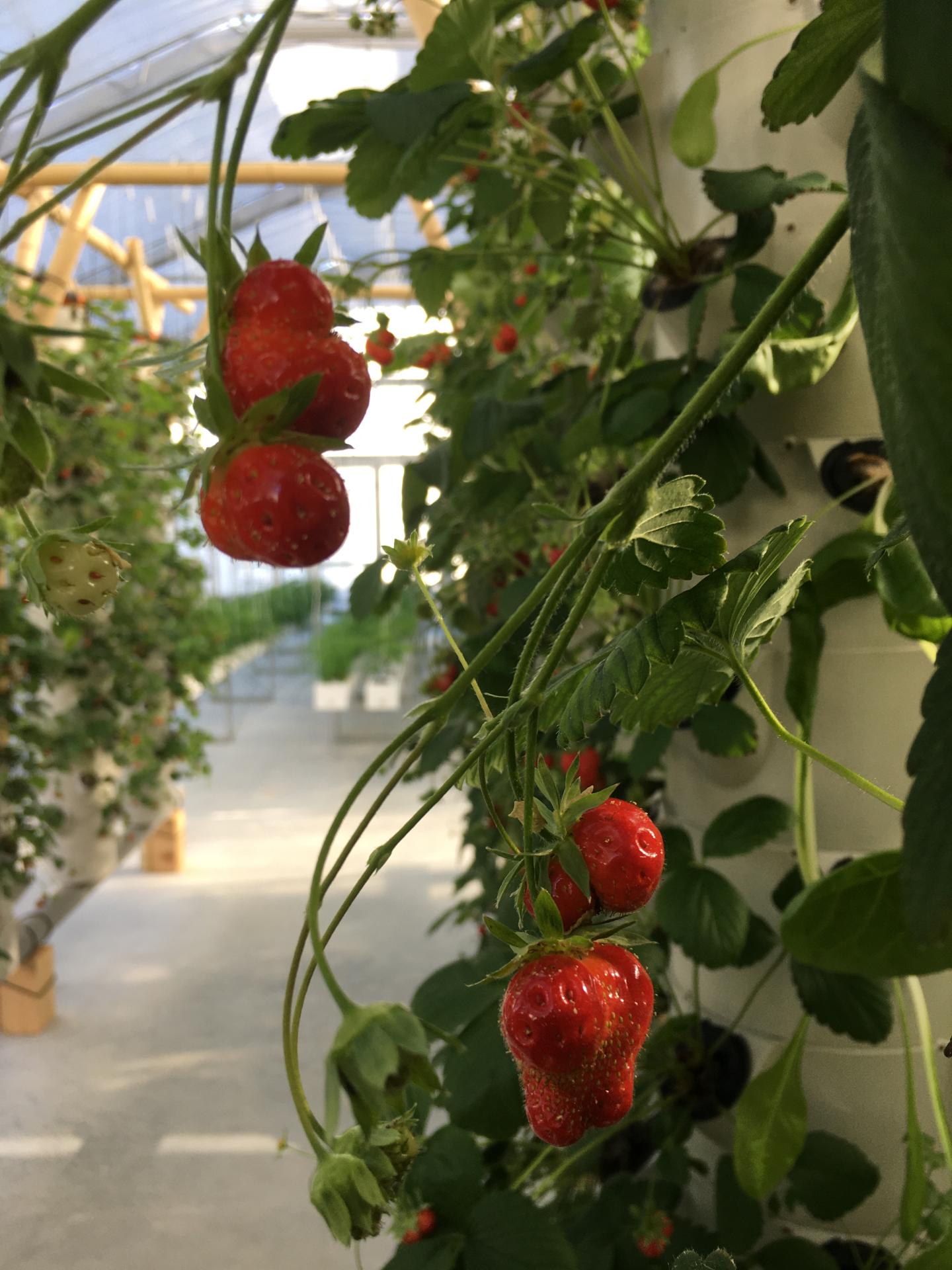
Moreover, all our units, be it farms or pergolas, are based on crops verticality as can be seen in some of the pictures attached below.