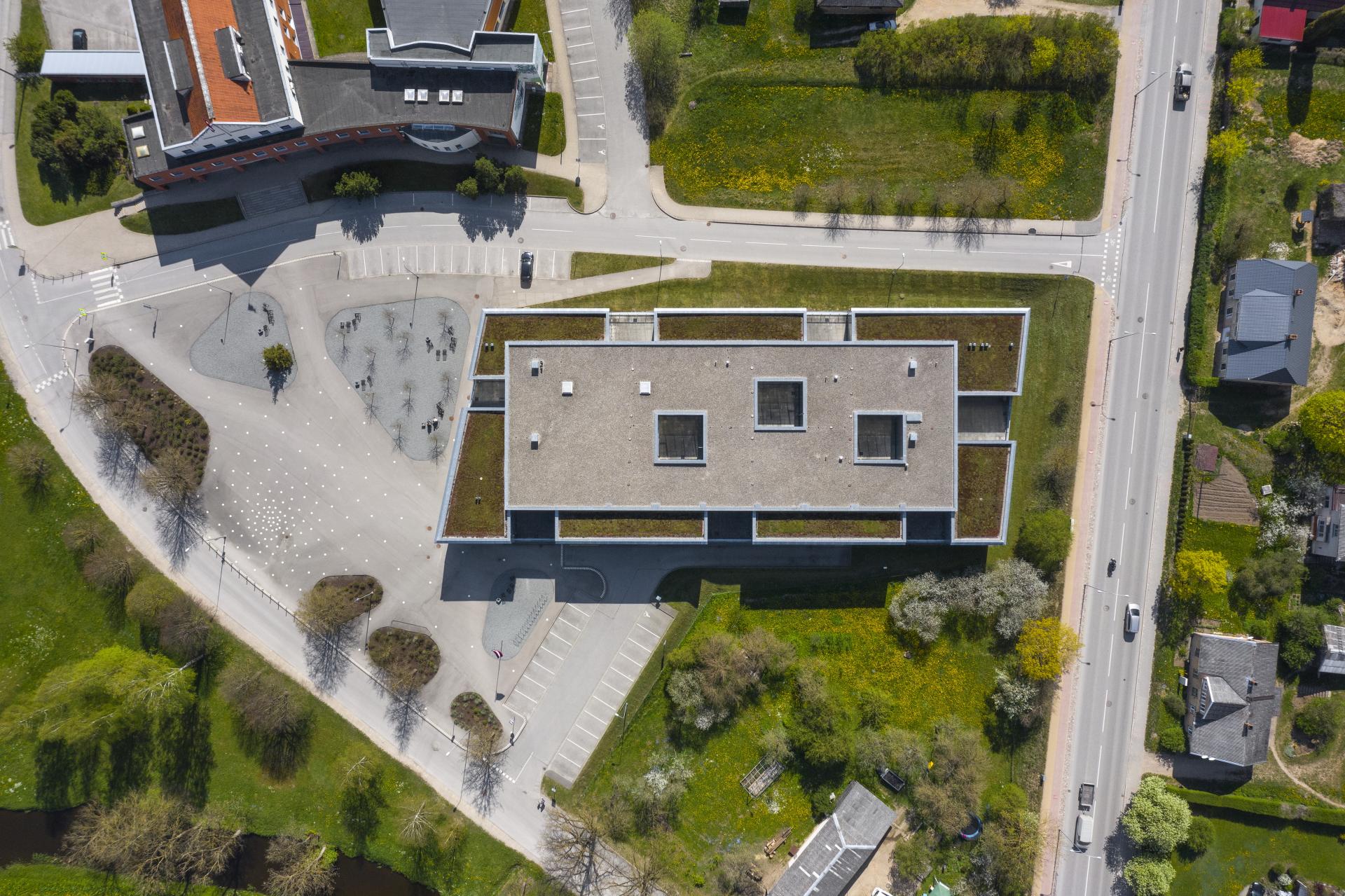
Saldus Music and Art school
Basic information
Project Title
Full project title
Category
Project Description
Saldus Music and Art school is contemporary educational building with innovative architectural concept that works as interdisciplinary connector of two institutions. Saldus municipality created inspiring learning environment and culture venue for local residents and travel destination for sustainable architecture lovers. Realized in 2013 Saldus town gained new urban square for everyday enjoyment and inclusive cultural hub of the county and placed Saldus on the map of Latvian culture scene.
Project Region
EU Programme or fund
Which funds
Other Funds
The project «Increasing the quality of interest education, lifelong learning and cultural offer and ensuring accessibility by building the Saldus Music and Art School building» has been implemented with the co-financing of the European Regional Development Fund (ERDF).
Description of the project
Summary
The building of Saldus Music and Art School is a project cherished in the community, where the need for more appropriate premises has resulted in an inspiring cultural building and square. Global trends in competence and interdisciplinarity based education have been realized in Saldus by bringing together two interest education schools. By adding to it a lifelong learning and activities of cultural offer, a hub has been created where people meet and share their experiences in the art world and unexpected ideas arise.
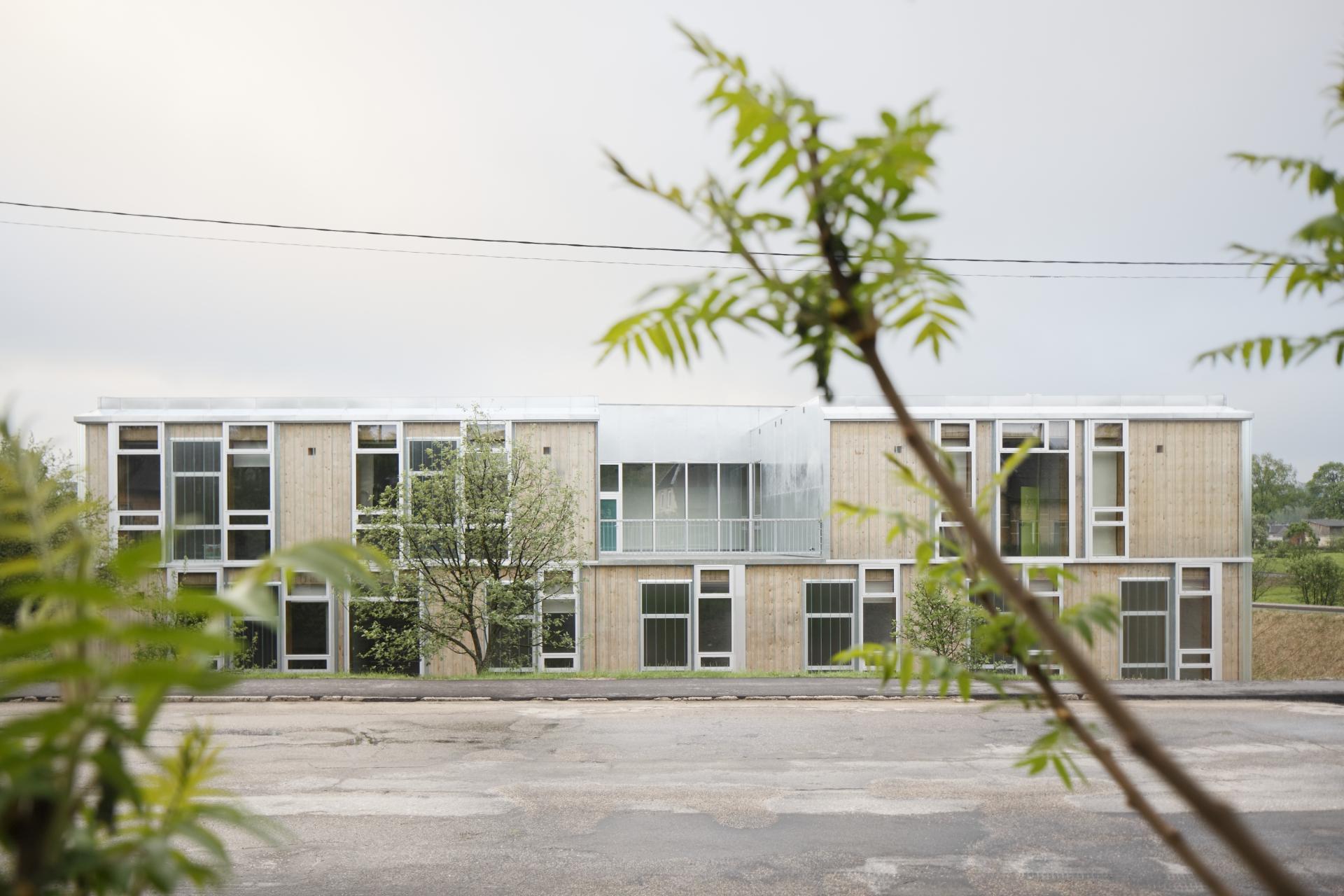
In 2007, «MADE arhitekti» won the open architectural competition with proposal of compact structure, leaving space for a public square. They also proposed various solutions of sustainability, which 14 years ago were innovative in the scene of Latvian architecture. In addition, the building's visual Nordic like laconic image and contemporary modesty with a solid wood wall exposed through a glass facade has served as a reminder of the need to use more renewable resources all these years.
Just as the facade of the school is already educational, the square next to the school, adjacent administrative building and nature trail emphasizes its inclusive nature, so that this place is intended for every citizen and guest of the town. The square is used in school-related plein airs, classes, workshops, and also in all kinds of special events, next to school activities. The mutual cooperation of music and art in the building of contemporary architecture, combined with the courageous participation in cross-border projects, has opened up the possibility of unprecedented events and experiences now and in the future. Even more, this site of co-creation, known as Saldus Music and Art school, has created a brand in the region that is associated with openness, space for everybody, sense of design, sustainability and a safe place for unlimited creativity.
Key objectives for sustainability
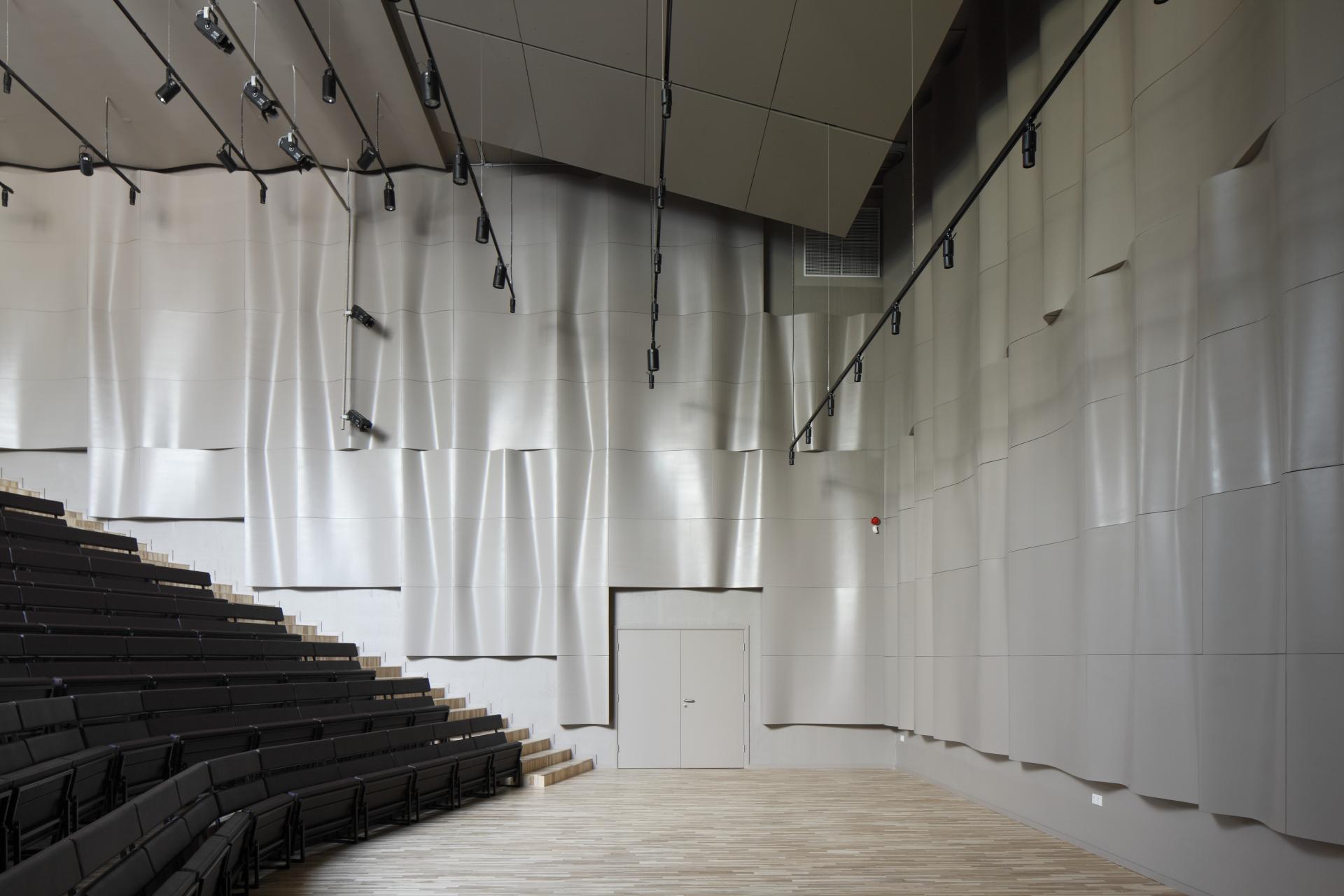
Combining Music school and Art school in one building with a large square in front of the building creates a new urban spot which is sustainable in its possible future uses. The school square next to the Ciecere River hosts various events and is connected to the nearby nature trail and children playground. Classes and halls of different sizes (including 200 seat concert hall) provide a place for other activities of citizens outside school hours – choirs, theaters, concerts, dance and yoga classes, various clubs, lifelong learning for adults etc. It is the central location in the proximity of square and the availability of different rooms with variable acoustics that make this place a demanding rehearsal place in the context of the whole county and active and sustainable culture hub in the future.
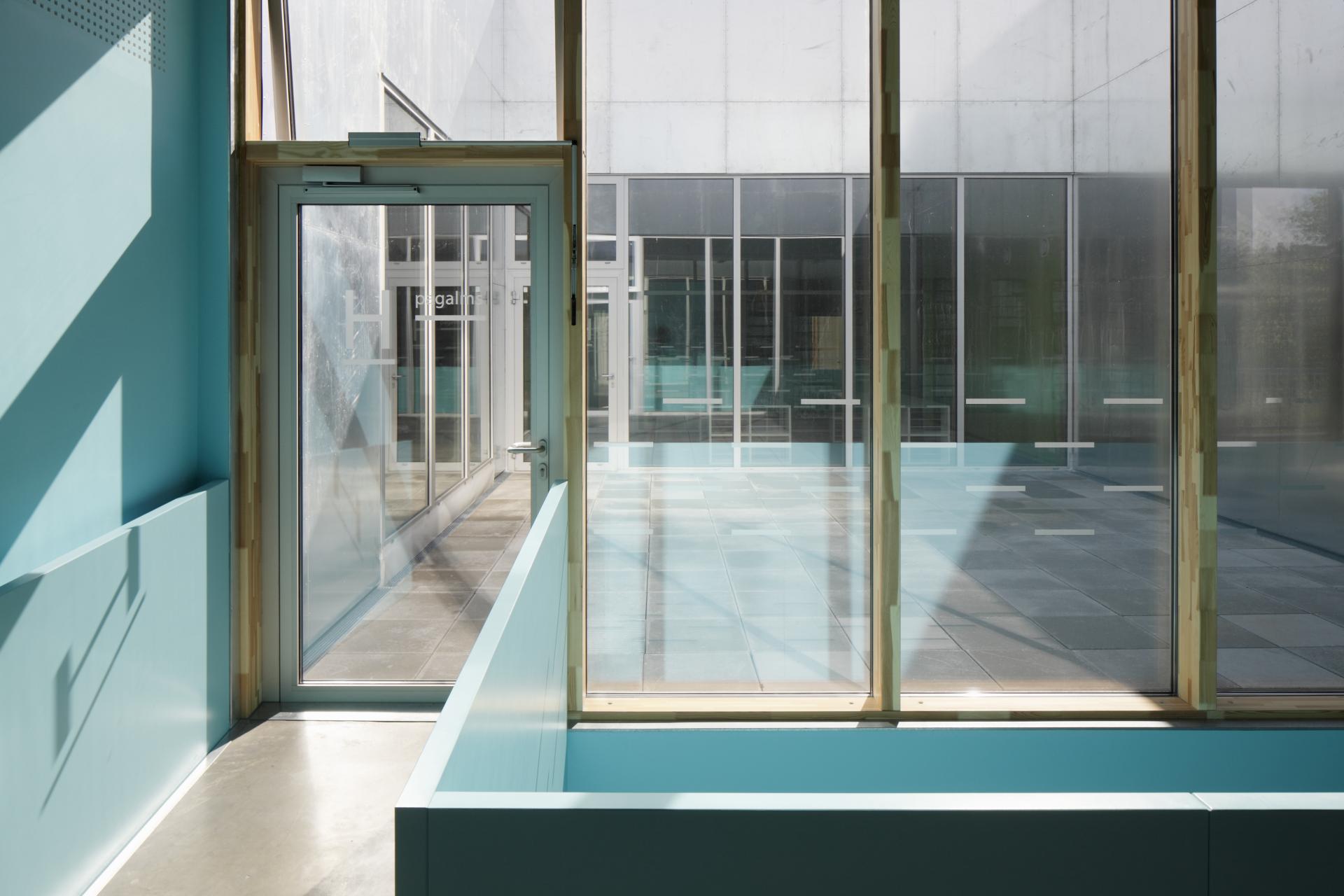
Sustainability regarding building itself is well thought through. In the compact building volume the classrooms are placed on perimeter, while practicing halls and libraries in the middle of the building. Light patios are the result of the compact plan, providing a lot of daylight and reflected light in the middle of the school, and at the same time being the space for both schools to interact. Large thermal inertia of the building and integrated floor heating delivers even temperature regime. There is no active cooling in the whole building including the main hall and classrooms and the comfort temperature is provided using passive technologies. Facade, consisting of massive timber panels, covered with profile glass, is a part of energy efficient natural ventilation system, preheating inlet air during winter. Massive wood wall with lime plaster accumulates humidity, providing the good climate for people as well as for musical instruments inside the classrooms. Building structure and materials work as passive environmental control at the same time exhibiting it's functionality. The green roof evens out rapid rainfall and does not overload rainwater drainage system.
Key objectives for aesthetics and quality
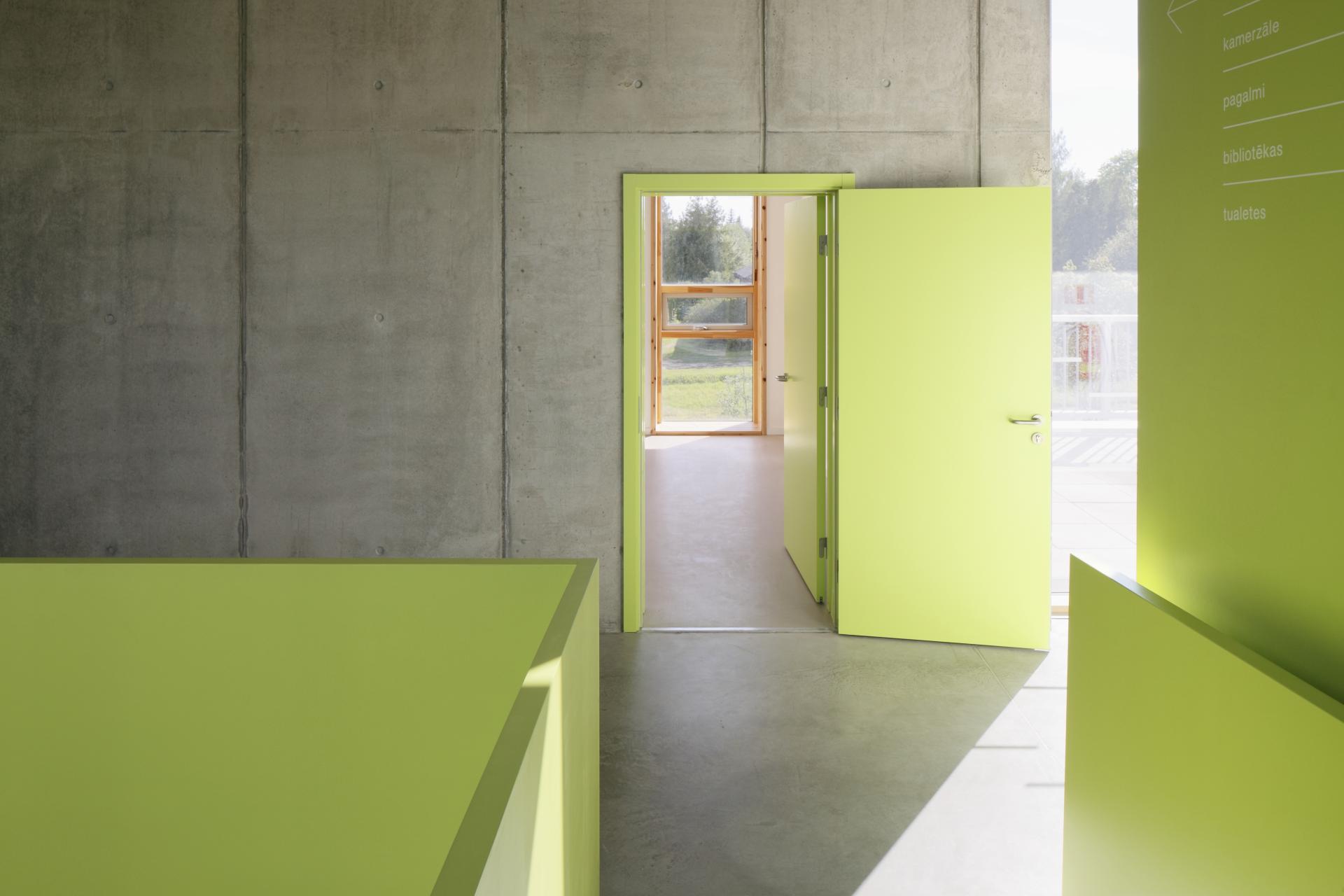
One of the challenges for architects was to combine two previously separate schools into one new building. Architecture office «MADE arhitekti» not only created new contemporary spaces for art and music education, but also gave students the opportunity to expand the boundaries of both spheres, creating a visual connection between the two schools. For example, while in an art school, it is possible to see how music school children play musical instruments in other rooms and vice versa. Green color in interior marks the Music school, while the blue is for the Art school, both colors meet in main stairs of the school.
Inner concrete walls and through the glass visible outside massive wood wall exhibit their natural origin, which architects proposed as an important issue especially at the institutions of education. There is no single painted surface on a facade of school building, every material share its natural color and texture. Ever changing facade which reflects the light and season outside demonstrates Nordic calm and qualities of contemporary modesty. The project Saldus Music and Art school received GRAND PRIX in Latvian Architecture Award 2013 and was nominated for the European Union Prize for Contemporary Architecture - Mies van der Rohe Award 2015.
Interior materials are simple and easy to maintain. Concrete walls are good for exhibiting artworks. Rough material aesthetics in combination with spatial circulation spaces, encourage creative interaction with the architecture and provide possibilities for unexpected artistic interventions in the circulation area outside the formal «white box» classrooms. As it is found in real life situations, the architectural interconnection of spaces and spatial connection of two floors of the building by staircases and light shafts motivate people to perform «outside the box» and unleash the creativity. The inside light patios literally connect Music and Arts school rooms in one integrated informal learning space.
Key objectives for inclusion
Interest education of Music and Art school is available in the afternoon for all children in the county. Exhibitions, concerts, workshops organized by the school involve and interest residents to attend the event first, but later also to participate in a lifelong learning program or any culture club held in the school. The school's activity in Latvia, as well as in cross-border projects, puts it on the map as a serious player on a much larger scale and establish a good example of inclusion of all members of community. The square and all spaces of the school building is fully accessible for disabled people.
The school project brings together music and art schools that have previously worked separately. Children from 4 to 18 years of age study in the schools. As the interest education classes take place after the general school classes (in the afternoon) therefore the morning hours and also the late evenings are possible for other activities of the city residents using the same space. The school premises gathers daily activities such as choirs, ensembles, theaters, dances, yoga classes, as well as art and music lifelong education activities for adults. The school 200 seat hall with amphitheater hosts concerts and performances that are accessible to everyone providing very intimate and bonding atmosphere during performance.
At the Latvia level, different state competitions and events have taken place at the school. In the summer, plein air workshops take place in and around the school, bringing together participants from all over Latvia and beyond. The school has actively participated in Nordic Council of Ministers' Nordplus programs, working with other professionals from Estonia, Lithuania, Norway, Finland, Iceland. The school actively organizes thematic workshops, such as collaboration with potters from Burgundy region of France.
Results in relation to category
An urban intervention created a culture building and a new town square, which used to be an empty suburban grass plot. Together with existing municipal building the school defines urban area, that interconnects with other public territories in Saldus town. An inclusive venue has been created in the town, where children's music and art education is primary, but everyone will find their interest. Created as a new school, it has outgrown its status to central cultural hub of the town, and now it is attracting local inhabitants and international guests both in various thematic workshops and in summer time plein airs named after the famous Latvian artist Janis Rozentāls. The square is a good addition to the adjacent Ciecere River nature trail, the adjacent administrative building where various events take space, such as weddings, as well as the square has set a completely new spot for any urban activity.
The work of «MADE arhitekti», selected in an open architectural competition, not only responded to the need for new premises for both schools, but also created a modern Nordic educational institution that has become an architectural travel magnet in the region with sustainable solutions and aesthetic qualities. In 2013 it was a first time in Latvia when a solid wood wall was used for public building. The intention of the architects was to exhibit the massive wood wall to the outside through the glass, thus paying attention to sustainability issues and promoting the use of renewable resources in Latvia. After the school opened, there were weekly tours of the school and the school staff enthusiastically showed the new spaces and architecture to the guests. As a measurable result, the building received GRAND PRIX in Latvian Architecture Award 2013 and was nominated for the European Union Prize for Contemporary Architecture - Mies van der Rohe Award 2015.
How Citizens benefit
Since the establishment of Saldus Art school in 1984, school always was in search for appropriate premises to carry on growing demand for interest education. The studios where located in the attic floor of the dwelling house, and the pottery was located on the basement. The same way Music school was located in the old building with wood oven heating system close to the main street, where transport traffic noise was constant disturbance. For a long time other priorities where more important. All the temporary solutions to adapt existing premises failed to deliver the spatial and acoustic quality that was very important for schools. After several attempts, the decision was made by Saldus county leader to build new school, that will be appropriate for both schools. The architecture competition was organizes in 2017 and the design task was prepared by Music and Arts school personnel.
The realized building attracted more people and teachers to move to Saldus, they see new spaces as motivation to carry out their educational work. The pedagogues from nearby counties and even Riga are coming to Saldus to perform at best due to the excellent work conditions and quality architectural premises. The construction of the building was carried out by local construction company workers and the challenges of realizing innovative solutions demanded extra commitment from people. The understanding of the fact, that people build this school for themselves and their families provided solidarity and bond between members of society. Even though there were different points of view about the project, the final appreciation and popularity of the building show successful integration of new building into the Saldus urban and social terrain. The school's project and square open up unprecedented experiences and encounters with people and various art forms. This school with the offered infrastructure has taken the place of Saldus Cultural Center, that was built during Soviet times in Saldus.
Innovative character
One of innovative characters is observed in education, combining both visual arts and music in one building, thus giving students the opportunity to expand the boundaries of the field to be studied. Together with concerts, exhibitions, workshops and cross-border guests at school, every school visitor can be sure that his or her experience in the school building will exceed his or her expectations, as the available cultural bouquet there guarantees new experiences and impulses. It is the interdisciplinary education of the future that will provide the unprecedented and desirable solution that society is striving for.
Another innovation is appearance of fresh contemporary architecture in the rather traditional small town. There are historical architecture landmarks present in Saldus, but indeed Music and Art school is striking contemporary addition. This does not place new building in opposition of historical urban creation. On the contrary: The new building is gently placed in the landscape and the square is formed with gradual landscape connecting two street levels, that the upper floor volume seem naturally merging with the site and facade is reflecting small urban scale of the surrounding buildings.
Thirdly the innovation lies in the sustainable concept of the architecture solution. Designed by young an passionate architects, pushing boundaries of the construction technologies and the notions of rural public buildings typology. The proposal of green roof today would seem logical solution, but at the time of design it was discussed a lot and finally accepted as sustainable element, because it would be seen from the other higher located places of the town.
Together with bold vision of architects to create sustainable clever solutions and inspiring aesthetics, and the successful management of cultural activities the school has not only solved the problem of lack of premises, but also opened the way of inspiration to other cultural institutions in Latvia and beyond.