Troepferlbad 2.0
Basic information
Project Title
Full project title
Category
Project Description
The objective of the project is the establishment of a european-wide, growing, self- organized network of cooling-optimized, shared urban open spaces (coolspots) via the "Troepferlbad" method.
The 4 modular pillars of the method are:
- Adaptive local design based on urban climate design principles
- Scientific simulation of various parameters towards climate resilience, resource efficiency and biodiversity
- Co-Creation and Participation
- Vegetation and Water as integral part
Project Region
EU Programme or fund
Description of the project
Summary
The aim of the project is the demonstration of the multifunctional benefits of co-creatively planned, self-organised and decentralized implementation of urban NBS solutions at public spaces. They aim is efficiently supported by digital simulation processes and adaptive local design and architecture. We call the structural marriage between those 4 pillars of urban new design the “Troepferlbad method”. This method has been jointly developed under the Smart City funding program of the Austrian Climate and Energy fund, together with the City-Municipality of Vienna, the District Council of the 6th and 21th district and partners from the industry. The idea and coordination of the project was led by the Viennese landscape engineering company Green4cities, supported by the architectural collective “Breathe Earth” and B-NK a Viennese company for participatory urban planning processes.
The project idea is based on the assumption, that NBS can tackle some of the most pressing urban environmental and societal challenges such as urban heat islands, fostering adaptation to climate, halting biodiversity loss and promoting public health and social cohesion. Local communities are a vital partner in enabling such solutions in terms of identifying concrete interventions or in maintaining infrastructure. The implementation of NBS at the neighbourhood level combined with the deployment co-creation solutions offer a promising terrain for societal transformation at the local level.
The overall aim is to create scalable, modular, changeable, cooling-optimized urban open spaces (coolspots) with a high quality of stay. Different participation and co-creation measures were tested in order to integrate various vulnerable local groups (senior citizens, homeless peoples, etc) and their interests to the design of the coolspots. The results from the project shall enable the creation of a coolspot network throughout Vienna and European cities.
Key objectives for sustainability
The Troepferlbad project directly meets the ecologic, social, economic and cultural pillar of sustainable development. Based on the ecologic pillar through fostering urban NBS in heavily degraded urban environment, social, economic and cultural dimensions are met via co-creational planning-methods and adapted local urban design.
Over the last decade, NBA have increasingly been promoted as cost-efficient, no-regret solutions to address urban challenges in cities. The multiple benefits nature delivers have been highlighted in
European and international frameworks such as the recently launched EU Biodiversity Strategy for 2030, the Urban Agenda 2030 or others.
However, progress in the implementation of urban NBS is not quick and widespread enough for NBS to be considered an efficient response to measurable climate adaptation or mitigation. The successful implementation of NBS depends on a sound knowledge and understanding of NBS, the complex processes of natural systems and NBS design features and options. Whilst scientific evidence of the multifunctional benefits of NBS is plenty and well documented, and technical knowledge on NBS design and implementation abundantly available, there is a lack of coherent, market-oriented and scalable models for local NBS design and implementation
The answer of the Troepferlbad method is the co-creative approach right from the beginning of the planning phase.
- Urban integration: Based on the analysis of existing local urban typologies and local user patterns of the urban space, first draft-planning options are developed, securing efficient and aesthetic integration of the Coolspot into the urban space.
- Co-Creation: The collaboration between central and local government, architectural and landscape experts, industry and local inhabitants, with special focus on vulnerable stakeholder groups
- Urban Climate Regulation (via NBS and locally adaptive design, the felt temperature shall not exceed 29 degree
Key objectives for aesthetics and quality
A healthy, cool urban climate is one of the most essential commons of our present society. Therefor the project goal is the creation of so-called coolspots, i.e. multifunctional cooling oases in the urban open space. The first phase of the project was the co-creative development and implementation of two prototypical demo-coolspots on two very different urban public spaces in two different districts in Vienna. Microclimatic simulation, material innovations and local energy production have been integral part of the project. The current second phase of the project aims to develop a concept for a citywide implementation of a European-wide coolspot network by providing guiding handbooks on the 4 planning pillars accompagnied by a presentation of possible classic and alternative financing instruments for local implementation.
The project title refers to the establishment of the first public bathes in Vienna, named "Troepferlbad". As a welfare institution, these were a blessing to public health and a contemporary response to the problems of the urban population of the 19th century, providing vulnerable groups with urgently need infrastructure and promoting social cohesion.
The coolspot-network shall imitate the social, architectural and functional success of the Troepferlbad network, giving to the today's urban population a common relief in the hot seasons, specifically for vulnerable groups and to those who cannot count with own balconies, gardens or other private green space. At the same time, the architectural design shall respond to the individual needs in the local space fostering social cohesion.
The Projekt “Troepferlbad 2.0” is therefore a successful, implementable and scalable connection between human kind, nature and architecture in urban space and should be a starting point for the transferability to other cities in Austria and whole Europe.
Key objectives for inclusion
A healthy, cool urban climate is one of the most essential commons of our present society. Therefor the project goal is the creation of so-called coolspots, i.e. multifunctional cooling oases in the urban open space. The first phase of the project was the co-creative development and implementation of two prototypical demo-coolspots on two very different urban public spaces in two different districts in Vienna. Microclimatic simulation, material innovations and local energy production have been integral part of the project. The current second phase of the project aims to develop a concept for a citywide implementation of a European-wide coolspot network by providing guiding handbooks on the 4 planning pillars accompagnied by a presentation of possible classic and alternative financing instruments for local implementation.
The project title refers to the establishment of the first public bathes in Vienna, named "Troepferlbad". As a welfare institution, these were a blessing to public health and a contemporary response to the problems of the urban population of the 19th century, providing vulnerable groups with urgently need infrastructure and promoting social cohesion.
The coolspot-network shall imitate the social, architectural and functional success of the Troepferlbad network, giving to the today's urban population a common relief in the hot seasons, specifically for vulnerable groups and to those who cannot count with own balconies, gardens or other private green space. At the same time, the architectural design shall respond to the individual needs in the local space fostering social cohesion.
The Projekt “Troepferlbad 2.0” is therefore a successful, implementable and scalable connection between human kind, nature and architecture in urban space and should be a starting point for the transferability to other cities in Austria and whole Europe.
Results in relation to category
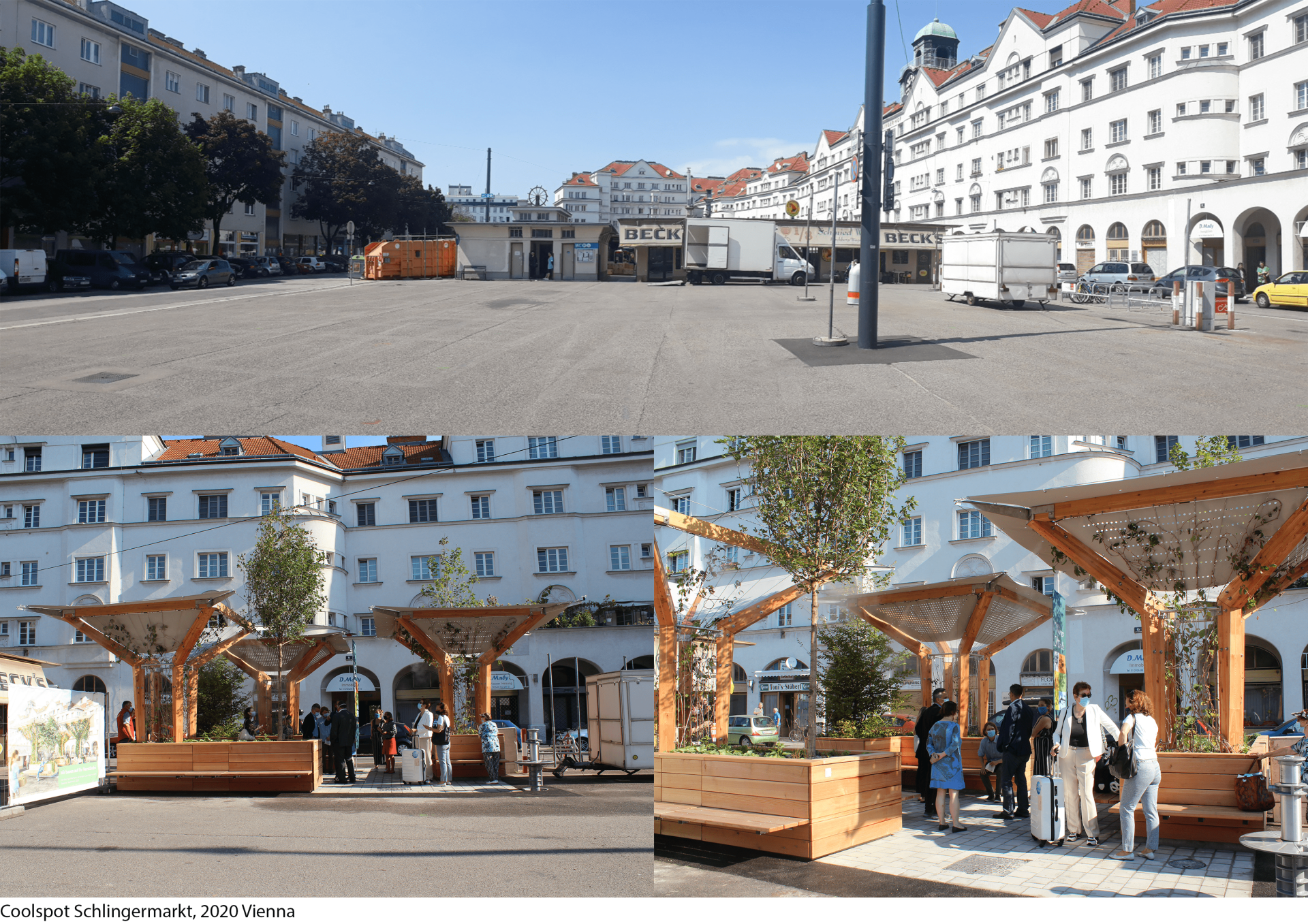
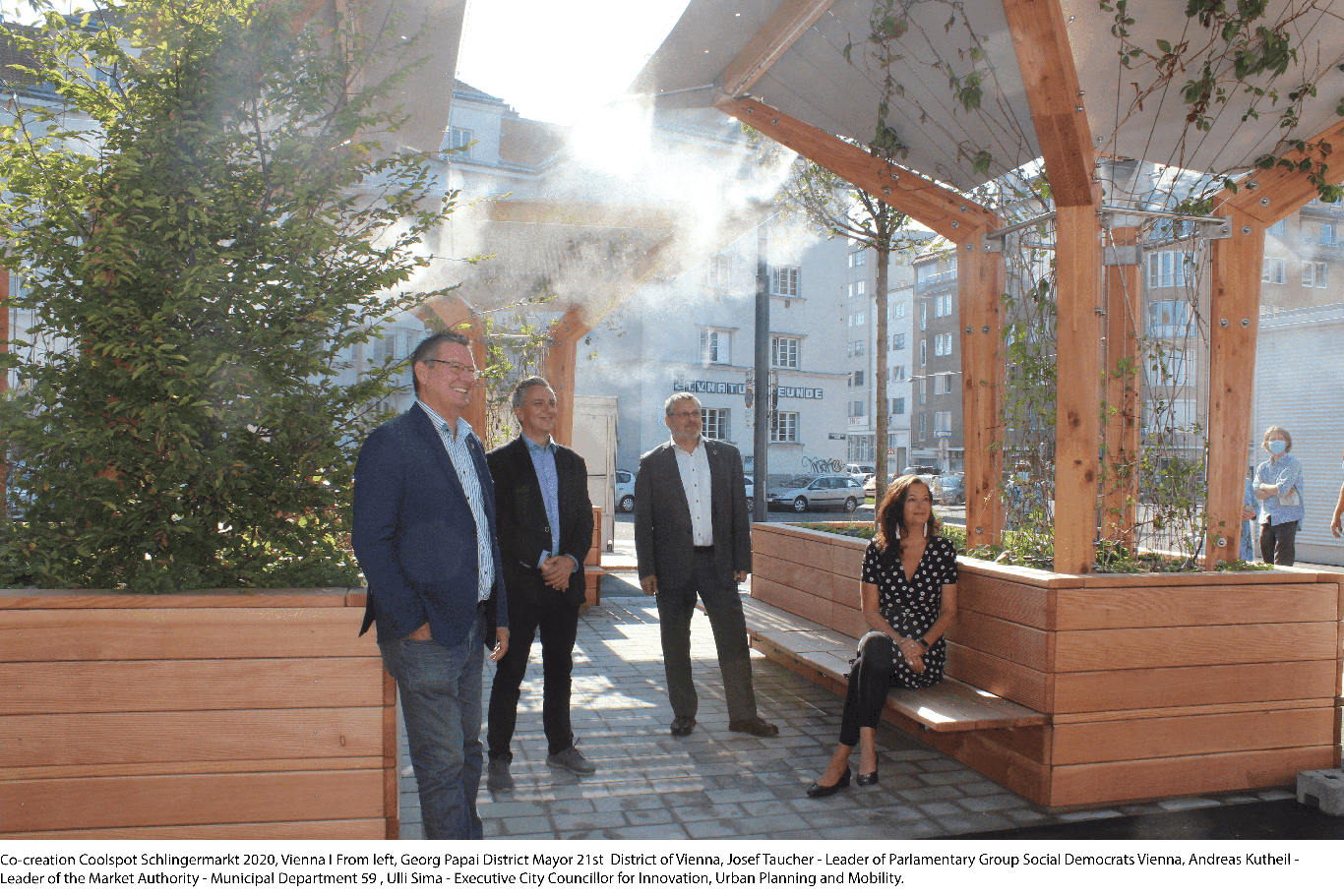
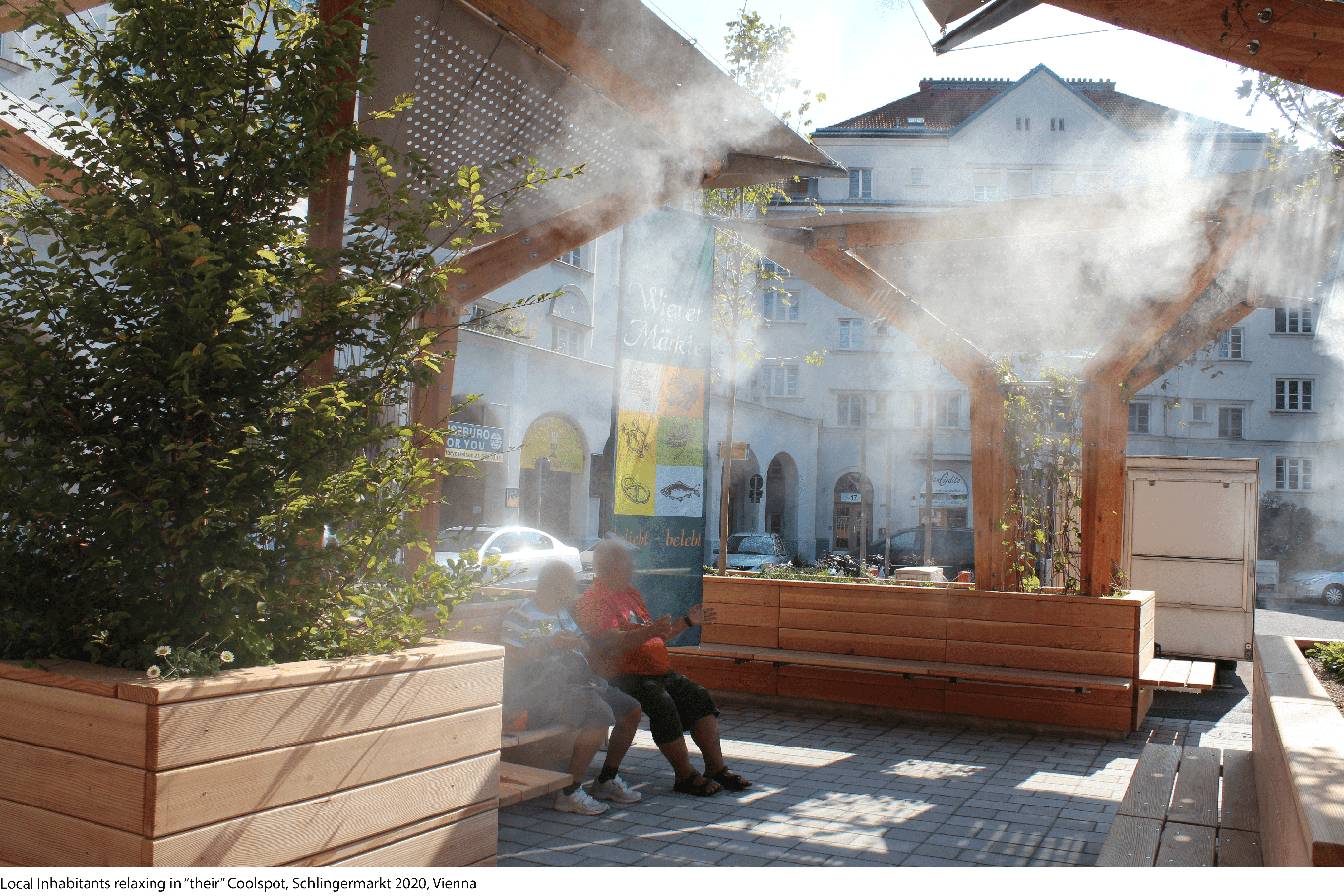
The Troepferlbad project co-creatively designed and implemented two coolspots at two very different urban public spaces in two different districts of Vienna.
Urban Coolspot 1: Schlingermarkt
The Schlingermarkt is a public urban market, located in the 21st Viennese district - a typical so called “Workers district”. The traditional market suffers from customer losses, due to very low quality of stay, not meeting the needs of the local inhabitants. The degree of sealed soil at the market is high (100% asphalt at the farmers market place), the shading is low, the heat rises up to 55 degrees felt temperature on hot summer days. Since the market free space is particular used as a meeting point by senior persons, these problems are serious.
The problems that need to be solved were:
- To find a solution that helps the local inhabitants to relief from the strong UHI
- Not taking away space for sales stands (fear of competition)
- Finding solutions concerning possible noise problems, deriving from social interactions within the Coolspots
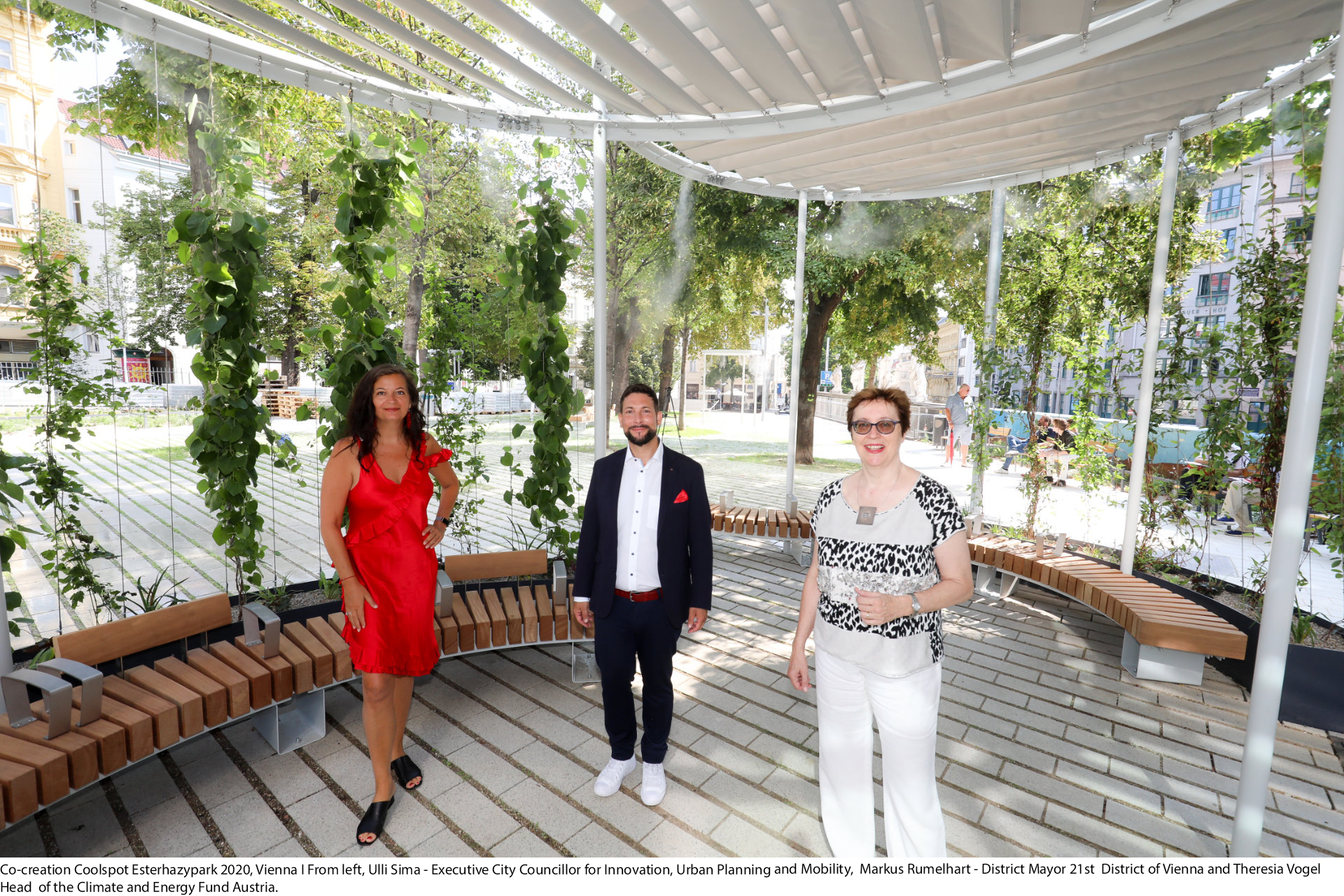
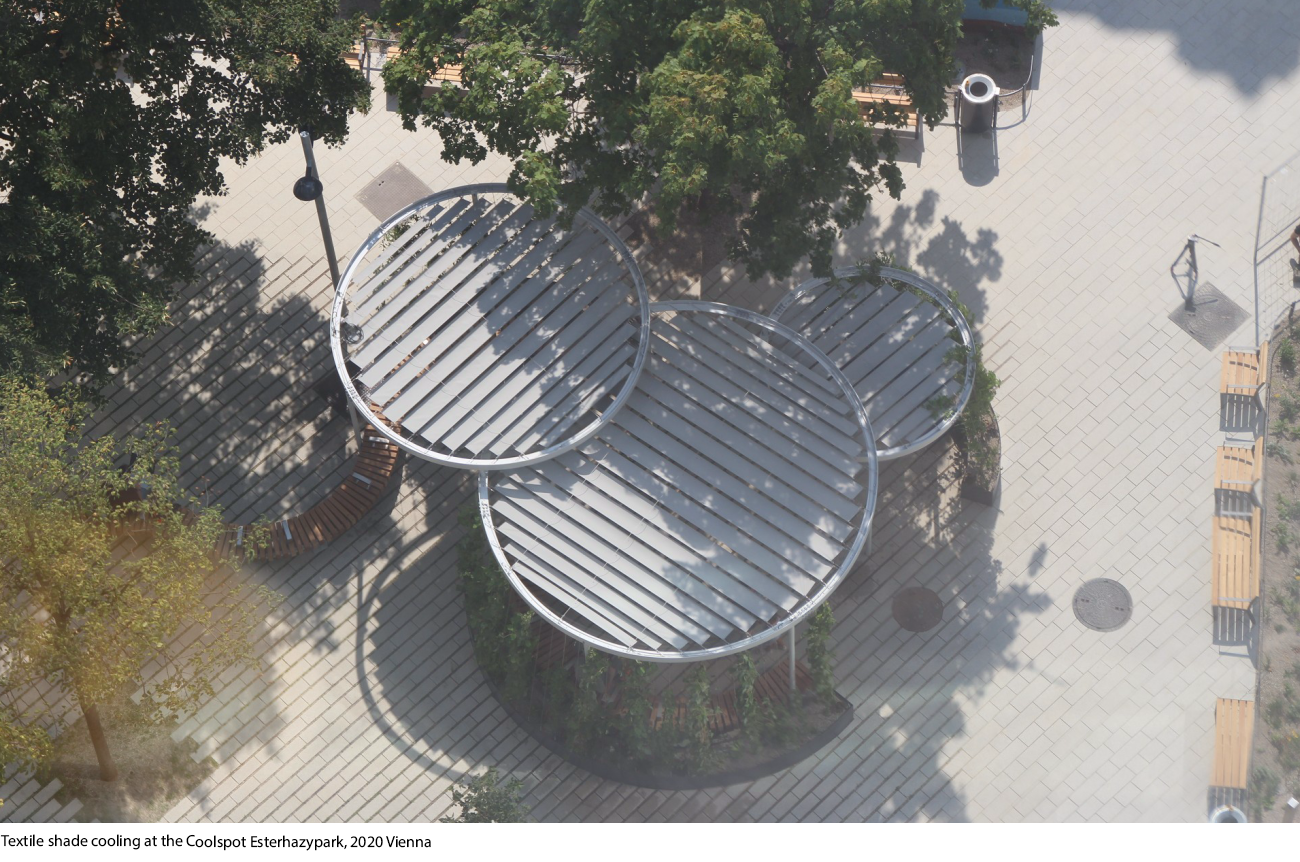
Urban Coolspot 2: Esterhazypark
The Esterhazypark is a small park in the middle of the city center district Mariahilf. A total of only 2% of the entire district is unsealed green space. The Esterhazypark is on the one hand located close to some touristic highlight (marine museum, cinema center, etc) and on the other hand it is a densely used neighboring park. Due to the proximity of the center for the homeless persons, the park is used very strong also by this group, especially in the night and evening hours.
The problems that need to be solved were:
1) Increase in NBS biodiversity and recreational function for the neighborhood
2) UHI_reduction
3) Requirements for high-quality design, integrated into the already existing park design.
4) Social integration and management of the use of so different stakeholder groups
The two Demo-Coolspots are considered as great succ
How Citizens benefit
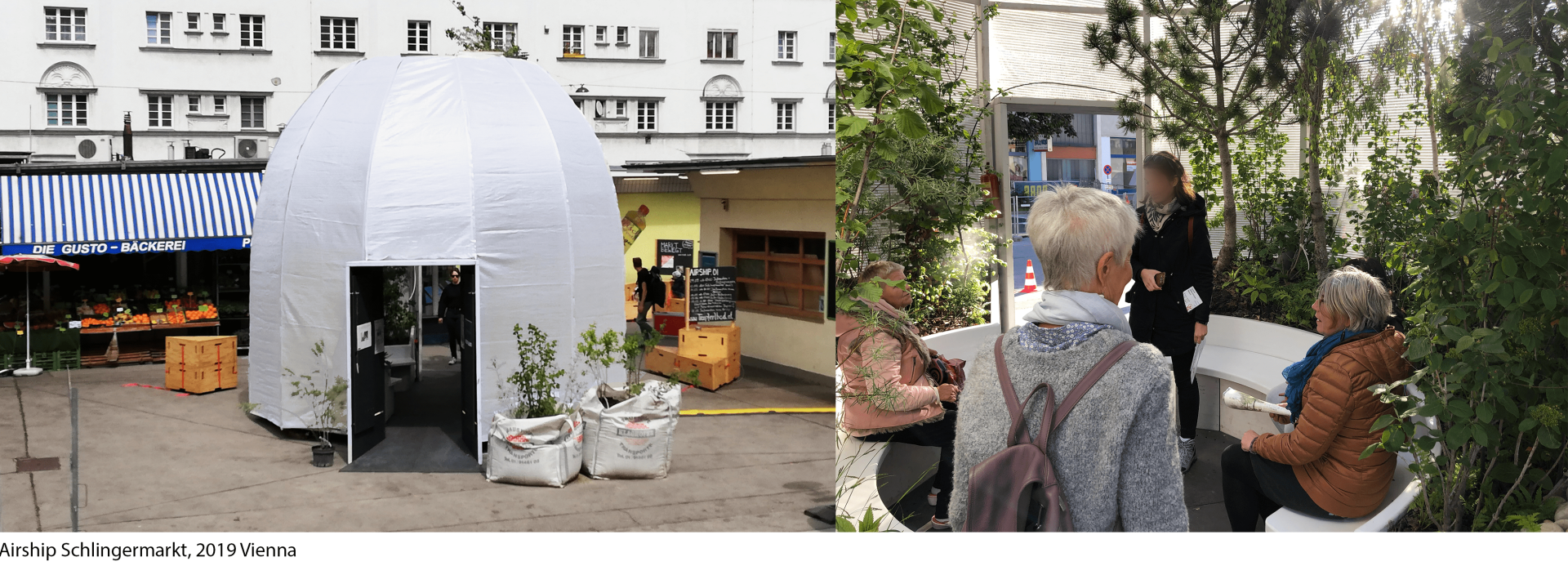
Right from the beginning of the project, the different stakeholder groups and local inhabitants have been addressed and motivated to participate. In addition to conventional survey methods and workshop formats, a mini demo object, a so-called Airship, has been installed at the demo-site and different place-making activities have been realised and monitored shortly after the start of the project. The Airship is a mobile climate installation of aprox 10m2 that is planted with an intensive piece of forest. Thanks to its intelligent architectural design, the Airship naturally cools the temperature up to 6 ° C and invites visitors to cool off, take a rest and visualize possible re-design options of the local demonstration site.
With the visible presence of the mini-demo object at the case study location over some weeks of time and the interactive interaction methods, it was intended to reach as many stakeholders as possible. It was intended to openly discuss and vision the expected effects while giving diret stimulations via the Airship demo. The findings from the participatory activities were incorporated directly into the development of the Coolspots as design guidelines.
The topic of (crowd) financing was also addressed. A direct relationship was established between the extent to which individual persons and / or organizations are affected (as neighbors, future users of the measure, interested persons, etc.) and the actual implementation. By participating in financing-instruments, the identification with the implemented measure increases.
With the chosen co-creation methods, the needs, desires and general feelings of different target groups are becoming part of the re-design-process. This leads to a stronger identification and thus acceptance by the local inhabitants and at the same time increases the quality of the created urban spaces.
Innovative character
The heart of the innovation of the Troepferlbad method is a novel marriage between scientific simulation and planning towards urban NBS, resource efficient use of materials, adaptive local design and social methodologies, applied at the very local scale in an urban district. The complex mixture of methods and scientific knowledge is broken down into easy to use and applicable planning, implementation and maintenance principles, so that a self growing and scalabe network in European cities can start.
Societal Transformation enabled by integrated planning and adaptive local design via place-making. Integrated planning and adaptive local design, informed by co-creative methods are crucial for addressing socio-economic challenges and for enabling transformational change.
Vertical and horizontal integration: Accelerating transformational change through convergence, cross- fertilization and peer-to-peer-learning via the co-creational methods which do not only integrate local stakeholder groups but also central and local governments.
The document “Evaluating the impact of Nature-based Solutions: a handbook for practitioners” was recently by the European Taskforce for NBS Impact Assessment (TFII). the Coolspot reunites some of the Handbook’s core indicators as relevant to show the innovative impact :
- KPI 1: Participatory planning is achieved through the number of affected stakeholders involved in co-creation/co-design sessions ( 20% of citizens) and increased sense of empowerment & trust in decision-making procedures and decision makers through perceived control and influence (qualitative indicator measured through citizen survey, focus groups and interview).
- KPI 2: Knowledge and Social Capacity Building for Sustainable Transformation is achieved through the participation of 30% in the total number of local inhabitants and stakeholders, involved in the local place-making activities per year.
- KPI3: Place R