Deeltuin
Basic information
Project Title
Full project title
Category
Project Description
The Deeltuin has reinvented the collective neighborhood garden. With this design, residents are invited to connect with each other and feel ownership that extends beyond their own plot boundaries, thereby creating a distinct shared neighborhood identity for a new city district.
Project Region
EU Programme or fund
Description of the project
Summary
When a completely new neighborhood is built, everyone has to find and create their home. However, feeling at home goes further than the house itself. In many cases, new neighborhoods do not yet have schools, shops or other public meeting places, so that a neighborhood identity takes shape very slowly. Since many residents work elsewhere, a dormitory city can then arise without social cohesion.
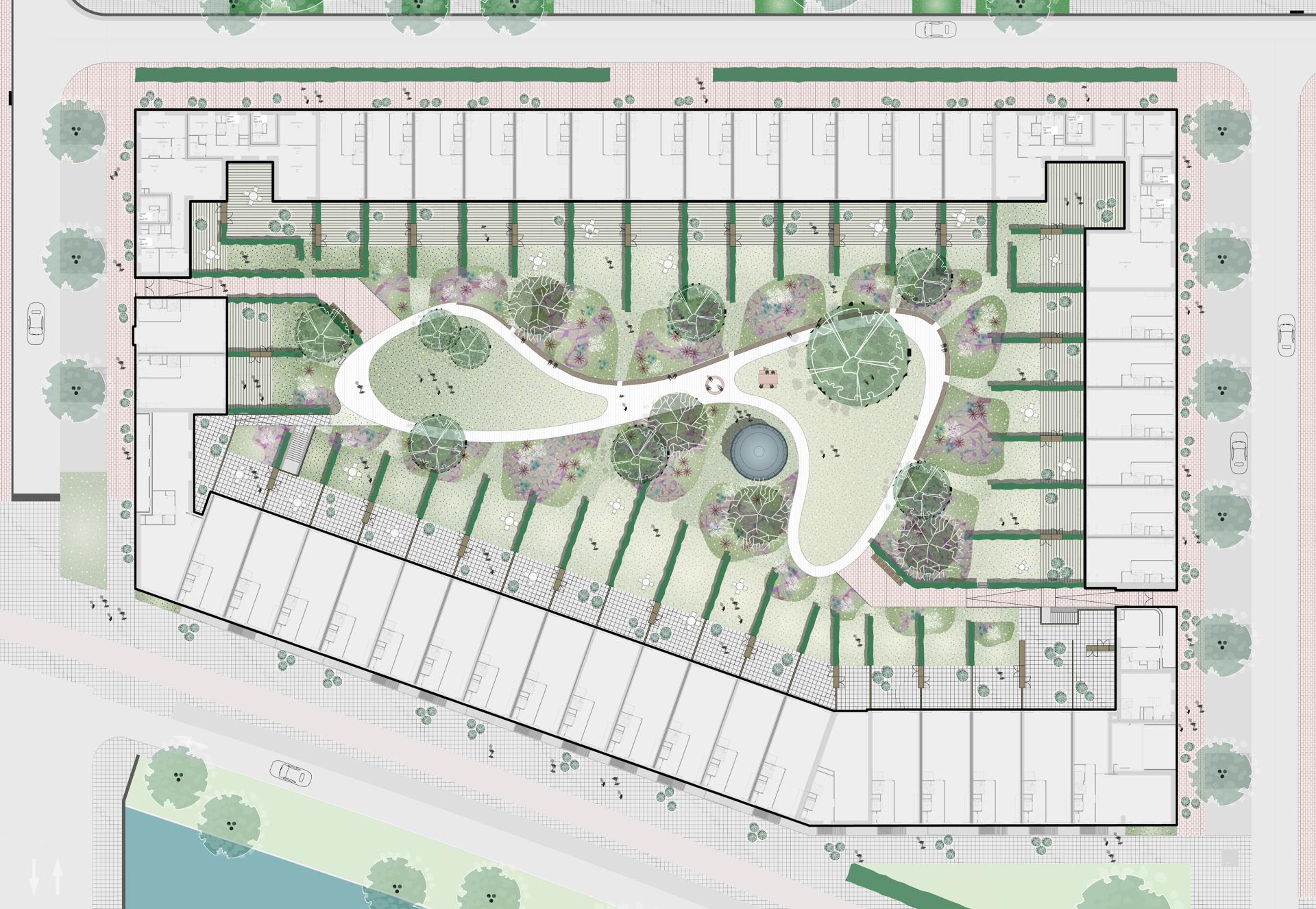
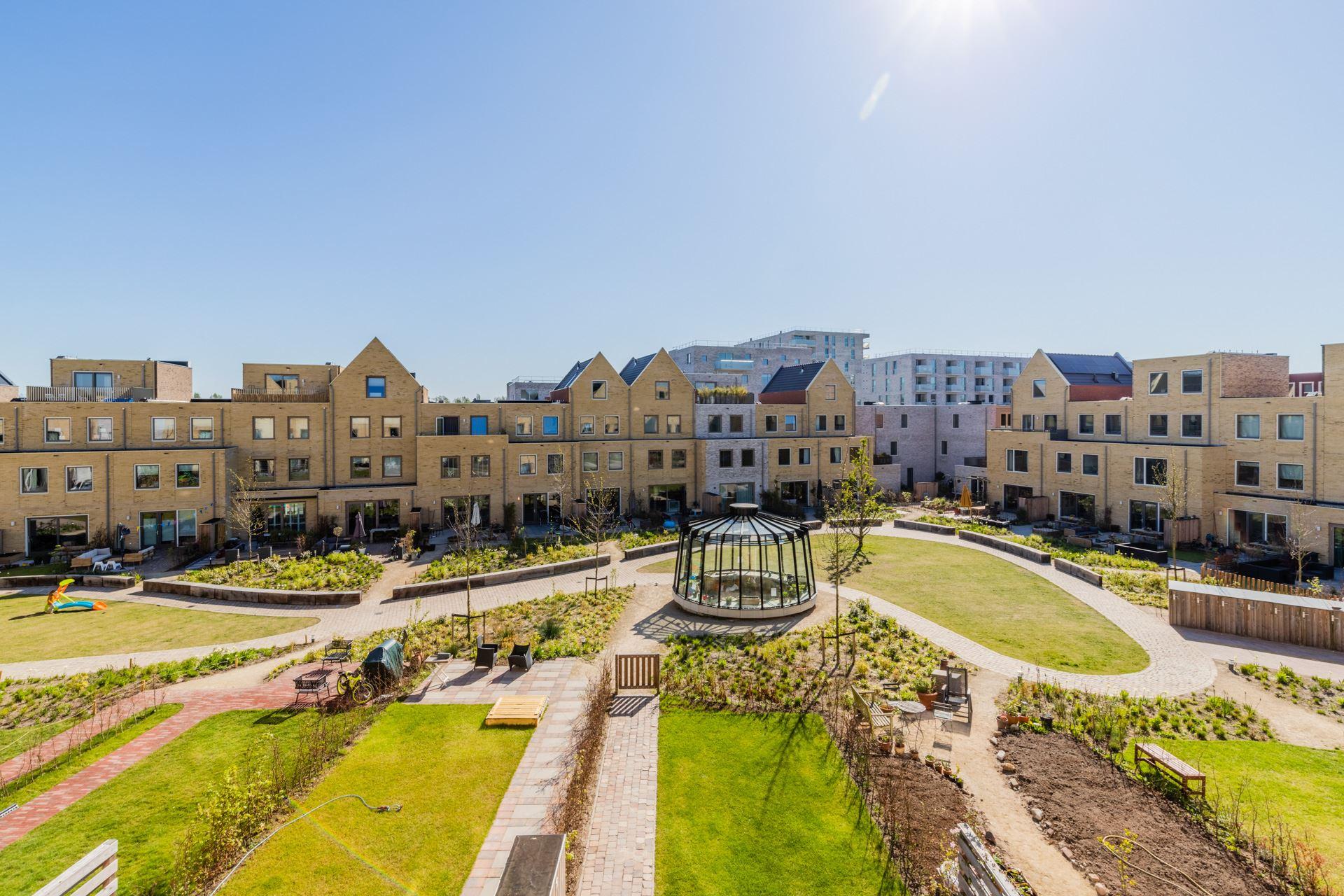
In response to this, we have designed a residential block in which private and communal space merge seamlessly. A modern interpretation of a courtyard that elicits a sense of community. The common area is also divided into different areas. Here, each space is clearly programmed for use so that visitors deliberately choose their place to meet each time.
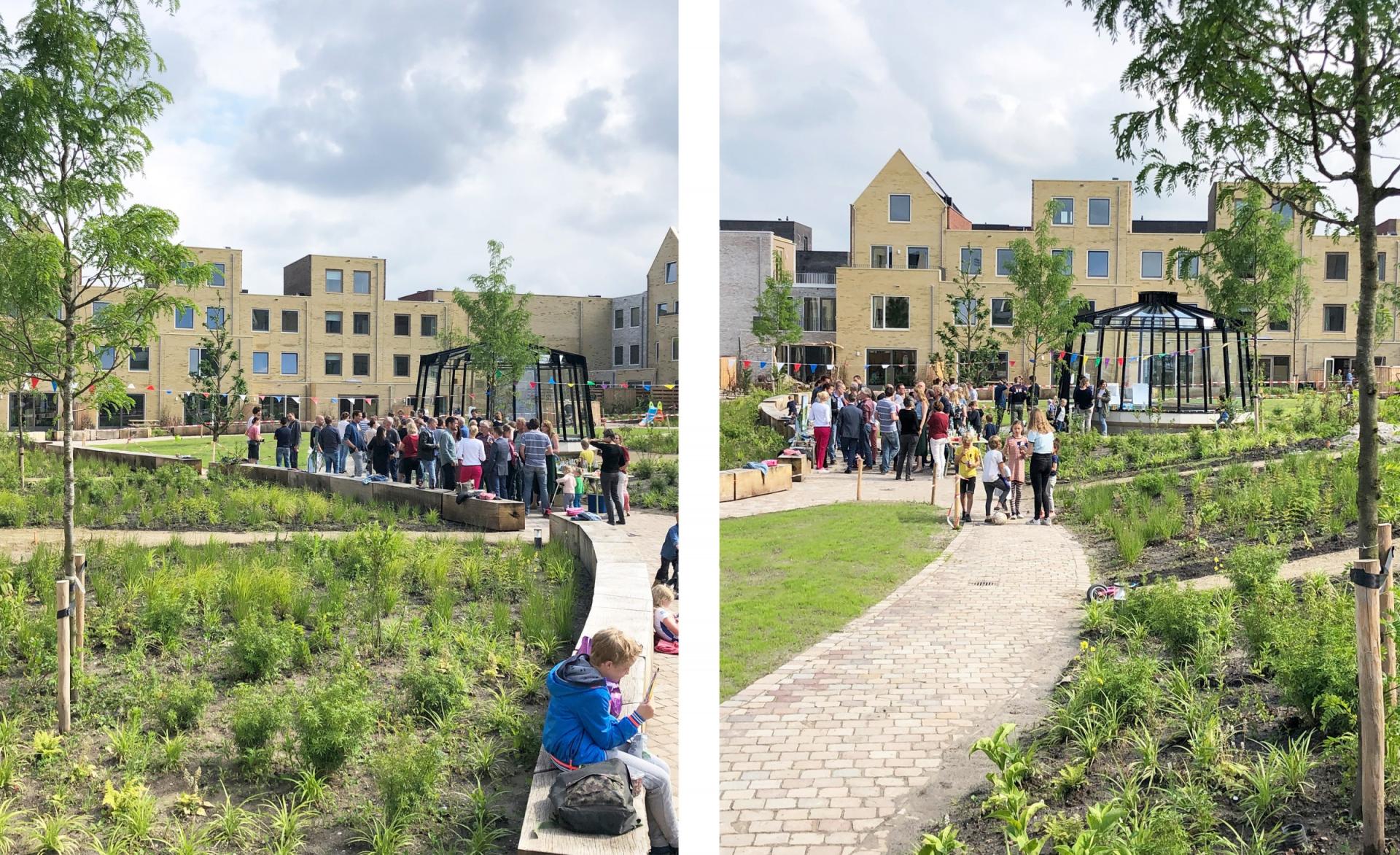
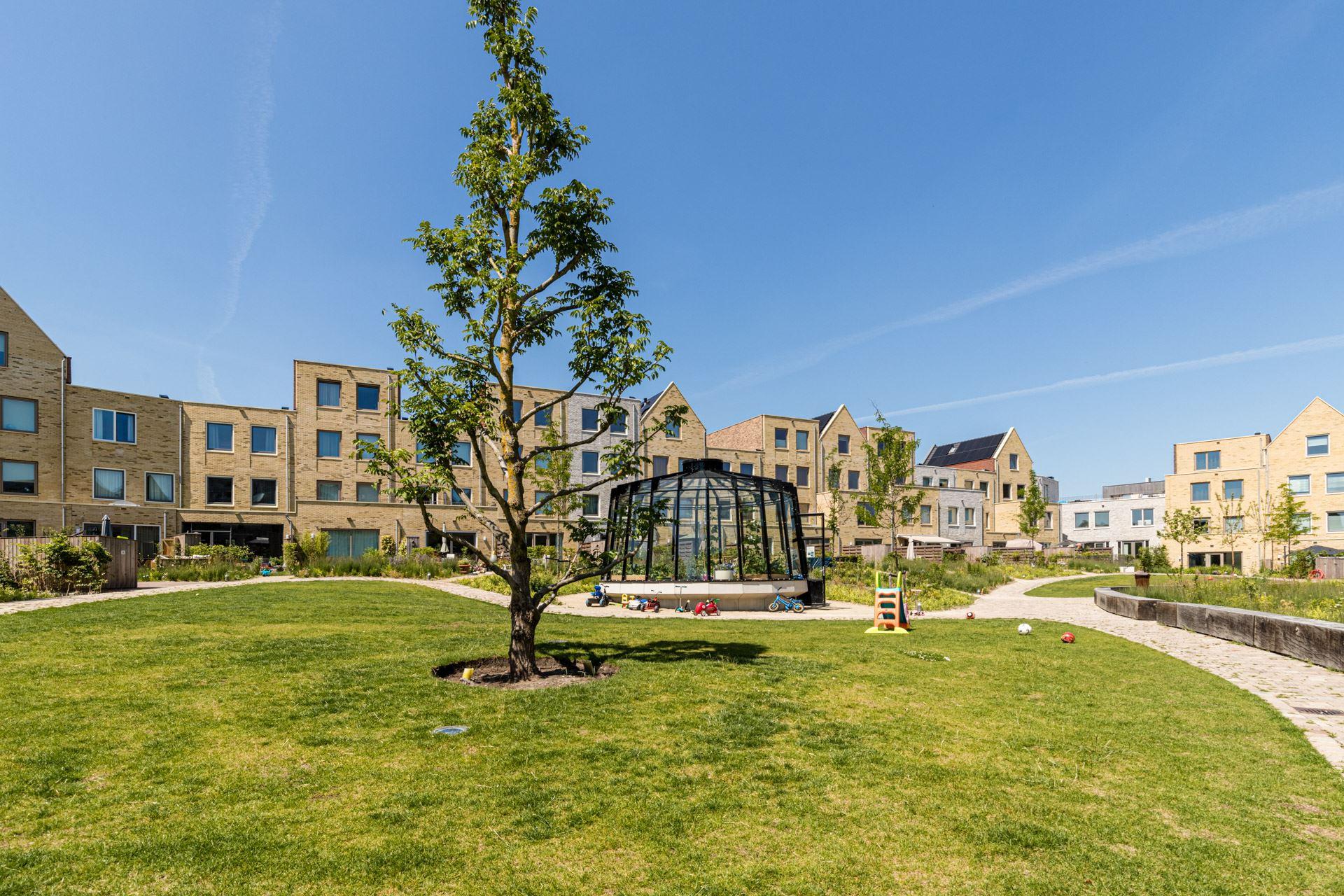
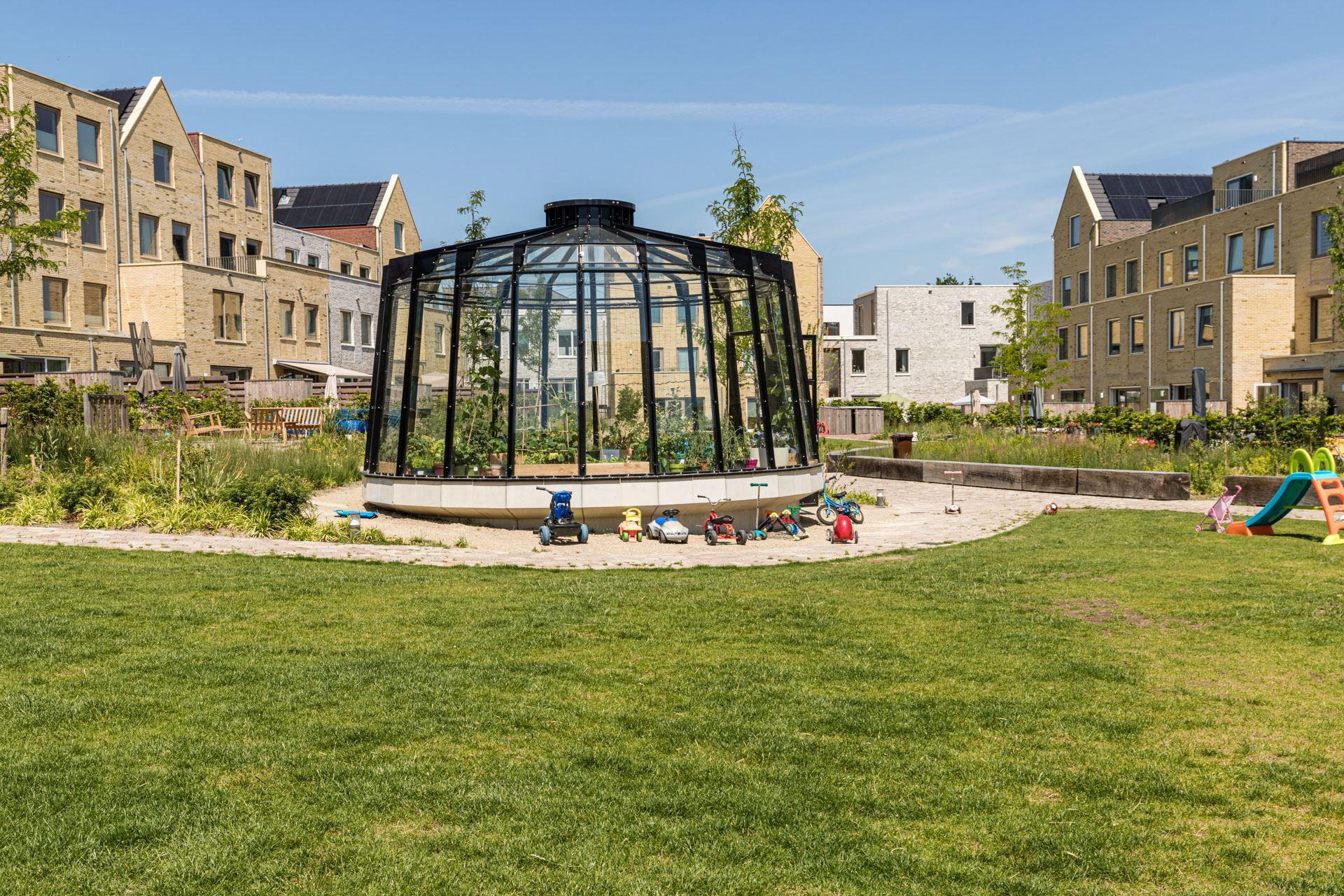
Children playing together, neighbors sunbathing conjointly in the meadow. It is a place that can meet many needs. Neighbors can grow vegetables together in the central greenhouse, after which they can organize a festive picnic a few meters away.
The design of the garden was realized in collaboration with the future residents. As co-designers, they are actually partly responsible for this place, not only for the design but of course also for the maintenance.
In addition to a sense of community, a modern city district naturally also requires other qualities. Hence, it is also a place of self-expression and, if necessary, privacy as well. Each has its own adjoining garden and each house has its own identity and facade, despite the common choices in finishing.
The quality of the site has been made possible by keeping motorized traffic out of the picture. The parking spaces are safely ssituated semi-sunken under some of the houses.
Key objectives for sustainability
Sustainability has been an important integral part of the development of the Deeltuin. Because the residents, as stakeholders, contributed ideas during the design phase, it has become a place where sustainable quality of life has been given a high priority.
The greenhouse and vegetable garden invite residents to grow their own food. The collective nature of this makes residents aware of the scarcity of these sustainable products and therefore requires fair cooperation.
Sustainable answers to water issues have also been provided. Rainwater that falls on the surrounding roofs is collected in rain barrels and then used for the maintenance of this garden.
As many of the flat roofs as possible have been arranged as green roofs. Not only do they provide natural insulation, but they also help with water management. Due to the underground parking, a much smaller area has to be paved for parking spaces. All these interventions ensure sustainable, autonomous water management. As a result, the space within the building block does not have to be linked to the sewer.
All in all, the Deeltuin has been developed sustainably and amply meets the applicable EPC requirements. The houses themselves are also offered energy-neutral. Various design choices have ensured that on the one hand the energy demand is limited and on the other hand maintenance costs remain low.
Key objectives for aesthetics and quality
The inner garden was created as a collaborative project between the various local residents. Nevertheless, it has not become a fragmented place. A fluid landscape has emerged in which the three usage zones smoothly merge into each other. Even more striking, however, is the same gradual progression between the private gardens and the collective inner garden.
The place embraces its new urban identity. Yet it also challenges: you will not find any old play equipment here, but climbing trees on which swings can be hung or huts can be built against it. In this way, children experience the freedom to feel connected to nature in the middle of the city.
The interventions in the communal space have a strikingly mature scale, which makes the place legible and well-arranged. The central greenhouse also has a prominent appearance. Like a sturdy tower, it is visible from the private gardens like a monument.
The design of the space arose from a play between the personal and the shared. Each has its own visual language, which creates an interesting dialogue on the border. A sloping landscape with a smooth path connects the whole.
Key objectives for inclusion
The project has been developed with the primary aim of facilitating a sense of community for all new residents. This can arise in an environment where people can meet each other safely, a place where openness is facilitated by intimacy.
For this reason, the residents have been co-designers of their own living environment. The approach was not to force anything on them, but to arrive at the most pleasant way of living in harmony with each other.
The designers were therefore mainly there to provide frameworks and inspiration and to translate the wishes into a realistic design. This resulted in a collaboration of mutual respect and a continuous dialogue.
Results in relation to category
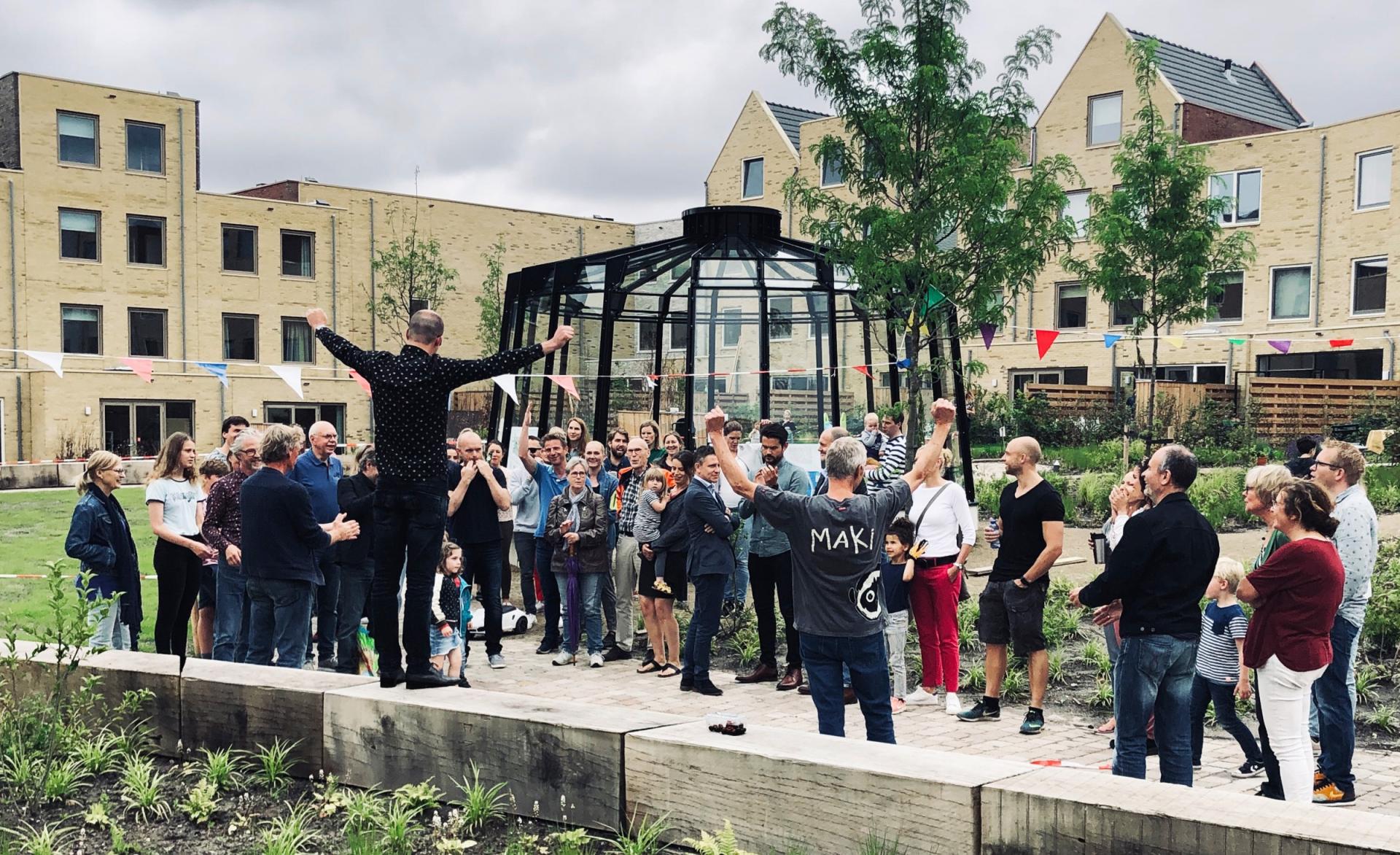
De Deeltuin originated from the ambition to embody the sharing economy in Utrecht. A special community has developed around the Deeltuin. The festive opening of the complex by the King was a starting point for a strong sense of togetherness. Neighbors work together to make their collective garden as beautiful and pleasant as possible. They get satisfaction from the maintenance of the place that binds them, with which it has become a truly living communal space that continues to develop after the first delivery. It has become a place for which people deliberately come to live. This has made it a place with unique added value for a new city block. A value that has translated into a good investment for the residents. For that reason too, the Deeltuin is an inspiring example for new housing projects.
How Citizens benefit
The sharing economy is a modern ambition that serves as a counterbalance to the individualization of today. It is a way of thinking that is an extension of a more sustainable and ecological society. The Deeltuin is a literal translation of that ambition and therefore also an expression of valuable emerging ideas. The design is an expression of love for the tangible quality that comes from collectivity. The collective responsibility allows the courtyard garden to acquire a quality that is unimaginable in a passive relationship with the local residents. As said earlier this has made it a place with unique added value for a new city block. A value that has translated into a good investment for the residents and a place with a sense of collective within the city
Innovative character
The design of the Deeltuin is the result of an ideological basis, an inspiring innovative approach, the craftsmanship of the designers and the involvement of the neighbors. An integral process makes this possible and gives the result qualities in the field of sustainability, liveability and collectivity that are an example for other projects.