Anis
Basic information
Project Title
Full project title
Category
Project Description
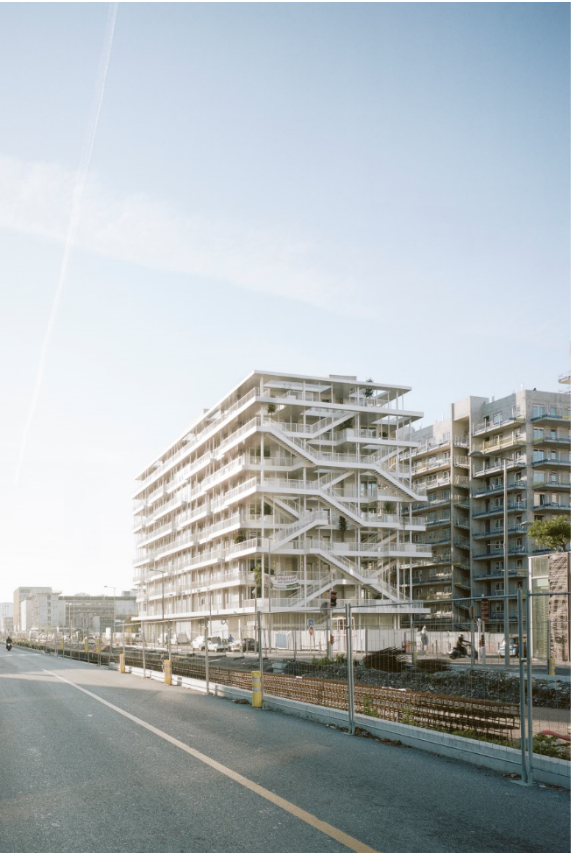
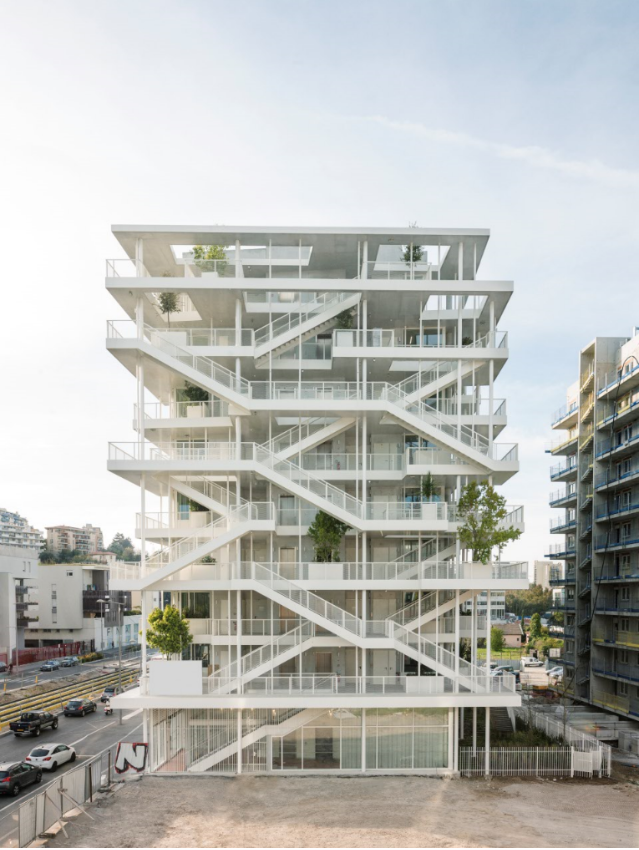
ANIS is an eight-storey mixed-use building of 6.962 m² with terraces. The main originality of the building is the 2,400 m² of outdoor space, nearly almost a third of the interior, which is unique in for office buildings.
Nicolas Laisné and Dimitri Roussel’s design was driven by three guiding principles: creating appealing working spaces, forming meeting places and offering flexible use.
This building is a manifesto for a new generation of buildings.
Project Region
EU Programme or fund
Description of the project
Summary
ANIS is located in the Plaine du Var Eco-Valley, a new quarter of the Nice metropolis and a driving force behind the economic and urban transformation of the French Riviera. This eight-storey office building of 6.962 sqm with terraces is built in a strategic environment : alongside a boulevard with a tram stop and surrounded by public and private parks. The main originality of the project is the 2,400 sqm of outdoor space, nearly a third of the interior, which is unique in office buildings. It also offers 616 sqm of service spaces open to all at ground level.
ANIS is the result of a strong environmental engagement. It has received the BREEAM “Very Good” and Smart Grid Ready Environnemental Certifications. It has also been labelled CRQE, a local frame of reference for environmental quality in the Plaine du Var Eco-Valley.
ANIS is the result of a deep reflection on new usages. Against the backdrop of increasingly flexible working arrangements and dynamic companies, Nicolas Laisné and Dimitri Roussel’s design was driven by three guiding principles: creating appealing working spaces, forming meeting places and offering flexible use.
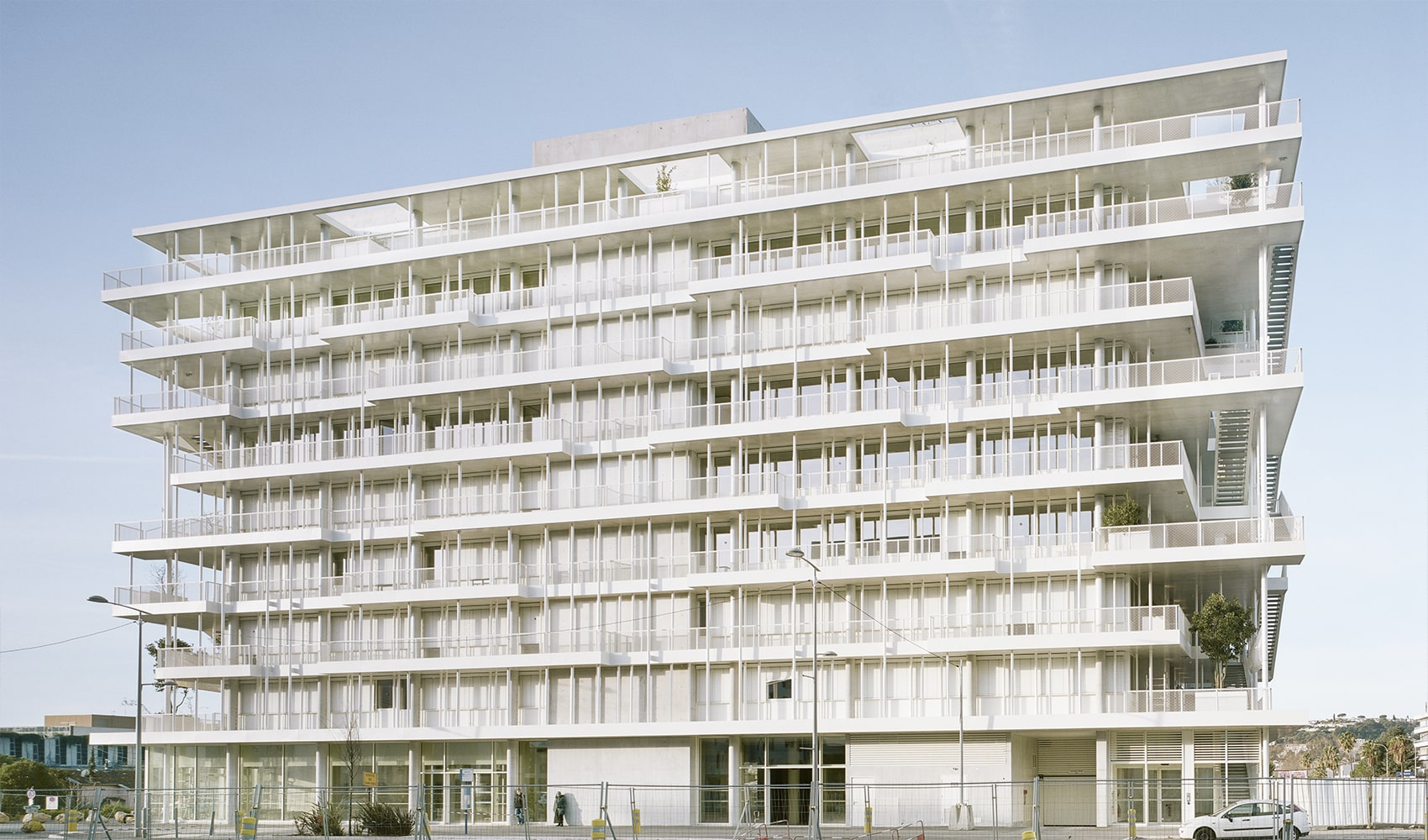
Handling these challenges from the point of view of Mediterranean architecture led them to suggest outdoor working spaces. The building is nestled in the heart of a green space. The terraces have gardens, but they are also connected to transform into a workstation or an informal meeting room. The transparent façades allow the light to enter, whilst the terrace overhangs provide protection from the sun, creating a climate-controlled environment.
This building is a manifesto for a new generation of buildings. This kind of architecture embodies three values :
- The adaptation to climate change
- Opening to the city and its inhabitants
- Accompanying the transformation of lifestyle
Key objectives for sustainability
Anis is located in Nice, a city shaped by a strong Mediteranen climate that significantly influences the lifestyle and comfort of citizens. Hence, the sustainable design strategy of this project was to transform this environmental situation into a way to improve the working quality and to address the phenomenon of Urban Heat Island Effect.
Our objectives were
- To create a bioclimatic envelope
The building design is optimised to respond to the weather: creating overhangs based on orientation, making use of solar energy in winter to reduce heating energy consumption, and providing protection from the sun in the summer, thanks to the facade high albedo and shadow from balconies. Anis also provides energy thanks to solar panels on the roof.
- To maximize natural ventilation
The corridor and passageway areas are used to create a climate-controlled environment and optimise natural ventilation.The Mediterranean climate inspired to offer outdoor workspaces and choose to move all the corridors and passageways outside on both sides of the buildings to free up entire floors. Circulation spaces placed on the outside opened up a floor space of 800 sq.m.
- To create long lasting buildings
The post-beam constructive system ensures great modularity of the floors, enabling this office to transform into housing and anticipating the reversibility of the buildings over the long term.
- To promote biodiversity
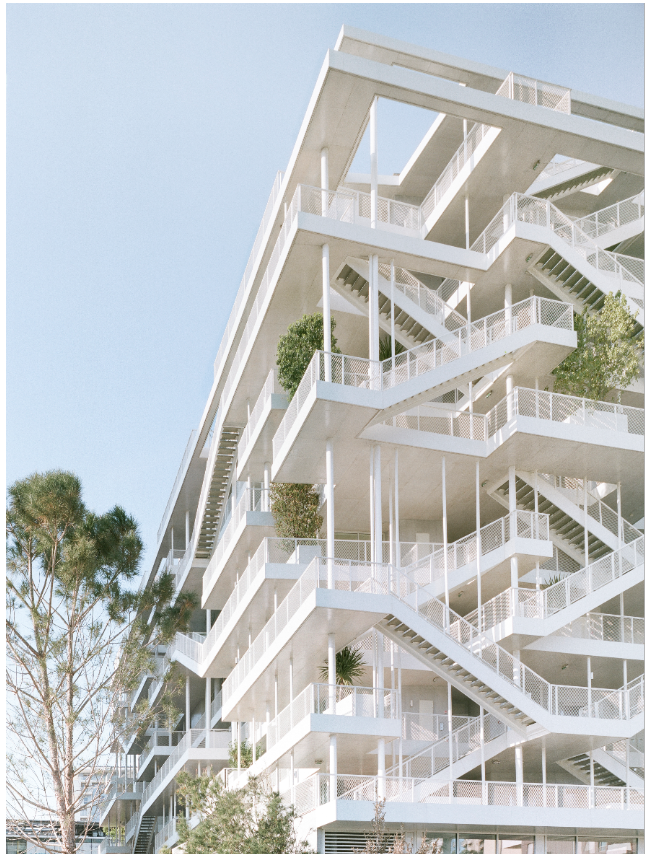
Planters with fruit trees and herbs on all levels are automatically watered because the facades are punctuated by thin posts integrating the downspouts of rainwater. The wide range of plants selected enables the facades to be animated all season and to benefit from a yearlong floraison.
Thanks to its environmental capacities, Anis has been able to obtain environmental certifications and to abide by the key objective of the surrounding Ecoquartier : to become an autonomous valley in terms of energy and low carbon emission.
Key objectives for aesthetics and quality
Anis aims to offer an architecture anchored in reality and yet beautiful, accurate, lifely, light, dense and ecologically virtuous.
Our key objective to achieve this goal were :
- To create a remarkable architecture
Anis plays with multiple faces, allying rhythm, dynamism and verticality. Its most visible facade is animated by the horizontality of balconies running along its length and rhythmed by multiple and thin colonnades that lightens the whole. Corners are sculpted by various overhangs, becoming the source of diagonal staircases when turning around the building. This aesthetic tangle of circulations, describing different lines without symmetry, gives a new dynamic to the building, enlightened and lightened by several vertical breakthroughs where big trees are growing.
- To adapt the building to its cultural and environmental ground
The point of view of Mediterranean architecture led the architects to offer outdoor spaces and a white unconventional facade. There was a desire to invite the Mediterranean vegetation within the architecture, thanks to tall trees at each level, animating the facade and echoing the regional landscape.
- To create sensation of space and lightness
Outdoors spaces, entire floors freed from corridors, passageways, and usual false ceilings are amplifying the natural sensation of space in and outside the building. These innovations offer the maximum freedom for occupants in their chosen layout.
- To create an active design
The scenery of outside circulation spaces are inciting people to walk stairs, to meet on the terraces, livening up the entire building from the outside. This design allows a new art of living between exterior and interior.
- To improve the quality of experience
The increasing need for flexibility, comfort and collaboration drove the architects to offer modular working spaces on the outdoors and the main hall which can be transformed into a place to have a coffee or a meeting.
Key objectives for inclusion
Inclusion is a strategic aspect of the ANIS building, because of its specific location.It also offers inclusion through the promotion of exchange and informal meetings.
Our key objectives were :
- To foster the inclusion of the building in the Ecoquartier
Nice Meridia is the technology district of the city's 2,800-hectare Eco Valley, a sustainable development area. It aims to become a leading example in terms of economic, environmental and urban transformation within the Riviera region. It has the ambition to become autonomous in terms of energy and low carbon emissions. Anis has achieved its geographic inclusion because of its way of attracting people by promoting better working conditions and of developing innovative environmental solutions by setting key environmental objectives,which had been recognized and labeled.
- To address the inclusion of nature and city together in a project
Local inclusion is a challenge of a smaller scale. Because the building is located in the heart of green areas, next to a boulevard with a tram stop, it has to include both urban and natural elements. This objective has been met with the service spaces offered on level 0 and the choice of the right vegetation according to the Mediterranean culture, at strategic places on the terraces. These elements of nature are echoing the surrounding green areas and are also building a delicate bridge between architecture and nature within the city.
- To ease inclusion of people by creating the conditions of informal meetings and exchange inside or outside the building.
With outdoor spaces and circulation, people are often meeting each other, have the opportunity to exchange and have the feeling of being part of the same community, instead of being muted strangers in an elevator. This building is also open to the society with its visible circulations and the offer of multiple services at the ground floor, enabling other citizens to have a different usage of the building.
Results in relation to category
By designing Anis, N. Laisné and D. Roussel tried to offer a new generation of working places as a place to meet and share. Anis was meant to be open, generous, integrated, innovative in the use of space and an exploration of new ways and practices of living and working together. Based on a constructive principle of intelligent facade and exterior circulation, tackling environmental issues and feeling of space, Anis actively responds to a new desire for community and better working conditions. It promotes a new style of life and work based on exchange, interaction between people to develop new synergies and cohesive urban communities.
In Anis, people have unique spaces and opportunities to meet and share, thanks to outside circulation and working spaces. Terraces are also connected to transform into a workstation or an informal meeting room, also offering gardens to relax. This reallocation of spaces and desire of openness are both generating a sense of community where people can informally meet each other, share spaces and share a common experience of new working conditions. All is set up to provoke positive exchanges and foster co-creation inside and outside the building, through this unconventional facade.
One of the key innovations of Anis is its capacity to reinvent itself, following the needs of its users and the needs of an evolving society. Thanks to its entire floors freed up from corridors, passageways and false ceilings, Anis can be shaped and adapted by its users, in line with their specific needs. But Anis already includes the possibility to be reversible into housing, if the quartier needs to evolve.
Anis can completely reinvent its usage without giving up its main purpose : to be a place to meet and share, generous, light and innovative, allowing a new art of living between exterior and interior, as a community.
How Citizens benefit
Anis has been designed in cooperation with the Local Planning and Development Authority for Nice EcoVallée (EPA), which has the status of Operation of National Interest. This EPA aims to develop urbanism projects with a high level of complexity, combining ambitious perspectives in terms of economic, employment, sustainability, city planning and anticipation of technological and natural risks.
Anis is an integral part of this particular and challenging urban development. Hence it has had the opportunity to benefit from such an involvement from civil society, composed in this case of the government, regional and local collectivities and citizens, through a Permanent community-based Advisory Committee. This assembly of national, regional and local players has ensured ANIS to play a key role in a big-scale urban and economic transformation, while taking into account local issues and perspectives.
Being part of this kind of civil-society-driven project with a strong environmental theme is a unique chance to be at the forefront of innovation in terms of sustainability and to develop, deploy and challenge environmental solutions of our own.
The Permanent Advisory Committee gives the opportunity to maintain a continuity of civil involvement in the project through dialogue and feedback of user experiences. It helps our building to reinvent itself but also, as architects, it helps to keep in mind the evolving reality of local communities in order to offer the most suitable solutions on other projects.
On ANIS, we received positive feedback from citizens, which is encouraging and proving that our main objectives for this project had been met. Directors from Promotion Pitch and KPMG, located in the building claimed that “outdoor spaces are pleasant to strike up an informal conversation, have a break or recharge”. They both planned on this building to offer a possibility to “exchange different ideas, share and mutualise”, enabling their teams to “live together”.
Innovative character
The design of ANIS was inspired by three principles : creating appealing working spaces, forming meeting spaces and offering flexibility of use.
But one of the biggest innovations from Anis is the way it tackles new challenges emerging from the constant evolution of society and from the pandemic. Office buildings no longer serve the basic paradigm of being a place to work.
Anis reshapes workplaces as places that should serve new working methods and conditions.
Flexibility, modularity, horizontal management and innovation through exchanges of ideas and practices. All these characteristics are fostered by the design of the building. Work has become a crucial part of life and should therefore be an appealing place where people feel a sense of belonging. But also a place where they are encouraged to be creative, while having the opportunity to relax and share formally or informally with various people.
Anis is also a manifestation of the necessity to be facing environmental issues and how climate constraints can be transformed into means of improvement of people's wellbeing. This statement is progressingly shared by various parties of the society, but this building shows that innovation has to be constantly challenged. Because the society and its urban environment are evolving, Anis has proven its capacity to reinvent itself and to be reversible whatever the evolution of the Ecoquartier. Not only by offering a mix-used program, but also by giving the possibility to transform the building into housing where the well-being of the user is still the first priority of the architecture.