200 years of building continuity
Basic information
Project Title
Full project title
Category
Project Description
The convent of the Gates of Heaven, in Lisbon, endured several transformations over its 200 years of life. Its survival and role as a cultural and heritage testimony were at risk of being lost, until the City Hall and a Private School signed an agreement for the installation of the Mira Rio School on the premises, thus restoring a decaying ruin and transforming a vacant lot and allowing for the dialogue between old and new, preserving matter and memory and transforming the community.
Project Region
EU Programme or fund
Description of the project
Summary
This project for a school includes the refurbishment of an 12th century convent, that has been abandoned for many years and the setting of a strategy to use a long-vacant plot with a pivoting urban role (mediating a residential neighbourhood, an international school, an historical route, gardens and an underground line terminal).
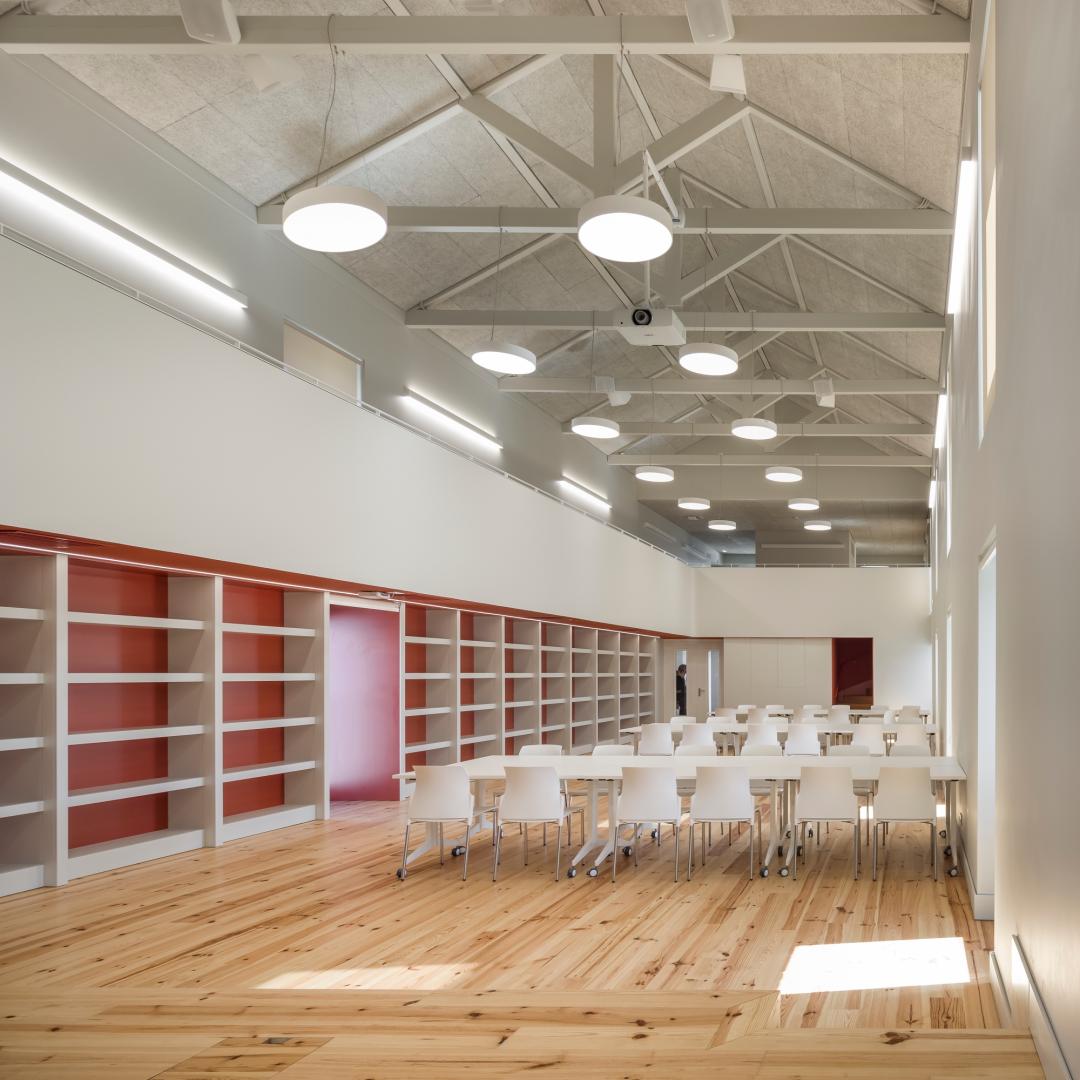
The project includes a kindergarten, a primary school, junior and high school, with children from their early age to 17 years old students. It also includes a library, a chapel, a canteen and a gymnasium, open air playground areas and the necessary administration offices. The main program of the old convent is the library, the music room, a multipurpose room and some of the administration and professors' offices.
In the convent a strategy of reuse of materials, spaces and of the memory of spaces was actively sought for. The connection between old and new is achieved through cloister spaces, reviving and rethinking a century long spatial structure.
The project stands as an example of collaborative strategic planning of public and private partners (i.e. the Municipality of Lisbon and the School board) that answers to the interests of a number of actors (national and local authorities, heritage protection authorities, traffic and transport public organizations, social security, education authorities, the wide and local communities and organizations and the families of the school community). However, the design aims to overcome all these distinct contributions and demands and proposes a sustainable approach to the task of rehabilitation of heritage through a modern, contemporary addition.
The logic of such an approach is to consider the building as a whole (rather than isolated materials) as a circular, valuable and meaningful asset, that thus has its life cycle increased.
Key objectives for sustainability
The project defined a clear approach to the refurbishment of the convent by specifying materials and technologies that are highly reversible and compatible with the construction techniques of the old convent building. The old convent structure was also reinforced to guarantee the structural stability of the convent throughout this new life cycle.
The new constructed volumes of the school were built with long lasting materials, in compliance with current seismic building codes and with resilient materials that are easily replaceable and that have increased durability due to the intense use of the school.
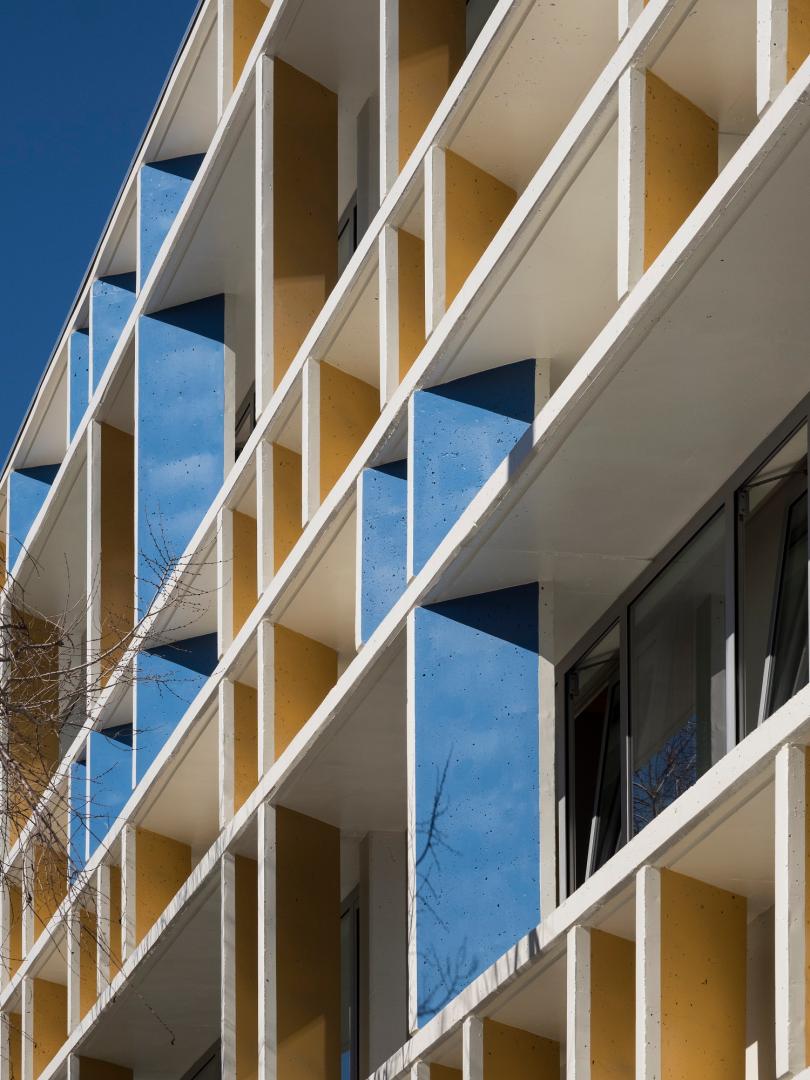
Façades were designed to provide light and shade to minimize direct sunlight into the classrooms and working spaces. A detailed acoustic and study of colour was carried out at project stage to optimize the interior spaces (especially of classrooms), since there is a close connection between the quality of the indoor environment and the learning process (for concentration and clarity of visual and oral contents), and especially more so for students with visual or hearing limitations.
Solar panels were introduced to provide for heat, hot water, and electrical power for the school. The building envelope was defined to provide high levels of thermal insulation and thermal inertia, so that interior space temperatures would be comfortable, while minimizing the need for heating and cooling of the school spaces.
Finally, the School location is also close to a wide network of public transportation systems which has a strong positive impact of the reduction of the carbon foot print related to the daily commute of parents / children, teachers and staff.
Key objectives for aesthetics and quality
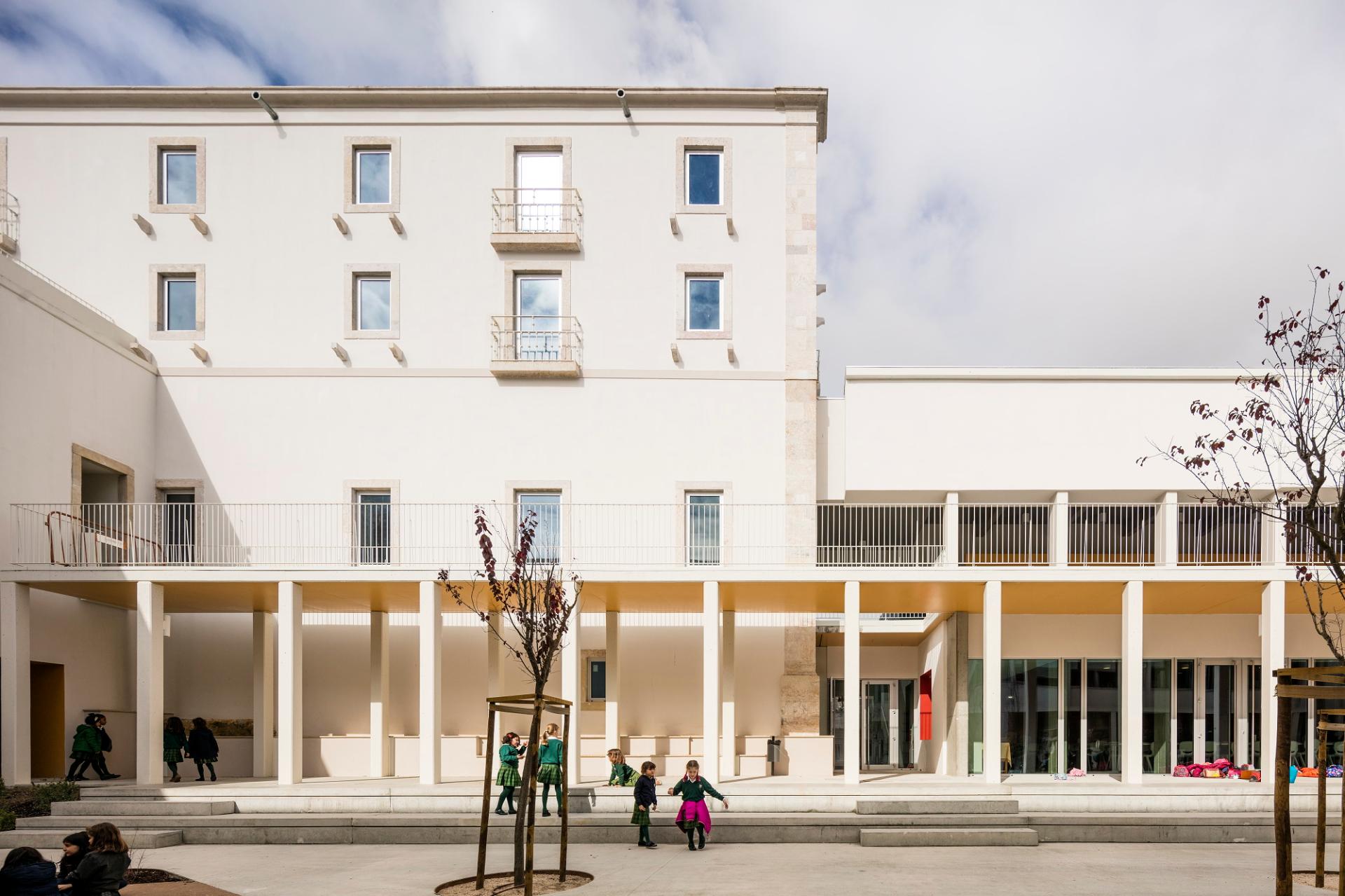
The project provides aims to provide a balance between the old convent and the new buildings of the school. The whole precinct is organized around a central courtyard where the main playgrounds are located - with spatial differentiation according to the age of students.
The central playground - where the old convent and the new school buildings all meet - has a cloister like configuration where all the circulation that links all the different programs of the school is located. It is a place where students from all ages can meet and play together and also an invitation to experience a true 'promenade architectural' with the project, a crisscross view between the parts.
The new buildings provide a contemporary aesthetic character to the school, especially in their relationship with the light and landscape (the urban, modern façade of the ensemble) and with the pre-existing German School of Lisbon right across the street. The new additions respect the scale of the old convent as the former are much lower than latter. This ensures that the urban presence of the old convent is maintained and respected.
Inside the convent, the vaulted spaces come to life once more, through the demolition of a clutter of partitions. The structural and constructive logic of the old building are rehabilitated, including massive stone slab pavements and centuries old 'azulejo' tiles. In the library, a double height space punctuated by the rhythm of the original window openings remains as a memory of the transformations endured by the building, along with a longitudinal mezzanine that aims to bring the 'promenade architectural' inside, to a space were use and meaning blend together.
Key objectives for inclusion
The project aims at creating an intergenerational meeting point of students of all ages: from toddlers to pre-university students, fostering a sense of community within.
The school was previously dispersed in several locations in different parts of Lisbon. In this location, not only the school community can function as a single one, but also a new proximity is achieved with other schools from the same promoter.
From an urban point of view, the project is sensitive to the diverse context around that includes several other groups or communities: the parochial church and community (the church building having long ago been separated from the convent), the scouts association next door; but also, the German School of Lisbon thus creating an educational cluster in the Telheiras neighbourhood. Also, from this point of view, the School acts as a linking element connecting different urban areas that lacked an articulation between one another due to the urban void of the vacant plot, before the construction of the School.
The fact that the School is located closer to a wider network of public transportation systems contributes to a more diverse community and has had a significant impact as previously families with children with different ages had to take them to previous different locations.
The project is fully inclusive to people with disabilities. The educational spaces were designed to foster the attention and ability to learn of children with visual and hearing limitations (abundant side natural light, reduction of glare, low reverberation, colour scheme both stimulating and inductive to concentrated work).
Results in relation to category
The new School foster for the renovation of an old 17th century convent that had been abandoned for decades: a physical rehabilitation, the introduction of a renewed logic of use and, of course, the attribution of meaning to such an intervention. This introduces a clear intent of longevity and of a more circular economy of means, as we are working to maintain and renovate existing buildings that are important landmarks that are part of our cultural and physical landscape (as opposed to discard them to build new constructions).
The design and construction / renovation of this architectural heritage, using old and new materials with traditional and contemporary technologies, allows the memories of the convent to continue to live amongst the next generations of students and teachers and of the community where the convent is located.
The project included the structural reinforcement of the existing convent (foundations, walls and roof). Within the latter, construction techniques were implemented that revived some old ways of building (as in the loading of the top side of the vaults, the reconstruction of the stone walls of the gates that were to be disposed of, or the laying of slab stones for the floor previously removed and carefully recuperated). These techniques had to respond to the existing building matrix and to current building code demands, in terms of their performance, durability and resilience.
In the new buildings a contemporary aesthetic was proposed, in a dialogue between old and new. Besides geometry and form, in the project live together both (reused) ancient spatial organization modes and (modern) ones: the 'cloister' and the 'promenade architectural', as a way to reach a balance between the two ages present in the project.
How Citizens benefit
The project for this new school included the renovation of an existing convent, considered to be an important element of the architectural heritage of this site. The convent had been abandoned for decades, with part of its structures collapsing and an empty vacant lot around.
The local community expectations were therefore high: on how public, inclusive a open to the local community a proposal for the site would have to be. However, public institutions (i.e. the municipality of Lisbon) had not the means to carry out such a rehabilitation operation. Extensive negotiations were carried out between the public powers and a private promoter (the administration of the School) and an agreement was reached for a long lease of the property in change of the obligation of the School to rehabilitate the building within a relatively short period of time.
Within the School several meetings with the school stakeholders, the board and the families were held to fine tune the exact extension of the program. There followed a design competition to select the best solution with a fully transparent process. The design process was complex and inclusive as different actors had to be consulted (the School board, the municipality, the Lisbon underground - since there is an underground line crossing the site - the heritage authorities, the traffic authorities, the parochial church, to name a few).
In the end, the project stands as an example of collaboration between public and private actors, with a deep local impact on the neighbourhood of Telheiras - that thus eliminates and urban sour - as well as on the lives and families of the wider school community.
Innovative character
- an example of a public and private collaboration, allowing for the rehabilitation of a decaying heritage building and a void, vacant plot in the middle of a residential neighbourhood in Lisbon.
- working with a community of families who are an integral part of the school stakeholders.
- working with local education, planning and heritage authorities as the program of the school included the renovation of the old convent, some community programs and a wide range of educational facilities since kindergarten to high school.
- working with old and new materials in an integrated way, as the convent was fully integrated into the school program.
- use of old and new spatial organization structures (the 'cloister' and the 'promenade architectural'), coexisting and promoting and integration between a 17th century convent and a modern addition.
- the proposal for a central courtyard that encompasses all the life at the school as it is where all circulations between the different parts of the school take place as well where the main playground is located.
- organization of the program to allow for multiple entrances for the several age groups with the "several" schools within the school and a close relationship with the common spaces of the school such as the library, the administration, the canteen, the gymnasium and the music room.
- respect for the scale of the existing convent, by using the topography to balance and integrate the new programs into the site.
– using old and new construction techniques that allow for the new buildings to be integrated with the old convent in an effective, meaningful and sustainable way.