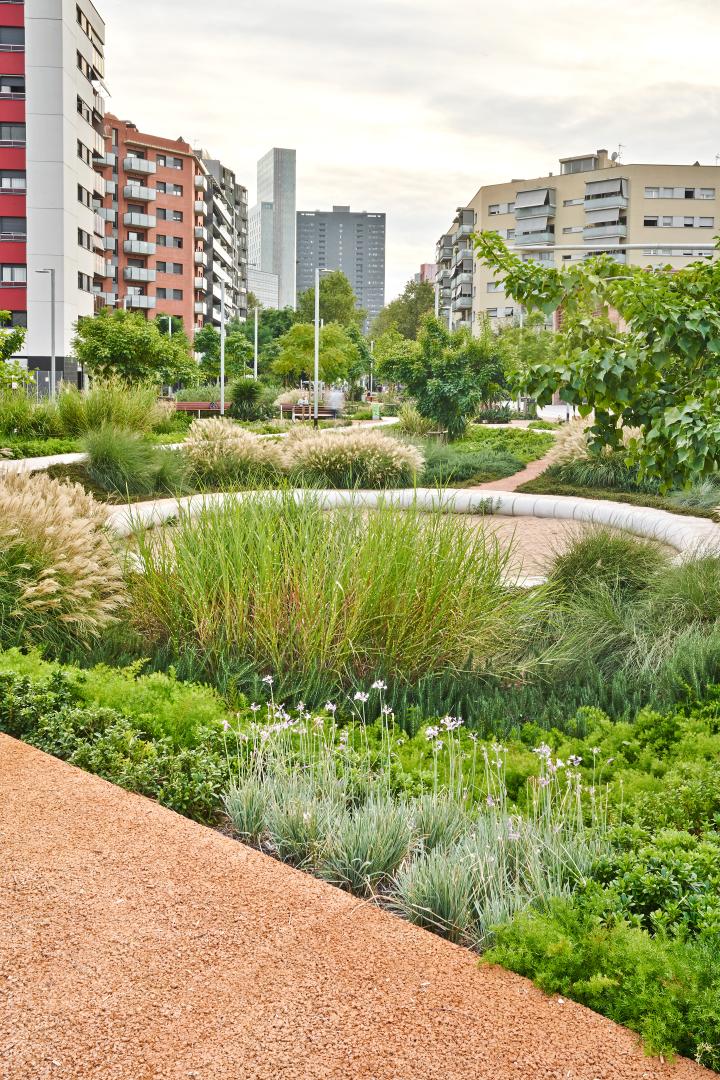
Cristobal de Moura Green Street
Basic information
Project Title
Full project title
Category
Project Description
Innovative technology and design take us back to nature with state of the art passive water management systems that make beautiful plant filled streets. Cristobal de Moura Green Street brings it all together with inclusive, participatory city planning.
This pioneering project uses the power of vegetation to manage rainwater where it falls, reducing pollution and water waste, with health benefits for people and the environment. It serves as a model and inspiration for future interventions.
Project Region
EU Programme or fund
Description of the project
Summary
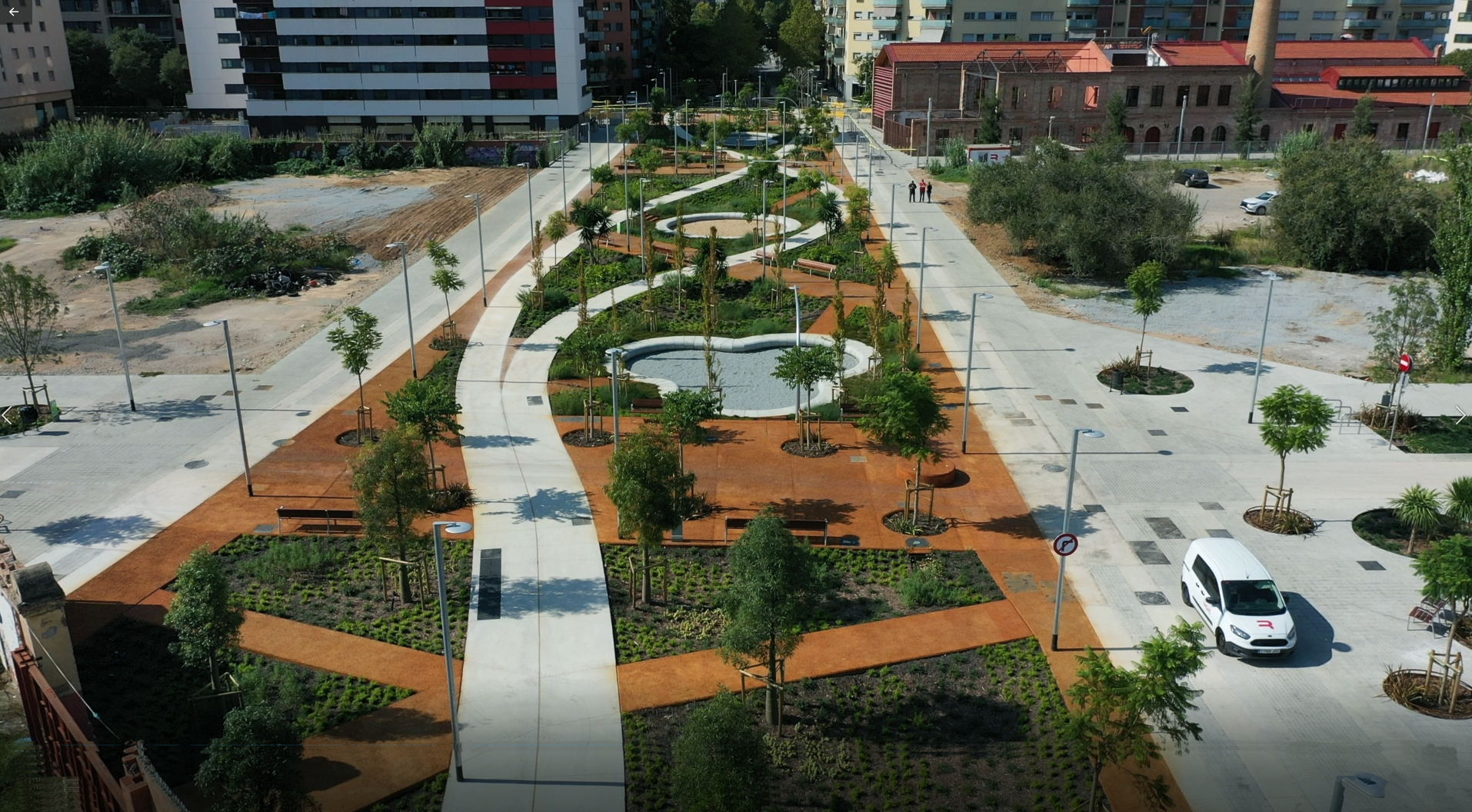
The transformation of Cristobal de Moura st. into a linear park is a pioneering project that leads the way into the future of the city - green, sustainable, resilient, and people centered.
It is found in Barcelona's 22@ technology district, in Poblenou, and forms part of the strategy of structuring the city through green corridors, creating healthy and functional spaces to stimulate neighborhood activity. Citizens have been placed at the center, encouraging their participation to generate a new multifunctional urban ecosystem designed by and for people, contributing directly to the Sustainable Development Goals, including SDG 11 on inclusive, safe, resilient and sustainable cities.
The intervention will be completed in different phases, and will connect the Central park of Poblenou with Besós park, and continue towards the municipalities of Sant Adrià and Badalona.
The urban development around this degraded axis has been minor, which allows for the reformulation of a mixed urban area of about 20 hectares, with new housing, economic activity, green public spaces and facilities, which will become an innovative and laboratory of an inclusive, sustainable and healthy city.
Aesthetics and user experience have been key aspects in its design which balances functionality with a naturalized urban experience, inductive of peace and wellbeing.
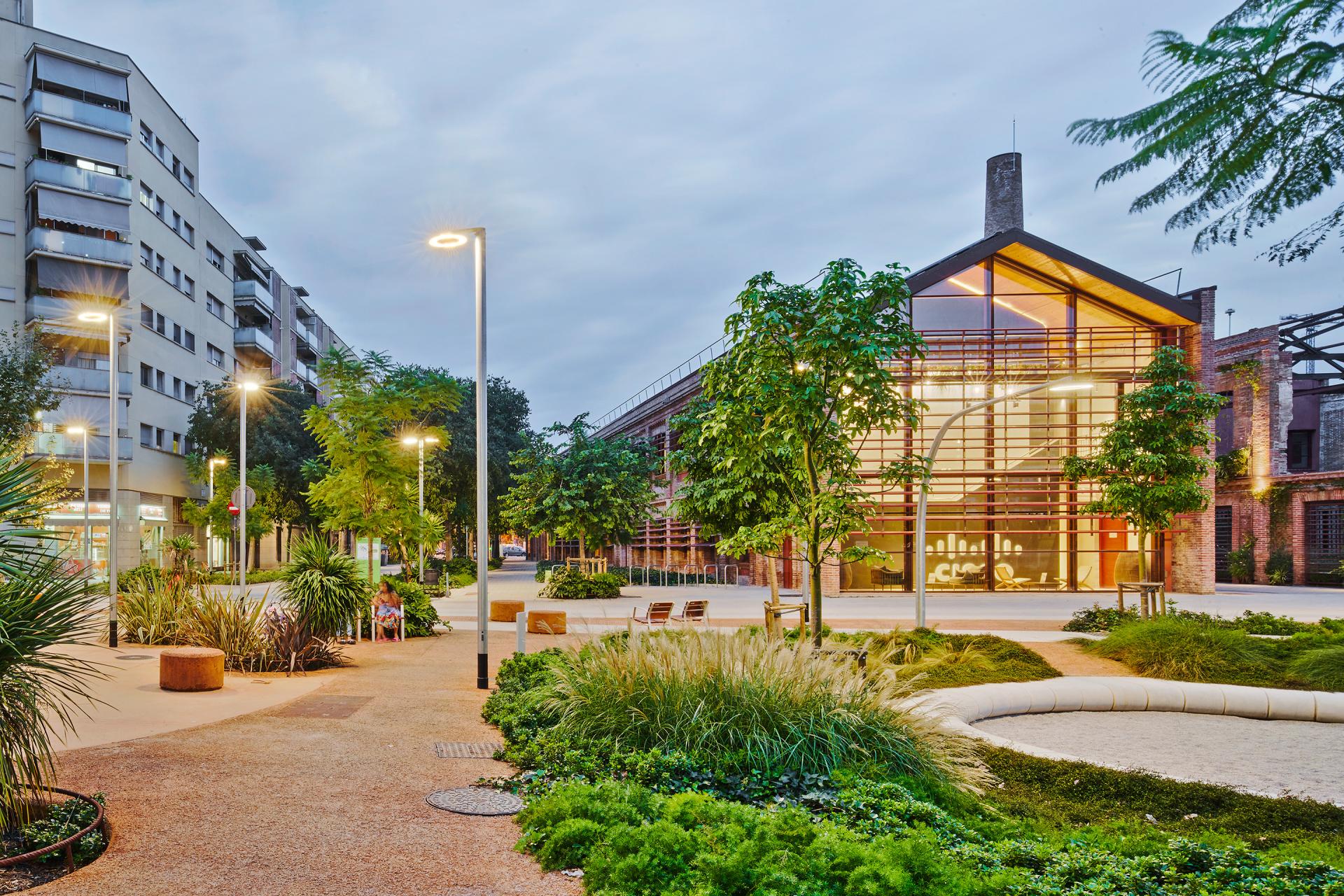
It has contributed to the revaluation of the neighborhood's environment and heritage, starting with the transformation of the former Ca l'Alier factory into an innovation center linked to smart cities.
The transformation of Cristobal de Moura is a model implementation of the Green Street strategy in Barcelona. In addition to traditional advantages of increasing biodiversity in the city, it incorporates rainwater management in a sustainable and passive way through Sustainable Urban Drainage Systems (SUDS). These techniques are considered a climate change adaptation strategy by managing flood risk while reducing runoff pollution.
Key objectives for sustainability
This project has two key sustainability objectives. The first is to create resilient urban drainage systems, able to adapt to and absorb new extreme rainfall events and enable the city to face the challenge of climate change.
The second, to improve the urban environment using the power of vegetation. The idea is that for the health and resilience of the city, vegetation is a necessity and not mere decoration.
The Green Street strategy presents us with the opportunity to combine this necessary increase in greenery with systems that manage stormwater where it originates, through Sustainable Urban Drainage Systems (SUDS); that treat stormwater as a resource and not as a waste to be quickly disposed of. It is a strategy for adapting to climate change, while mitigating the risk of flooding in the city.
The Cristobal de Moura Green Street has achieved both its objectives. In addition to reducing runoff and improving water quality, we also reduced the heat island effect, road safety, reduced the carbon footprint and improved the aesthetics and livability of the neighborhood;
It also contributes to the protection of the city's surrounding water bodies, as the system is designed to treat the concentration of pollutants contained in urban runoff water at source, retaining and biodegrading these pollutants in the first layers of soil, thus avoiding the risk of contamination of the aquifer and the receiving environment.
Greenery plays a key role, as it contributes to the management of runoff from the built-up basin, retaining and managing rainwater generated in the paved and built environment.
Therefore, greenery increases its functions, becoming part of the water cycle management, serving as flood areas, sinks, filters, decanters, bioretention areas, etc. This additional and very important function encourages green spaces to stop being almost confined to parks and squares, and expand to the rest of the urban space, thus democratising vegetation in the cia
Key objectives for aesthetics and quality
The aesthetics and quality of the user's experience have been key aspects in our project design. Its objective is precisely to balance the functionality of a street with a naturalized urban experience. We wish to inspire users and planers to imagine a city that harmonize construction with vegetation, a place that generates peace and well-being without losing its functionality.
Key objectives have been:
- To create a city street that generates a sense of peace and well-being similar to being in nature, or in the urban context, of being in a park, without losing the urban feeling.
- To create a space that invites calm and reduces the stress typical of big cities.
- To inspire both users and urban planners to imagine a naturalized city.
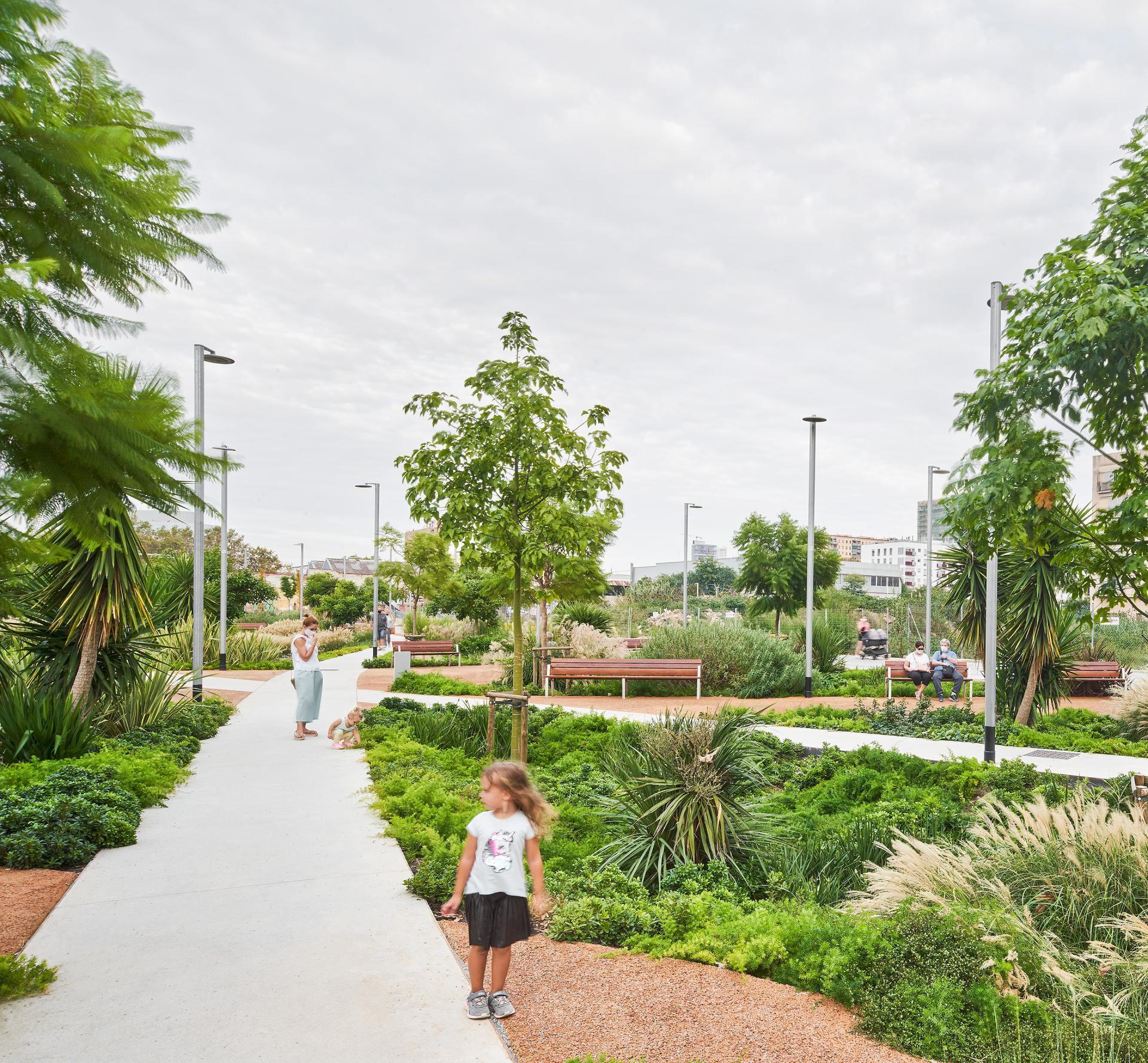
These objectives are reflected in our project, first of all, in the centrality of the vegetation. The vegetation in the project has been designed to give a sense of exuberance and lushness, without creating hidden or insecure spaces. This has been achieved by playing with different layers of vegetation, such as shrubs, trees and creeping plants. In this way we created a space that gives a park feeling without being one.
The natuarlized experience envolves all the senses, shades of green and chromatic variations of plants, smells of aromatic plants and the sounds of birds. Since the street has been pacified, noise has been reduced considerably.
The constructed part of the street was designed with sinuous, organic and at the same time discreet lines, to leave the protagonism of the space to the vegetation. The details of the construction use materials common to the city.
The street is gradually transformed into a park along the first few blocks. This makes the experience immersive as the user progressively enters the street park. It also suggests the idea of a transformation of the city over time, thus inspiring to build more spaces with these characteristics.
Key objectives for inclusion
Barcelona city council is deeply committed to making Barcelona an inclusive, socially just city. In the development of the Cristobal de Moura Green Street project, the following inclusivity goals had been defined:
- Connecting disfavoured areas with the center.
- Promoting physical and mental health.
- Creating safe spaces of transit.
- Creating accessible routes.
- Building public housing.
- Creating spaces for work, meeting and recreation for diverse collectives.
The idea of the lineal park is to connect the center of Barcelona directly to the disfavoured Besòs and beyond, to depressed Sant andrià and other excluded areas.
It offers direct, easy access through a pleasant pacified park street to the lively center, inviting marginal population to participate more fully in the social, cultural and economic life of the city.
Health is an important objective of this project. The centrality of vegetation and the pacification of the street offer a healthier, less polluted environment. The reduced noise and contact with nature favour peace of mind and relaxation beneficial both for mental and physical well-being. The project includes recreational and sports areas for adults, seniors, and children.
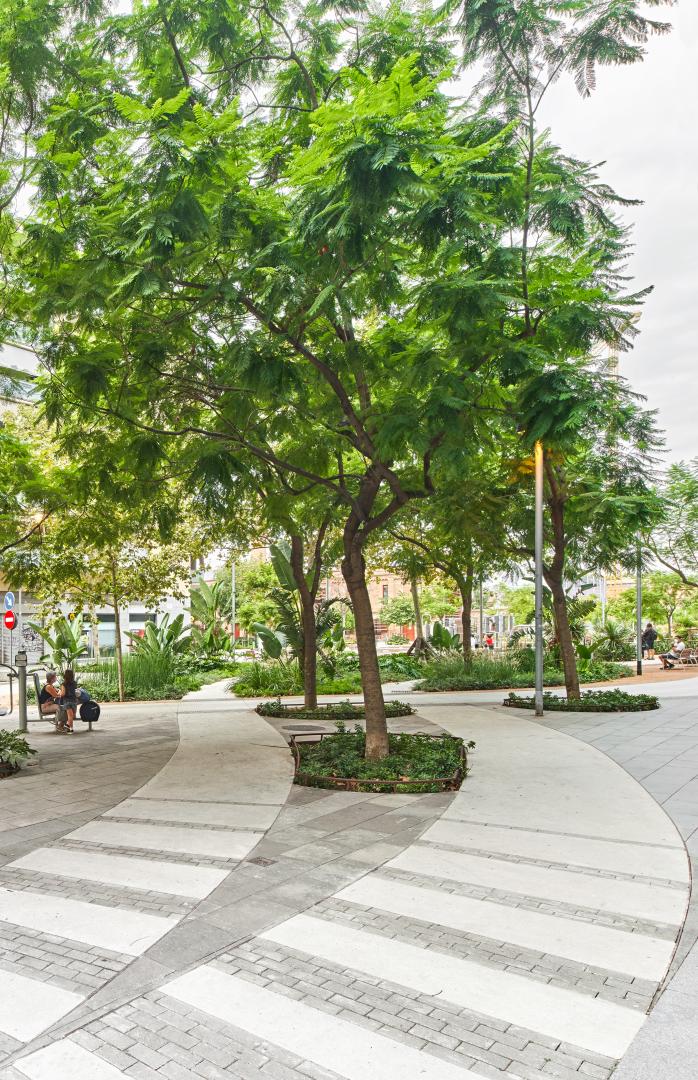
The paths give priority to pedestrians and bicycles, encouraging healthier mobility options. They are fully wheelchair accessible and make the park a place which everyone can enjoy.
Safety is important to different vulnerable collectives. The challenge of creating an exuberant and dense greenery without dark hiding places was successfully met in this project by layering varying heights of vegetation.
The lineal park includes affordable, public housing and gives the opportunity to enjoy living in a park environment to people of lower economic possibilities. It also includes kindergartens, social centres, a public gym, coworkings, and other social, cultural and educational equipment for a diversity of collectives to ejnoy.
Results in relation to category
Cristobal de Moura Street was a degraded, semi-abandoned industrial street. It was converted by the present intervention into a vibrant, lush, pacified, lineal park, which passively manages rainwater with Sustainable Drainage Systems. It is based on the idea of ruralizing the city and creating spaces that offer both well-being and functionality.
The project is located in poblenou, a neighborhood with an agricultural past which later became one of the most important industrial zones within the city of Barcelona. As industries relocated outside the city, it went through decline and degradation which finally gave way to the current process of urban regeneration.
Some important aspects of this regeneration are the construction of quality housing, facilities, tertiary activity and public space.
The Cristobal de Moura Green Street project is based on the concept of ruralization of the city, not only to make it more suitable for biodiversity, but also for people. Creating a more social environment where coexistence in streets and neighborhoods becomes a reality, with a suitable natural environment and the presence of vegetation that provides us with health, both physical and psychological.
Ruralization also becomes a political gesture, a way to weave networks and relationships, to revitalize the community, etc.
This project has been important and necessary in order to demonstrate that Green Streets can function adequately in any urban environment, and that they can be coupled with existing infrastructures to meet the objectives of efficient rainwater management.
In short, it goes a step further on the road to a healthy and climate change resilient city without giving up functionality, and is an example of contributing to the Sustainable Development Goals (SDGs) with local actions.
How Citizens benefit
Cristobal de Moura green street project is part of Barcelona´s innovation district - 22@. This semi-abandoned, historic industrial district was reconverted and renewed to attract technological, creative and digital innovation companies and information workers.
In 2016, after 16 years, the district reassessed its priorities through the prism of collective, debated and negotiated action, and incorporated into the decision making process previously unheard voices.
The new goal of the district became finding a common ground between different views and necessities
and in order to guarantee urban policies that meet local needs.
In order to achieve these goals, the district convened a “quadruple helix” consisting of the managers of the city (the public sector), those who live there (community residents), those who work there (the business sector), and those who reflect upon it (university and research).
In parallel to the meetings of experts representing the quadruple helix, the district held a participation process open to citizens which included round tables, exploration routes and digital platforms, aiming to reach as many people as possible.
These multiple mechanisms of participation have impacted the design of the 22@ district. The Cristobal de Moura Green Street project was informed by these processes and owes part of its special character to them.
The Cristobal de Moura project answers the residents' demand for more green, open public spaces. It constitutes a mixed urban area with new housing, economic activity, green public space and amenities, which are innovative and experimental for an inclusive, sustainable and healthy city.
Just as it harmonises the functional city street, a relaxing walk in nature and innovative, passive sustainable water management systems, so it reflects the needs and desires of the different cultural, social and economic residents of the district.
Innovative character
The most innovative part of our project deals with rainwater management. Our solutions serve as a model for rainwater management actions and even for the drafting of manuals and technical recommendations for urban drainage.
We implemented the Green Street strategy - a stormwater management approach that incorporates vegetation, soil, and engineered passive systems to slow, filter, and cleanse stormwater runoff from impervious surfaces. It captures rainwater at no energy cost at its source, instead of directing runoff into storm sewer systems that discharge directly into surface waters, rivers, and streams.
From the hydrological-hydraulic point of view, the vegetated zones or bioretention areas have been designed to capture, store and evacuate by evaporation, evapotranspiration and infiltration processes to the ground, all the annual precipitation events for a 10-year return period design rainfall (with a total precipitation of 53 mm per m2 in 60 minutes) in the entire area including the roof surfaces of the future adjoining buildings. Modeling for the 10-year return period the proposed system reduces the peak inflow to the unitary network by 100 %.
The rainwater is used to irrigate the landscaped areas directly and subsequently to recharge the aquifer and recover its level prior to industrial exploitation to counteract the saline intrusion wedge at the coastal boundary. Aquifer water will be used as a resource for urban uses such as irrigation of green areas, etc., through a network created for this non-potable phreatic water, avoiding the use of drinking water.
In addition to benefits of water cycle management, other benefits are obtained from implementing SUDS multifunctional green areas in public space, such as quality spaces for neighbors, the reduction of the "heat island" effect through evapotranspiration, which implies energy savings, reduction of CO2 emissions, improvement of air quality and, ultimately, an improvement in the quality of life in cities.