1st GROHE Cradle to Cradle products
Basic information
Project Title
Full project title
Category
Project Description
GROHE is a leading global brand for complete bathroom solutions and kitchen fittings. With waste recycling rates of 99 percent and a use of brass with recycling proportions of up to 80 percent, the sanitary brand has incrementally approached a circular economy for years. In 2021 GROHE took the next big step away from a linear model towards circular value creation by launching four best-selling products as Cradle to Cradle Certified ® variants.
Project Region
EU Programme or fund
Description of the project
Summary
Take-make-waste: This is how most economic processes are currently working. Resources are extracted to create a product which is disposed of after its end of use. This has led to an extensive resource exploitation that is diminishing the remnants of scarce and valuable resources by the minute while also creating a global waste problem. The Global Risk Report 2021 of the World Economic Forum unambiguously states that it is high time to fight resource overconsumption: The “natural resources crises,” defined as “a result of human overexploitation and/or mismanagement of critical natural resources,” is ranked as the fifth “top risk by impact” and is expected to become a critical threat within the next 5-10 years.[1]
With waste recycling rates of 99 percent and a use of brass with recycling proportions of up to 80 percent, GROHE has incrementally approached a circular economy for years. But this year, the global brand has taken the next big step away from a linear model towards circular value creation by launching four best-selling products as Cradle to Cradle Certified ® variants.
To break this new ground in product development, GROHE has collaborated with strong partners and drawn on the Cradle to Cradle® (C2C) design concept, which has become increasingly significant for those striving for a circular economy. In contrast to a linear model, the C2C concept enables GROHE to drastically reduce the use of new resources: a product is designed and manufactured with the intent of using its components in its end-of-life-phase for the creation of new products.
[1] Global Risk Report, 2021, www3.weforum.org/docs/WEF_The_Global_Risks_Report_2021.pdf.
Key objectives for sustainability
The C2C concept is an approach for designing intelligent products, processes, and systems by taking the entire life cycle into account: All materials are understood as nutrients in closed biological or technical cycles. The concept differentiates between consumer goods (e.g. natural fibers or detergent), which are biodegradable, and service products (e.g. faucets), that are broken down into their original materials. Therefore, resources can potentially be re-used endlessly, meaning that the C2C approach goes far beyond the conventional recycling of products. Cradle to Cradle Certified ® products have thus been assessed for their use of environmentally safe, healthy, and recyclable materials.
As there is a massive opportunity for innovation in the building sector, since it accounts more than 50 percent of the worldwide material consumption, the key objective was to stop the linear take-make-waste model and set up a circular usage of product components.
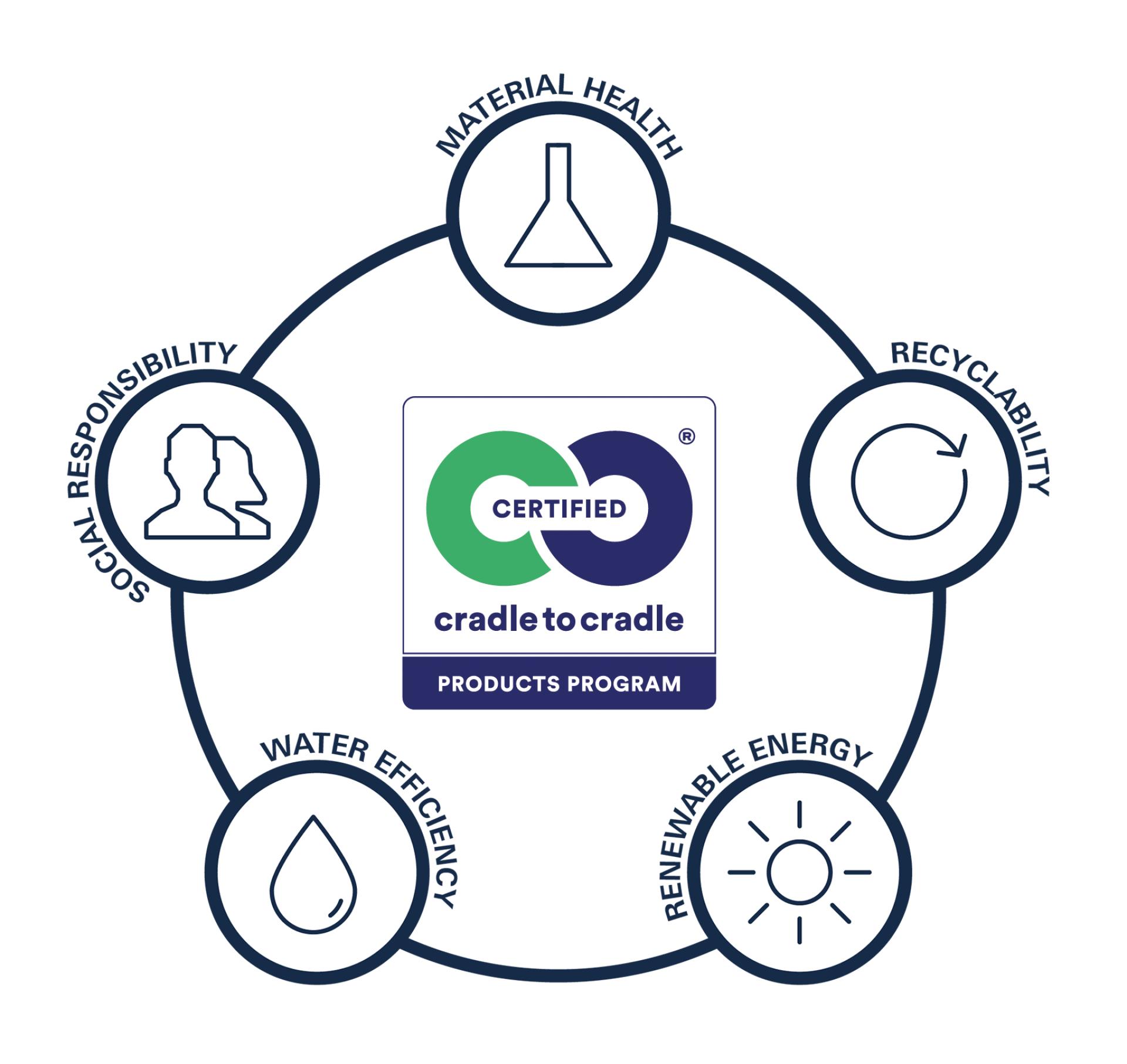
To achieve a certification, a product is evaluated in terms of the following five categories:
1) material health
2) material reutilization
3) renewable energy
4) water stewardship and
5) social fairness.
Each product is then designated a level of achievement. By evaluating all components, GROHE was able to gain further insights into the products, these insights will be used for upcoming product developments.
Key objectives for aesthetics and quality
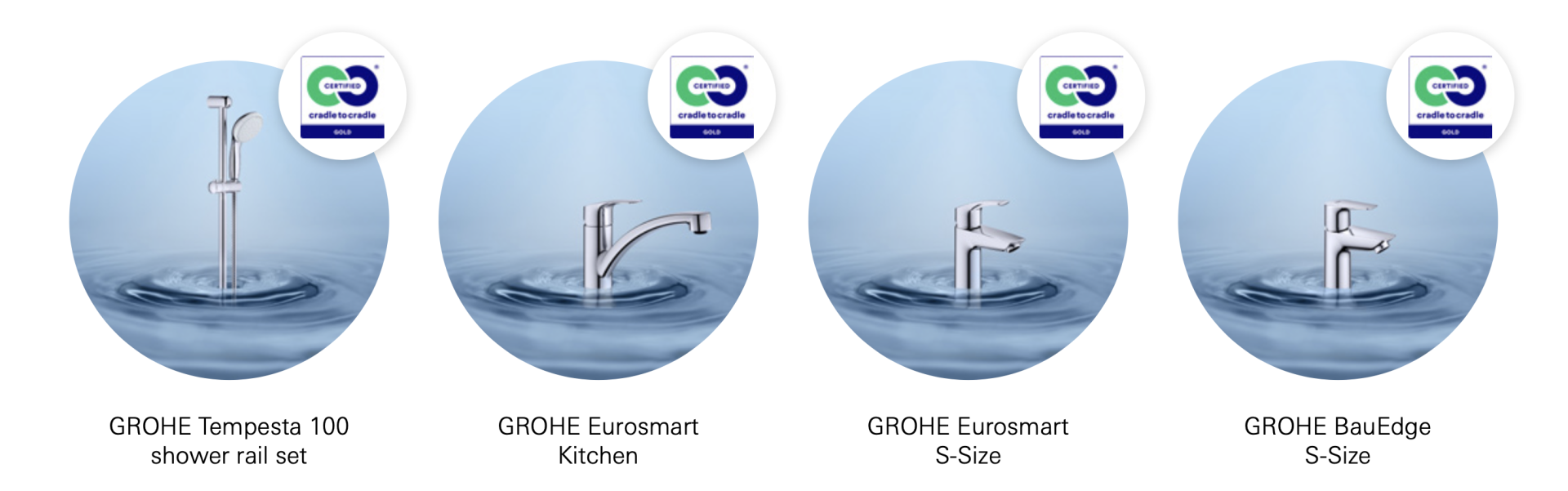
Three faucets (GROHE BauEdge S-Size, GROHE Eurosmart S-Size, GROHE Eurosmart Kitchen) and the GROHE Tempesta shower rail set are now Cradle to Cradle Certified at the Gold level.
The quality of experience beyond functionality is give by a special technology as the sustainable impact of the washbasin faucets GROHE BauEdge and GROHE Eurosmart is enhanced with the so called SilkMove ES technology, where ES stands for energy-saving.
The technology prevents the unnecessary use of hot water by supplying only cold water with the faucet lever in the middle position. In this way, GROHE’s SilkeMove ES technology can help reduce a building’s carbon footprint – particularly important in light of the fact that carbon emissions from buildings and construction constitute almost 40% of global carbon emissions.
If a family of four uses the SilkMove Technology they are able to save up to 279 KG of CO2 each year.
Key objectives for inclusion
Since 2014 GROHE has been part of the strong brand portfolio of the Japanese manufacturer of pioneering water and housing products LIXIL.
In support of the Corporate Purpose, which is to make better homes a reality for everyone, everywhere, LIXIL´s corporate responsibility strategy outlines core pillars of activity where we will leverage our expertise and business operations to drive positive change on global issues that require urgent action. These 3 pillars are:
I. Global Sanitation & Hygiene
II. Water Conservation & Environmental Sustainability
III. Diversity & Inclusion
Pillar 3 includes the important aspect "inclusion". Here one of our goal is: "By 2030, ensure all products and services are based on LIXIL’s Universal Design concept." The aim is to promote the development of universal design products and services that are "Good for one, Good for all, Good for a lifetime". LIXIL-wide all products will be easy to understand, easy to use, safe and secure, and easy to love.
The four Cradle to Cradle Certified GROHE products do fulfill these goals: They are easy to use for everybody, no matter how old, young or prabably disabled a user may be.
Results in relation to category
The C2C concept enables GROHE to drastically reduce the use of new resources. It is a holistic approach to the design of products, manufacturing methods, processes and systems, taking into account the entire life cycle: all materials are understood as so-called "nutrients" in closed cycles. A product is not disposed of at the end of its life, but its raw materials can potentially be endlessly reused.
This kind of thinking and acting has a huge impact on the way a product is developed.
By having Cradle-to-Cradle-Certified-products the following benefits are given.
1) MATERIAL HEALTH: Investigation of the Bill of Material using ABC-X categorisation: Identification & evaluation of all ingredients with regard to eco-toxicological data with subsequent optimisation. Environmental aspect -> products tested for harmful substances
2) REUSABILITY: Achievement of a technical cycle. Defined strategy for taking back & reusing materials. Environmentally friendly aspect -> Resource conservation through recyclability.
3) RENEWABLE ENERGIES: GROHE's production facilities manufacture CO2-neutral. A management of GHG emissions is given. GROHE uses green electricity and solar technologies & combined heat and power plants. Previously unavoidable CO2 emissions are compensated by offset projects:a) Hydroelectric power plant in India, b) A water borehole project in Malawi. Environmental aspect -> Reduction of the CO2 footprint, support of the Paris Climate Agreement.
4) WATER MANAGEMENT: Responsible use of water is a relevant GROHE KPI: Audits are given -> Defined wastewater management. Optimisation of water consumption -> Monthly reported KPI in the Sustainability Council. Use of a constructed wetland in Klaeng/Thailand. Use of water recirculation systems, environmental aspect -> Water savings.
5) SOCIAL FAIRNESS: Integration Global Compacts -> Production with defined social standards
How Citizens benefit
Citizens will benefit from the four C2C certified products as they are able to use safe, healthy, and recyclable products.
An interesting fact is that independent life cycle assessment studies by the EU Commission on the Energy Efficiency Directive show that approx. 99% of all environmental impacts of sanitary environmental impact of sanitary fittings, showers and flushing systems are in the use phase.
GROHE therefore focuses on on developing WATER & ENERGY SAVING SOLUTIONS to enable consumers to live a sustainable lifestyle.
GROHE has enhanced the sustainable impact of BauEdge and Eurosmart by using SilkMove ES technology (ES=EnergySaving): unnecessary consumption of hot water is prevented as only cold water flows when the tap is in the middle lever position. The technology helps to reduce CO2 emissions in the home or in buildings. A big plus, because CO2 emissions from buildings and construction account for almost 40% of global emissions, according to the European Commission.
In addition, both taps are equipped with GROHE EcoJoy flow-limiting technology: it allows water consumption to be reduced from 10l/min to approx. 6l/min. The use of GROHE EcoJoy results in the fact that a family of four can save up to 31,400l of water each year.
Innovative character
GROHE is currently the only leading sanitary brand considering the Cradle to Cradle design concept.
Other sanitary manufacturers have not yet taken the C2C idea into account. GROHE wants to act as an impulse generator for the entire industry, inspire other companies for the topic and build partnerships. With the help of joint solution approaches, topics such as take-back concepts for end-of-life products can be solved more quickly and efficiently in the future.
The Cradle to Cradle Certified product standard teaches us to look at the life cycle of products differently, in a way that sees them as valuable stores of raw materials and only uses materials that do not harm people or the environment. The benefit of this is clear: a drastic reduction in the consumption of new resources. It is GROHE´s duty and declared goal to bring about and drive a rethink in the industry.