DRIN
Basic information
Project Title
Full project title
Category
Project Description
The answer to the question: "Where can I find a creative?" - A space for the nesting and dissemination of cultural innovation and creative and cultural industries that combines culture and artistic disciplines together with technical and scientific professions
Project Region
EU Programme or fund
Description of the project
Summary
DRIN is located in the Ex-telefoni di Stato: the former building for the international communication of the city of Bolzano, situated in the northern Italy (South Tyrol). Our Province has one of the lowest percentage of youth-unemployment, but there's no data regarding the "quality" of this occupancy. DRIN is the place dedicated to all the young people that desire to explore new cultural languages and are willing to define new ways of living that can assure the possibility to work with their own passions.
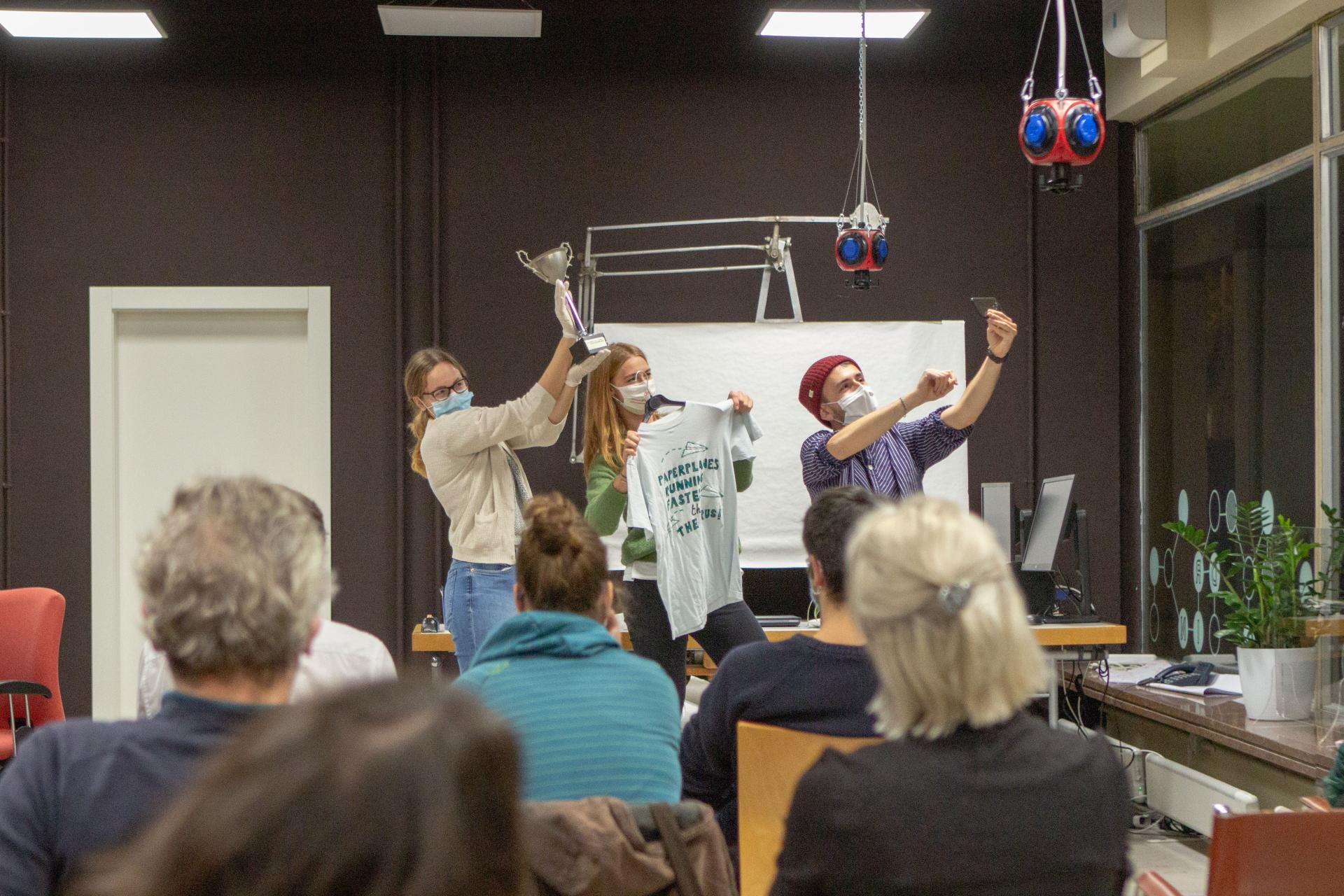
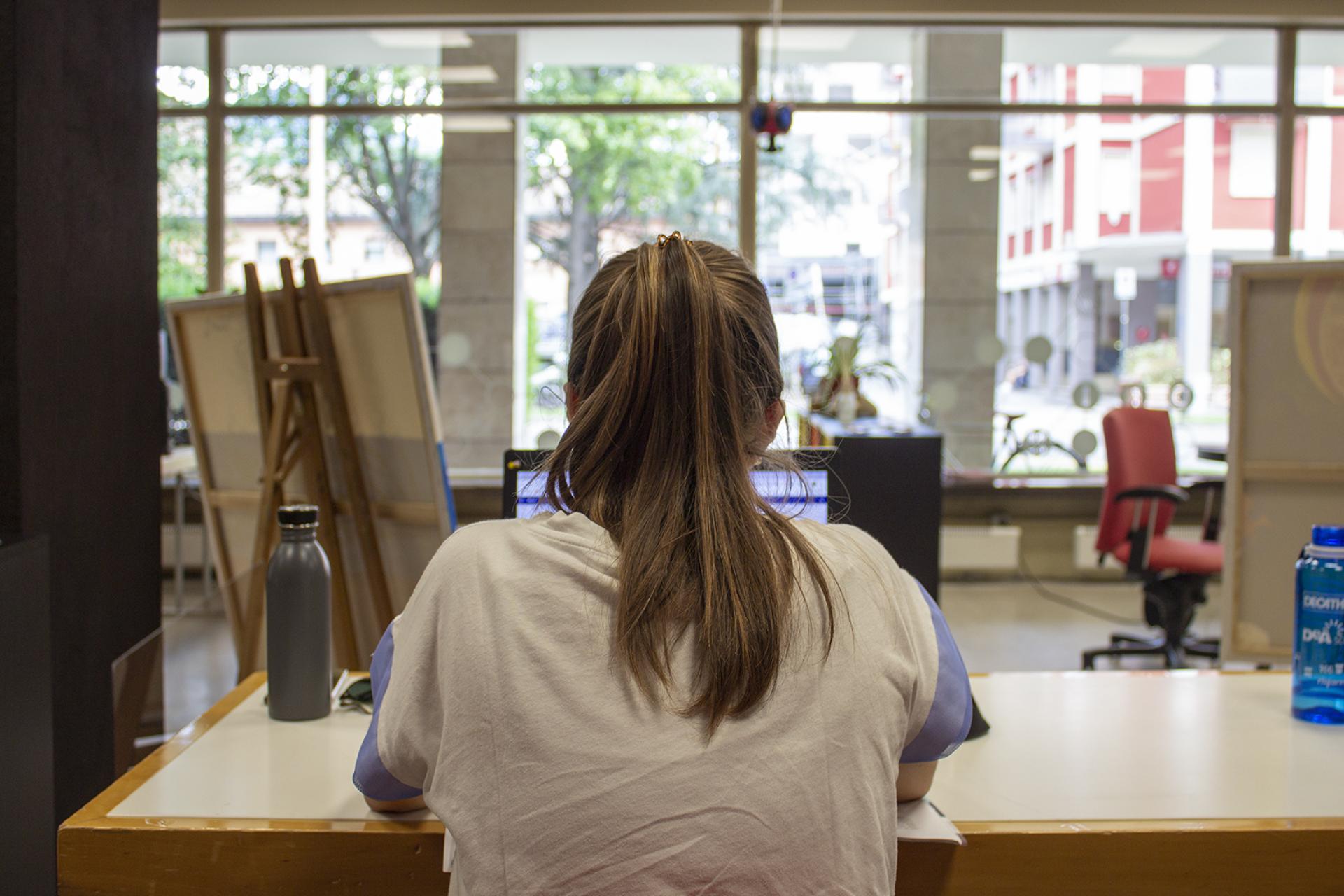
For now DRIN is a 200mq open space in the city of Bolzano free to use for groups or individuals that need a space to develop and implement their idea. To be quick is normally called "coworking", but the essence of the projects spreads out of this definition due to his practical and artistic contamination. Inside this space you can meet the creative startupper, the filmmaker, a little temporary atelier, a venue for cultural events and a platform for Wordpress developer, just to make some examples.
DRIN opened his doors on November 2019 and quickly lots of requests to use the space have been met until March 2020 when the pandemic hit our territory. The space closed for more than two months and reopened in May 2020 with the difficulties of the period and other new closure like in autumn/winter between 2020 and begin 2021. Nevertheless the activity, even if different as expected, went online with online "encounters" of realities in a similar situation and with other projects that could have boosted the creative citizenship of our territory.
The idea is in the near future to expand DRIN to the whole building - Ex Telefoni di Stato - and transform this laboratory in a bigger hub for the creatives of our territory.
Key objectives for sustainability
Modularity and fluidity of the space was one of our first objectives. We didn't want to create a space with a specific functionality-idea that, maybe, in the future would've been considered unuseful and, as a consequence, a waste of time and resources. So the regeneration of the 200mq was just conservative: we created a open space, bought some furniture that could've been used also as office divisors to create work-niches and added a little kitchen.
In the same spirit we went in the depository of the Public Administration to search among chairs and tables that have would have been thrown away just because "old" and we've taken what was necessary. Ongoing plan is to create a collaboration with some students of the Faculty for Eco-Social Design of the Free University of Bolzano (our local university) to make this old furniture something new and more interesting.
Always with the same Faculty we developed a collaboration before the regeneration works where the students developed a series of concepts and ideas (as well as some prototypes of chairs and tables) that could be useful in the space we were developing.
Clearly the "hard" sustainability meets in this space a more "soft" idea of sustainabilty, that is new models of work that aim to create more job opportunities that fit an idea where everyone could make out of his/her passion a job opportunity finding new ways to innovate the world and make our territory a better one to live. This is an ongoing and broad always "work-in-progress" objective due to the modular nature of the project. Be developed some transversal strategies, which root in the work done in the last years in the territory witch associations focused in different aspect of the youth culture (art, job, civic participation, music...) and trying to bring their most innovative practices in this space.
Last but not least we're starting a collaboration with our Department for Ambient and Energy to find new ways to integrate culture and sustainabilty.
Key objectives for aesthetics and quality
The space has been only regenerated thanks to our partnership with the local Department of Public Estate: the infrastructural work has been of maintenance of the existence and the furnishings brought inside were essential to permit the modularity of his usage. The idea was not to impose from the top the aesthetics of DRIN, but to catch the drive during the ongoing process of "living" in the space. Somehow it remembers a construction site, with the electric sockets hanging down from the ceiling to give the idea of a creative lab.
Except for some basic furnishing, we spoke with the users of the space (associations, institutions and single person) to understand with them what could be implemented and what could have been co-constructed. For examples: the decision of the chairs and tables among the available ones has been made with two girls of an association of the territory that now is developing a project inside of DRIN. Another curious anecdote is the need of the inhabitants of DRIN to have plants among them, but after the furnishing the care of them has been shared between all habitants.
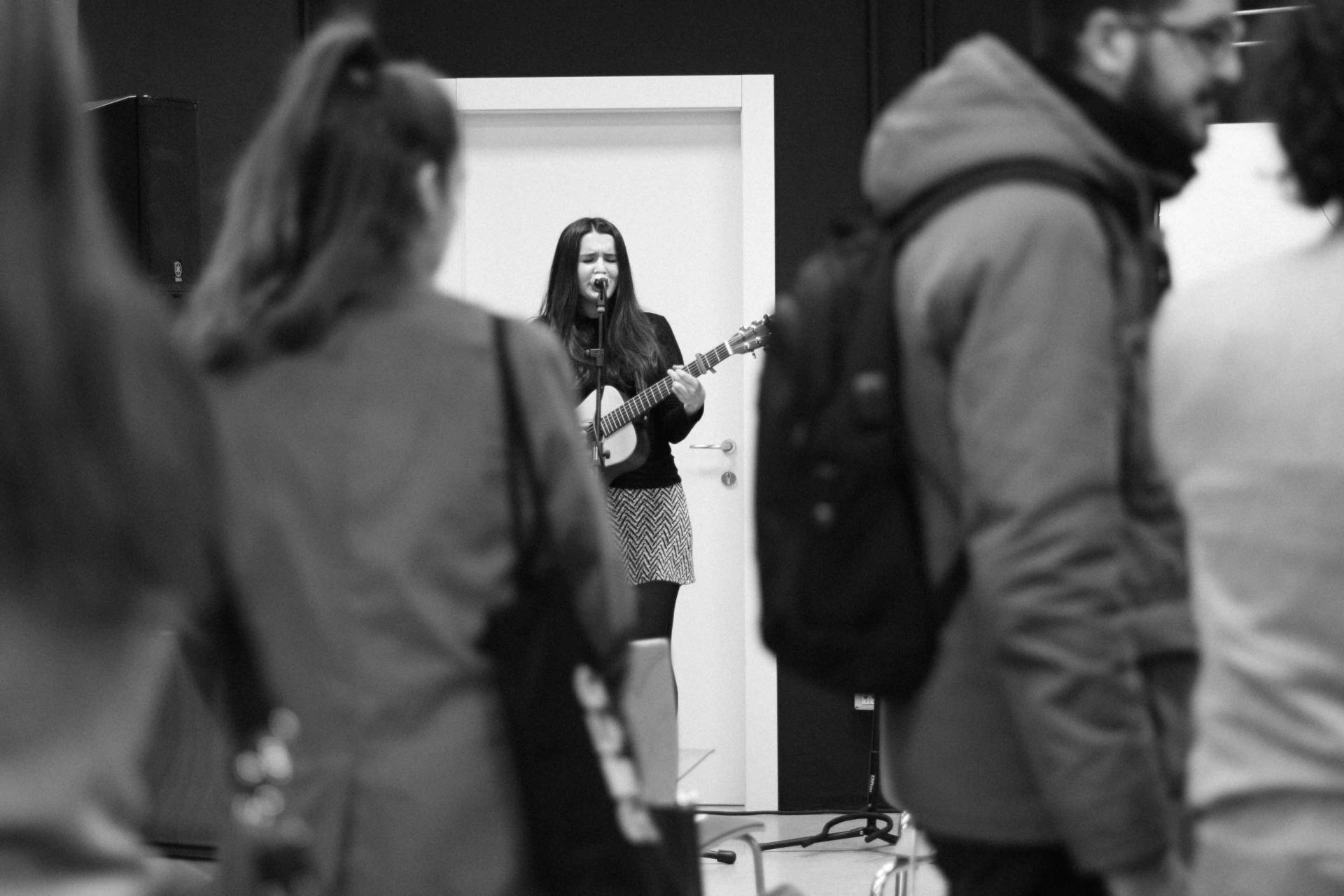
Another way to develop the aesthetics of DRIN has been to experiment different uses (projections, presentations, performances, creative breakfasts, "ordinary coworking", ateliers...) to define the new possibilities of making the space something co-constructed and to understand how it worked better surely regarding the functionality of it, but also in his appearance. To know (but in the photos is pretty clear) is that DRIN is de facto on the street with just a wall of glass from which is possible for the citizenship to look inside and see what's happening... a light of culture in a part of the city that normally is just a passing-by-zone.
Key objectives for inclusion
The space, as directly managed by the public administration, is free to use for whoever would ask to develop a project regarding cultural innovation and cultural and creative industries. The diffusion of these possibilities has been made in a traditional way (newspapers, social media...) as well as thanks to contacting singular realities and showing and sciussing together the possibilities connected to the use of the space. In particular the real use of the space with so different projects has been a multiplier to the diffusion and possibility to access to this world for more and more people. As previously said our target are young people in the search of a space to transform their own passion in one work.
Even if is commonly called "coworking" what we're trying to create a new concept of networking that can connect culture and artistic discipline together with technical and scientific professions. Furthermore in our territory the traditional cultural assosiation are facing a period of decline, because their activity is based mostly on volunteer and young people are more interested in a work. Putting these two realities under the same roof should favour the generational exchange we need to combine the new tools of cultural management with the values of the associations rooted in the territory for decades.
To be noted: the project started in November 2019, five months before the Covid-19 reached our region - so, for the time after, we mostly transferred our activity online, which was something else in comparison to the original project and the whole process has been slowed down.
Results in relation to category
From 15.11.2019 until 06.03.2020 and then again from 18.05.2020 until 30.10.2020 - these are the periods we could be opened due to the pandemic - we got more than 1000 people coming physically in our spaces, from which more than 300 interested in developing a project reagrding cutlural innovation. We hosted even 22 associations of the territory for events of their own and developed a series of networking events and workshops.
In autumn 2020 we started a series of webinar, talk and online events dedicated to the young people interested in culture as work. In particular we begun to create a network even with other similar spaces in the northen Italy and we organized some talks with other realities still available on our Facebook page.
Particular interested has been found among young people at the end of the universitary life and starting to look around for work. People like them are the most frequent "clients" of our space and we're really glad when some of them find themselves in our space and then has the opportunity to grow together. Good outputs are, for examples, the winning of a call bya group that met and worked in our space and the plagiarism of an action we made (giving part of the space of DRIN for a month to a local artist) by an association of the territory.
The results of the project, which is still going on even if the space reponed in the middle of May 2021, are to be related to the territory we're living in. The city of Bolzano - where the space is located - has 107.000 inhabitants ca. (data from 2017) and has not a rooted tradition of cultral innovation, a process that the public administration started to stimulate some years ago. DRIN is the first big output of this strategy dedicated to the cultural and creative industries in the territory and the cultural innovation in the territory and it's going to be the prequel of the bigger project of Ex Telefoni di Stato, that is the whole building where now DRIN is just the first floor.
How Citizens benefit
Before opening and defining the details of the project, together with the Youth Council of the Autonomous Province of Bolzano has been made a field trip to some realities around Italy and Europe that fitted the desires/needs we were trying to answer.
Simultaneously we asked to a class of the course of Master in Eco-Social Design of the Free University of Bolzano to think about this project and propose some ideas to develop the project (the name DRIN, for example, is a product of this action). Two students of that course explored the neighborhood to ask and trying to catch the feeling of the citizens regarding the project we were trying to concretize: they used a cart made with some actual pieces of the building and went around the neighborhood asking the people to fill the card with their desires and expectations regarding the future of the space.
Collecting the outputs of these two main actions we developed the concept of the space, which has been shared with the colleagues of the Department for Public Estate who curated the works of renovation of the space.
Since the opening mostly students of the faculty of Design begun to use the space to encounter themselves and work on their own project. In the meantime the possibility to use the space for public presentations and events brought inside DRIN lots of people and made for the public administration clear that some niches of cultural professions were unseen (eg. web developer and hubs of social media managers). Moreover, in the spirit of innovation, this space is begging to be the main place to create a connection between humanities and technological science in the territory - for example a cooperative of the territory use DRIN to organize a campus dedicated to the co-creation of an artificial intelligence "of the neighborhood" (IAQOS).
Innovative character
DRIN is one of the first spaces led entirely by a public administration completely dedicated to the experimentations in the field of culture and creativity related to the world of work. Moreover it's a free space to experiment new ways of construct a professional life and, we've seen in the last months, it's a mid-step between the student and the working life. Actually who has already begun to work for a while has already a studio or a private office as well as a network of partners and collaborators and they don't really need a so public space. On the other hand someone who needs to introduce himself/herself in this field finds in DRIN a great opportunity.
Moreover the idea behind the space is innovative, because it's focused not only on the need to occupy the youth, but to help them find a job they really like and that fulfills their passions and perspective.
Finally to imagine DRIN as an hub where culture and creativity, thanks to their intrinsic transversal nature, can collect different points of view and synergies permits the connection with artisans, expert in the new technologies, traditional associations, young students, artists and so on exploding the potential of the project.