Masterplan "Camino de Santiago" in Yesa
Basic information
Project Title
Full project title
Category
Project Description
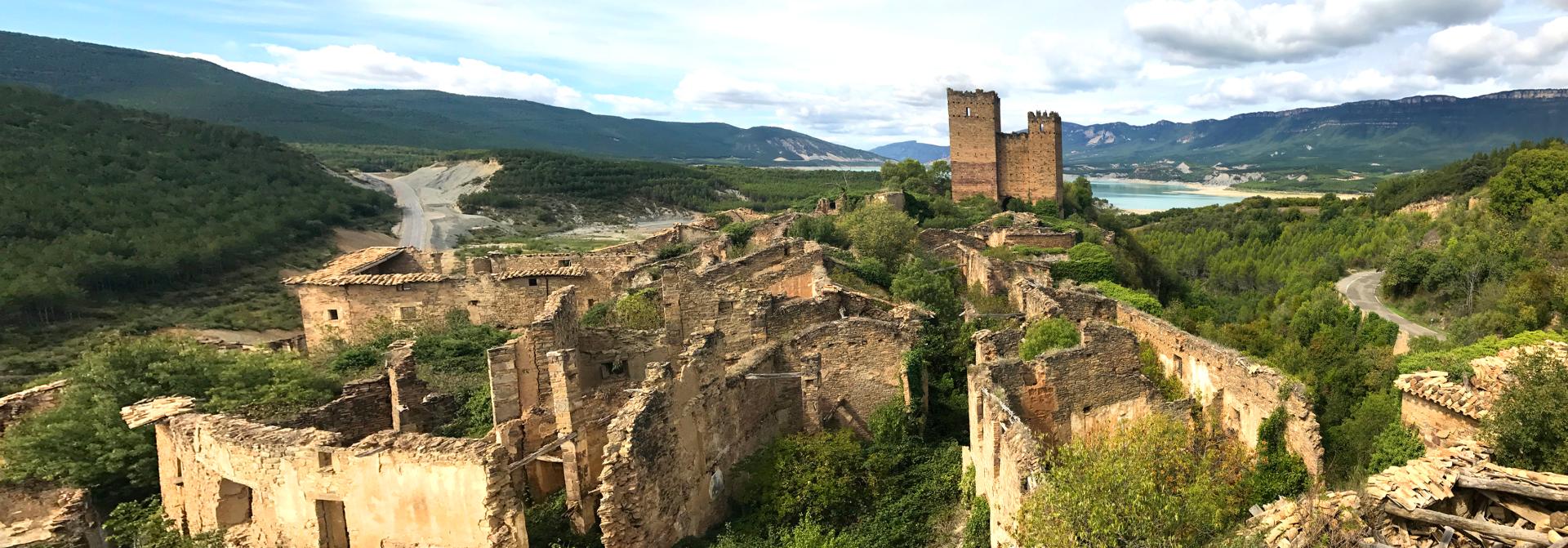
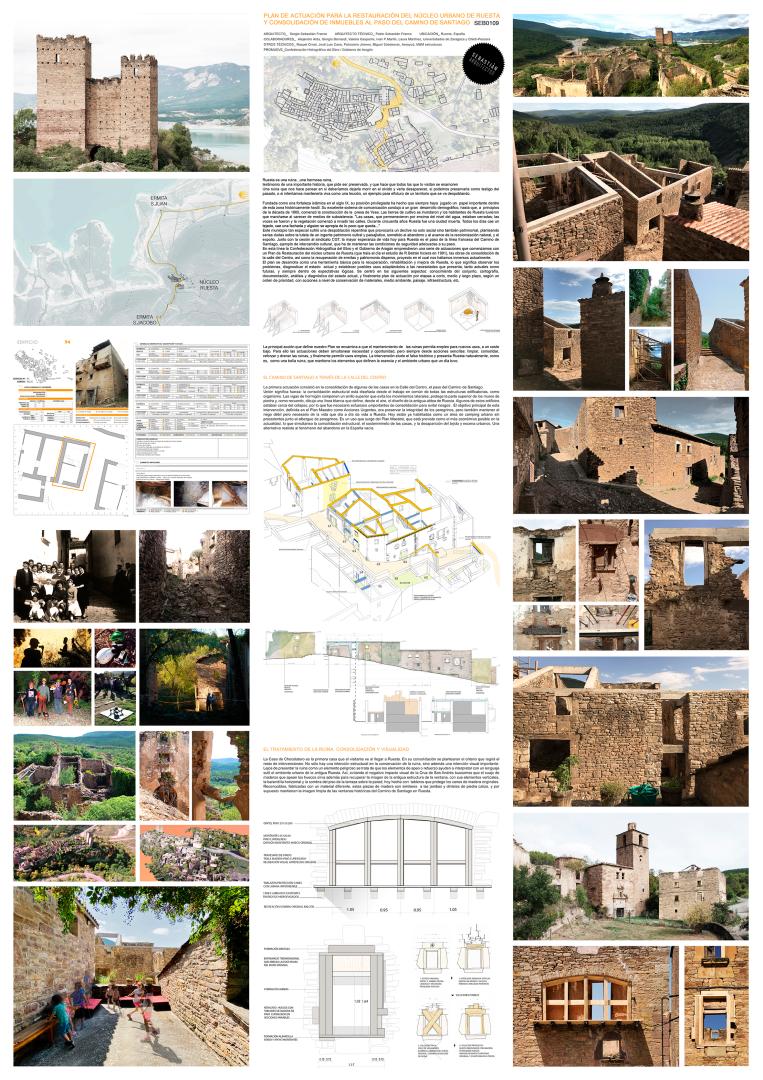
Ruesta is a beautiful ruin, testimony of an important history that asks for being preserved, makes all who visit it fall in love, and reveals a territorial reality: the uninhabited Spain. The expropiations due to Yesa reservoir’s construction raised serious doubts about the guardianship of a huge cultural and landscape heritage. The Masterplan carried out is about about proposing new ways of inhabiting the fleeting time of a place in the Way of St James, as this region vital sustenance
Project Region
EU Programme or fund
Description of the project
Summary
The work is linked to the French Way of St. James in the area surrounding the Yesa reservoir, promoted by Hydrographic Confederation. It is located in the Aragon valley, a natural connection route between Jaca and Navarre, used as the Way of St. James since the Middle Ages, in what is known today as the French Way of St. James (Via Tolosana), in its Aragonese section from Somport to Navarre.
The phenomenon of pilgrimage to Santiago de Compostela declined until its disappearance in the 18th century; however, since the 1960s, its reappearance as a cultural phenomenon has made it an Asset of Cultural Interest with a great global impact. However, at that time, the Yesa reservoir was already in operation and had flooded the land through which the historic traces of the Way passed. For the same reason, towns such as Ruesta, Escó and Tiermas had been abandoned, although their urban centres were not affected by the flood level. As a consequence of the new flood level, numerous assets associated with the Way were flooded. However, following the reduction of the height affected by the regrowth to +514m, the compensatory measures to relocate the affected assets were transformed into restoration and rehabilitation actions in their original locations.
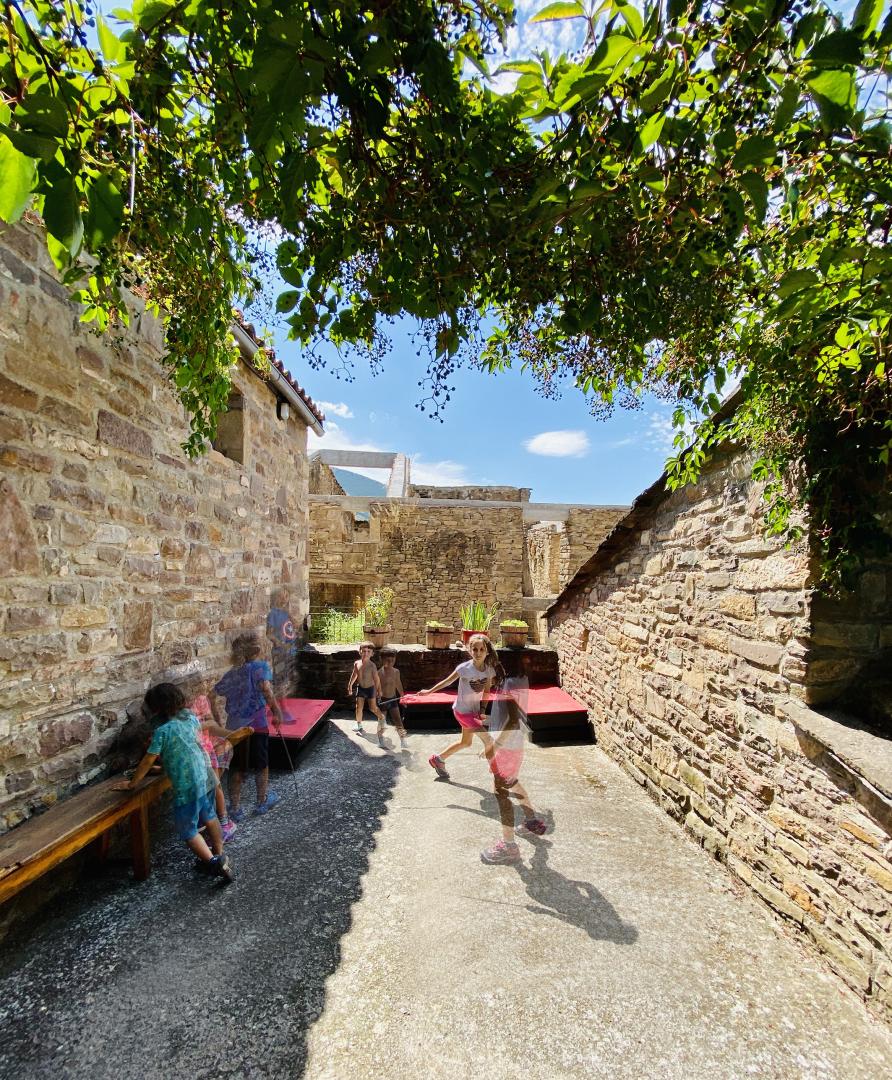
The actions carried out have made it possible to recover the phenomenon of the Way as it passes through Ruesta, as well as the rehabilitation and restoration of the street in the centre of the town, the chapels of San Jacobo de Ruesta, San Juan de Ruesta and San Juan de Sigüés, all organised by two master plans: one for the Pilgrims' Route to Santiago and the other for the Recovery of the centre of Ruesta, which have taken shape in various execution projects and which are part of the interventions linked to the Route in this area. Thus, it becomes the backbone of a territory that places its hopes in the revitalisation of the Route as a fight against depopulation and as a means of conserving the local heritage
Key objectives for sustainability
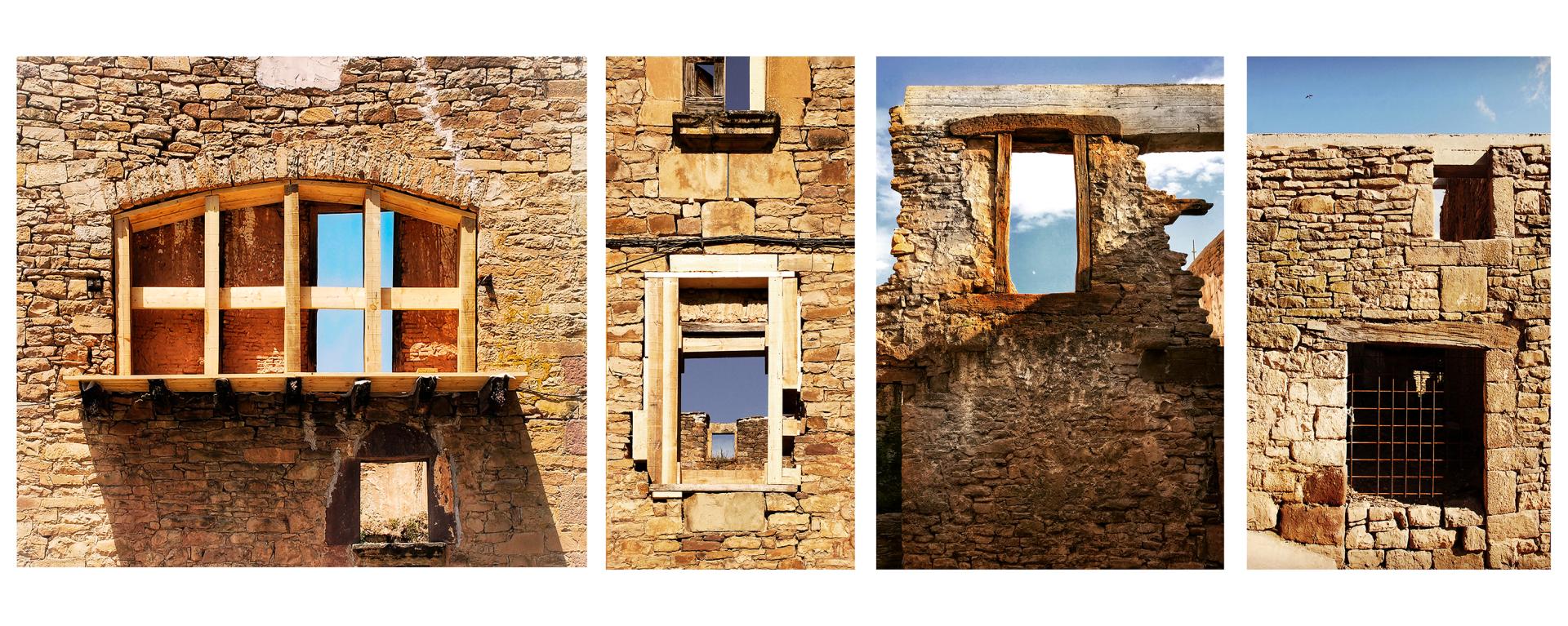
The work is being carried out in an area with an extraordinary wealth of heritage, which until recently was in a state of complete abandonment and deterioration. The exceptionality of acting in Ruesta and its surroundings, which were abandoned to their fate since the 1960s, consists in adding to a unique atmosphere, in which the intervention has always sought naturalness and minimum impact, but also recognisability to avoid the creation of a false history, but also to allow a clear reading of both the original elements that were still standing, and the contemporary elements carried out, which allow preserving and enhancing the value of the pre-existence.
The action is not justified by the exclusive intervention on a single singular element; on this occasion it is quite the opposite, the proposal includes a set of actions that are intimately linked to the territory, to the Way of St. James and to its passage through the surroundings of the Yesa reservoir. One of the main objectives of the actions is to revitalise the Way, which is the way to promote the municipalities linked to it and thus make the conservation of their heritage viable, proposing actions that promote self-sustainable uses and minimal investment that will allow their own management and maintenance in the long term.
Key objectives for aesthetics and quality
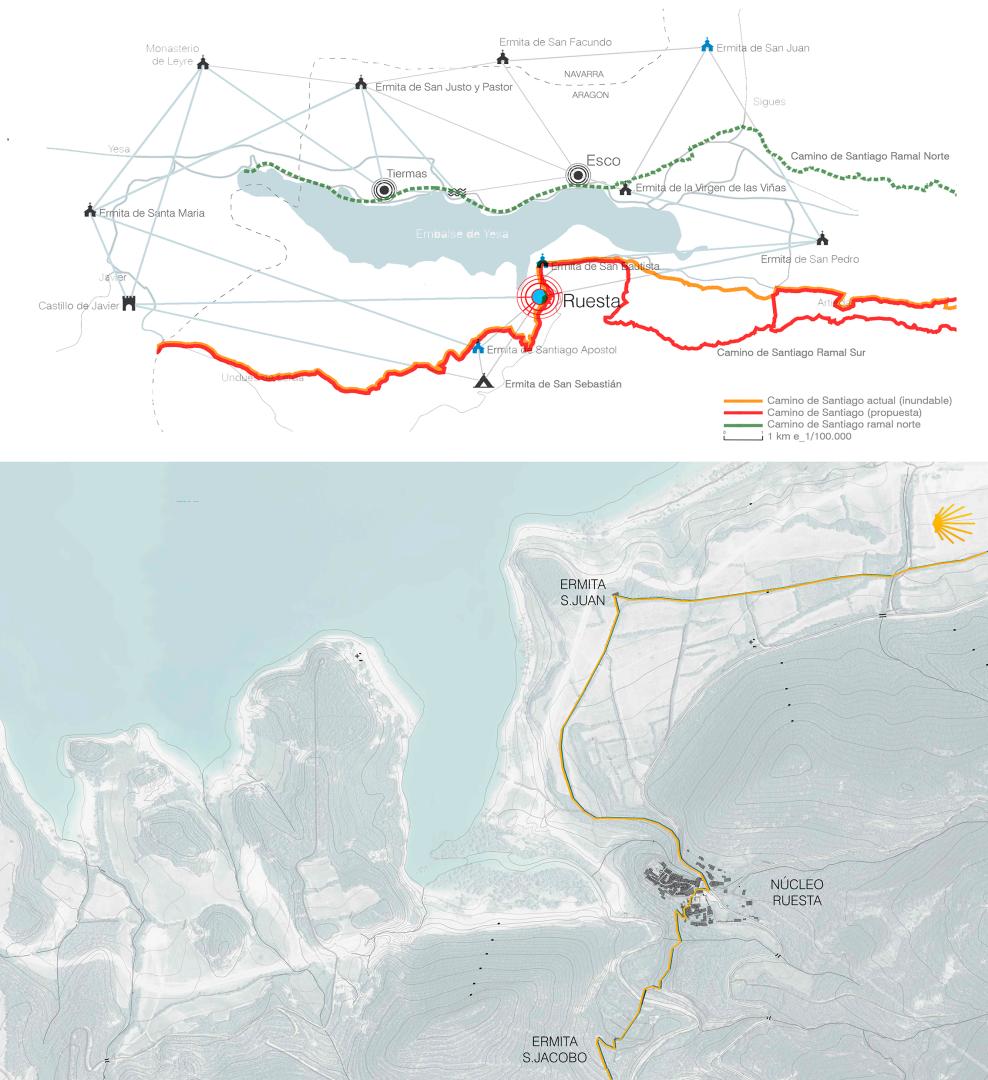
All the actions carried out are covered by two master plans, one for the recovery of the centre of Ruesta, and the other, the Master Plan for the Pilgrims' Route to Santiago de Compostela, in which the context of action is framed. For all these reasons, the Master Plan proposes the conservation of the current route wherever possible, but also a proposal for a branch, with which to enrich and humanise the pilgrim's experience, using the Way as the backbone of the territory, a characteristic intrinsic to it throughout its history, thus proposing a branch that culturally enriches the pilgrim, that offers landscapes of great interest, and that provides the necessary infrastructure and facilities to make their walk more comfortable and bearable.
This territorial strategy, which covers more than 50km, is accompanied by the execution of specific actions that allow the addition of equipment and infrastructure, as well as tourist, heritage, hotel and catering values and strategic refreshment points, which to date has been embodied in the execution of the rehabilitation of the street in the centre of Ruesta, which also allows the installation of the diffuse hotel in the same and the restoration, rehabilitation and self-musealisation of the hermitages mentioned above.
Key objectives for inclusion
Nowadays Ruesta´s hostel administration is an opportunity for reinsertion unemployment people, who search for new vital opportunities.
Accessibility is one of the main work lines, with the objetive to promote free accessibility in all the Way affected by the Masterplan.
Results in relation to category
All the interventions have a multiple impact: historical, social, cultural and heritage preservation. Moreover, they are closely linked to the structuring of the territory through the Way of St. James, and to the enhancement of the area through the interventions carried out in the Masterplans. These tools are the ones that have allowed us to have a joint vision of the territory and in which the germ of future actions, many of which have already been developed, was collected.
On the one hand, the Master Plan for the French Pilgrims' Route to Santiago de Compostela as it passes through Aragon includes a historical study and a detailed analysis of the current state of the BIC, as well as of all the assets associated with it, to end up projecting a proposal for the replacement of the sections affected by the heightening of the Yesa reservoir, as well as the recovery of a route that passes through the population centres of the area, that humanises the Way and that through a symbiotic relationship allows the revitalisation of the population centres and the flow of pilgrims at the same time. To this end, the strategic enclaves of the territory are analysed, among which the points in which action has already been taken stand out, and which are described below (the town of Ruesta and several hermitages as assets associated with the Way).
On the other hand, the Ruesta Recovery Plan represents an intermediate link between the territorial scale of the Way Plan (which studies more than 130km) and the scale of the project for the execution of each action, since this Plan studies an area of about 5 hectares. The Ruesta Plan is also limited to the Pilgrims' Route to Santiago de Compostela, which has historically crossed its centre. It includes the historical cataloguing and the current state of the ancient town, which allows the actions carried out to be based on an exhaustive prior knowledge of the property in question.
How Citizens benefit
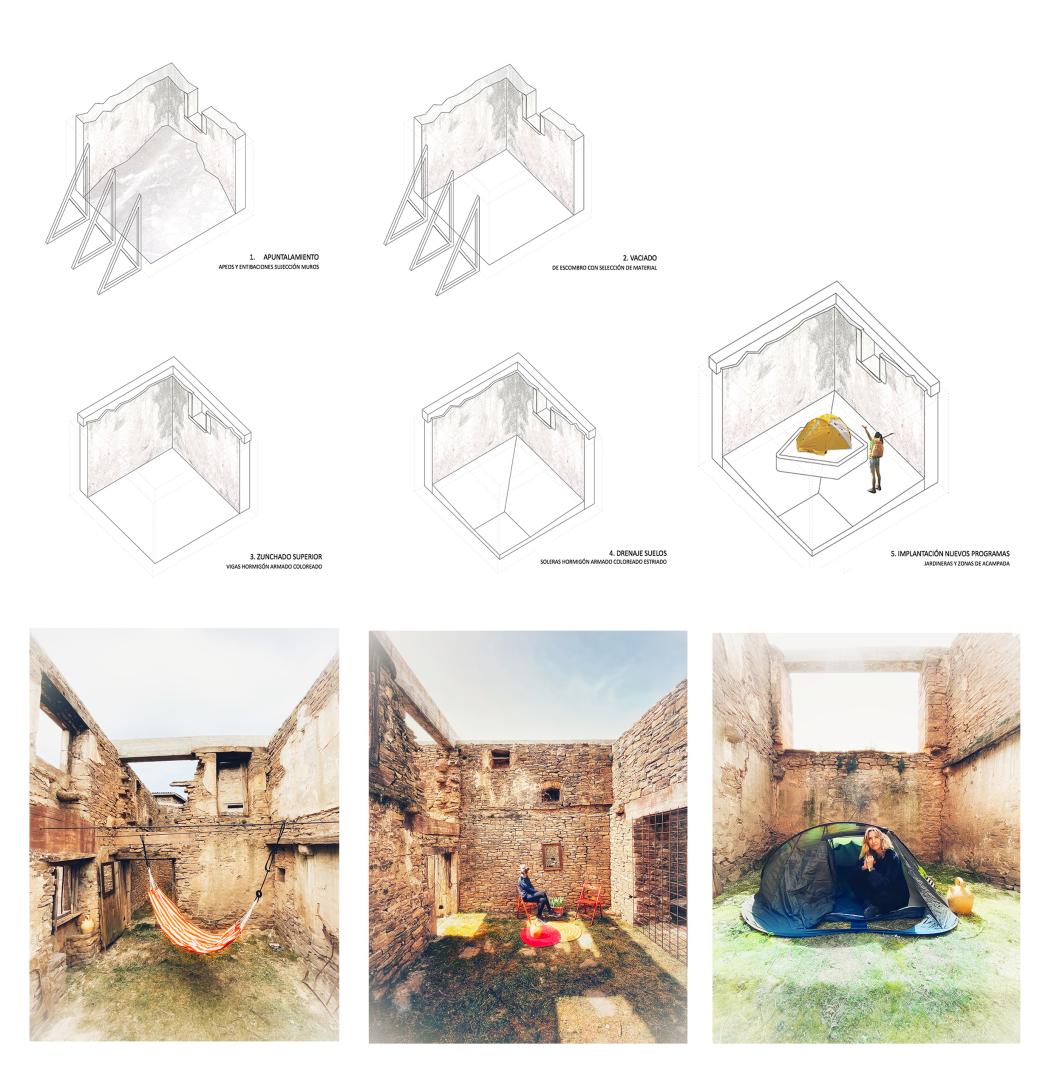
The actions carried out allow pilgrims and tourists to safely return to enjoy the exciting experience of walking the Way of St. James, but also to give it a use, a new life, a new opportunity. Therefore, the actions developed in the old houses will be enabled as an unprecedented archaeological camping area next to the current pilgrim hostel, becoming a realistic alternative to the phenomenon of abandonment in empty Spain, following the model of diffuse hotel as a form of tourist accommodation in which the rooms are distributed in various buildings arranged in the vicinity and are provided with a general reception, so it is an initiative that once rehabilitated the structural skeletons can be launched with a very low cost, and that would come to solve an existing need. In this way, the refurbishment of the urban complex makes the use of the site a major guarantor of its maintenance, but also a residential programme such as this one does not require an intense and complex refurbishment of each facility. In the following actions, as they are located in hermitages in the middle of the natural environment, devoid of services, other uses have been proposed, compatible with the diffuse hotel, as they will act as "self-musealised" cultural focal points, and which also allow the iconic image of the Way to be reinforced, strengthening the attractions of walking along it.
Throughout the interventions there has been collaboration and joint financing between several of the administrations and institutions involved: from the CGT union (current concessionaire of the use of Ruesta), the Ebro Hydrographic Confederation (CHE), the Government of Aragon (departments of Heritage, Tourism and Territory), the local councils of Urriés, Sigüés and Artieda and other organisations in the area, such as the Pyrenean Institute of Ecology, the Association of Friends of the Way or the Association of Municipalities of the Way of St. James.
Innovative character
Both master plans were developed as a tool for the recovery, rehabilitation and improvement of the complex, which means observing the problems, diagnosing the current state and establishing possible uses, adapting them to the needs it presents, both current and future, and always within logical expectations. It focused on knowledge of the complex, mapping, documentation, analysis and diagnosis of the current state, and finally, a plan of action by stages in the short, medium and long term, according to an order of priority. To this end, an innovative methodology was applied, developed in three phases:
-Data collection: Consisting of a historical and artistic study of the complex, a report on its physical state, the drawing up of plans and a description of the architectural elements and those of artistic interest, materials, construction systems, structural systems, etc. To carry it out, we have developed an intense data collection in situ with drone flight, to measure, photograph, analyse, and live the archaeological space of Ruesta, understanding that this is the best and only way to know and value the property.
-Analysis and Diagnosis: The aim is to establish the regulatory framework for the scope of subsequent actions based on the current state and future needs. On the other hand, and in parallel, analyses have been carried out of all the aspects assessed in phase I, the current general state, the configuration of spaces and their evolution, material and construction pathologies, deficiencies to be rectified, the state and functioning of general services, as well as the needs of the future programme.
-Action Plans: Maintenance and management plans to correct pathologies and constructive and functional deficiencies, recover and/or enhance elements of interest and their spatial configuration, as well as propose new uses. In this last phase, all the previous development has been included.