The Generative Workshop
Basic information
Project Title
Full project title
Category
Project Description
Designed by Gaëtan Robillard, the Generative Workshop aims to develop a sustainable and inclusive vision in digital art education. The project involves a software designed together with a workshop for creative algorithmic practice. It also involves an art installation thought of as a space bringing together generative machine learning, drawing and student’s thinking on algorithmic aesthetics. The project places inclusiveness and human capacity for action at the heart of the process.
Project Region
EU Programme or fund
Description of the project
Summary
In a world that is now composed with algorithms, coupled with the promise of a computational intelligence, it is appropriate to ask which place we reserve for the construction of the subject (in the words of the psychologist Jean Piaget). In this project, art which is conceived with algorithms, and in particular the digital image, is investigated in the context of education. This involves high school students, university students, art school students, and more specifically university students involved in teachers training programs (Institut National Supérieur du Professorat et de l'Éducation, Paris). Designed by Gaëtan Robillard, artist and researcher, the Generative Workshop aims to develop a sustainable and inclusive vision in digital art education. Its main objective is therefore to gather a broad audience around a constructive and novel approach in this field. The project involves two distinct outcomes.
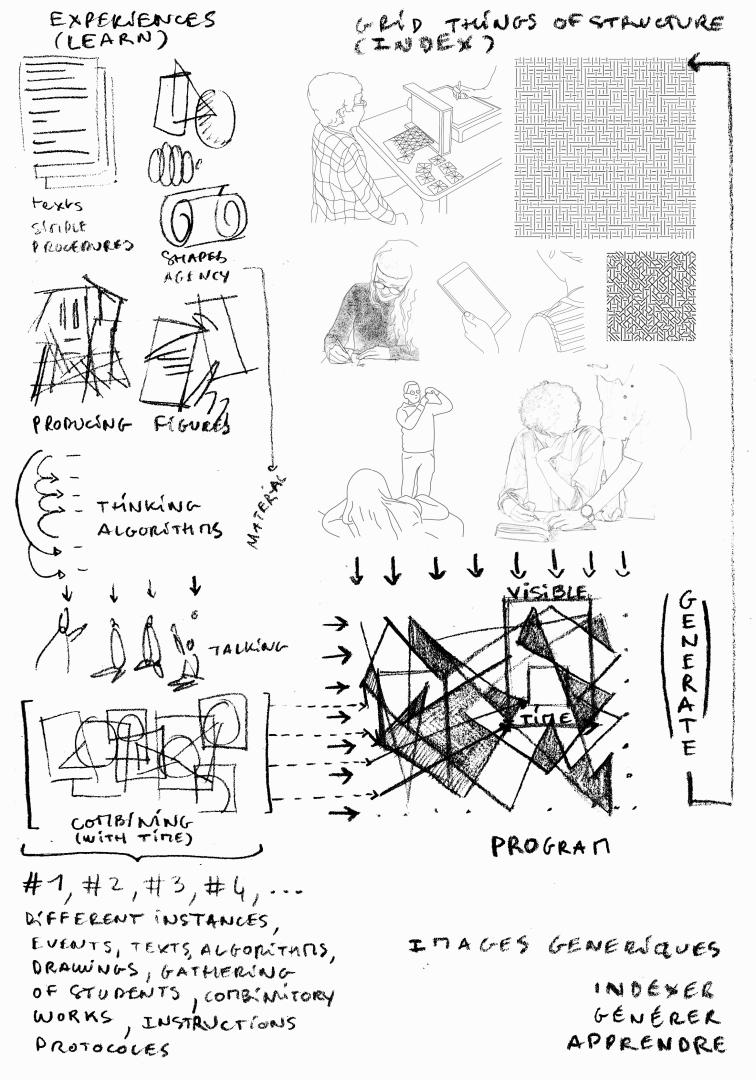
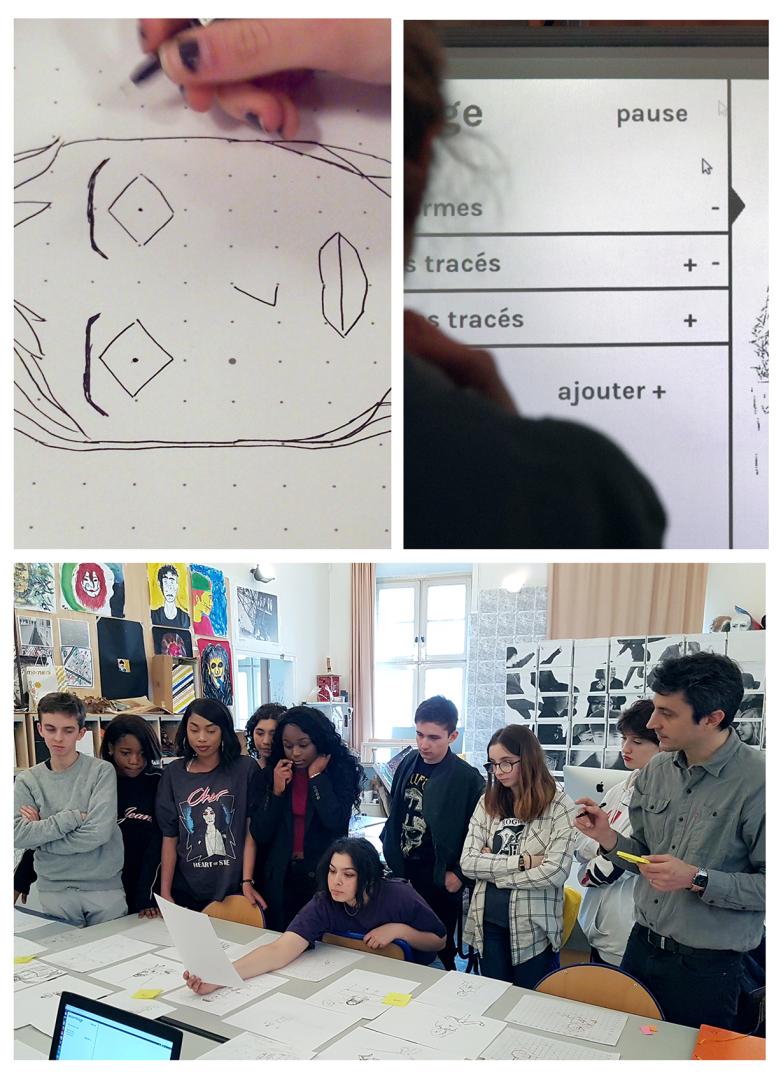
1) Generic Images is a software designed together with an open workshop for algorithmic practice in the context of art education. It acts as a graphic generator that produces meaning from a participatory process, fostering an increased interaction between individuals, algorithms and artistic language. It’s a pedagogy relying on three key notions: index, generate, learn
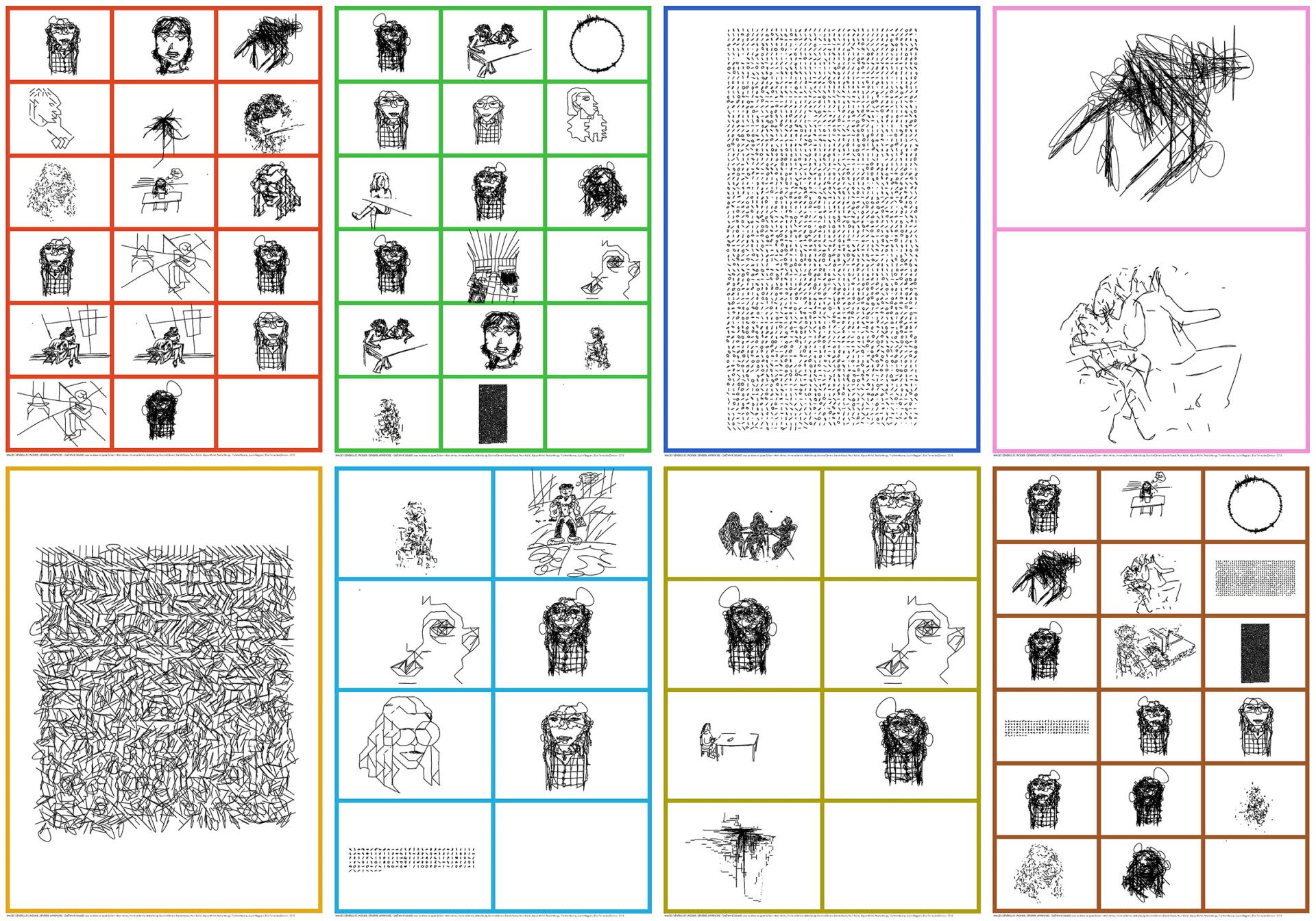
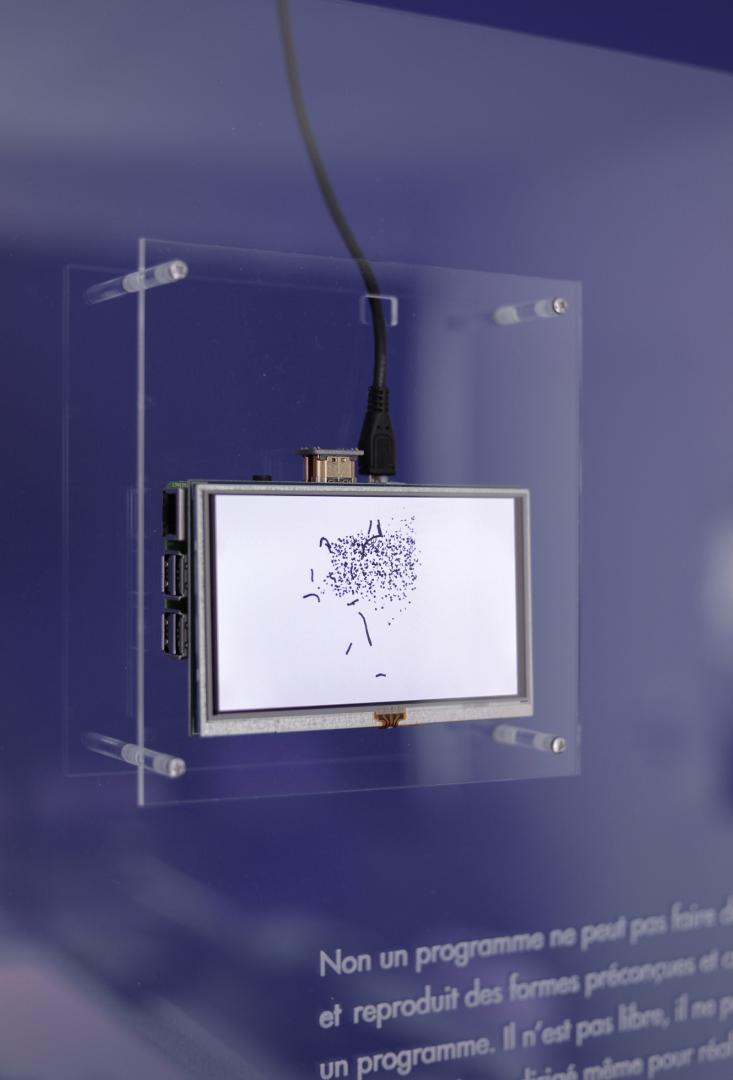
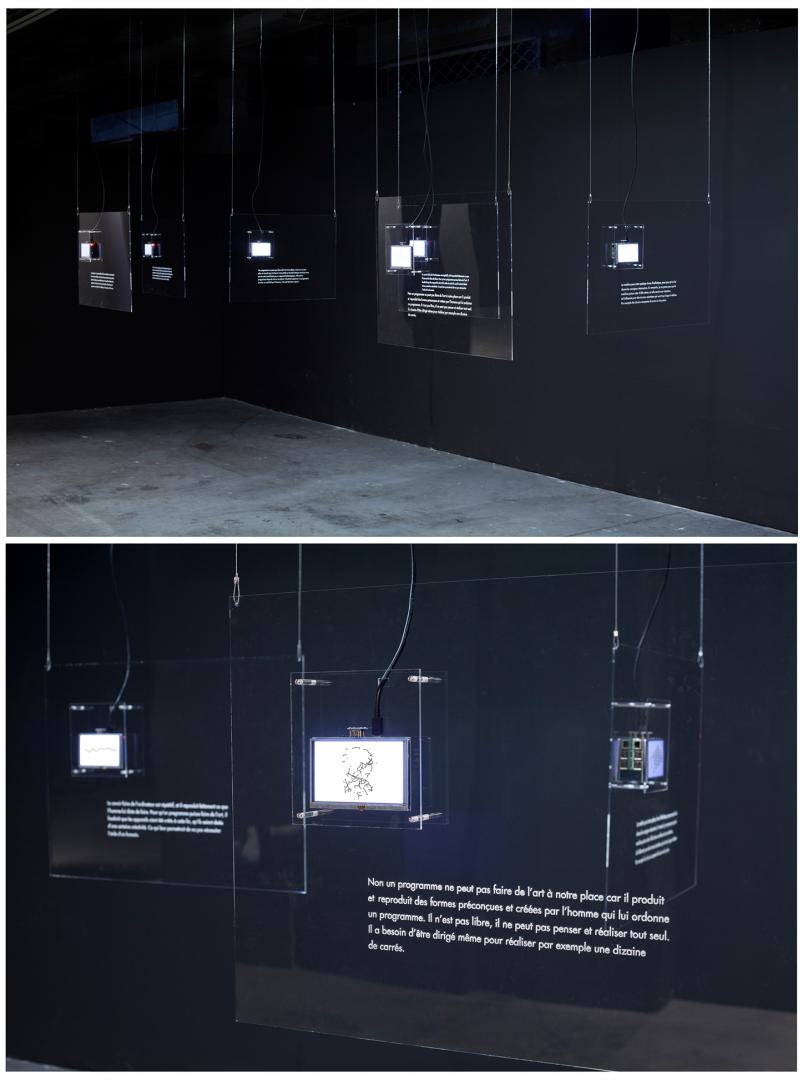
2) Logical Drawings is an art installation (re)cycling drawings, processes and texts produced in Generic Images. It involves the design of a space that brings together generative machine learning and student’s thinking on algorithmic art
Exploring different dimensions of generative aesthetics, the Generative Workshop brings together different generations (high school students, university students, researchers, and artists) with different backgrounds and curriculums – in a critical process, questioning human activity in the era of automation of cognitive work. It is placing human capacity for action and inclusiveness at the heart of the process. It aims at a sustainable education in digital art.
Key objectives for sustainability
One of the working hypotheses proposed here is that in order to produce an environment specific to artistic development and teaching of generative aesthetics – it is necessary to think of an environment that is human, software and hardware. Moreover, this environment relies on three key notions:
1. Index: an index of visual elements drawn by hand or generated by algorithmic procedures – graphic shapes, hand drawings, or transformations of these drawings. The index can be related to the notion of repertoire found in generative aesthetics (Max Bense, 1965; Frieder Nake, 2005).
2. Generate: new visual arrangements resulting from the distribution of elements contained in the index. Most of these spatial operations use random calculation. The generativity of the software is similar to the distribution of probabilities in the field of generative aesthetics.
3. Learn: learning through verbalization and the determination of a syntax of visual operations, in between natural and formal language – a language allowing to describe algorithmic operations (instruction, assembly, loop …), but also – saving visual results.
It is the experience of different groups with Generic Images software – from its design to its use, that engender a sustainable model for artistic and digital environments. Focused on the aesthetic continuity of the line, the model adapts to different types of place-based activities ranging from art to design, and from software literacy to abstraction. The software literacy is underlined by the open source philosophy surrounding Generic Images software.
Key objectives for aesthetics and quality
As we understood in Generic Images, the artistic challenge in designing generative software does not rest only on the software domain. To apprehend forms and produce meaning, it is necessary to conceive the material space in which the software is situated.
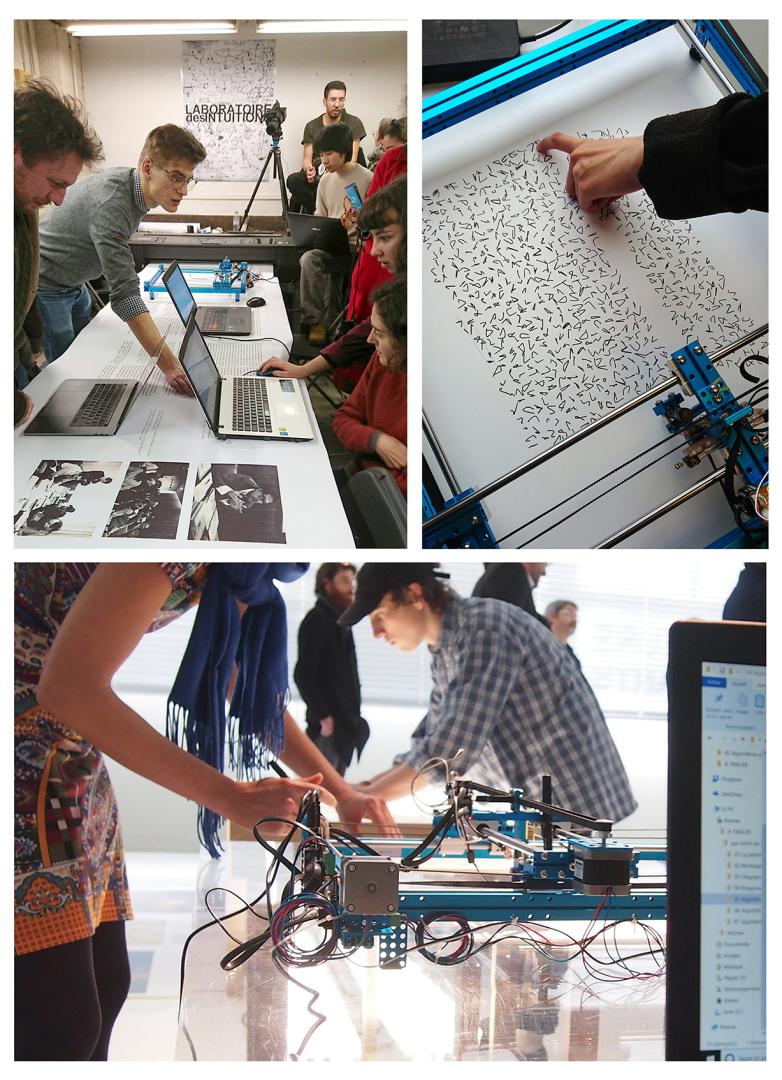
As an art installation, Logical Drawings involves the design of that space, together with a drawing algorithm based on machine learning. Used as primary material, responses the high school students gave to the survey in Generic Images offer a discursive counterpoint to the presentation of the generated images. Answers to questions such as – “do you think an algorithm can do art for you?”, raised awareness of the place of the human and his relation to the machine through a process of artistic creation. Referring to freewill, intention, nature or technology, answers showed great diversity. In the installation, they are displayed together with generative drawings produced with the help of low consumption nano-computers.
As a whole, the installation presents us with a multitude of drawings that change over time. As an environment, it offers a transaction of meaning between software, image and language. The verbal responses of the students in formation counterpoint the algorithmic image. The divergent opinions represented by these texts sometime oppose to the logic of the program. We hope that this juxtaposition forms both the aesthetic and the critical character of the installation which enhances public awareness on learning and creating in the digital era.
Key objectives for inclusion
In terms of inclusion, the key objectives are relying on diversity, speech and accessibility.
The project cares for bringing together different generations: high school pupils, university students, art school students, teachers, artists, researchers. Therefore it also involves people from different education framework. It is remarkable that the engineer students who developed the Generic Images software directly addressed themselves to the students in high school: transmitting their work, issues that were met, and asking questions to their audience. And this is reciprocal: from high school students to engineer students. Furthermore, high school students were also involved in sharing their work to a broader audience, notably at the occasion of the event Atelier partagés [Shared workshop] at digital culture institute Gaîté Lyrique, in Paris. The various occasions where the Generative Workshop was proposed also showed that the different expectations found in each education framework were met, for instance: discovering involvement of code in the arts (high school), designing software with educative purposes (engineer faculty), experimenting new educative methods (teachers training program).
It is also important to notice that high school students had an active part in the creation of the installation Logical Drawing: Their own reflection was included as text material in the art piece itself. Finally, by introducing various generations to the role of algorithms in making art, the Generative Workshop provides accessibility to processes that usually remain hidden under digital interfaces of everyday life. This accessibility also contrast with the idea that thinking algorithms is reserved to high competence. In this sense the project fosters an inclusive and emancipatory view in the era of the digital.
Results in relation to category
We are recalling here the main lines of the Generative Workshop events:
December 2017. Lecture
Gaëtan Robillard, « L’art à l’ère du numérique [Art in the Digital Era] », Académie de Créteil, Maison des Arts
April 2018. Workshop
Gaëtan Robillard, Generic Images, Gaîté Lyrique and Lycée Colbert, Paris
March – April 2018. Master class
Gaëtan Robillard, Generic Images, INSPE (Institut National du Professorat et de l’Education) Paris, Sorbonne university
May 2018. Exhibition and presentation with students
Gaëtan Robillard, « Generic Images », Ateliers partagés (Shared workshops), Gaîté Lyrique
March / May 2018. Workshop
Gaëtan Robillard, Generic Images, ESA Dunkerque
October 2018. Workshop
Gaëtan Robillard, Generic Images, ESAD TALM-Tours
December 2018. Publication
Gaëtan Robillard, Alain Lioret, « Generic Images (index, generate, learn): A Heteromatic Environment? », Generative Art Conference, Argenia, Verona, Italy, 2018
October 2018 – January 2019. Exhibition and workshop
Gaëtan Robillard, Logical Drawings (solo show), INSPE, Paris
Main impact: the creative involvement in generative processes (by thinking processes and algorithms) make us reflect on digitization and machination of society as active participants.
How Citizens benefit
Coming from different age groups, and different pedagogical models, the pupils and students benefited from the opportunity to work together. They are the future civil society. The project aims long term benefit, such as software literacy, aesthetic engagement with the digital image and critical thinking in machine learning.
The Generative Workshop has also touched a larger public through exhibition and public events. One major impact of this communication to the broad audience is the invitation in rethinking schools and teaching in the digital era. The project always received positive feedbacks from the various public events. The three exhibitions of Logical Drawings in Paris, Roubaix and Valenciennes were successful.
On another note, the exhibitions of the project in art venues also showed that art spaces can be strongly activated by education. This remarkably echoes issues that are raised in the discussion of the becoming of museums, in regards to new societal expectations[1]. In terms of philosophy, the Generative Workshop was much impacted by this context.
[1] Here we are referring to exhibition Open Codes, ZKM, Karlsruhe, 2017-2019.
Innovative character
We have seen that the Generative Workshop leads to questions on the relationship between manual and intellectual gesture, but also between thinking and algorithms. We believe that today the wakening to the importance of such questions is necessary and that it goes beyond the framework of artistic education. The heteromation analyzed by Hamid Ekbia and Bonnie Nardi in 2017[1], which divides the work between humans and machines by means of algorithms, poses an economic, social and political problem. Just as artificial intelligence can be perceived as an “epistemological revolution”[2], the importance of illuminating relationships between human cognition and machine calculation must be considered. Focusing on the artistic creation to reflect the social activity of an era also allows a critical experience in a complex maze of individuals and algorithms.
The Generative Workshop project explores different dimensions of generative aesthetics. We presented and defended the way Generic Images software has been designed, placing human capacity for action and inclusiveness at the heart of the process. We also wanted to stand back from an existing model for the transmission of art and algorithmic thought. We believe that it is necessary to form a triangular relation between intuitive gesture, generative algorithm and material realization. This model then requires a certain creation and transmission environment. It is seen as a global chain where each part must be linked to the other two through an experience.
[1] Hamid R. Ekbia and Bonnie A. Nardi, Heteromation, and Other Stories of Computing and Capitalism, MIT Press, Cambridge: MA, 2017.
[2] Robert Maggiori, « Humanité », Voyage au cœur de l’IA : Comment l'Intelligence Artificielle va changer nos vies [Journey to the heart of AI: How Artificial Intelligence will change our lives], Libération Hors-Série, 2018.