Arco
Basic information
Project Title
Full project title
Category
Project Description
The feast understood as a work of art is the most concrete form of worship, where body and soul, through songs and dances, prayers and invocations create an atmosphere of great complicity between the sacred and the profane, religiosity and popular worship.
The feast as a paraphrase of life.
The path as an act of knowledge
The journey as an act of encounter
The journey as an act of communion
The journey as an act of creation
The journey as an act of change
The journey as an act of explorat
Project Region
EU Programme or fund
Description of the project
Summary
These are the reasons that determined the choice of the proposed theme:
- the desire to deal with a theme that was connected to the life of the Vesuvian area - the attempt to give the "action of the path" a value that was not the mechanical crossing of a place;
- the intent to "observe" these paths, increasingly reduced to a fleeting backdrop of our movements and a rapid sequence of evocative images;
- the possibility of re-finding new representations of the territory.
THE JOURNEY, THE WALK AS A MEANS OF EXPLORING PLACES AND TERRITORY, AS A SPACE OF WELCOME AND HOSPITALITY WHERE TO MEET AND HOST THE OTHER.
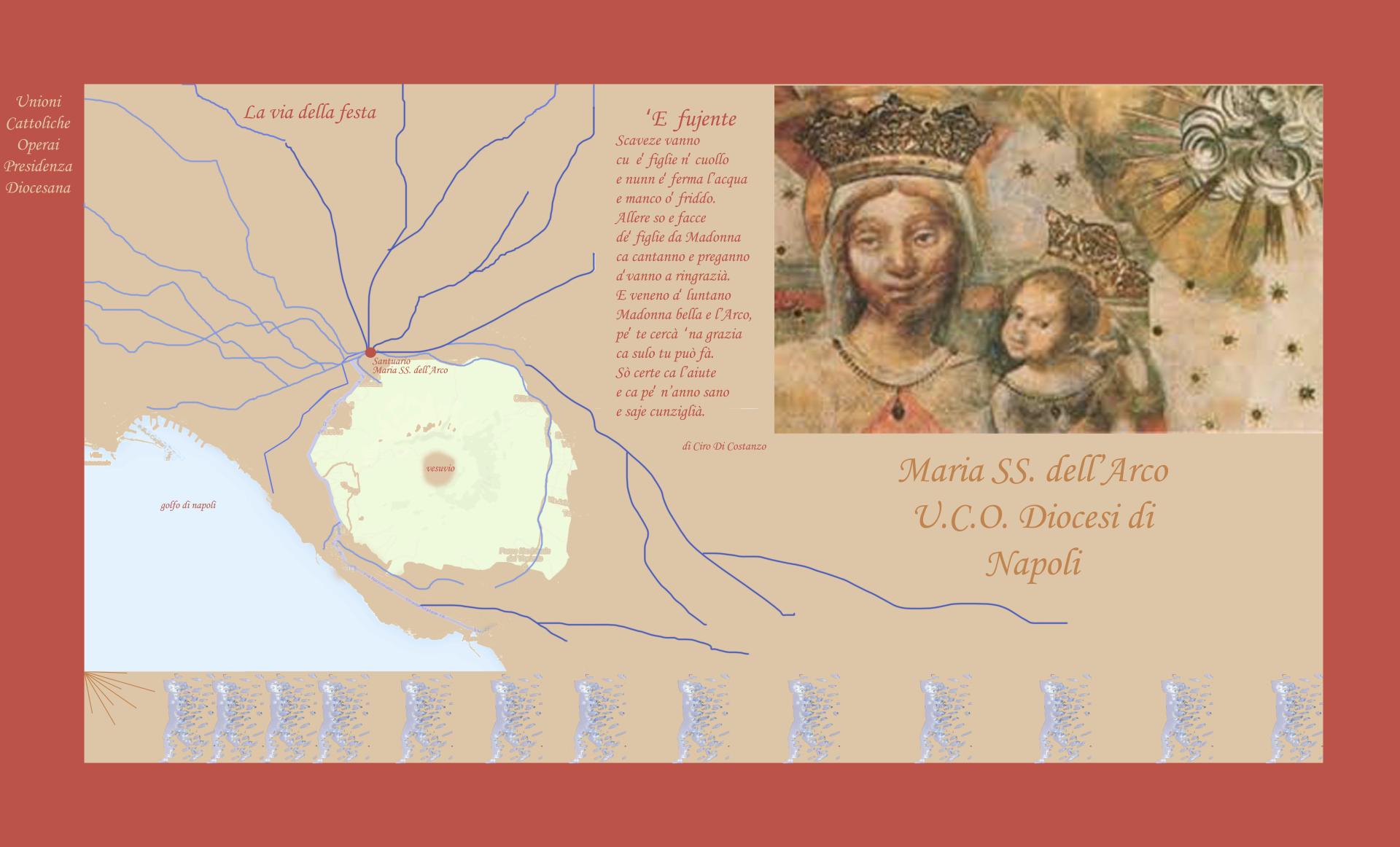
On Easter Monday, the metropolitan roads that connect the Vesuvian towns and the city of Naples to the town of Sant'Anastasia, where the Sanctuary of the Madonna dell'Arco is located, displaced by the frenetic weekday traffic, change their rhythm: the flows of cars are replaced by human flows. So, for the streets in rivers are poured the faithful, the c.d. "fujenti", that transform them in the "way of the walk toward the Sanctuary": they pray, they intone sacred songs and they execute votive dances in front of the aedicules of the territory, changing the city rhythms in the rhythm of the party. The roads followed by the fujenti to reach the Sanctuary, located close to the Vesuvian conurbation, are simply the roads used every day by themselves as citizens: therefore neither isolated nor difficult to access. The random event that attracted my attention was a poem about the cult of the Madonna dell'Arco taken from the book "Verità e bellezza" by Ciro Di Costanzo entitled "I Fujenti", where it is evident the concept of pilgrimage as a TRIP of the soul and the body in perfect communion with the places that are crossed.
Key objectives for sustainability
The journey and the crossing of the urban fabric on foot and not by means of transport offers the opportunity for new forms of use of space, where the natural environment, the services to the reception and the stop find a preponderant value. The environment is not the different from my space understood as private property but my space in a shared form: common property with others, meeting place and relationship that must be cared for, respected, equipped and especially protected.
The goal is to create within the urban fabric new visions of space, new forms of sharing and cohesion that improve, transform the same according to a shared vision that favors the realization and future management.
Create new places of meeting, rest and relationship that enhance the spaces of communion for a social and cultural growth linked to environmental roots.
Strengthen values in a local sense and global key.
Define new forms of use of the spaces and especially alternative forms of means to cross them, the tradition encourages the walk, the walk that obviously requires different forms of architecture of spaces and roads that must adapt to the pedestrian use often penalized and not considered.
Consider the "walk" as a form of knowledge of the territory, creating ad hoc pedestrian routes.
Thus creating forms of beauty that together with the environment create sustainable and livable spaces.
Key objectives for aesthetics and quality
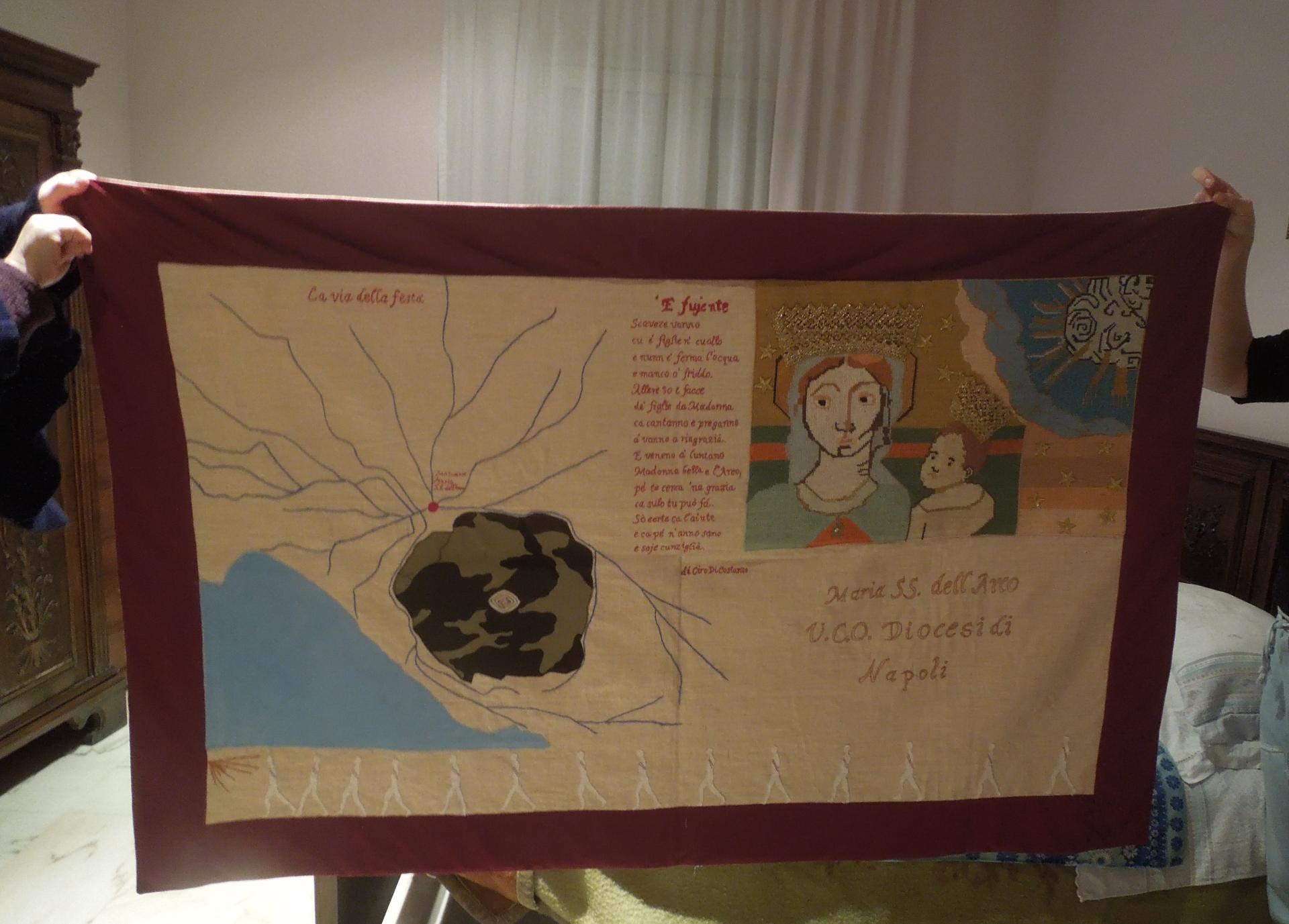
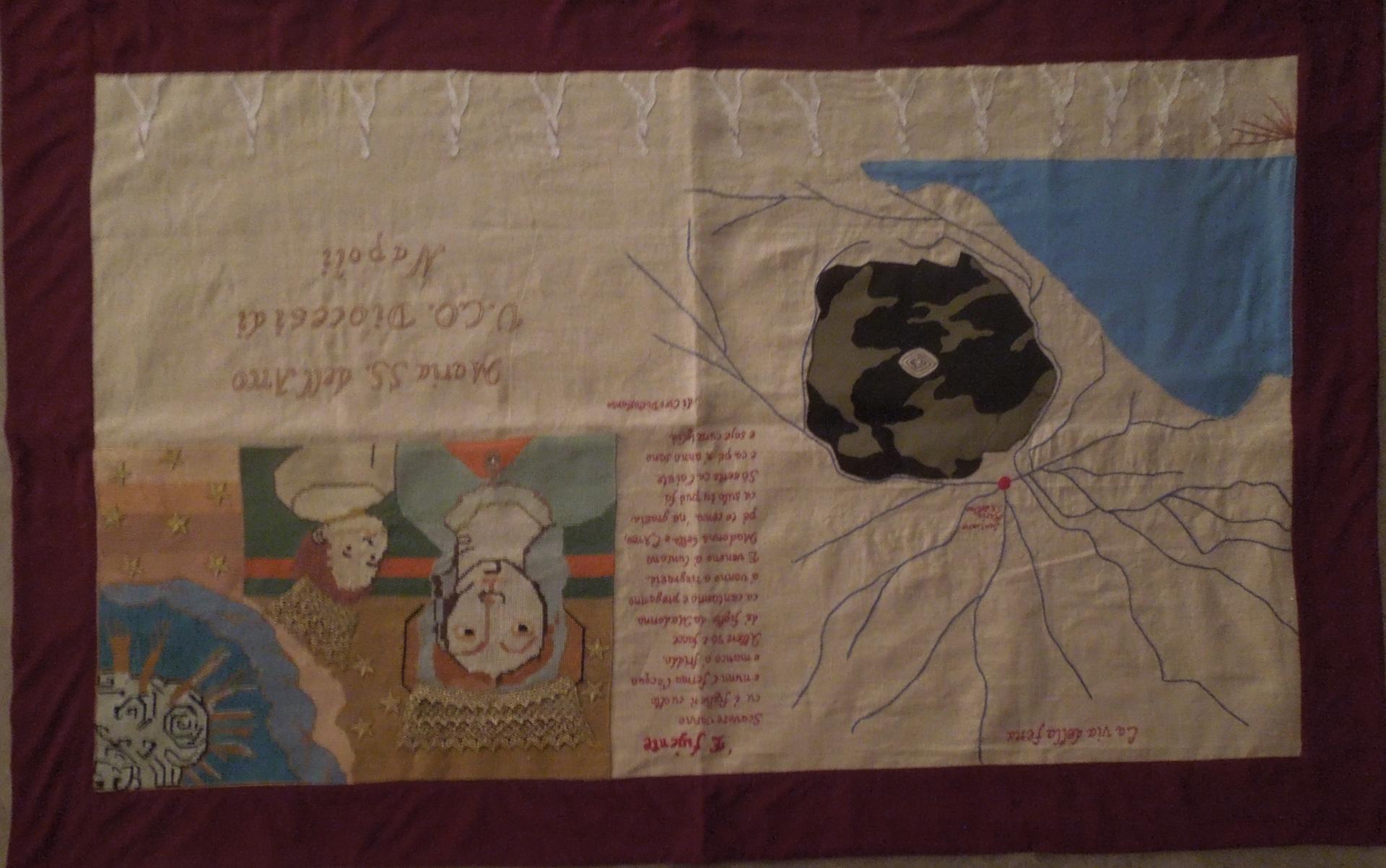
The project proposes the creation of a tapestry made up of as many pieces as there are associations in the diocese of Naples that celebrate worship.
We are what we contemplate, man bears on his face the image of the reality that surrounds him and therefore it is urgent to create beauty food on which man feeds. Architects and artists have this responsibility.
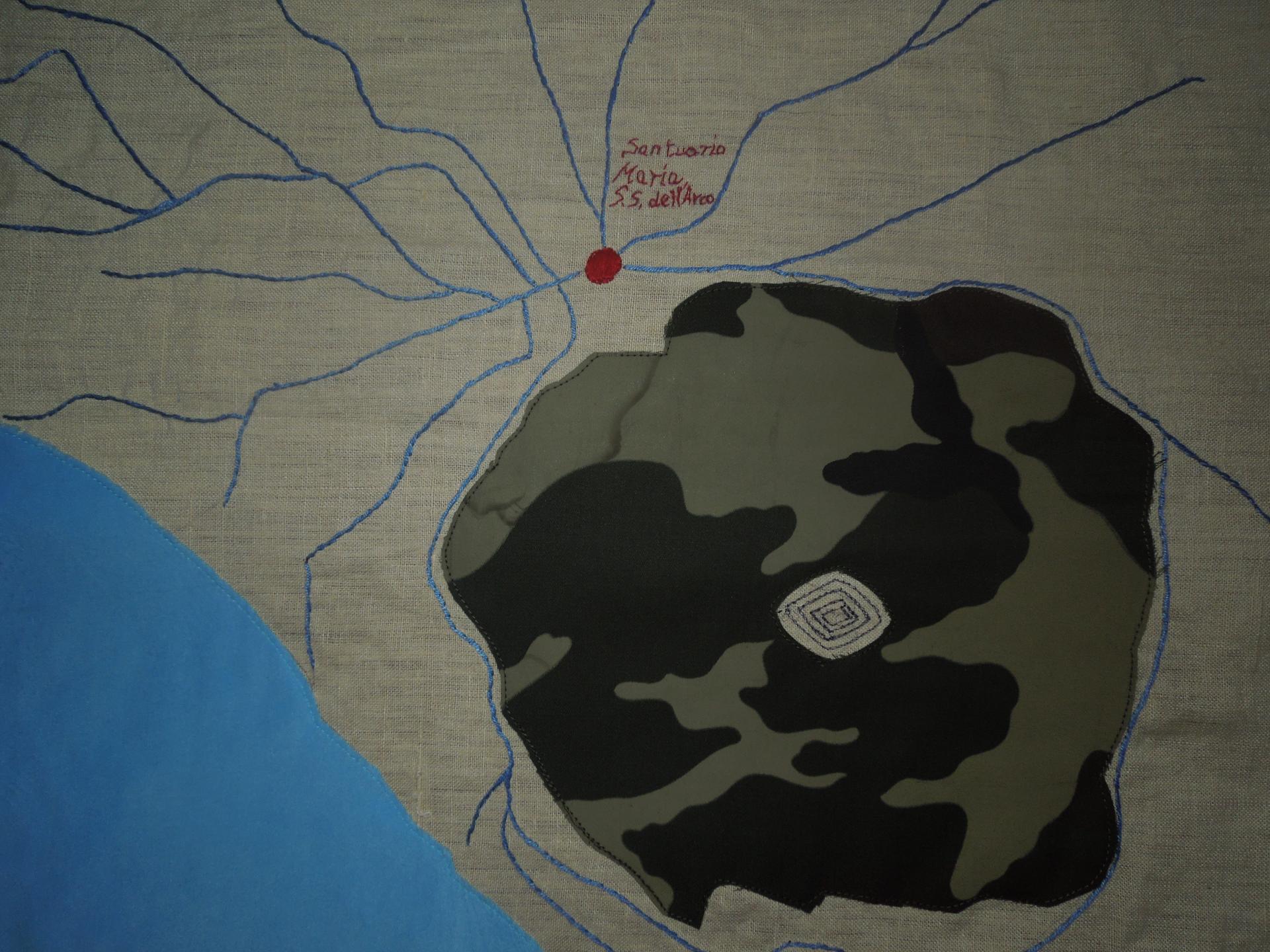
The tapestry evokes the territorial peculiarities of the individual associations and ideally retraces the paths of pilgrimage and popular devotion to the cult of Our Lady of the Arch.
The meetings with the associations and the archiepiscopal delegate of the Curia of Naples directed the work towards the realization of a gift that would be evocative: of the common cult for the Madonna dell'Arco, of the territorial extension of the cult, of the community value that animates them.
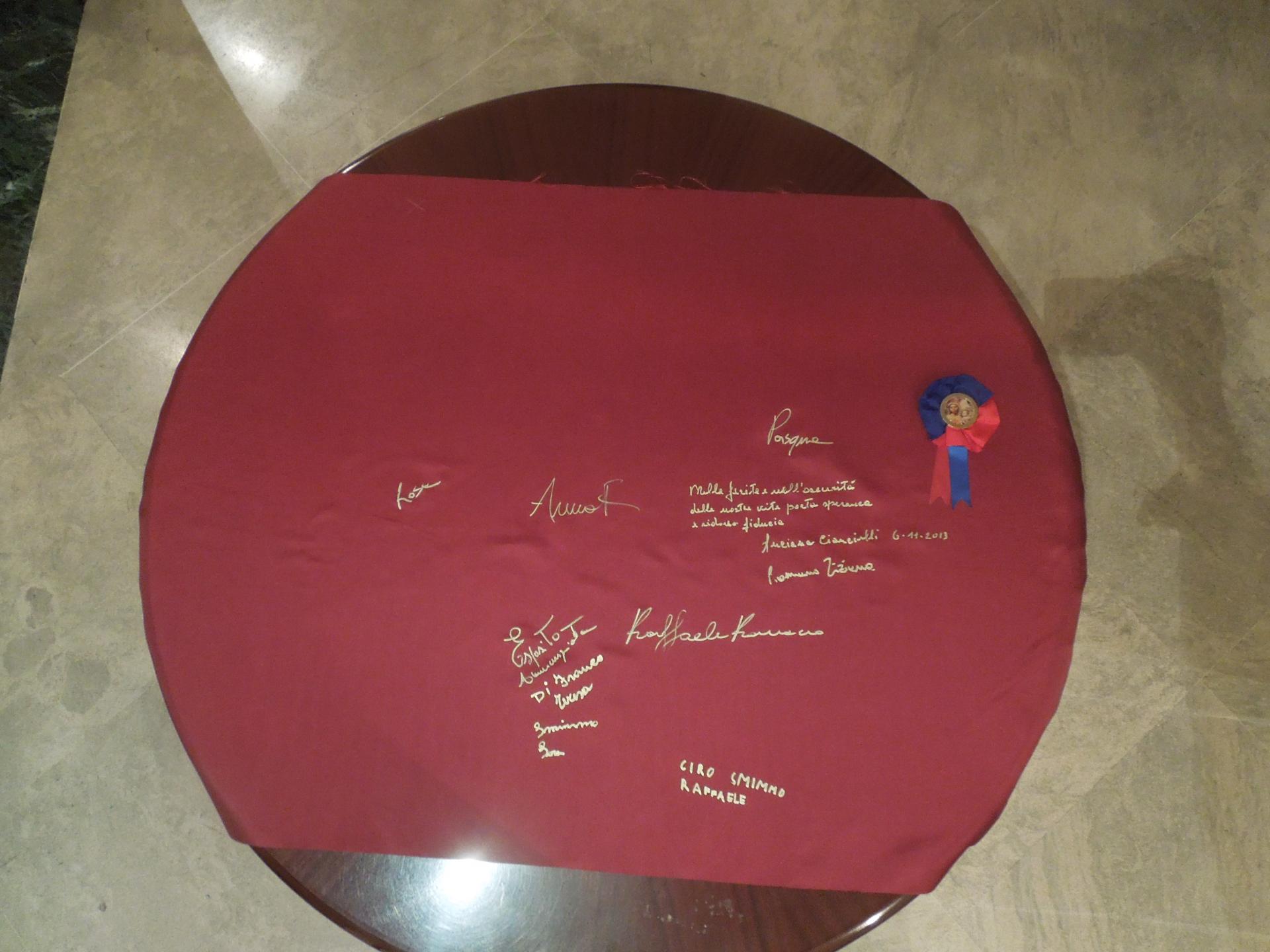
The value of the gift of offering according to tradition as an ex-voto emerged in an unequivocal way (tapestry), as the will through the name of the association to express its associative identity (uco....), the value of the pilgrimage (path).
The gift can take place as usual during the "Feast" in which, however, the communitas of the bearers embrace the Sanctuary and therefore the Madonna, an "urban hug" that brings together worship and territory.
The PILGRIMAGE, which at first glance could be read as a way to participate in the feast, is actually a festive institution in its own right that has taken its form through the specific mode of "travel".
There is no pilgrimage without a journey, and between the two paths, the outward journey and the return journey, the feast is enclosed.
Of course, this walk is full of symbolic meanings, mythical and magical, reaffirming the transition from profane to sacred place, from the space of everyday life to the dimension of the feast.
Key objectives for inclusion
For the realization of the tapestry the community has been called in first person: from the selection of the material to the realization of the same.
In this way, all the forces of the territory were involved and together they gave life to the final result FEELING THAT THEY WERE PERSONALLY INVOLVED IN THE RESPONSIBILITY AND PROTAGONISM OF THE RESULT.
At first we met in the house of the various protagonists, then in the stores, then together we made the party in the association and then walking we made the pilgrimage and then lived the experience of the journey and the party.
So the poet meets the tailor, the embroiderer meets the storyteller, the spectator becomes the protagonist and everyone collaborates in the realization of the project enriching and enriched, creating new forms of sociality, communion, work and sharing; creating from the past through the practice of the present, the future as new life styles.
The pilgrimage is a metaphor for the transition from everyday life to a collective moment full of meaning, the festival brings together the various groups of devotees scattered throughout the territory (associated and not) in a communitas that in the journey finds its social identity and territorial. The concept of communitas is influenced by the family and territorial tradition.
Madonna dell'Arco is the name of a district of Sant'Anastasia, a Vesuvian village located on the slopes of Mount Somma, 8 km from the center of Naples, where in May 1593 began the construction of the homonymous sanctuary.
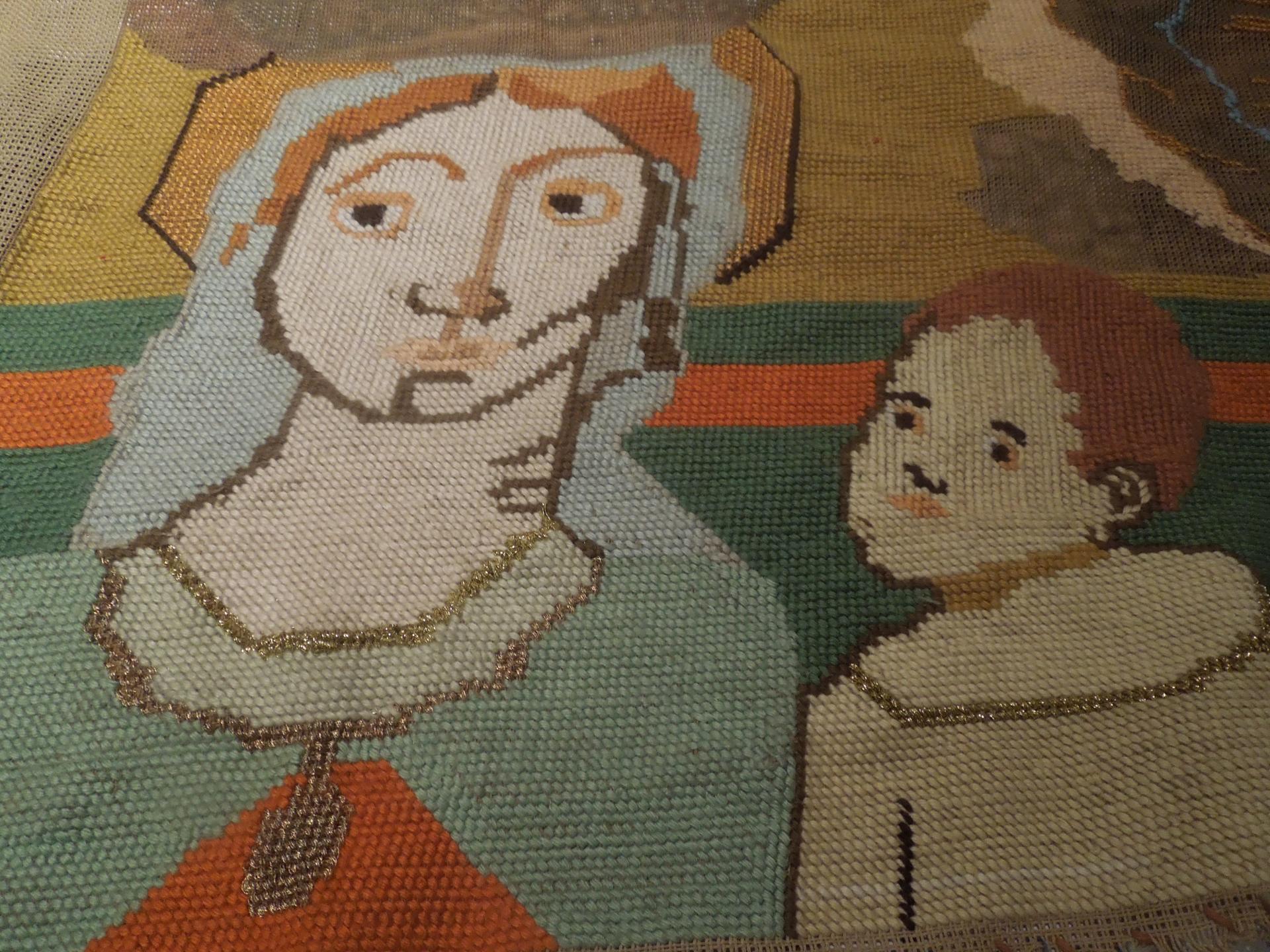
The origin of the cult of the Madonna dell'Arco is linked to the image of a Madonna and Child painted under the arch of a Roman aqueduct that crossed the road Naples - Somma and hence the name that identifies it as the Madonna dell'Arco.
A new style that does not tolerate, accept or host diversity but welcomes it in the difference, transforming it into a force that innovates precisely because it is different.
Results in relation to category
In order to create innovation, it is fundamental to start from tradition, from the consolidated forms of the past, only in this way it is possible to build a bridge through the present towards a growing future that is open to innovation.Creating a culture of change that is never something that falls from above, but that comes from a shared vision of reality, acceptance and vision of the future, creating a mission and a broad vision that makes everyone feel protagonists and actors involved in the process of transformation and management of change, innovation, evolution because it creates culture of the process itself, care of the goal, maintenance of the result. Process The first phase was of knowledge and study of the phenomenon at the Centro Studi Arco of the Sanctuary where the cult is practiced. The second phase was of knowledge of the devotees: I met the devotees of one of the associations of my country. They showed me their sections, told me the miraculous story that is at the basis of the foundation of the association, and showed me their treasure: toselli, flags and banners that they carry on pilgrimage every Easter Monday. Then it was necessary to meet the archiepiscopal delegate in charge of the associations (Unioni Cattoliche Operaie) of the Archdiocese of Naples of which the U.C.O. Maria SS.dell'Arco, is part. The third phase began with a meeting with representatives of the associations of the thirteen deans. Together we discuss the local peculiarities that the cult has taken in different countries: the sea in the countries of the coast, Mount Somma and Vesuvius in the countries of the hinterland, the main votive shrines, the traditional routes and the main stages along the pilgrimage, the importance of the image of Our Lady on toselli and badiere. On the basis of these data I tried to hypothesize a graphic composition of the tapestry.
How Citizens benefit
Together. This is how this tapestry was born.
It constitutes the project of the thesis of the University Master of Arch. Rosa Romano but immediately becomes in its realization manifestation of a shared life experience.
Inspired by the poetry of Dr. Ciro Di Costanzo, linked to the tradition of the fuienti that on Monday in Albis go as a sign of devotion to the Sanctuary of Our Lady of the Arch, it draws the paths of pilgrims on their way to the Church.
on their way to the Church.
The Section of Caravita dedicated to the Madonna dell'Arco has witnessed and told through the sharing of their devotion the spirit and the feeling that characterize these paths of faith.
The work was therefore born from the synergy and collaboration of many people.
It is a choral work where everyone has contributed to the realization: those who design, those who direct, those who embroider, those who sew, those who take care of the details, those who write, those who walk, those who observe, those who tell, those who sing, those who listen.
Each one, according to his or her role and task, actively participated in the executive process of the work whose beauty lies in the experience of communion that it reveals.
Innovative character
Potential results by working together, starting from one's own history and roots and transforming tradition into evolution. thus creating new forms of economy, cooperation, encounter and sociality. starting from one's own history from local value to create forms of extra-territorial cooperation capable of being a value in an even wider reality open to the global.
Spreading culture from the value of traditions to innovation: new forms of communion.
Despite the changes that the city has undergone, the pilgrimage has not stopped his "going", nor changed its mode of implementation, indeed each time has the power to repeat ways and uses of archaic and rustic space, related to the rural society that was, rather than the industrial never took off. In fact, in the advanced capitalist system, holidays are the time of non-work, unproductive time. Weekday and holiday time are strongly structured as parts of the productive mechanism that separates the moment of production from the moment of consumption. In the peasant culture, however, the festive plan was not distinct from the productive time, indeed, the work was characterized as festive because socially it was to share with the whole community a part of the production. The peasant festivals have shown a remarkable degree of resistance both in time and in the way they are carried out, despite the birth of industrial settlements, the disintegration of rural communities and of the agricultural social fabric.