NaN (Not a Number)
Basic information
Project Title
Full project title
Category
Project Description
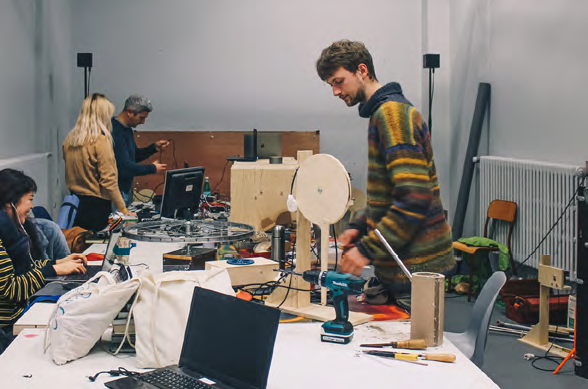
NaN (Not a Number) is an interdisciplinary and inter-institutional program on the theme of digital arts and sciences, carried out since 2015 by the Ecole supérieure d'art et de design TALM-Angers and Polytech-Angers, engineering school attached to the University of Angers. Since 2015 the two graduate schools have been conducting a collaboration that is organized as a time of collective experimentation. It is a transversal space that plays with the borders between disciplines and teachings.
Project Region
EU Programme or fund
Description of the project
Summary
Since 2015 Polytech-Angers and TALM-Angers have been conducting a collaboration that is organized as a time of collective experimentation, free from the usual constraints and hierarchies, which allows everyone to consider the place of their knowledge. It is a transversal space that plays with the borders between disciplines and teachings to place at its center the "doing together". Project-based teaching is a working method that produces exchanges, from conception to completion. It prioritizes the process of research and improvisation rather than the result. This method involves observation and questioning of the world around us in order to achieve a singular appropriation of the elements that constitute it. It claims interdisciplinarity in order to encourage exchanges between people of different backgrounds and knowledge so that they generate opportunities for human collaboration, with the desire not only to promote the creation of qualified digital works, but to integrate the cultural, social, political and ideological dimensions that build our culture and shape our relationship to technical or artistic objects and question the issues of their production, documentation and distribution.
Every year since 2015, the NaN project has given rise to workshops (from 2 to 5 days per workshop, involving guests), public presentations, live performances, livecoding sessions, etc.
NaN was initiated and developed by Mathieu Delalle (professor at TALM-Angers), Mehdi Lhommeau (lecturer at Polytech-Angers) and Sébastien Lahaye (university professor at Polytech-Angers). The project is supported by West Creative Industries.
Key objectives for sustainability
The sustainable dimension of the training is to be found in the rapprochement that is achieved within it between art and technology, arts and sciences. Indeed, this rapprochement allows students to address scientific issues and subjects through the prism of art, in a sustainable way since it is complete and allows them to work on all aspects of complex scientific problems and to deal with contemporary issues.
Some of the new areas of creation today involve questioning the relationship between art and technology. A phenomenon of convergence, of capture between the two models seems to be able to be actualized sustainably, where each draws from the other systems of organization, methods of conception, sometimes even the finalities. Two territories, then - art and technology - come together, inspire each other, overlap to the point of building common platforms. The Boolean schema that distinguishes and separates the artist, as the exclusive guardian of the symbolic and spiritual depth of the world, and the engineer, as a materialist subjected to the triviality of technology, is inadequate to describe the great shuffling of norms, hierarchies and values that the contemporary world is confronted with: the lines are shifting, the social and symbolic roles, in a complex game of displacement, openness and rupture are blurring the common sense.
Key objectives for aesthetics and quality
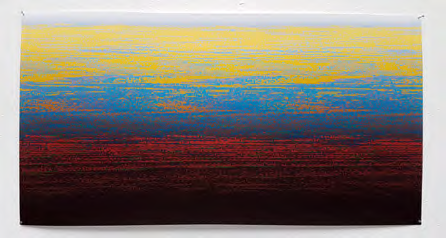
Several interdisciplinary lines of research have been developed by NaN, carrying different aesthetics.
- The research axis Live at the Museum was oriented on the question of the machine-tools with which it is possible to work and think. This orientation implies to leave the passive attitude, to which certain devices lead us, to encourage, by technological and artistic competences, to act directly on these tools and to maintain with them a creative relation.
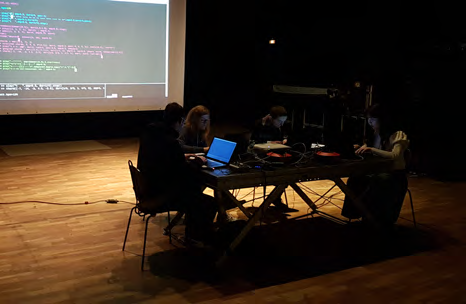
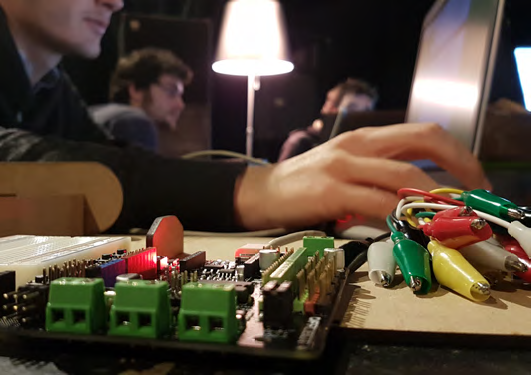
- In 2019/2020 the NaN project has been working on live performance. The language of code and computer programming are used to generate interactive physical interfaces, activated in real time. The action of the gesture in real time reveals the living and sensitive part of the digital technology conceived here as a management tool on the model of an instrument. The challenge is to bring the students to imagine processes delimited by certain rules that generate sound and perhaps visual actions. In an experimental practice, here, the performers, who are also the composers, are led to invent instruments with their electronic, mechanical or computer systems offering different connections between chance and singular choices. These systems are not only a story of technique, they are above all the means of an artistic writing. They create a multimedia environment in which the performers play all the roles linked to the production up to the performance in order to avoid the danger of a purely technicist vision of digital tools.
- In 2020, the NaN project proposed LiveCoding Jam sessions in streaming. Livecoding is a computer programming technique based on live improvisation. During the performance the player codes on a computer and the audience sees what happens on a screen. Livecoding scenes like Algorave are developing all over the world. In particular in Berlin and in Great Britain, driven by the Toplab network. Livecoding is a natural extension of the first music played on synthesizers.
Key objectives for inclusion
The numerous restitutions and public presentations attest to the success of this project, which has succeeded in blending the disciplines as well as the students and teachers with the local population and amateurs. The project promotes issues of "do it yourself" and "do it together" in public presentations, at the crossroads of crafts, scientific culture, technical culture, digital culture, art, etc.
Results in relation to category
The intention is not to train a student who is a specialist and user of a world in which he or she will work, but to arouse the desire to play an active role in it by finding a unique place in it, thanks to his or her capacity for analysis, attention, monitoring, adaptation and initiative. The project is based on the sharing of knowledge, from which it follows that no one is the owner and that any training can only be evolutionary, continuous and moving.
The project involves three teachers and twenty students each week. Since 2015, the teachers in charge of the project organize workshops that vary from 2 to 5 days. It is an opportunity for the students to meet new practices, to form new work groups, but above all to meet the guest artists who come to share their practices and propose new research directions. It is also an opportunity to go abroad to work in new cultural environments. Since 2015, in partnership with the Studio Tostaky / Le Chabada and the CDN (Centre dramatique national) Le Quai, the question of live practice has been addressed with artists such as Mattieu Delaunay - Laurent Carlier - Jérôme Abel - Anthony Fenshu - Julien Bellanger and Laurent Malys. These workshops are an opportunity to live a collective experience and often to offer a public presentation of the work produced during this period.
How Citizens benefit
The project has involved local people, through several events.
- In 2017 the co-organization of Festival D, that took place in Angers, with 6 partners (Ping / TALM / Polytech-Angers / Le QUAI CDN / Le Chabada / Terre des Sciences), with the objective of raising awareness among the public and more widely the territory to a hybrid digital culture, that of "Do It Yourself", at the crossroads of crafts, scientific culture, technical culture, digital culture, art, etc. This edition of Festival D was able to exist in Angers thanks to its strong territorial anchorage which reveals the quality of cooperation between local actors in the conduct of a common project. The success of the event, that gathered 5100 visitors over two days, reveals the desire of the people in Angers to participate and get involved in this field of activity.
- Public presentations in the spring of 2017 and 2018 at the Musée des Beaux-arts d'Angers as part of the Festival de la création universitaire. As well as at the Musée de la Tapisserie Contemporaine during the 2018 European Heritage Days. The exhibition Live au Musée at the Musée des Beaux-arts d'Angers in 2018 gathered 2000 visitors.
Innovative character
Putting the intersection of scientific and artistic disciplines at the centre of the training offers students - beyond technical knowledge - a sensitive approach to digital tools that allows them to examine and question their uses. The project's main challenge is therefore to envisage strategies to broaden the intellectual and cultural interests of students. Placing computer code and digital interactions in a perspective that stimulates curiosity and the imagination encourages a multiplicity of experiences and forms of expression. History shows that interdisciplinary projects have enabled artists to participate in the development of communication technologies, data processing, interfaces, software that create new generations of tools for artists. The artist or engineer is part of a contemporary context that he or she must know in order to be able to act, that he or she must question in order to transform it. The sharing of knowledge - that is not the property of anyone - is the basis of teaching which can only be evolutionary, continuous and changing. Training is thus based on a dialogue between students, teachers, administrative and technical staff, and outside contributors who encourage, within the projects proposed, invention, creation and innovation.