Buga Fibre Pavilion
Basic information
Project Title
Full project title
Category
Project Description
The Buga Fibre Pavilion demonstrates how combining cutting-edge computational technologies with constructional principles found in nature enables the development of truly novel and genuinely digital building systems. Its load-bearing structure is robotically produced from advanced fibre composites only. This globally unique structure is not only highly effective and exceptionally lightweight, but it also provides a distinctive architectural expression and an extraordinary spatial experience.
Project Region
EU Programme or fund
Description of the project
Summary
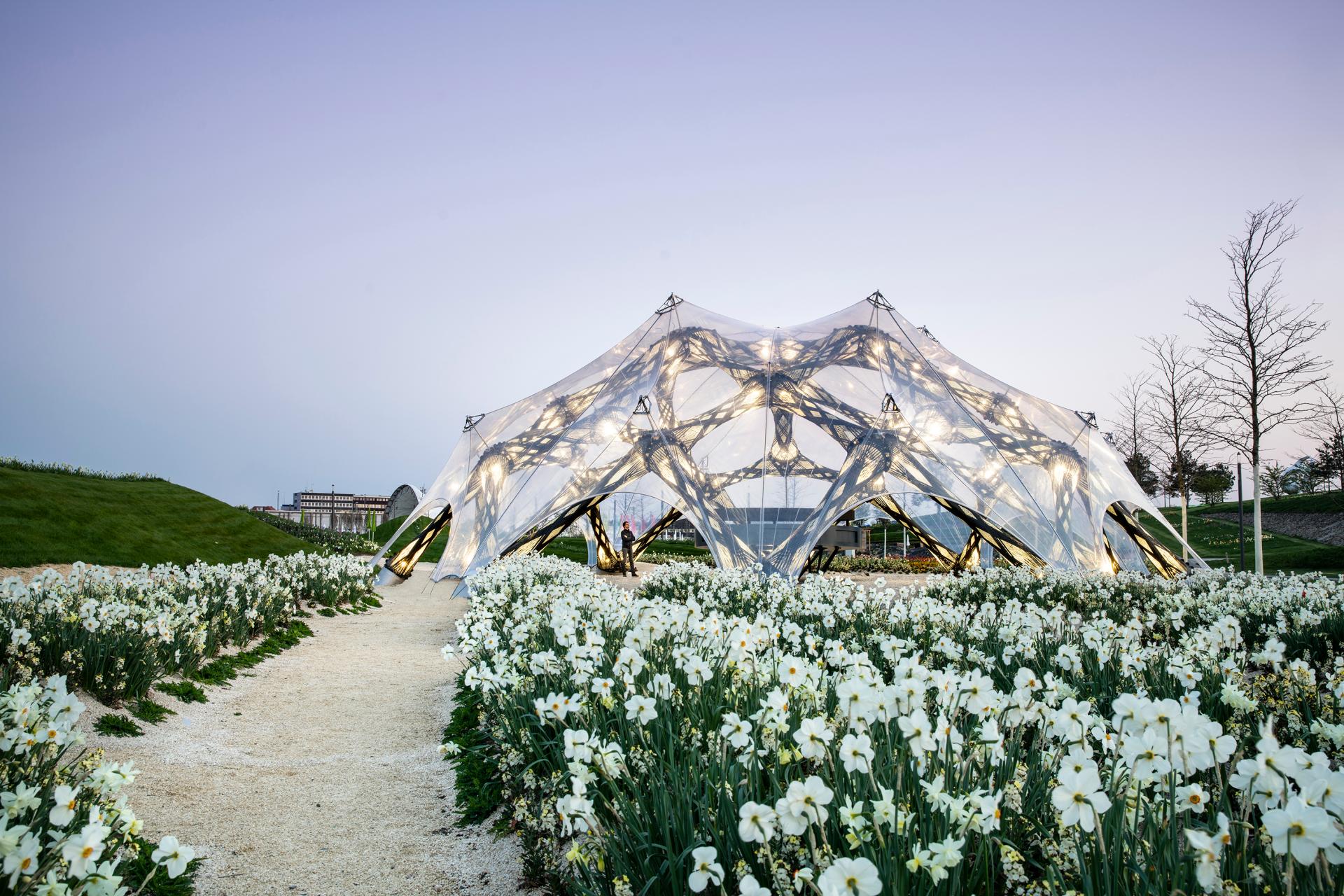
Embedded in the wavelike landscape of the Bundesgartenschau grounds, the BUGA Fibre Pavilion offers visitors an astounding architectural experience and a glimpse of future construction. It builds on many years of biomimetic research in architecture at the Institute for Computational Design and Construction (ICD) and the Institute for Building Structures and Structural Design (ITKE) at the University of Stuttgart.
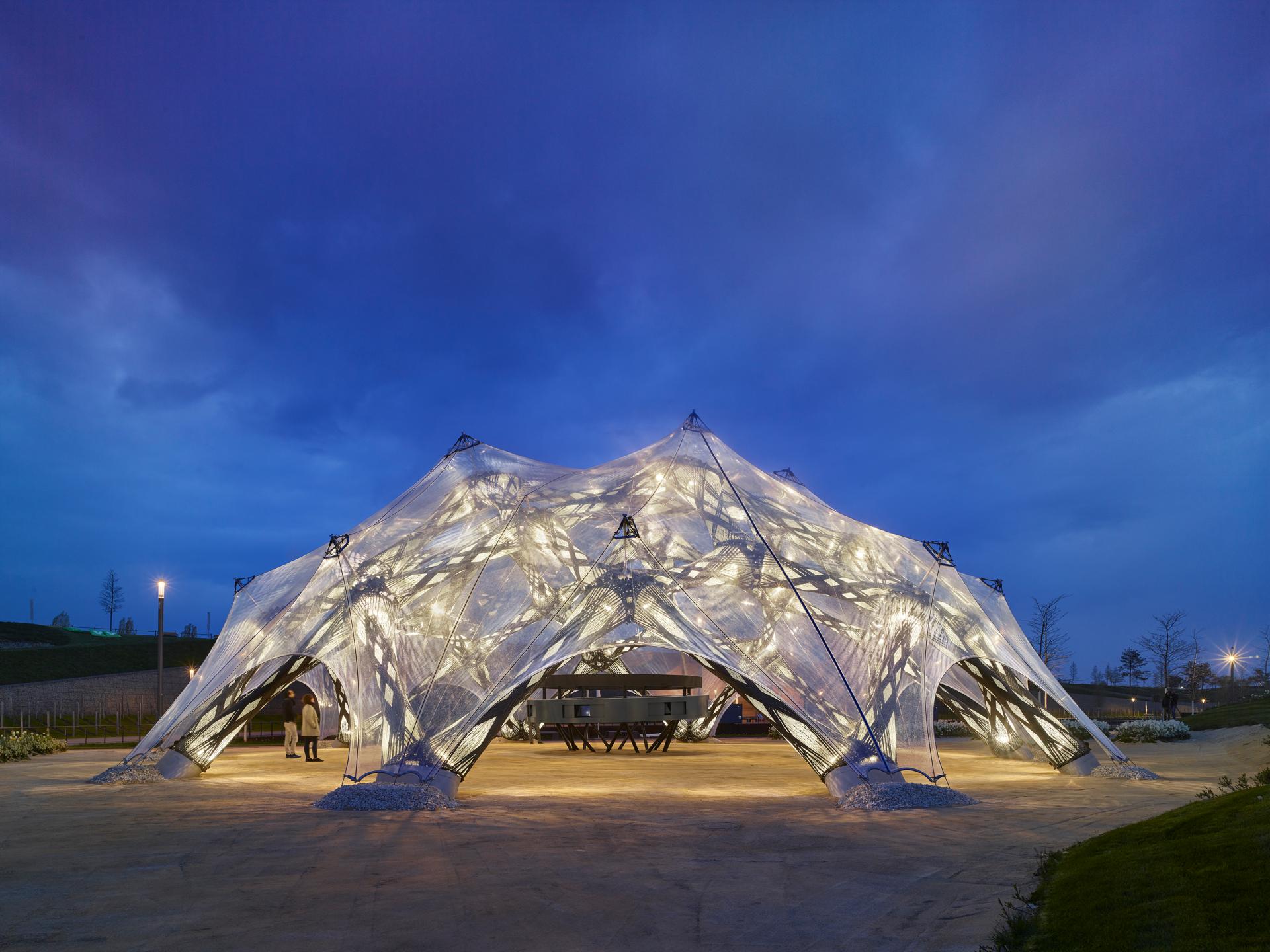
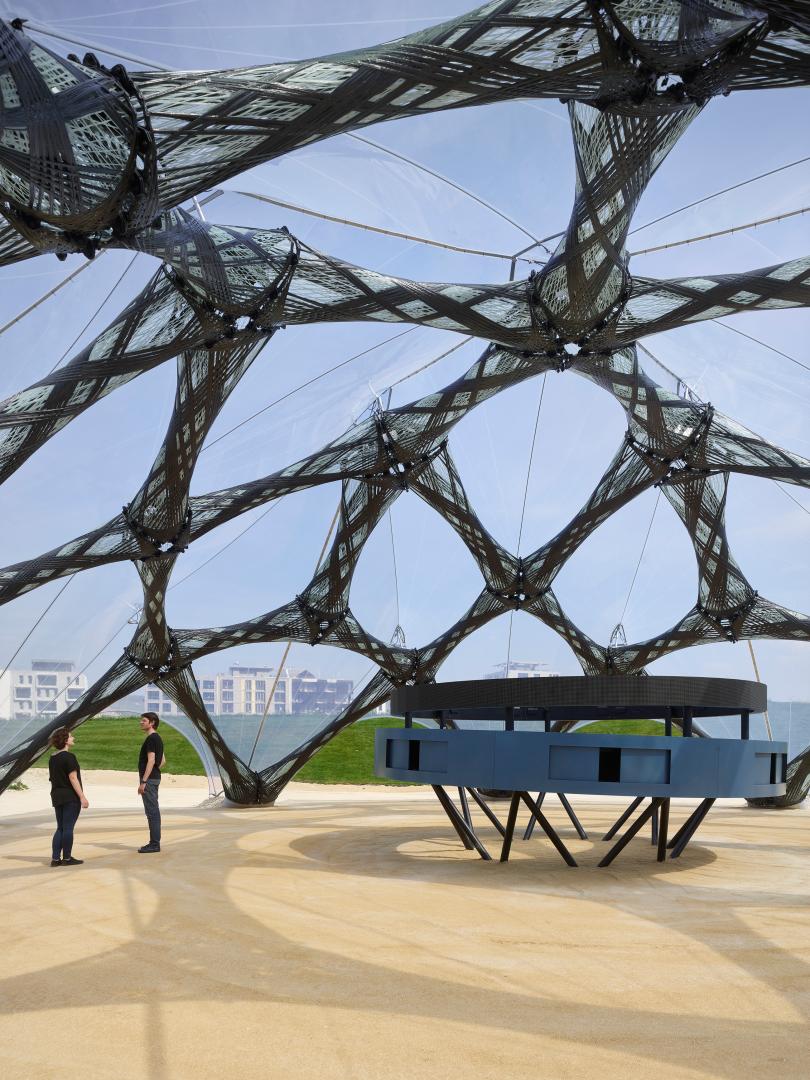
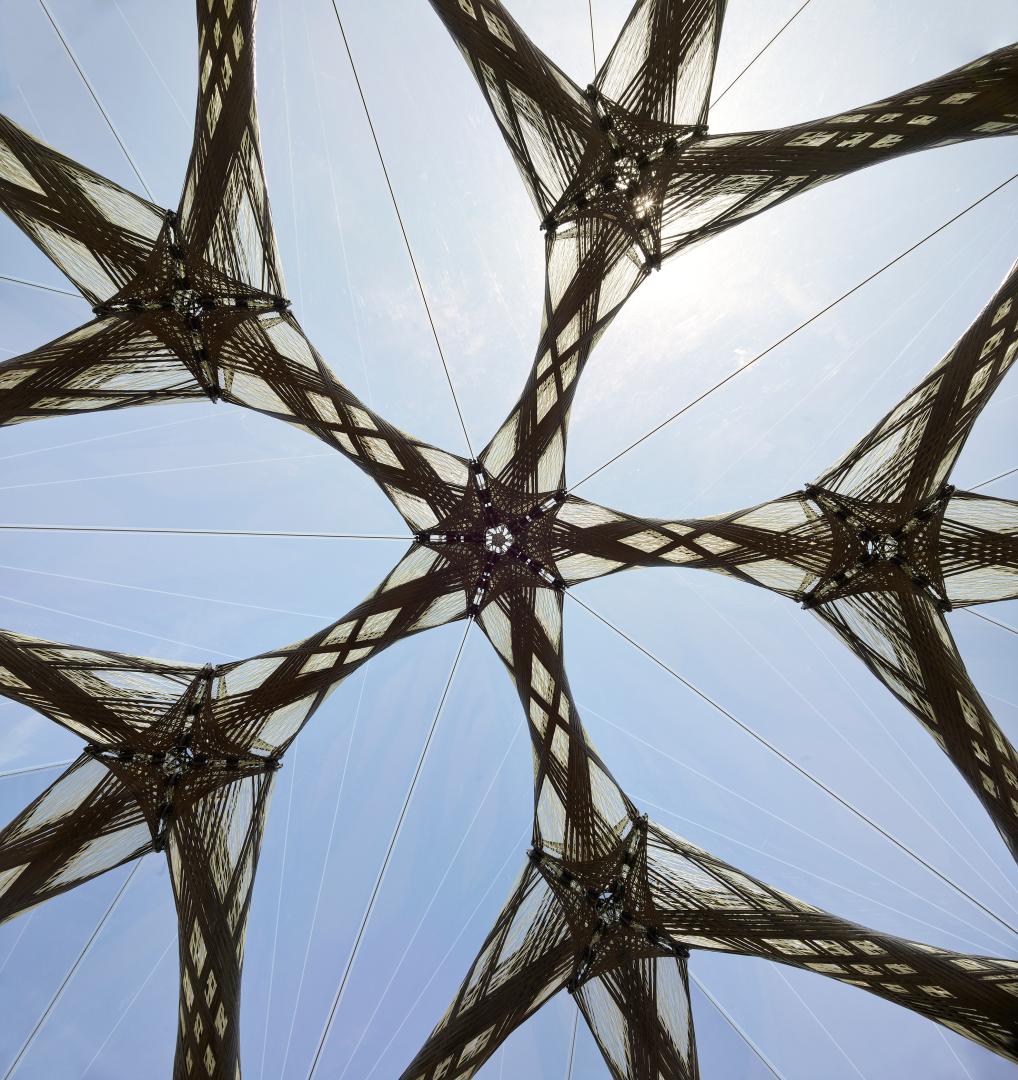
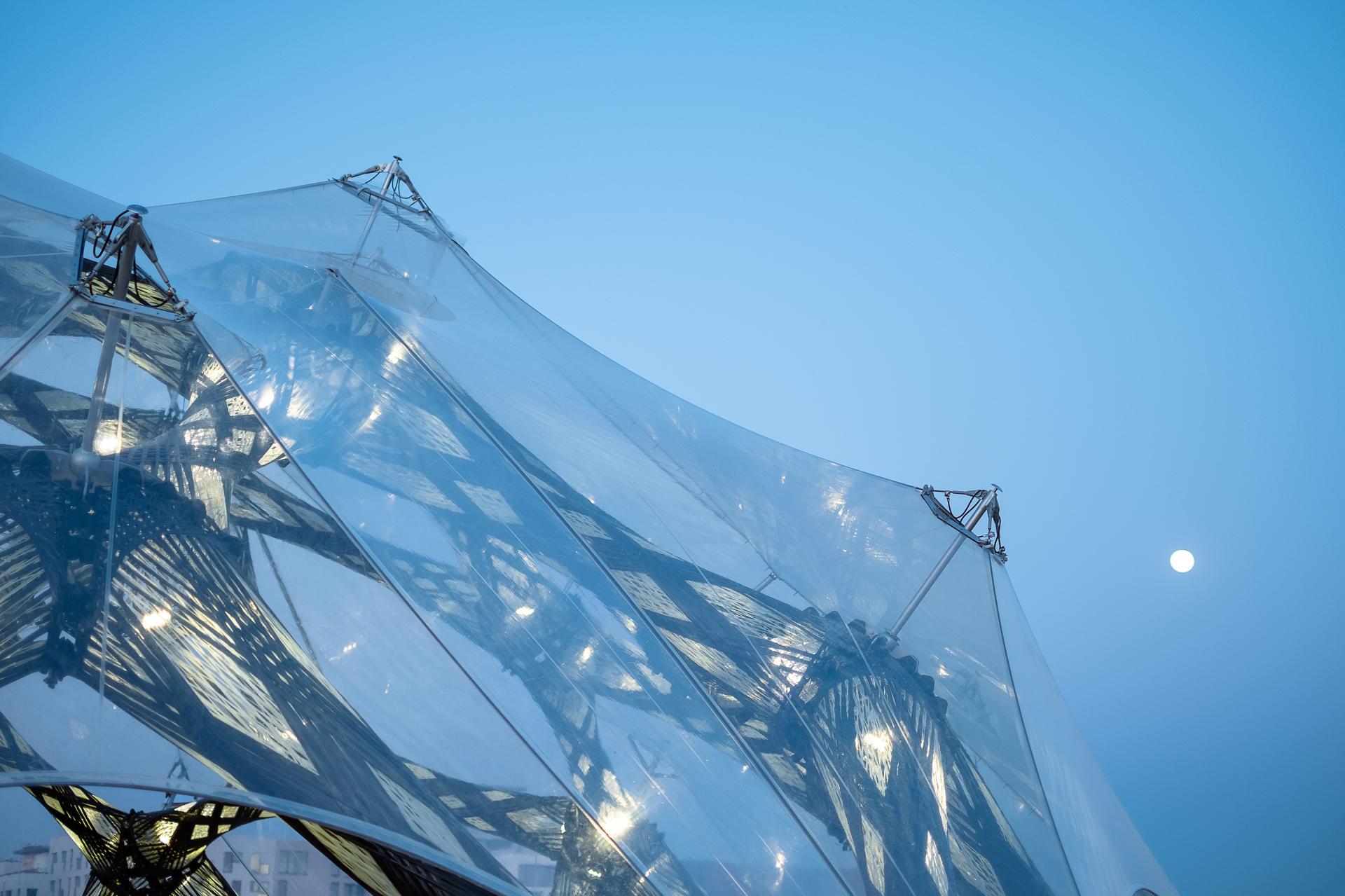
The pavilion covers a floor area of around 400 square meters and achieves a free span of more than 23 meters. It is enclosed by a fully transparent, mechanically pre-stressed ETFE membrane. The primary load-bearing structure is made from 60 bespoke fibre composite components only. With 7.6 kilograms per square meter, it is exceptionally lightweight, approximately five times lighter than a more conventional steel structure.
Instead of a linear workflow, design, engineering and fabrication of the fibrous system were seamlessly interconnected in a collaborative design approach. Component development, structural analysis and fabrication simulation were conducted digitally in a constantly updating feedback loop. Each component`s fibre arrangement, density and orientation were calibrated to strict structural, architectural and fabrication requirements.
Key objectives for sustainability
The astounding performance and unrivalled resource efficiency of biological load-bearing fibrous systems, was the sustainability driver for this project.
In order to pursue this goal, the design methodology had to be steered and adapted to a novel co-design approach. Architectural design, structural engineering and robotic fabrication are developed in a continuous computational feedback, so that the fibre arrangement, density and orientation of each building component could be individually calibrated, structurally tuned and architecturally articulated, while remaining directly producible. Only this innovative approach to design ensures that material is exclusively placed where it is needed.
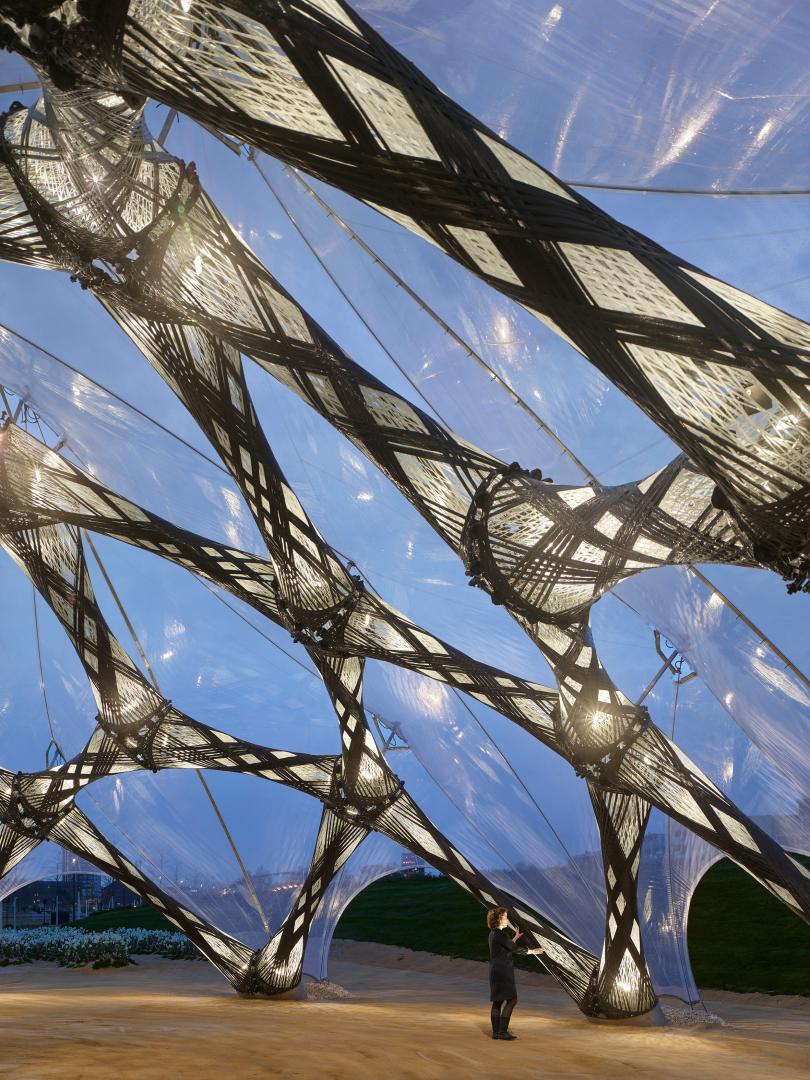
Furthermore, the fabrication method and phyisical setup developed specifically for this project does not generate any production waste or material off-cuts. Each of the 60 bespoke elements is realized through robotic coreless filament winding. This fabrication technique eliminates the need for moulds, as the structurally active component surface emerges from the interaction of freely spanning fibers, and their subsequent reciprocal deformation, while the robotic arm progressively deploys them into the system. During manufacturing, a lattice of translucent glass fibres is generated, onto which the black carbon fibres are placed only where they are structurally needed. This results in highly load-adapted components with a truly distinct architectural appearance. Each component takes between four to six hours to make from around 1.000 meters of glass fibre and 1.600 meters of carbon fibre on average.
Key objectives for aesthetics and quality
The pavilion translates the innovation on a technical level into a unique architectural experience. The black carbon filament bundles, wrapping around the translucent glass fibre lattice, like flexed muscles, create a stark contrast in texture that is highlighted by the pavilion’s fully transparent skin. This distinctive architectural articulation is further intensified by the gradient from sparser carbon filaments at the top towards their denser application on the slenderest components that meet the ground.
The long, slender components around the perimeter of the structure form portals to the pavilion, inviting the visitor towards the inside while at the same time seamlessly extending the interior space into the surrounding grassland of the BUGA garden show. The thin, mechanically pre-stressed ETFE membrane protects the interior from the elements and provides an impressive ambiance to the exhibition on digitalization, housed inside the pavilion.
While most visitors may not have seen anything like it before, the pavilion exposes its underlying design principles in an explicable yet expressive way. Its unfamiliar yet authentic architectural articulation evokes new ways of digital making, which no longer remain a futuristic proposition but already have become a tangible reality.
Key objectives for inclusion
The methodological framework encompassing design, structural engineering, and digital fabrication developed over the course of this project, allows lowering production costs for highly efficient ultra-lightweight composite structures, making them a viable proposal or alternative for the future built environment.
Results in relation to category
In biology most load-bearing structures are fibre composites. They are made from fibres, as for example cellulose, chitin or collagen, and a matrix material that supports them and maintains their relative position. The astounding performance and unrivalled resource efficiency of biological structures stem from these fibrous systems. Their organization, directionality and density is finely tuned and locally varied in order to ensure that material is only placed where it is needed.
The Buga Fibre Pavilion aims to transfer this biological principle of load-adapted and thus highly differentiated fibre composite systems into architecture. Manmade composites, such as the glass- or carbon-fibre-reinforced plastics that were used for this building, are ideally suited for such an approach because they share their fundamental characteristics with natural composites.
Elaborate testing procedures required for full approval showed that a single fibrous component can take up to 250 kilonewtons of compression force, which equals around 25 tons or the weight of more than 15 cars. The pavilion shows how a truly integrative approach to computational design and robotic fabrication enables the development of novel, truly digital fibre composite building systems that are fully compliant with the building regulations, exceptionally light, structurally efficient and architecturally expressive.
How Citizens benefit
The Buga Fibre Pavilion was centrally located on the Summer Island of the Bundesgartenschau Heilbronn 2019 and housed the exhibition “Zukunftskarusell” ("Future Carousel").
At this prominent central location at the Federal Horticultural Show (Buga), it served as a catalyst to attract visitors. It is calculated that more than 2 million people have visited the Buga and have been exposed to the innovations represented by the Buga Fibre Pavilion.
Innovative character
The pavilion is made from more than 150.000 meters of spatially arranged glass- and carbon fibres. They all need to be individually designed and placed, which is very hard to achieve with a typical linear workflow and established production technologies. Thus, it requires a novel co-design approach, where architectural design, structural engineering and robotic fabrication are developed in continuous computational feedback. In this way, the fibre arrangement, density and orientation of each building component can be individually calibrated, structurally tuned and architecturally articulated, while remaining directly producible.
The building components are produced by robotic, coreless filament winding, a novel additive manufacturing approach pioneered and developed at the University of Stuttgart. Fibrous filaments are freely placed between two rotating winding scaffolds by a robot. During this process, the predefined shape of the building component emerges only from the interaction of the filaments, eliminating the need for any mould or core. This allows for bespoke form and individual fibre layup for each component without any economic disadvantage.
The project shows how an interdisciplinary exploration of biological principles together with the latest computational and digital fabrication technologies can lead to a truly novel and genuinely digital fibre composite building system. Only a few years ago, this pavilion would have been impossible to design or build.