SKAIO
Basic information
Project Title
Full project title
Category
Project Description
SKAIO is a 34 m high, 10‐storey timber‐hybrid structure that points the way forward for innovative architecture and future building methods. The building is a pioneer in ecologically sustainable residential construction: all details are planned in such a way that it can be demolished and thus recycled in a single type at a later date.The project offers new approaches in sustainable housing and solutions in view of the major socio-political challenges of the future.
Project Region
EU Programme or fund
Which funds
Other Funds
SKAIO is funded by the European Regional Development Fund (ERDF).
Description of the project
Summary
The Stadtsiedlung Heilbronn GmbH is the oldest still active housing association in Germany and is known to support, initiate, and promote innovative projects. The company is increasingly taking socially relevant topics and developing market-driven solutions. Sustainability and inclusion plays an especially important role for Stadtsiedlung Heilbronn GmbH, as it often is the owner of the properties it builds.
The SKAIO project, in the context of the city exhibition Neckarbogen on the site of the Federal Horticultural Show (BUGA 2019), represents a model for comparable construction tasks in the future.
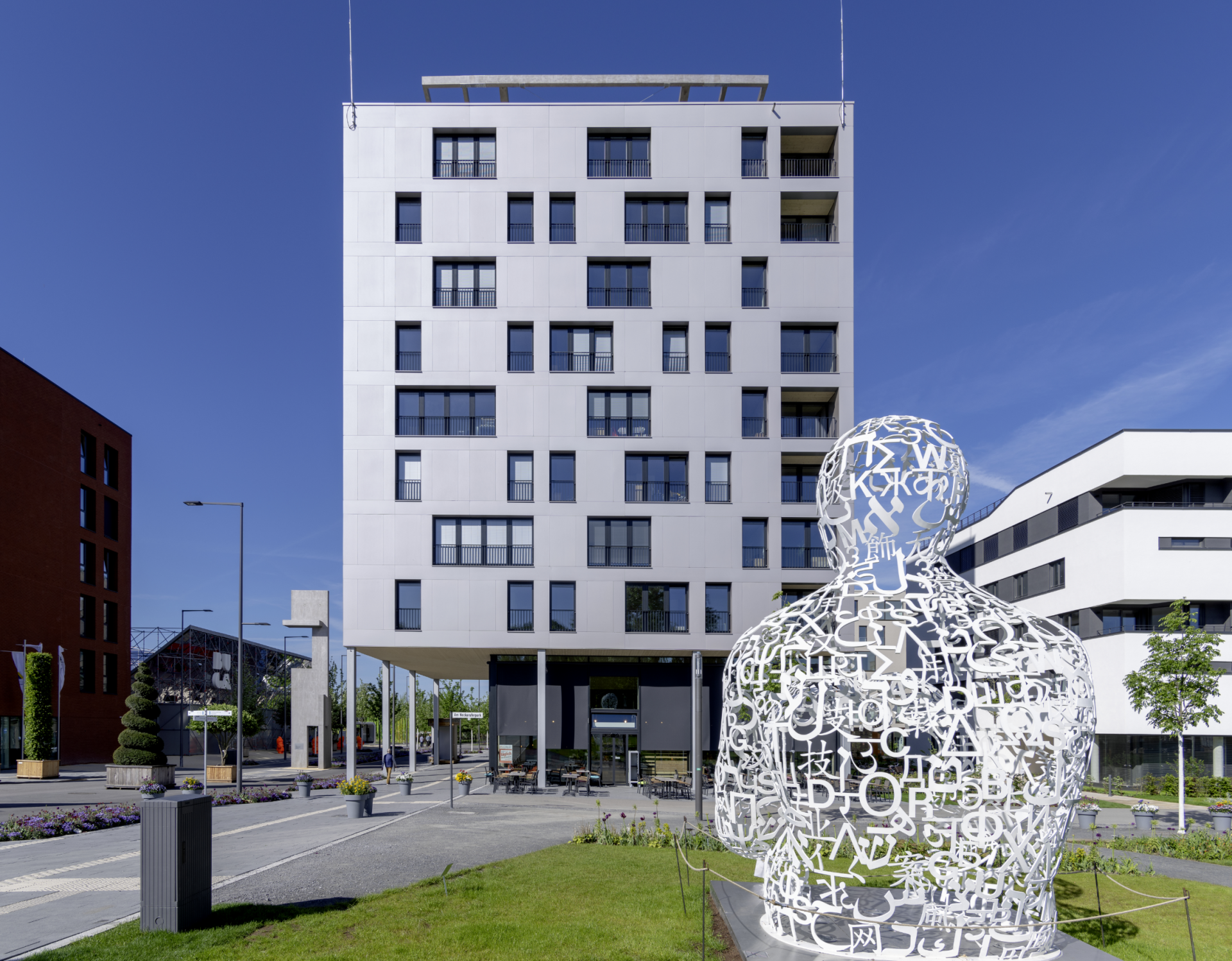
SKAIO is a 34 m high, 10‐storey timber‐hybrid structure that points the way forward for innovative architecture and future building methods. The building is a pioneer in ecologically sustainable residential construction: all details are planned in such a way that it can be demolished and thus recycled in a single type at a later date. SKAIO clearly exceeds the German industry definition of a high-rise building, which specifies as such any building in which the floor of the last occupied storey or room is situated more than 22 metres above the ground. It is the first wood building in Germany to meet this definition.
Key objectives for sustainability
Sustainability
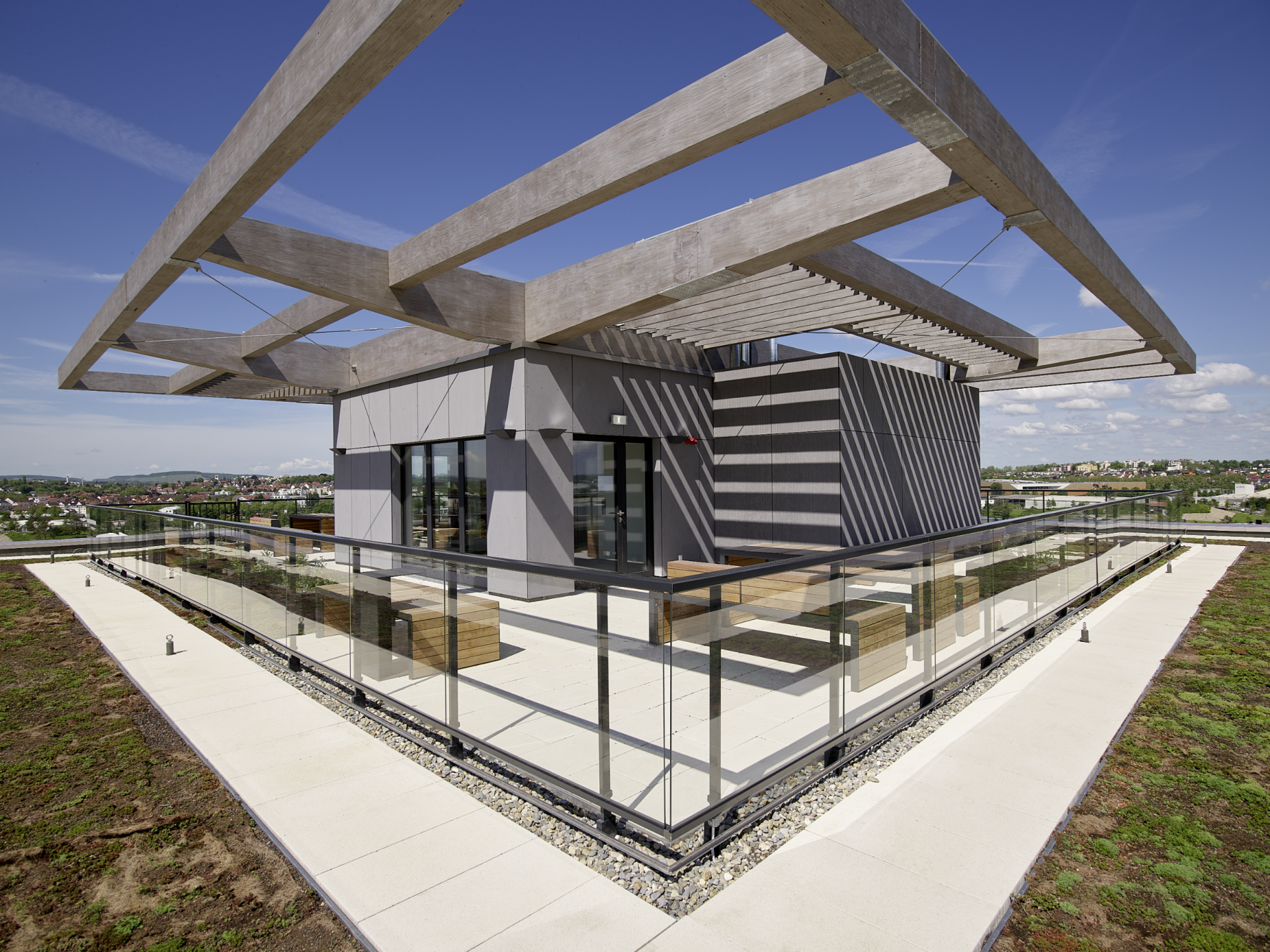
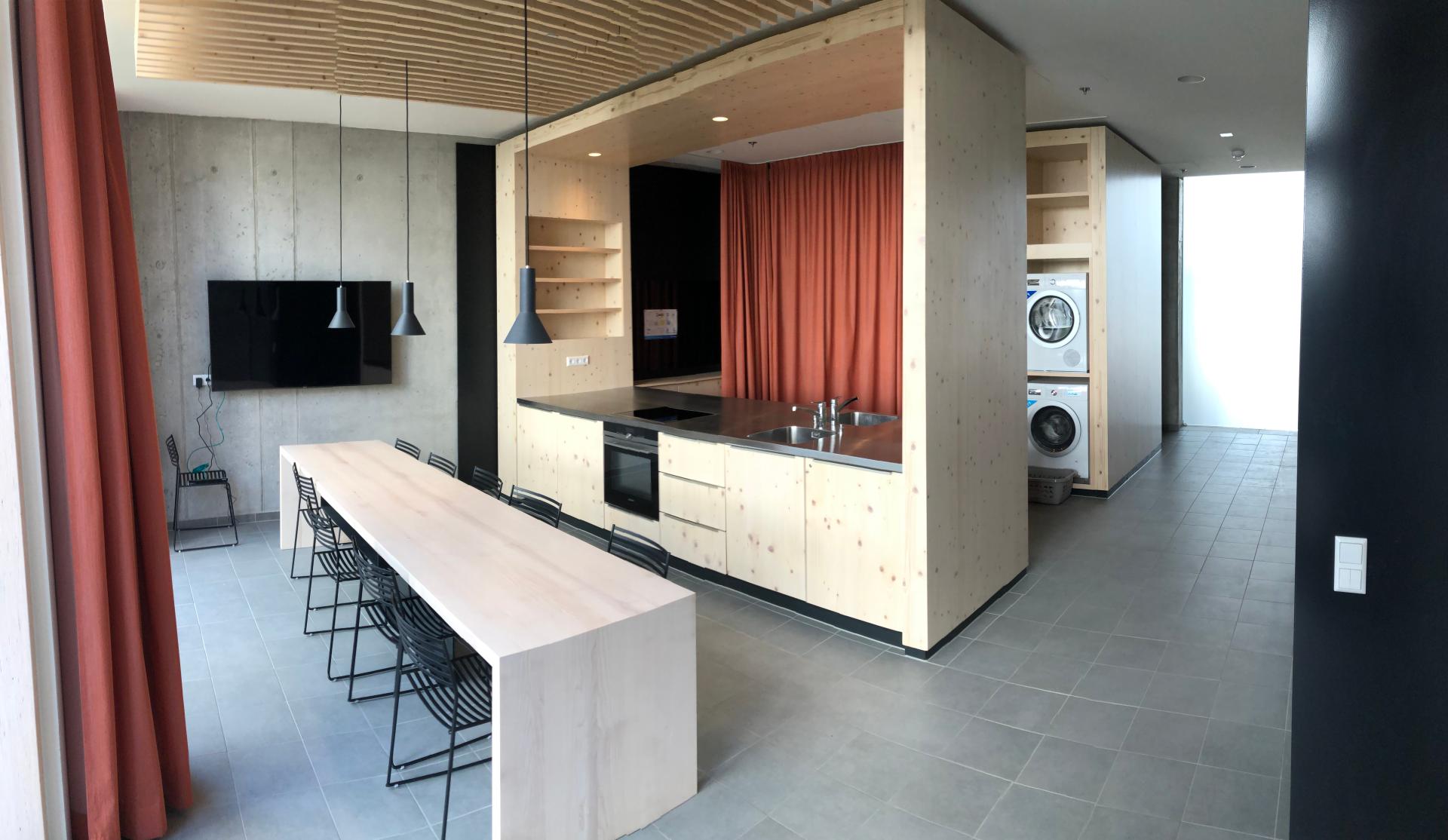
Timber buildings of this size are far from being standard, yet wood is becoming increasingly interesting as a construction material – so too for housing companies. In terms of its life cycle assessment, timber is unbeatable as a material in construction. Every cubic metre of wood used in construction stores one tonne of CO2 that the trees absorbed from the atmosphere during their growth. The building will be nearly 100 % recyclable. This reflects the philosophy of cradle-to-cradle design according to which all material that is used in construction can also be dismantled and recovered. The walls and ceilings of the high-rise building are made of wood, which makes up the majority of the building. Only the base floor and the staircase are made of reinforced concrete, while the façade is clad with aluminium panels on the outside. Above the underground car park, the ground floor features commercial spaces, common spaces - laundry room, communal kitchen - and ample bicycle parking. Common laundry rooms in Germany tend to be rare and save valuable surface area in each apartment. A central core made of reinforced concrete contains the safety-stairwell and an elevator, which allows for barrier-free access to all apartments. While the primary structure in the basement, ground floor, and first floor are made of reinforced concrete, all other load-bearing components are made of wood or wood-steel hybrids. In total, SKAIO comprises almost 1,500 cubic meters (52,972 cubic feet) of certified wood, thus taking a firm stance against issues in the built environment in view of the 2015 Paris Agreement.
Key objectives for aesthetics and quality
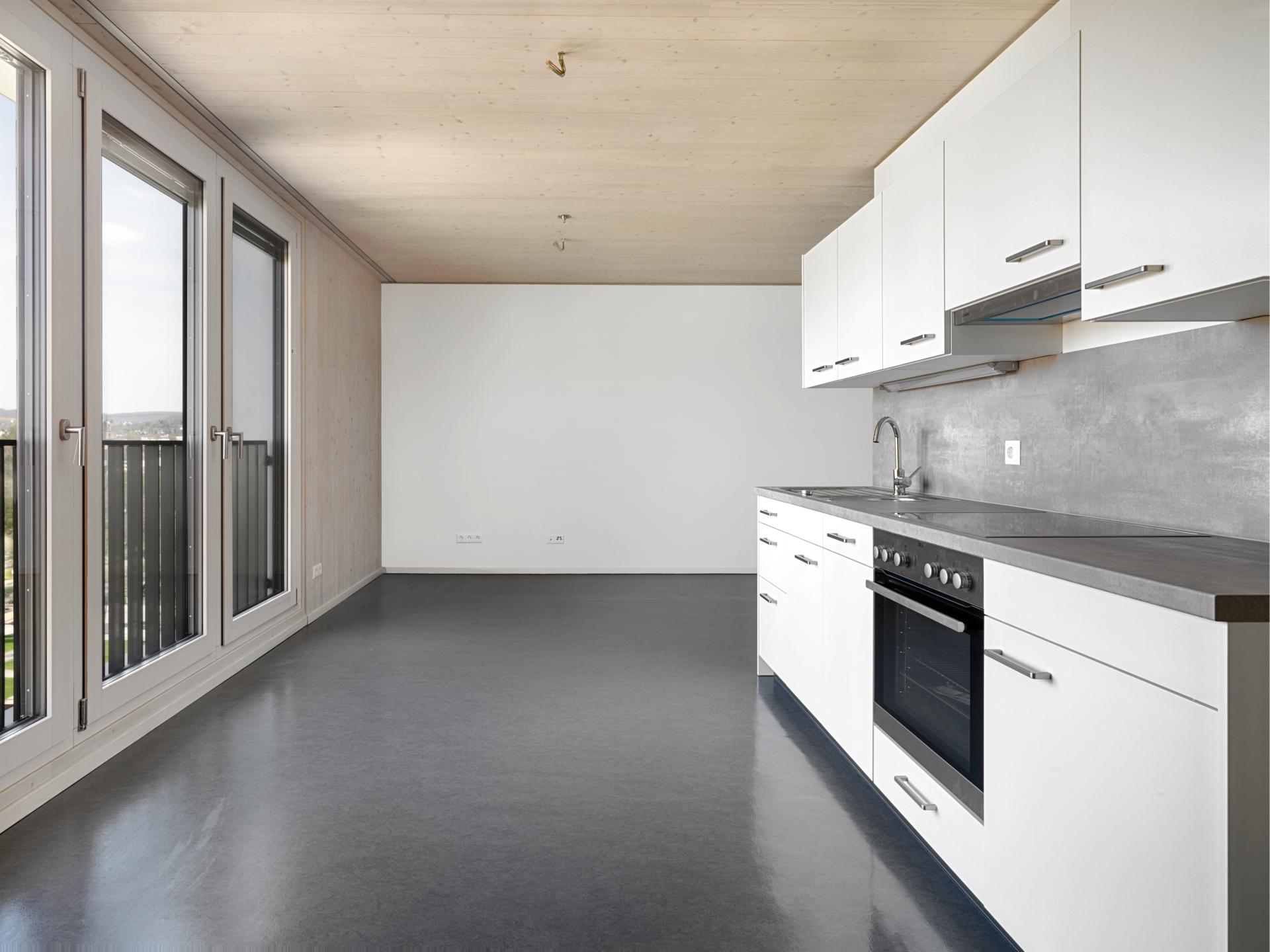
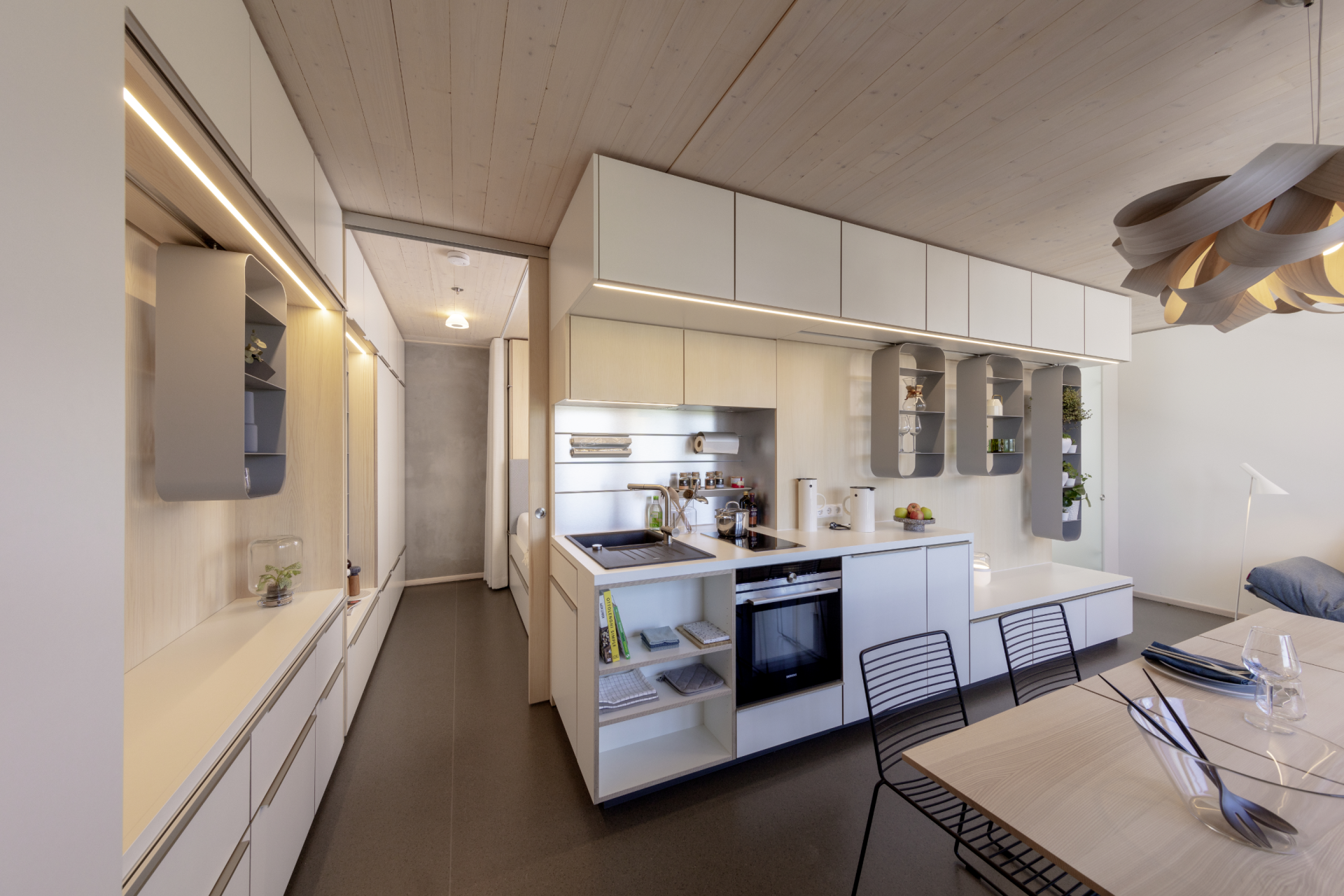
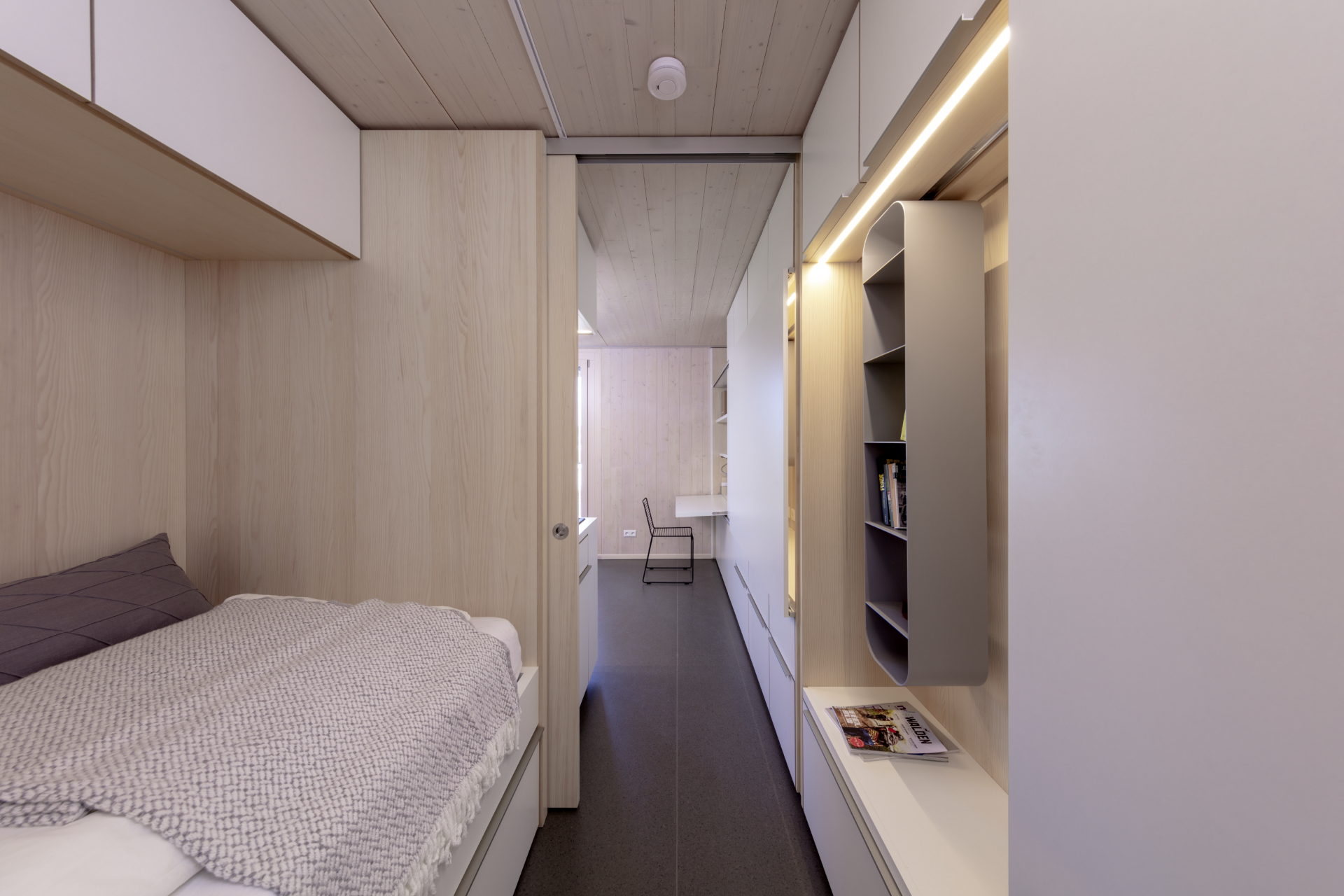
It is not only the height that is remarkable about Germany’s first high-rise built of wood. The building has an organic architecture and makes a statement about people’s need to reconnect to nature, as well as their need for better indoor air and light quality and better social interaction. Loggias and ceiling-high windows without the usual anti-flashover parapets give the bright apartments a high quality despite their compact floor plans. On all 10 levels, the wood material has been left visible on large portions of the wooden walls and ceilings; the sprinkler system and the combination of wood, concrete and steel make this possible.
Key objectives for inclusion
The Stadtsiedlung Heilbronn GmbH is the oldest still active housing association in Germany and is known to support, initiate, and promote innovative projects. The company is increasingly taking socially relevant topics and developing market-driven solutions. Inclusion plays an especially important role for Stadtsiedlung Heilbronn GmbH, as it often is the owner of the properties it builds.
Another innovative novelty for Heilbronn is the building’s tenant structure. With a 50 % share of subsidised housing, SKAIO will not be a luxury high-rise but is intended to attract a colourful mix of tenants from the middle of society. SKAIO offers apartment types that are usually hard to come by in a contemporary city: 56 smaller studios and one-bedroom apartment. These individual units, however, can be easily combined to accommodate future changes in use. In addition, four shared apartments are dedicated to socially disadvantaged members of society, run by two of Heilbronn's social welfare organizations.
Results in relation to category
Timber buildings of this size are far from being standard, yet wood is becoming increasingly interesting as a construction material – so too for housing companies. In terms of its life cycle assessment, timber is unbeatable as a material in construction. The building will be nearly 100 % recyclable. This reflects the philosophy of cradle-to-cradle design according to which all material that is used in construction can also be dismantled and recovered. It has been a declared goal from the very beginning of the project to achieve the highest degree of recyclability of all elements and materials. Its details are designed in such a way that individual elements can be replaced, disassembled, or reused. All components are completely dry and every material can be collected separately. The bathrooms are based on prefabricated self-supporting sanitary units. Its wood construction consequently reduces the carbon footprint in the long term. During the entire useful life of the building (or if elements are reused), CO2 is removed from the atmosphere and stored. Thanks to the use of PEFC-certified timber from sustainable forestry, its carbon budget is balanced. At least as much timber as is contained in SKAIO's structure is reforested. The most far-reaching effect of SKAIO is that the findings from the project were considered in the drafting of the state legislation of Baden-Württemberg (Germany) concerning the use of wood as building material for high-rise buildings. This will facilitate the construction of wooden buildings in Baden-Württemberg in the future.
SKAIO won several renowned architecture awards: German Sustainability Award for Architecture 2020, German Sustainable Building Council (DGNB) Certificate in Gold, DGNB Diamant award.
How Citizens benefit
The SKAIO was a project in the context of the city exhibition Neckarbogen on the site of the Federal Horticultural Show (BUGA 2019). The planning process for the national garden show BUGA in 2019 ran over a period of more than 10 years, with intensive citizen participation. Citizens could participate in the planning of the new quarter from the very beginning and used this opportunity extensively. They were included in all steps of the planning process through information events, workshops, BUGA café events, ideas competitions, townhall meetings, exhibitions, and site tours. The citizens were also involved in a competition for finding the name for the new district. In the summer of 2015, the results of the investor selection process were presented to an interested public in a three-day exhibition open to all and in the form of printed documentation.
Innovative character
SKAIO therefore does not stand on its own but is part of a comprehensive future-oriented urban development concept: compact, space-saving and - as a result - affordable; with a carefully devised mix of uses and users and intelligent layouts in the residential units. All with the aim of testing the limits of what is feasible in timber construction. The SKAIO project represents a model for comparable construction tasks in the future.
- First wood-hybrid high-rise building in Germany
- Sustainability as an accompayning element during design, future deconstruction integrated into design
- lighthouse project demonstrates efficiency of timber construction
- 10 storeys, 1,500 m3 of wood, sequestration of 1,500 t of CO2
- strong focus on diversity and inclusion
- flexible layouts
- high degree of prefabrication
- only spruce wood is used for the wooden walls and ceilings – mainly from German forests and all of them bear the PEFC certificate, the seal for sustainable forestry
- extinguishing system: high pressure water vapour extinguishing system
- SKAIO is the model for future building and living standards