Let landscape educate the coming society
Basic information
Project Title
Full project title
Category
Project Description
“The future architecture will be green or won’t be”.A path is set to achieve this responsible lifetime tattoo by engaging coming generations with a gathering space placed at the heart of the community erasing the actual boundaries between nature and architecture.
Project Region
EU Programme or fund
Description of the project
Summary
At the end of the 19th and beginning of the 20th century, Trapagaran developed exponentially thanks to the iron ore mining that provided the requested iron to the factories at Bilbao.
The inhabitants split their time between agricultural, cattle raising and mining activities, this last one greatly contributing to the regions development as local iron was exported all over Europe. During the first world war the iron extraction became no longer profitable, and the town was forced to shift from mining to an industrial development, increasing local population and attracting foreign capital. The last settlement created two geographical realities: the lowest area with big factories, schools, services and most of the population, and the high lands, a vast green landscape of abandoned mines conquered by nature. This social disruption created an alienation from traditional ways of living banishing local dwellers and the strong natural surroundings.
After a century, two world wars, few global crises and one global pandemic, there is a call for new social gathering spaces where people are allowed to mingle again in a safe environment and in close relation with the verdure. It is aimed to create a device to reconnect the local landscape’s identity with the challenges of the 21st century’s society.
Key objectives for sustainability
The construction sector uses more energy than any other one and is a growing contributor to CO2 emissions, it consumes 40% of global energy annually, it generates 20% of global greenhouse emissions and consumes 40% of the raw materials globally.
Therefore, the main goal is not to implement great technological solutions but to inspire locals with a livable, sustainable, resilient and affordable spaces contributing to city-wide resilience. Three main axes will be developed through the project:
There is a reduction of greenhouse gas emissions by using an aerothermal heating system, achieving performances of up to 700% and taking two-thirds of the energy that it would need directly from the air. The electric energy consumption will be reduced to one third.
Furthermore, the massive wooden shelter structure and the soil surrounding the building will add resilience and extra insulation protecting the building from temperature variations. The CLT construction results in substantially fewer greenhouse gas emissions than any non-wood materials, and once the building is no longer required to be in use its entire wood structure might be recycled, encouraging circular business models. The massive wooden prefabricated construction will also prevent from wasting materials on site by only bringing the necessary resources.
Lastly, implementing water and waste management will be achieved with the vegetal rooftop, collecting and redistributing the water between the public toilets and green areas, avoiding extra water consumption.
Key objectives for aesthetics and quality
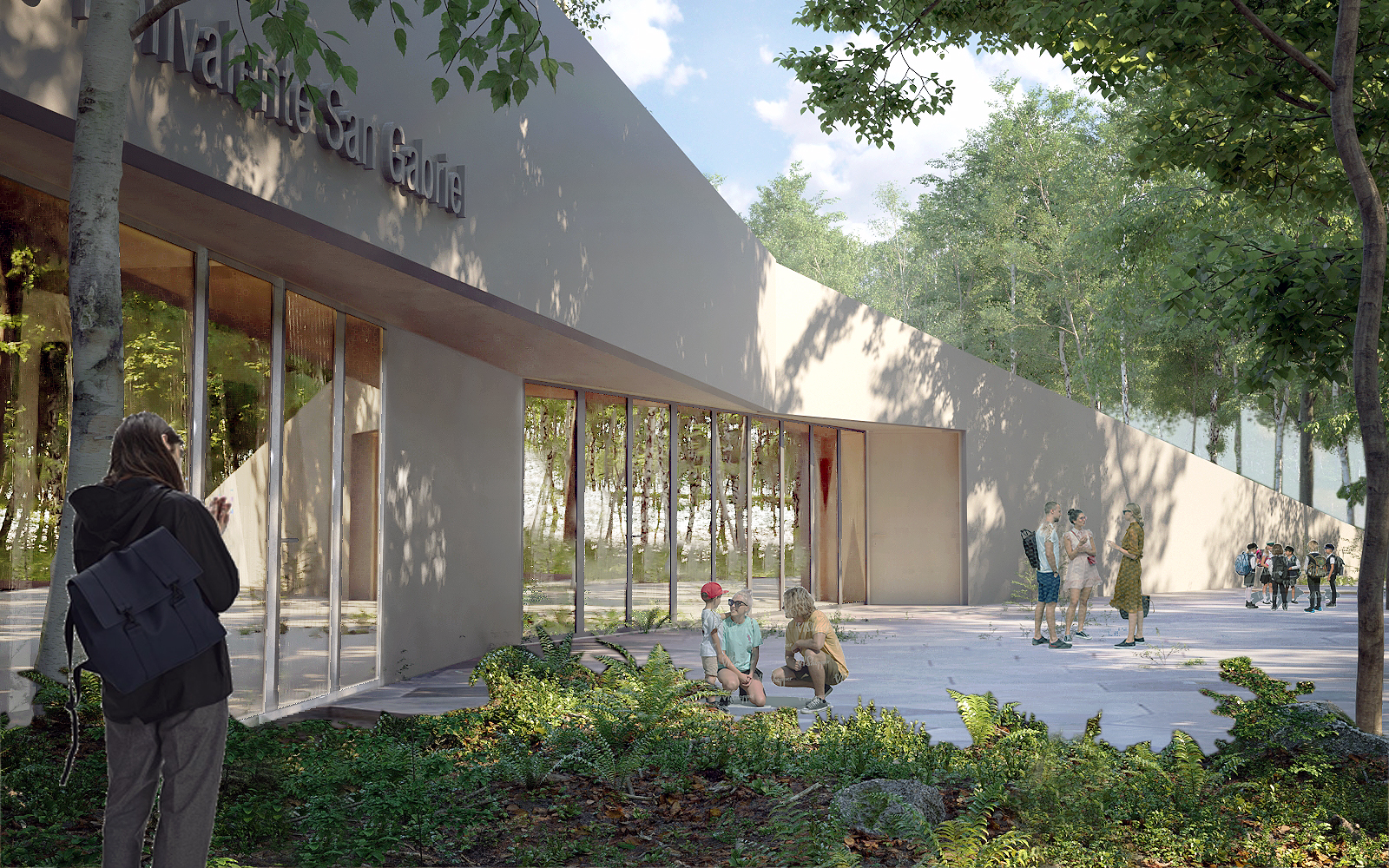
Inspired by local landscapes, the aesthetics of the project aim to bring references of the historical heritage from the highlands to the lowlands, reproducing the archetype of the cave that had great significance in this mining area.
Following the logic of an honest architecture that is shown as it is, a global response is given, proposing solutions that in addition to working constructively generate aesthetically interesting spaces.
On the outside, the implantation of the program together with the green roof aim to merge the building with the landscape, while on the inside, a sober solution is sought in which the structural wooden elements provide warmth to the interior open spaces. All of this takes the quality of experience one step further, uniting tradition, local resources and sustainability.
Key objectives for inclusion
The area of intervention is located at the meeting point of three different realities: an educational, a sociocultural and an urban area. This encounter generates a complex relation giving place to a unique space that has the vocation of bringing different people together with a transgenerational logic.
The program rises from the ground giving shape to a public space that seeks to fulfill its fundamental role to connect. The goal is to create a place without barriers, that blurs the boundaries between nature and constructions, and therefore between the inner space and the square, all understood as a global scheme to bring together the community around this agora.
The flexibility in the design supports the inclusive philosophy kept in mind thorough the process. The building is designed to cater to each person’s specific needs- disabled or not. The program is placed all in one level avoiding architectural barriers. In addition, the building contains no visible structural elements that may hinder the circulation of users. This results in a flexible and accessible layout that encourages ease of movement.
Innovative character
Trapagaran has a unique spirit and customs that have been carefully molded over time. Every single stakeholder has taken part in shaping the landscape, which has become an invaluable asset. When building for the future, it is essential to take a step back and rethink which values make up this custom that is so unique. Great care must be taken in preserving the culture and enhancing the local experience by adaptive environment shaping space through its users, in order to create a place of reference to attract a great variety of people of all ages. This broad spectrum will allow to draw creativity and ideas from the young minds, and wisdom and expertise from the experienced. The new development must be iconic, original and serve as a teaching instrument for the future generations.
The objective is to set a new local benchmark for its multipurpose services and a shared infrastructure. The intervention seeks to continue to share the holistic inclusive, sustainable and learning experience approach, with the hope that the shared ideas and innovations will inspire others to think outside the box and perhaps even choose “unconventional” solutions by vanishing the boundaries between the built environment and nature for the benefit of both: their creations and ultimately, the society.