FROM THE FRINGES TO THE CITY HEART
Basic information
Project Title
Full project title
Category
Project Description
SANTERAMO CITY, APULIAN LANDSCAPE, ITALY. LAND OF ALTA MURGIA NATURAL PARK.
THE DESIGN PROPOSAL CONSISTS IN THE RAVAMPING OF THE CITY AND THE CITIZENS OF SANTERAMO, PROVIDING A DYNAMIC CO-DESIGN IN ALL THE FRINGES OF THE CITY AND ACTING ON THE PUBLIC SPACES BETWEEN CITY AND COUNTRYSIDE WITH 3 MAIN ACTIONS
- REGENERATING PERI-URBAN LANDSCAPE AND PUBLIC SPACES
- VALUING HISTORICAL LANDSCAPE AND RURAL ARCHITECTURES
- REGENERATING ABANDONED BUILDINGS
Project Region
EU Programme or fund
Description of the project
Summary
The design proposal aims at creating a new alliance between man and nature, revamping the city and the citizens, through different actions at different scales that fully produce contemporary agro-urban scenarios in terms of beauty, sustainability and inclusion.
Peri-urban area.
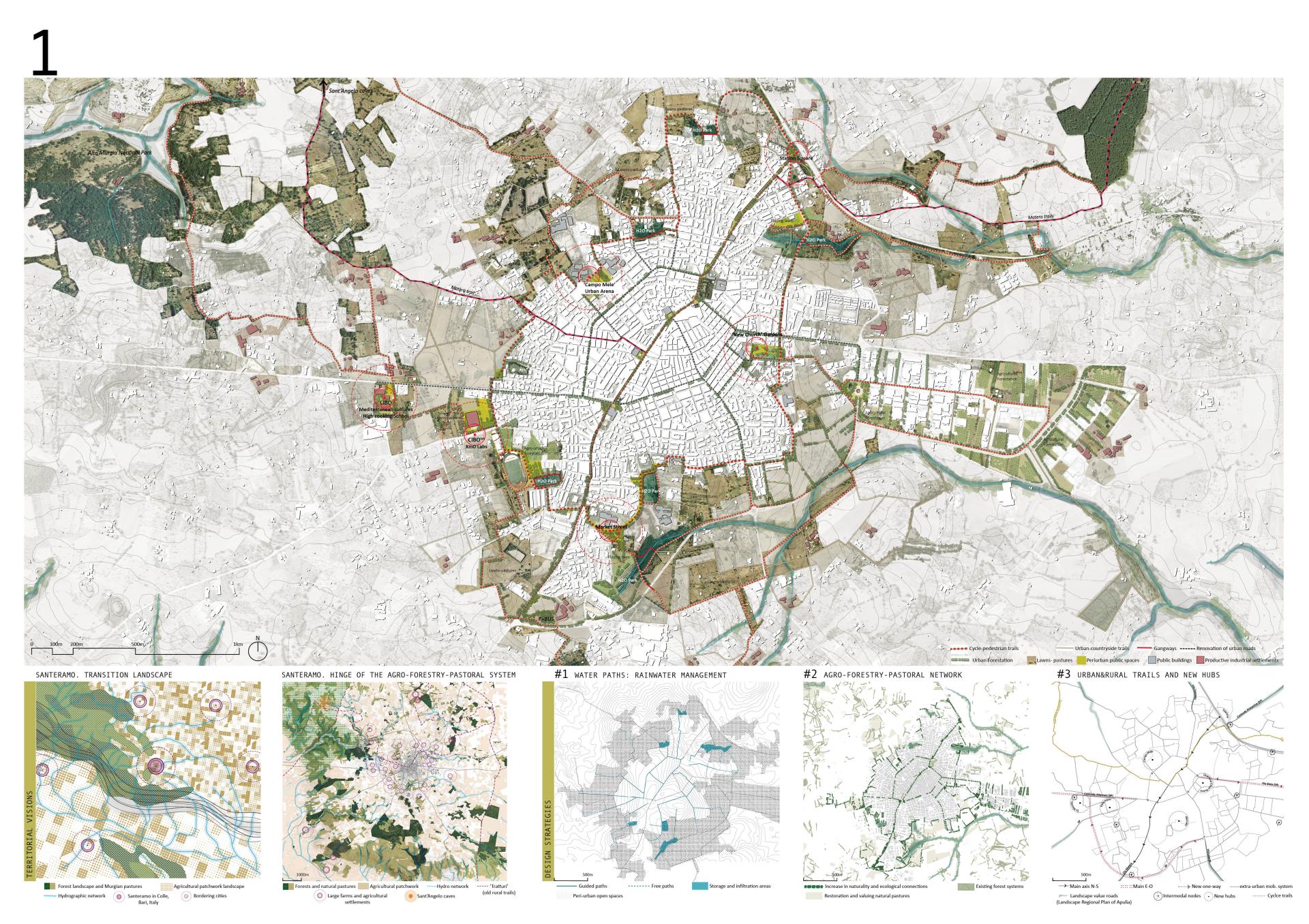
Concept. Definition of a peri-urban ring around the city that has two functions in two different but strictly integrated spatial directions.
- Circular direction: connecting the new public spaces all around the city - urban arena, sports fields, restored buildings – with natural element that are 'H20 parks', lawns-pastures, forests.
- Trasversal direction, being the connection between city and countryside. Strengthening the four city halls, citizens and tourists can enter the city enjoying the high quality peri-urban public spaces.
Water system. Integrated rainwater management strategy intended to maximize water retention and facilitate rainwater reuse. The water is stored and filtered for urban rain-gardens and for the growth of new ‘H20 parks’.
Trails and new Hubs. The design proposes a new slow-mobility network that lets people understand the value of old rural paths connecting the city to the countryside and enjoying the new walking routes through which citizens and tourists can walk from the deep countryside to the main square of the city and beyond.
Urban sites.
Walking on new high-quality paths all around the city, people will find
- The building 'CIBO/ High School of mediterranean-cultures Culinary Arts ' that will train new food operators, passing on the long-standing cooking crafts to the new generations, renewing them thanks to the creativity and innovation of the model business (food design). [WEST]
- The building 'CIBOlab/ Km0 Labs', a center for food production as a cooperative cheese factory to support the growth of producers in the area. [WEST]
- 'Campo Mele' urban arena [NORTH]
- 'Street market' [SOUTH]
- 'New Church' gardens [EAST]
Key objectives for sustainability
- Environmental sustainability. Santeramo is not just for people. Based on 11 principles for climate, biodiversity and health, the peri-urban system of Santeramo has been designed as an urban ecosystem through re-forestation actions and water collection system. Exploiting the different slopes of the city, the design makes the new rainwater storage system structuring and smart: the water is stored and filtered in water collection areas in a circular economy approach. Part of this water is used to water new gardens or to encourage the growth of new plants in these so called ‘H20 Parks’ all around the city. To use the rainwater as efficiently as possible, the water becomes a playful element in the squares; it lets new gardens grow; it provides cooling and with the plantation of new trees it contributes to a sustainable new ecosystem against climate change effects.
- Social sustainability. Creation of new professionals strictly linked to traditional crafts such as: cheese production, animal farming, mediterranean culinary arts. In this way, the city of Santeramo becomes a city in which young people can study, train and live their successful life. At the same time, the city turns into a regional point of convergence for food industry and wine-food tourism.
- Economic sustainability.
- Reuse of two abandoned buildings to fight land consumption;
- Through the cooperative cheese factories, local milk producers can sell and transform their products for an equal and fair price and gain all the Europe food regimes such as “protected designation of origin” (PDO), “traditional specialities guaranteed” (TSG), “protected geographical indication” (PGI).
- Sheeps eating pastures take care of green space and, at the same time, they are row material for the Cooperative cheese factory and for the High School Culinary Arts.
Key objectives for aesthetics and quality
Respecting the 3 main actions of the project design, the fringes of the city will become beautiful places in terms of quality of space. The colors and sounds of natures will break the anonymous grey barrier between city and countryside. The peri-urban spaces will turn into meeting and leisure places.
More specifically, 'beautiful actions' are provided for
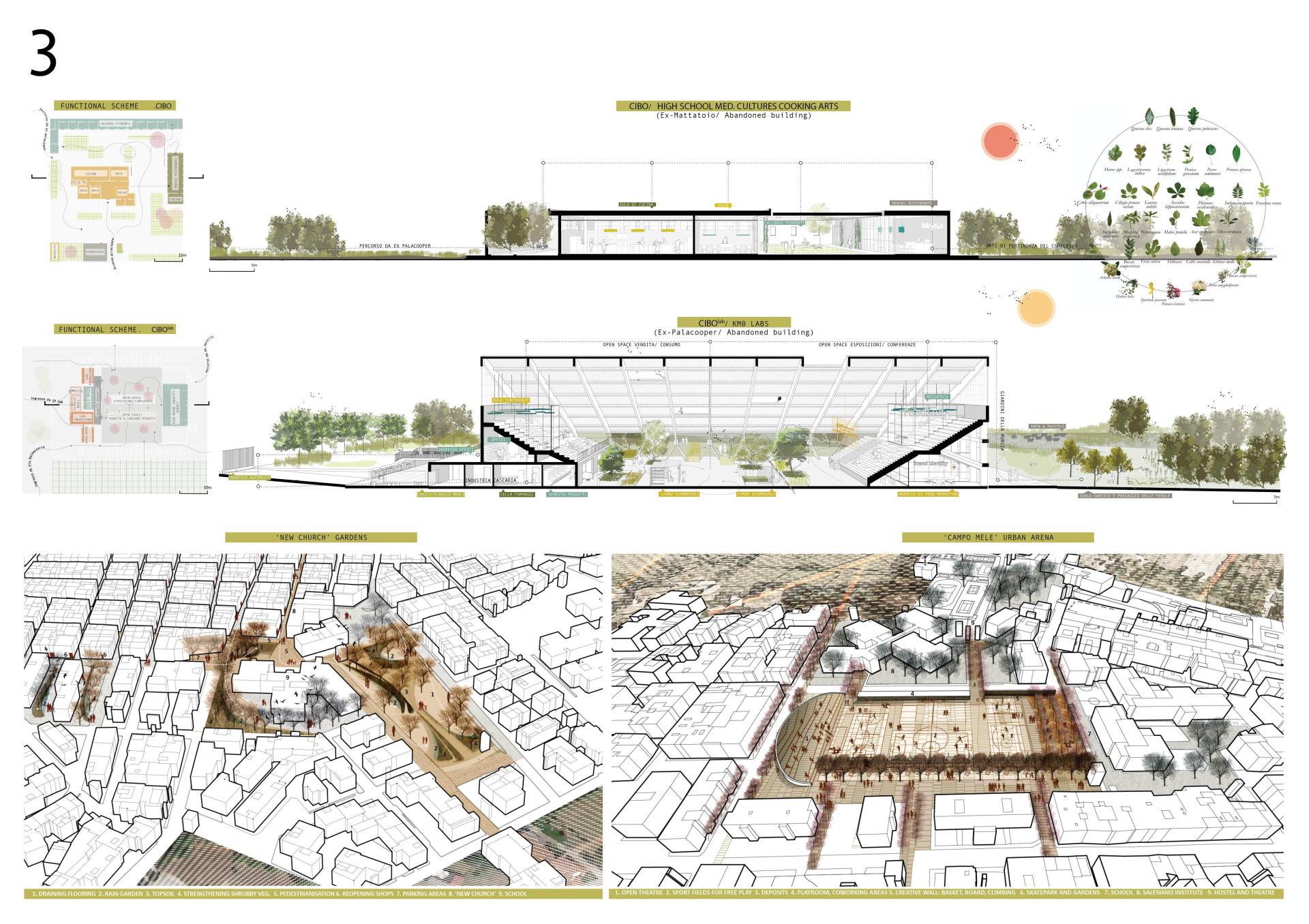
- Architecture. Through the demolition of perimetral walls, the former sports arena and now ‘CIBO. Km0 Labs’ consists of a covered plaza that lets landscape enter with plants and local shrubbies: in this way its function meets aesthetics values.
- Open public spaces with people, services, colors, sounds, sports, arts. ‘Campo Mele’ urban arena will turn into a permeable space open and connected to the sorroundings viability. This space keeps the old sports vocation integrating multiple public activities (open theatre, design co-working areas, creative blackboards, skatepark, relax area with new gardens – img.3 ). Old citizens and young people can enjoy a colorful square, with an ever-changing design that is open and changeable. Furthermore, the new design for the 'street market' keeps the market function with public services function together, producing new colored scenarios. In addition to this, lots of periurban parks will live the new biodiversity that will be realized planting several species of trees, with the new rainwater system that will produce new sourroundings with high quality natural scenarios and new natural sounds. Following point 2, 'New Church' gardens will become lush gardens entering the east of the city.
- H20 Parks. These parks are ecological resting places on the edge of the city. Nowadays they are wild and people tend not to appreciate their value. After the recognition of these 'green lungs', new plants will grow inside and rainwater collection tanks will be designed. People will be able to cross these lush spaces and relax.
Key objectives for inclusion
Reconnecting people with nature, the design approach aims at stimulate different levels of inclusive nature experience in urban environment, using the high potential of the countryside. From now on, the city and the countryside will no longer be opposed. Far from this opposition, farmers and citizens can meet in these peri-urban inclusive fringes and participate in mutual qualities, exchanging knowledge. The fringes of the city are no longer seen as limits or as somewhere where men stopped to build, but as mediation borders where all the citizens can live and spend time, far from high city noise.
More specifically, the design is inclusive both physically and socially because
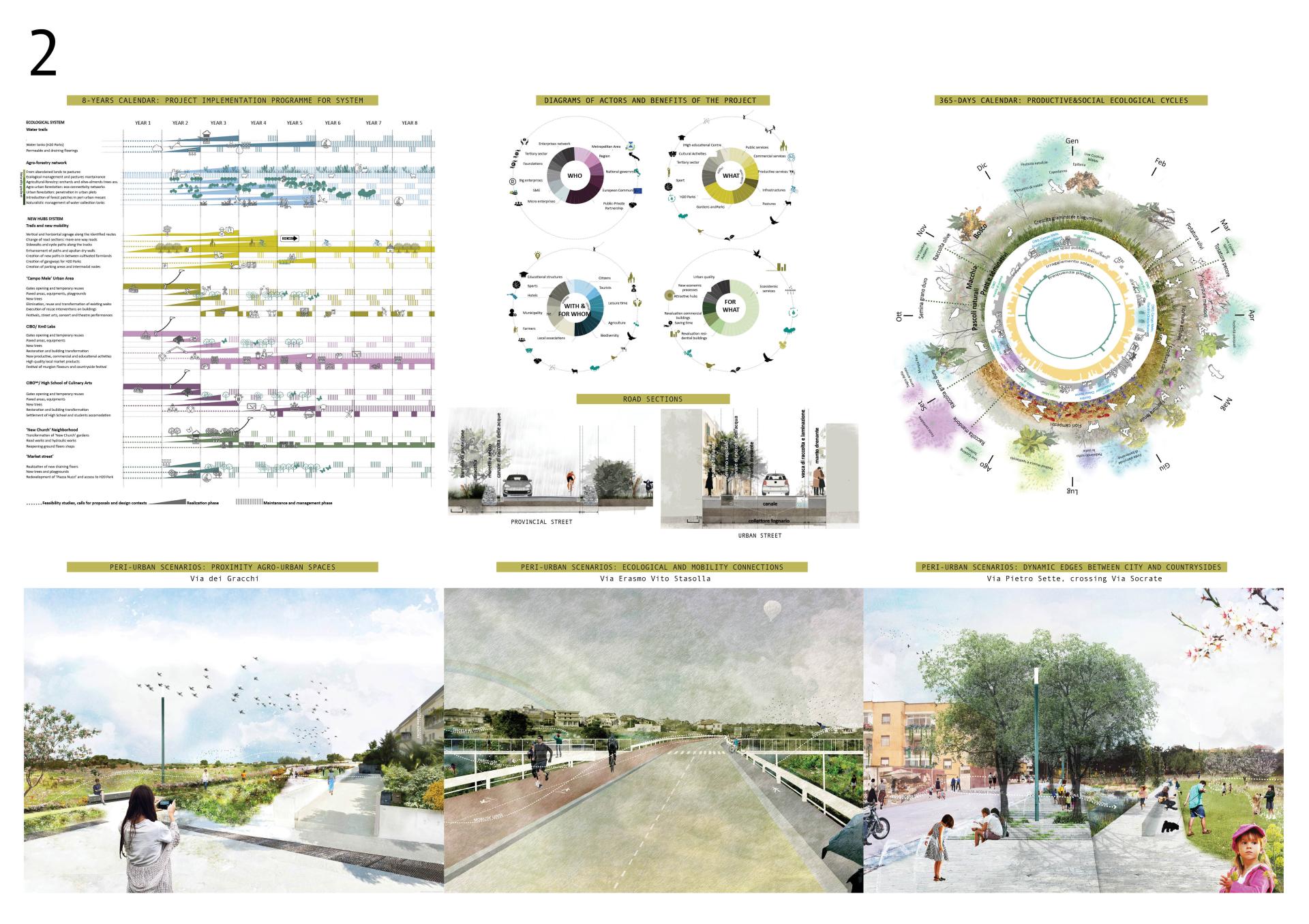
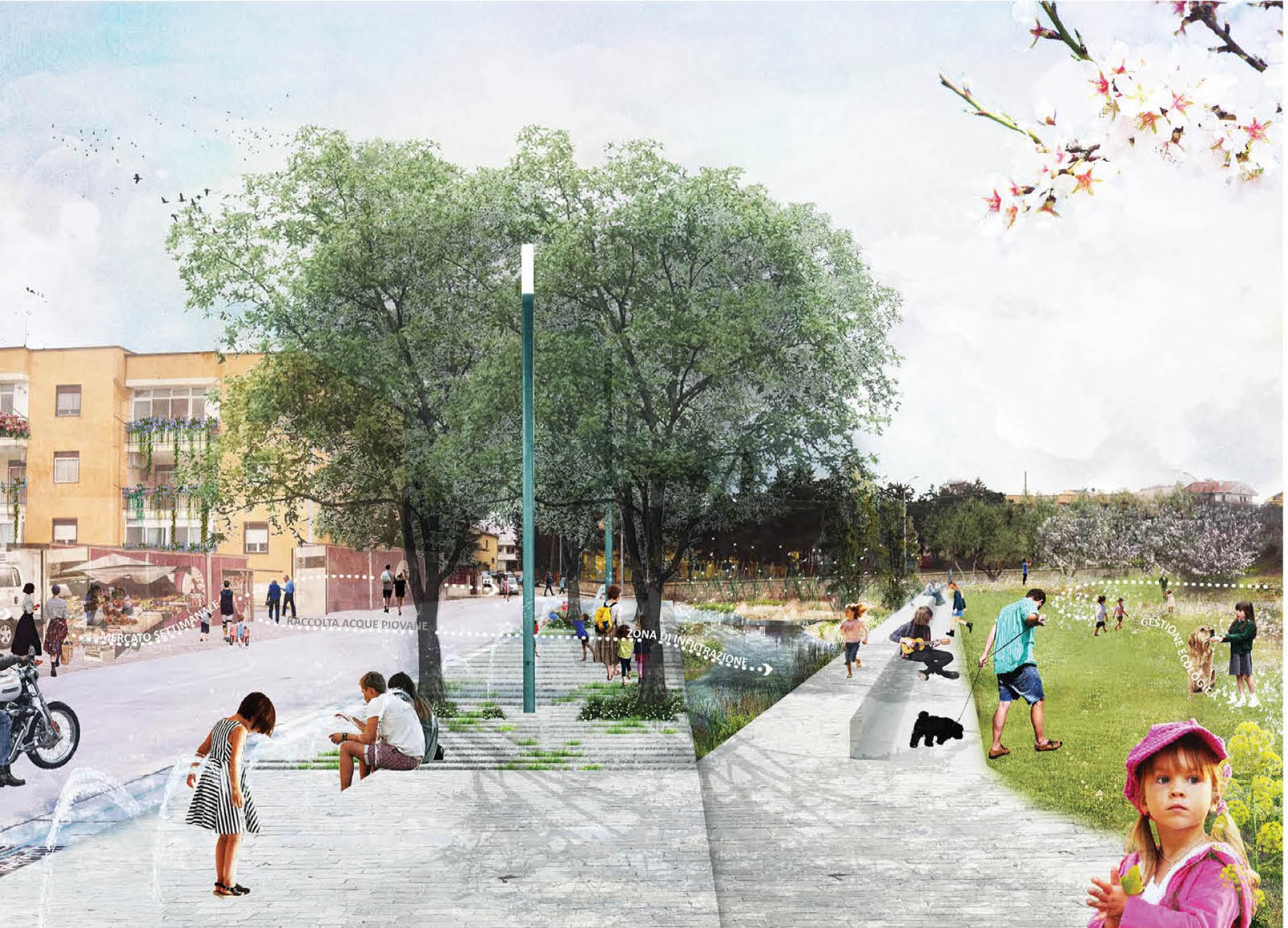
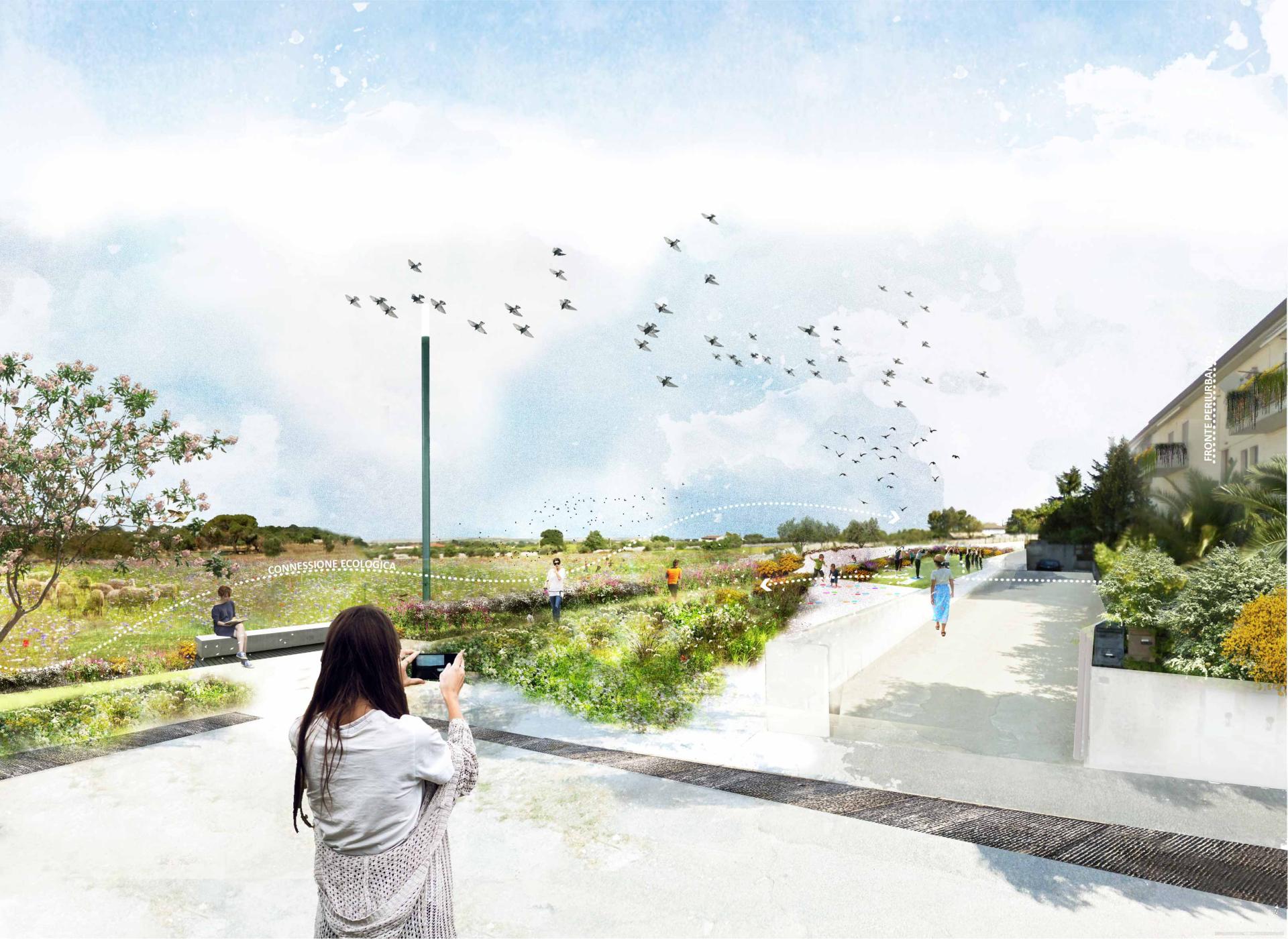
- Citizens living in the fringes of the cities can enjoy new peri-urban scenarios through beautiful agro-urban spaces with small equipments such as seats, floorings, new local plants that mediate the passing from built environment to countryside (img. 5). From being anonymous, grey and unsolved places, the peri-urban fringes turn into livable places to spend time and meet people.
- The new slow-mobility system with cycle and pedestrian trails encourage citizens and tourists to enter or exit from the city with bicycles, and not necessarily with cars, being able to contribute to the reduction of air pollution (img. 2 below: 'Ecological and mobility connections').
- In urban space, the project design for ‘Campo Mele’ breaks high walls all around former football pitch, transforming the urban arena in an open space connected to the city. In the periurban areas the project design breaks smalls walls that nowadays separate city and countryside, in order to connect the two dimensions and to create a continuous space both physically and functionally (img.4)
Innovative character
The project operates in full respect of nature cycles, following a systemic logic organized for phasing, clarifying actors and benefits (at the top of img.2).
The transition landscape project goes beyond the double relation between city and countryside, between urbanity and agriculture, between citizens and farmers, including forests and pastures as third part of this agro-forestry-urban mosaic that explains the transition in an ecologic and economic way.
In Apulian urban contexts, thare are still lot of urban realities with predominant 'grey space'. This project is innovative and contemporary because besides respecting all the European design parameters for a good design of an healthy city, reaches high standards of beauty combining natural components with urban functions.
More specifically, this design is innovative in
- Techniques. Permeable surfaces and rainwater collection system;
- Functions. Mixitè of functions encourage citizens and tourists to meet, stay and move around. The project design aims at creating spaces with multiple functions through the day. For instance, the reused building ‘CIBO. Km0 Labs’ hosts at the same time a productive factory, a food exposition center, a learning center, a brand identity food agency and an open square. In this way, the building is used in different times of the day and throughout the year.
- Vegetation. New plantations to stimulate biodiversity are realized with 100% indigenous plant species. The criterium is not to plant the same species but to enrich biodiversity.
- Public spaces. The project design aims at producing ever-changing spaces. For instance, ‘Campo Mele’ urban arena has been for a long time just a simple football pitch. It will be thoroughly renovated and would be able to host art exhibitions and local festivals. The new 'Campo Mele' forms the largest and funniest city square in Santeramo. Besides being a social connector, it will become a beautiful meeting place.