Utopee
Basic information
Project Title
Full project title
Category
Project Description
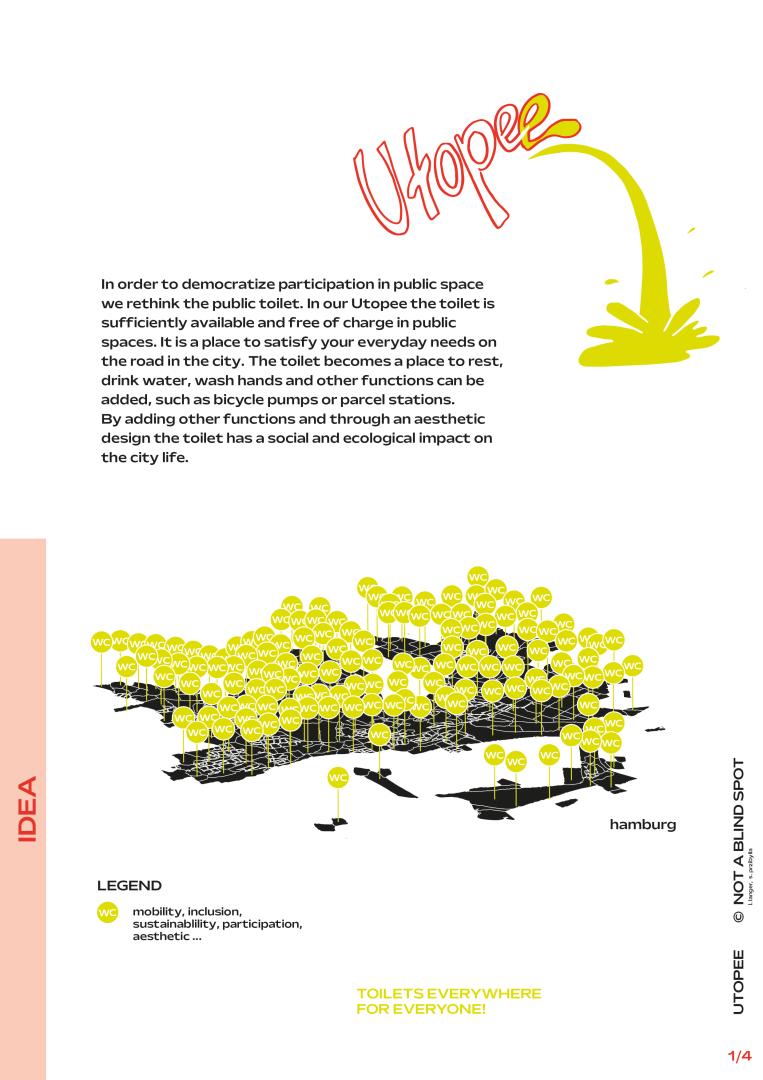
In order to democratize participation in public space we rethink the public toilet. In our Utopee the toilet is sufficiently available and free of charge in public spaces. It is a place to satisfy your everyday needs on the road in the city. The toilet becomes a place to rest, drink water, wash hands and other functions can be added, such as bicycle pumps or parcel stations. By adding other functions and through an aesthetic design the toilet has a social and ecological impact on the city life.
Project Region
EU Programme or fund
Description of the project
Summary
Public toilets everywhere for everyone to ensure participation in public space. – What does the most natural human need have to do with a sustainable, aesthetic and inclusive idea? Isn't the idea of building free and clean public toilets just as unspectacular as its familiar dreary design?
Let's face it. Ignoring nature, putting ourselves above it and thinking too complexly has not brought us any further. We have destroyed the climate and created a throwaway and consumer society from which, it seems, there is no more escape.
But let's take a step back and start where an equally natural basic need is completely obviously ignored and people consequently disappear from participation in urban space and, accordingly, from the cityscape: the public toilet. Public toilets everywhere and for everyone doesn't sound spectacular, but let's now dare an Utopee and consider what this infrastructure could do for a city.
In order to democratize participation in public space, we are rethinking the public toilet. In our Utopee, the toilet is sufficiently available and free of charge in public space and is a place to satisfy everyday needs in the city. The toilet becomes a place to rest, drink water, change diapers and wash hands, and other functions can be added, such as bicycle pumps or parcel stations. By adding more functions and aesthetic design, the toilet has a social and environmental impact on city life. As a result, it inevitably becomes an element that can bring about a sustainable city.
We turn the city dwellers into activists, the urban space is our arena and we use the need for another toilet as a tool to create this sustainable and inclusive cityscape of our Utopee.
Key objectives for sustainability
The main goal of our Utopee is to promote a sustainable way of life for all citzens by creating a new access to urban space through our toilet project.
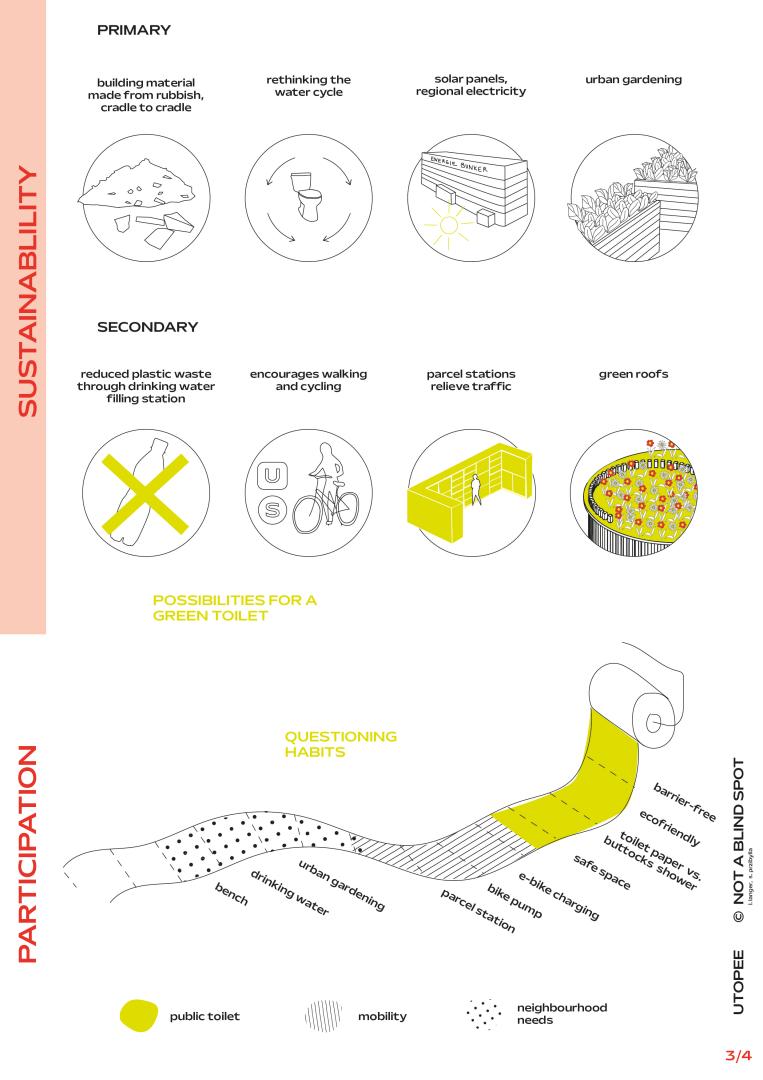
We primarily focus on the sustainable construction of the toilet project, which, as a state-of-the-art, creates a special awareness among city residents for sustainable construction and self-sufficient functionality. We envision reusing old building materials, like building rubble from urban demolitions nearby. Other parts that cannot be built from old materials would be constructed according to the cradle-to-cradle principle. Rainwater and greywater can be fed into the water cycle for rinsing. It would also be conceivable to use a filter system to transform rainwater into drinking water. Solar energy, which is generated by panels on the roof, provides light and electricity (lighting, charging station for e-bikes and cell phones, etc.). Optionally, surrounding energy projects could be integrated into the planning. It should also be considered whether the manure could be used as a fertilizer for regional agriculture.
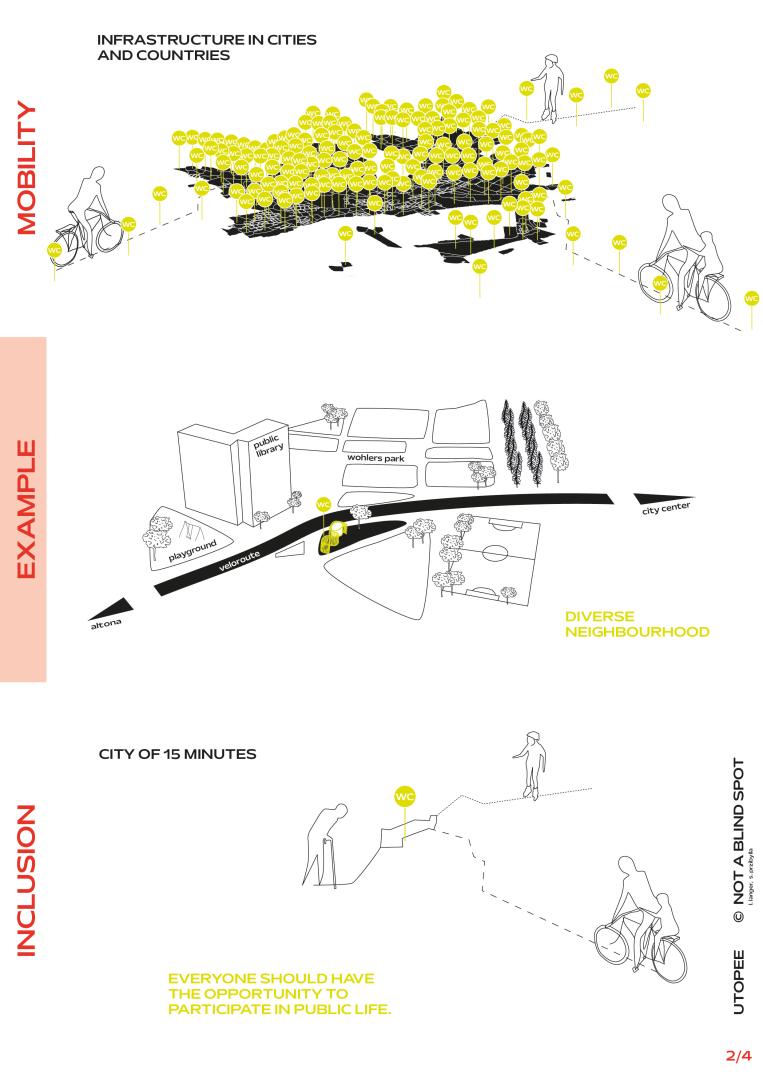
In addition, the toilet project also promotes a sustainable lifestyle. We call this secondary sustainability. An infrastructure of public toilets along existing bicycle infrastructure, just like fuel-stations for cars, not only promotes the use of this environmentally friendly means of transport, it also makes it more attractive to do things throughout the city by foot. Drinking water filling stations allow you to fill up your own drinking bottles. A green roof of the facility helps regulate the temperature in the city and offers a diverse range of plants for insects. In addition, individual modules create additional moments of relief for the urban space. An attached parcel station can reduce traffic, congested roads and emissions.
Key objectives for aesthetics and quality
The greatest aesthetic goal of our concept is to create access for all people regardless of gender, class or disability to a natural human need. This naturalness is therefore specifically transferred into the aesthetic design of the project.
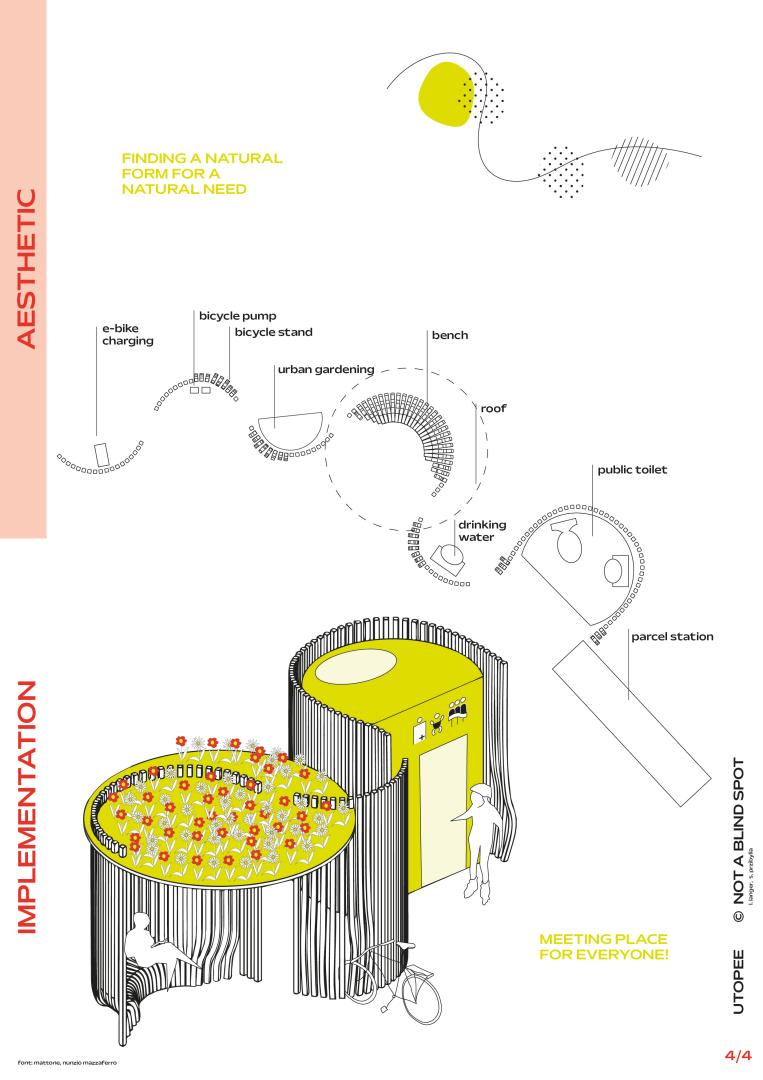
The round elements of the design pay homage to the Fibonacci spiral. But the winding shape of the toilet paper is also reflected in the arrangement. An atmosphere is deliberately created that moves public toilets out of their gray area and defecation out of taboo in the middle of society and creates a completely natural type of encounter. The other modules are also integrated in this way and, in addition to their functionality, impress with their well-thought-out design elements. The struts of the wall become a bicycle stand or flow over into a bench.
In addition, the flow of the round elements adapts to different individual situations and requirements and can be expanded as required and space. They look particularly harmonious in park landscapes and other natural environments. In a grey concrete desert, they become an aesthetic eye-catcher.
Another reason for the targeted aesthetic approach is the resulting protection against vandalism and pollution. The design acts as a participatory element. The planning of the Utopee for and with the city dwellers creates a special quality. And that is exactly our understanding of urban planning. Our Utopee becomes a meeting place and promotes a sustainable infrastructure. The needs of the citizens in urban space become visible not in a striking way, but rather from a subtle self-image.
In this way, the design creates a justification for the project beyond its necessity.
Key objectives for inclusion
Public toilets decisively promote participation in public urban space. Because the accessibility of the urban space also requires the removal of barriers for people who do not meet the urban planning norm. We see such a hurdle in the lack of public toilets. Accordingly, those who cannot participate in city life without the option of a public toilet must be included in the planning. Those who would otherwise be forced to stay at home or use the city only as an infrastructure instead of the city as a living space. Such an exclusion not only hides the diversity of city dwellers, it also is excessively discriminating and in no way inclusive. This profoundly contradicts our understanding of the city. Because everyone, regardless of skin color, gender or disability, has the right to participate in public urban space and to use it for themselves. A toilet for everyone inspires our desire for a city for everyone. Everyone naturally belongs to it.
In our Utopee, the rest area has the potential to function as a meeting place for people.
In order to achieve this ambitious goal, we would like to enable the residents to participate actively in planning toilets according to the required elements, depending on the location. Our aim is to create this Utopee with and for the city dwellers.
Innovative character
We focus on the participation of people in the public urban space and focus on an element that has been forgotten in urban planning, although it buzzes in our heads every day: the public toilet.
Our Utopee, an infrastructure of clean and free public toilets, is as simple as it is effective. In our city for all, we thus create a place that fulfills a basic need without pursuing an economic interest.
The design is an essential component in order to promote the acceptance of the project, but above all to ensure safety and, in a second step, to protect it from vandalism and pollution. In addition, the design adapts to the needs of the citizens. An island of participation is created, which is designed for people and far from economic aspects. Thanks to the sustainable approach of the entire rest area concept, people are playfully encouraged to lead a more sustainable life in the city. In the best case scenario, the project subconsciously leads to a more sustainable life without prohibitions, but with opportunities and incentives created by the tightly mashed infrastructure of the Utopee.
The innovation of this project therefore consists in the following aspect: Passers-by can become activists by moving autonomously through the urban space and inevitably being able to pursue their natural needs.
This recaptured participation of people in urban space, in this case through the toilet as an integrating element, is the essential factor for a sustainable, inclusive and livable city.
In this way, we promote and demand a life in urban space and thus bring about sustainable mobility, a new type of encounter and an inclusive city.