Circular Maker Academy
Basic information
Project Title
Full project title
Category
Project Description
Fab Lab Barcelona designed and implemented the Circular Maker Academy; an innovative and immersive training programme that provides people with the skills and guidance to successfully scope, plan, establish and manage their Circular Makerspaces as core to local urban and social development activities. The programme is designed around a local capacity building approach to ‘train the trainer’, a method that sees individuals become ‘community champions’ of making meaningful local change.
Project Region
EU Programme or fund
Which funds
Other Funds
The Circular Maker Academy was designed and implemented by Fab Lab Barcelona in the framework of Pop-Machina in the year 2020. Pop-Machina is deployed in seven pilot cities: Santander (ES), Istanbul (TR), Venlo (NL), Thessaloniki (GR), Leuven (BE), Kaunas (LT) and Piraeus (GR) with each city selected for their diverse characteristics. The pilots aim to demonstrate the potential of circular innovation and support the implementation of the EU Circular Economy Action Plan at a local level. The approach identifies underused urban areas and buildings, waste materials, underrepresented social groups, skill development as well as collaborative tools and technologies to engage, promote and support long-term circular practices as part of the city’s social fabric. The project aims to establish and support self-governing maker communities in each pilot city through the implementation of co-creation workshops, ideation sessions and the setup of Circular Makerspaces.
Description of the project
Summary
Increasing numbers of different types of creative and productive spaces are being established around the globe. Makerspaces are often community-led spaces in which individuals and groups of people have access to machines, tools and can share resources. Whilst makerspaces intend to be openly accessible for citizens, democratizing access to machinery and tools, enabling collaborative making processes, they do also face limitations. They currently lack strategically implemented material flows analysis, life cycle assessments, social inclusion methods. While the apparent limitations may seem daunting, makerspaces may also be the most suitable to actively incorporate new strategies and practices. Which leads to the idea of how this revised approach of making practices may formulate. The Liquid Circular Maker Space is a call for a reflective approach to take systematic action as individuals, groups and institutions to support each one another to enable equitable futures.
The Circular Maker Academy programme was conducted by Fab Lab Barcelona @IAAC during 2020 in the framework of the EU Project Pop-Machina. The aim of the academy was to equip maker champions from six different countries with the skills and knowledge following the training the trainer approach. With the objective to support the holistic establishment of Circular Maker Spaces in their respective cities. Due to the Covid-19 pandemic the programme was transformed to a 100% online immersive learning experience. Pop-Machina is a Horizon 2020 project that seeks to highlight and reinforce the links between the maker movement and circular economy in order to promote environmental sustainability and generate socio-economic benefits in european cities.
Key objectives for sustainability
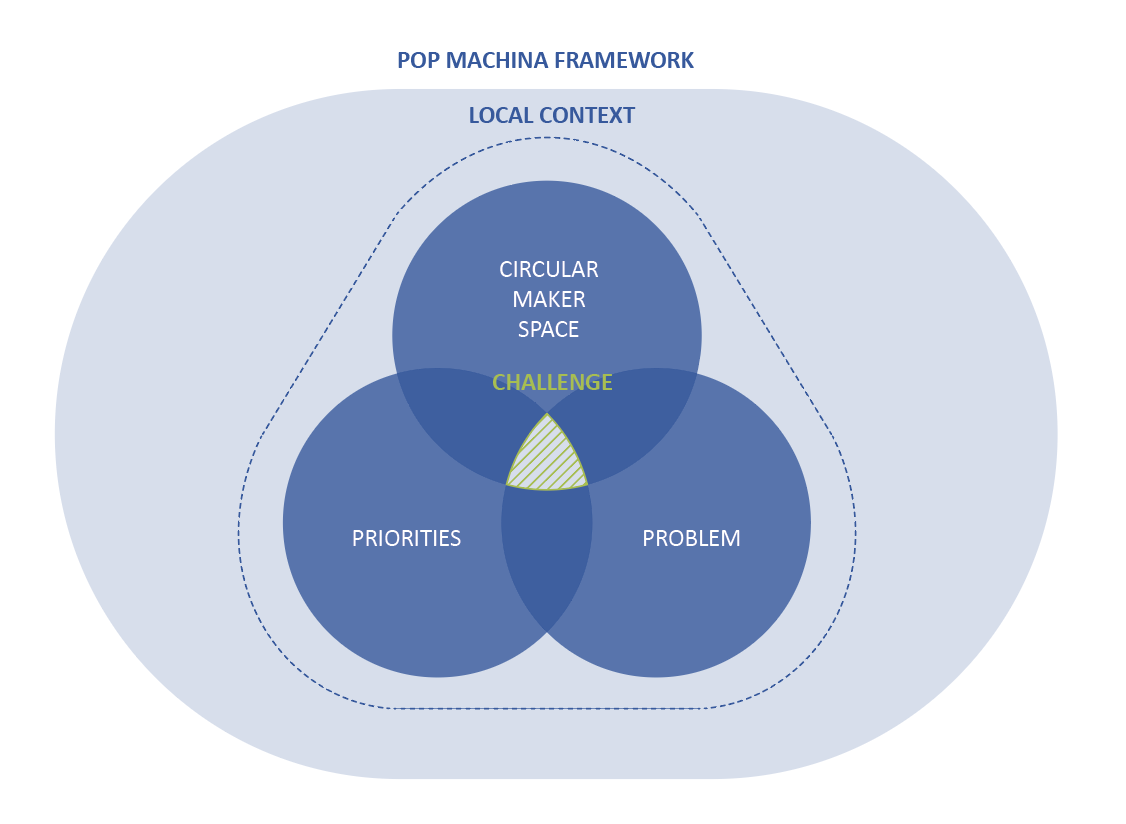
The Circular Maker Academy (CMA) was conducted by Fab Lab Barcelona in the year 2020 and due to Covid-19 adapted to a fully online immersive learning experience. The objective of the academy was to equip maker champions following the train the trainer's approach the skills and knowledge to successfully open Liquid Circular Maker Spaces (LCMS) in their respective cities. Beyond learning about digital fabrication tools, coding and other making practices the participants learned to understand their local ecosystem This understanding is based on material flow analyses and life cycle assessments which are matched with the existing capabilities of the LCMS to create challenges. The local challenges are then addressed with workshops, hackathons, round tables and other activities organized by the LCMS to extend the knowledge and built capacity within the citizens surrounding.
In conclusion, LCMS serves as a site in which equitable, circular solutions to complex problems can develop, mature and scale. In this space citizens and local communities are engaged to take part in circular making practices, co-creation and co-design of circular solutions for dilemmas which the local communities face. A LMCS is more than just its physical space and its machines. The aim is to work collaboratively, experiment and foster new synergies with surrounding or encompassing ecosystems. Being adaptive and iterative by nature, with low barriers for participation and an empowering environment.
Key objectives for aesthetics and quality
The Circular Maker Academy gave us the opportunity to explore, together with the Circular Maker Champions, what a LCMS could be and the academy itself should be designed. How the approach to local challenges should be addressed and how people will be engaged. An extraordinary example are the makerspaces established in Leuven and Istanbul. In Istanbul we were able to follow the processes of a Circular Maker Champion which was able to engage within their neighbourhood, slowly starting their own local community of practice. Now, in the year 2021 we are excited to see the opening and the activities being established in Döngüsel İşler Atölyesi (Turkish for Circular Maker Space), the Circular Maker Space in Istanbul. The prior established community of practice will finally have physical space to meet regularly. After concluding the academy, all Circular Maker Champions shared a similar sense of belonging and sense of community. We are collaboratively trying to keep our community from the distance via monthly online meet-ups in which we share updates and continuously have peer to peer workshops. We are still exploring how a distributed Circular Maker Champion network may articulate. In times of covid-19 in which people felt more connected and disconnected at the same time the sense of belonging and being able to create a community online was met. This served us as a proof of concept of the qualitative experience we were able to embrace.
Key objectives for inclusion
The CMA actively co-designed the curriculum with the participants. Through continuous feedback loops, the needs of the participants were addressed in inspirational talks and hybrid hands-on learning experiences. Basically, the CMA itself was merely the supporting framework for the journey of the participants on an instructional, guided and ultimately autonomous path to develop their own communities of practice locally.
With a people-centred approach the LCMS sees people as agents of change, re-thinking and re-inventing solutions. Hence, the terminology “liquid” is based on the idea that a LCMS is just as adaptive as the people within, supporting resilience in times of rapid change. Interests of people change as a function of time. This is part of human nature. Hence in this respect, the liquidity of the space plays an important role. The LCMS is a multi-dimensional living system, composed of everyone who wants to partake. It explores the development of and interconnections between the individual, groups of people and the larger ecosystem. Social inclusion should actively be part of the implementation strategy of a LCMS. Making tools and information accessible, for an equitable environment. Having a democratic approach in which community members and citizens are part of decision-making processes, to ensure a shared responsibility. Acknowledging the differences, characteristics, cultures which exist within the communities. And with this the LCMS takes the shape of the community, reinventing itself through iterative and agile cycles by continuously evaluating its needs in function of its community. This may mean adapting everything from the LCMS´s physical layout to how it is governed and used.
Results in relation to category
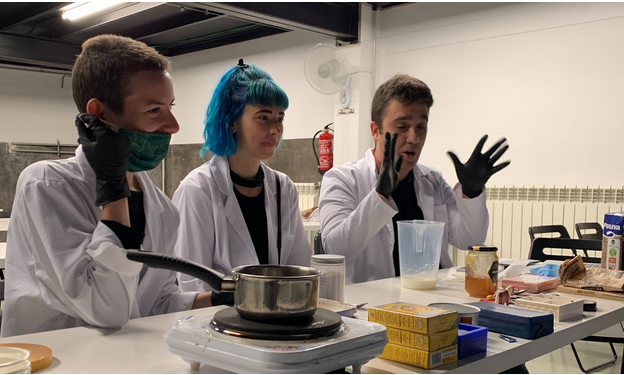
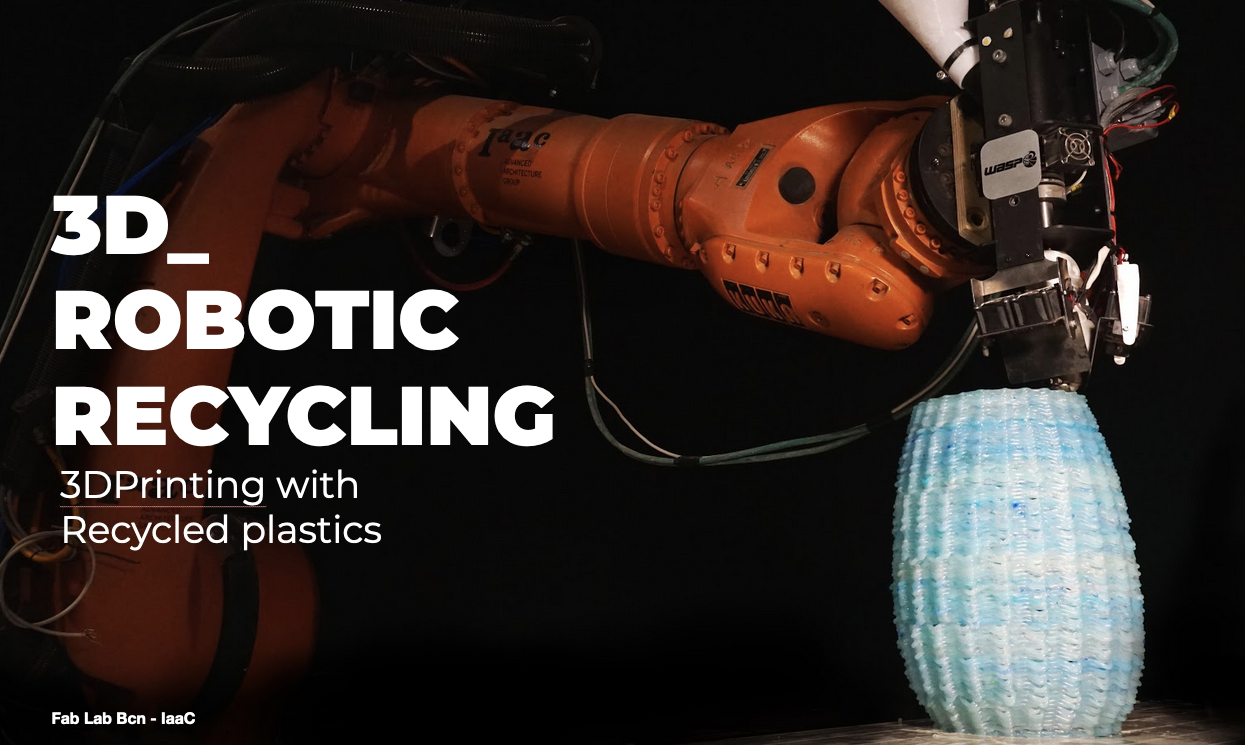
Makerspaces are being challenged for their use of supposedly energy-intensive machines. Often being compared to large scale industries, the actual benefits which can be accomplished in makerspaces are often forgotten. LCMS’s work in their local context. It is the role of the community champions, and individuals themselves to ensure that local challenges are being addressed holistically. Sharing their insights and best practices on a global scale - a common ideology in the maker movement. However, not only the choice of machinery and tools play an important role in the circularity of makerspaces. Rapid prototyping techniques and many academic programmes which take place in makerspaces still use the same materials as many years ago. These materials are increasing in their scarcity. This means products or projects emerging from makerspaces may have a heavier impact than assumed. It is about time to find valid material alternatives especially for young makers, and participants of educational programmes to ensure that experiments and exploration can take place in a more sustainable way. Using materials that can be fed back into the material flow, for example, bioplastics. Or having machines and tools available which ensure that plastics can be recycled. Giving materials, electronics, and other discarded items which may be forgotten in our basements a new life. Rethinking new applications, remixing and reinventing to not only fit personal needs, but collective ones. One person's trash is another person's treasure. Eventually, there would be no more “waste”, only materials and products in different stages of their lifecycle.
The Circular Maker Academy formalizes these concepts into an innovative, immersive learning environment in which people are empowered to become agents of change. Supporting their local transformations processed towards the implementation of a circular economy.
How Citizens benefit
Ultimately the Circular Maker Champions are equipped and enabled to open their local Circular Maker Spaces. On a practical level, the development of LCMS is established with the people: There is an individual with an interest in circular making practices. This individual, or Circular Maker Champion, cultivates different types of activities in which citizens can participate. While doing so a group of people, sharing similar interests, starts to manifest around the Circular Maker Champion. Eventually, depending on the size of the group of people, areas of interest may start to differentiate, articulating in areas of expertise. Together these groups can be seen as a community of practice. Throughout this whole process, there was no need to have one specific makerspace. Activities could have been in community centres, at home or in repair cafes. However, when this community of practice has the resources and support from e.g. an institution, a dedicated physical space (the LCMS) may be established in which they reside.
Innovative character
The Circular Maker Academy (CMA) has an innovative approach to "traditional" e-learning environments. By co-creating the content context based on the participant's local challenges. Taking into account the existing knowledge and skills of the participants themselves and giving them opportunities to host sessions within the academy. Creating thematic months which are building a narrative to tie together the different challenges, skills, knowledge and needs of the participants. The CMA mixes traditional making techniques, digital fabrication tools with circular making practices. While the participants follow their personal learning paths through instructional, guided and autonomous they also learn how to connect their interests with a sense of agency to their local environment.