L'Annexe
Basic information
Project Title
Full project title
Category
Project Description
The Chalets Group and Letellier Architects chose a bold transformation of the former MSA and Chamber of Agriculture of Haute-Garonne building, an iconic 1970s office building located along the Brienne Canal, into 153 student housing units - a project completed in September 2019. Our desire was to apply the same philosophy of "recycling", "continuity" and "reuse" to both the building and the furniture throughout the project.
Project Region
EU Programme or fund
Description of the project
Summary
Letellier Architects chose a bold transformation of the former MSA and Chamber of Agriculture of Haute-Garonne building, an iconic 1970s office building located along the Brienne Canal, into 153 student housing units - a project completed in September 2019.
The Chalets Group acquired this building at a time when the conversion of offices into housing was not yet a very widespread practice, but which meets the strong need for housing for people with modest incomes, particularly students, in the heart of the city of Toulouse (the residence is located in the city centre, close to the universities and the Grandes Ecoles).
This first aspect represents the first innovation of the project, which has 3 others: rehabilitation with a strong raw architectural bias, the choice of second life furniture to furnish the student housing and the implementation of a social dynamic with the students on eco-responsible practices.
Work began at the end of 2017 and brought to life a 9-story building with 153 units, the majority of which are small living spaces to meet the needs of students (studios and one-bedroom apartments) and a few larger apartments intended for shared living. The project was completed in September 2019, for the start of the university year.
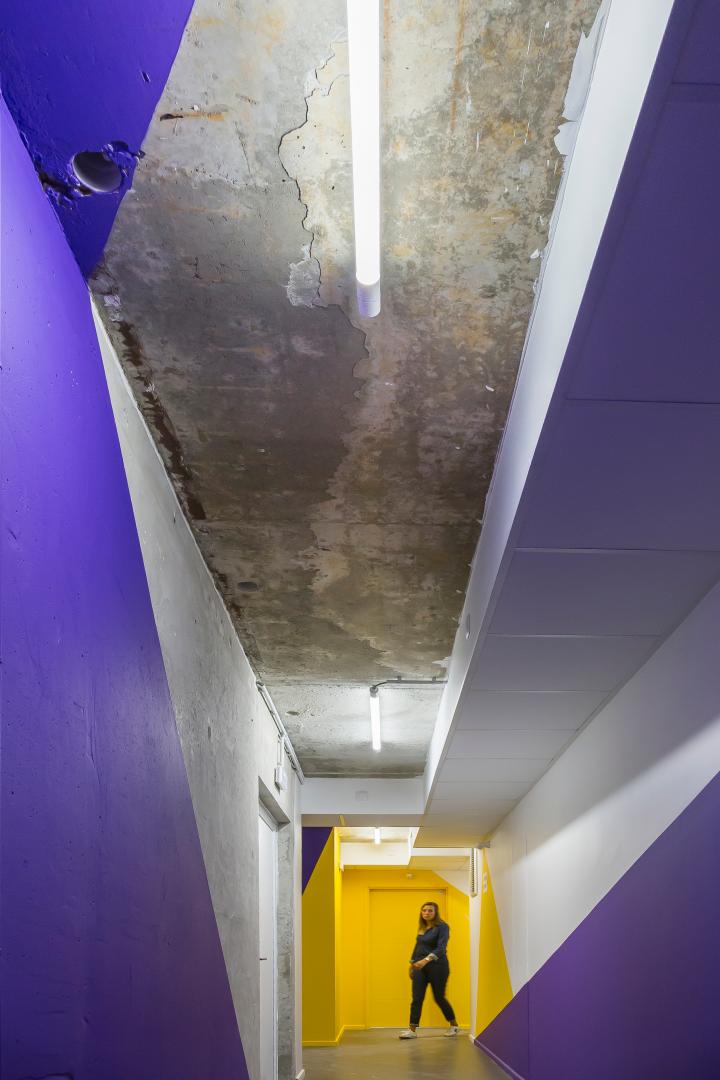
This collaborative work, in which architectural quality and innovation are given pride of place, expresses the desire to conserve existing architecture while integrating it into the city of tomorrow. We transformed the structure by not hesitating to use a strong architectural bias highlighting the raw side of the building.
Key objectives for sustainability
This building is a unique opportunity to develop a student housing program close to the universities.
The main technical challenge of the project was the change of use of the premises. The creation of residential units, up to 18 units on some floors, considerably increased the electricity and water requirements. Each apartment requires an electricity panel and a plumbing system. The configuration of the building required the installation of individual water columns for each apartment. The structural modifications work had to be consequent to guarantee the stability in view of the numerous reservations created. Another characteristic of the building is the acoustic constraints due to its location next to a road with a lot of traffic. In order to guarantee acoustic comfort, all of the residences giving on to this road had VMC double flow installed.
A real work of substance and form since the Chalets Group called upon the Merci René association, "facilitator of sustainable environment", in order to combine the fitting out of spaces with second life furniture or responsible new furniture to carry out this project highlighting sustainable development.
Key objectives for aesthetics and quality
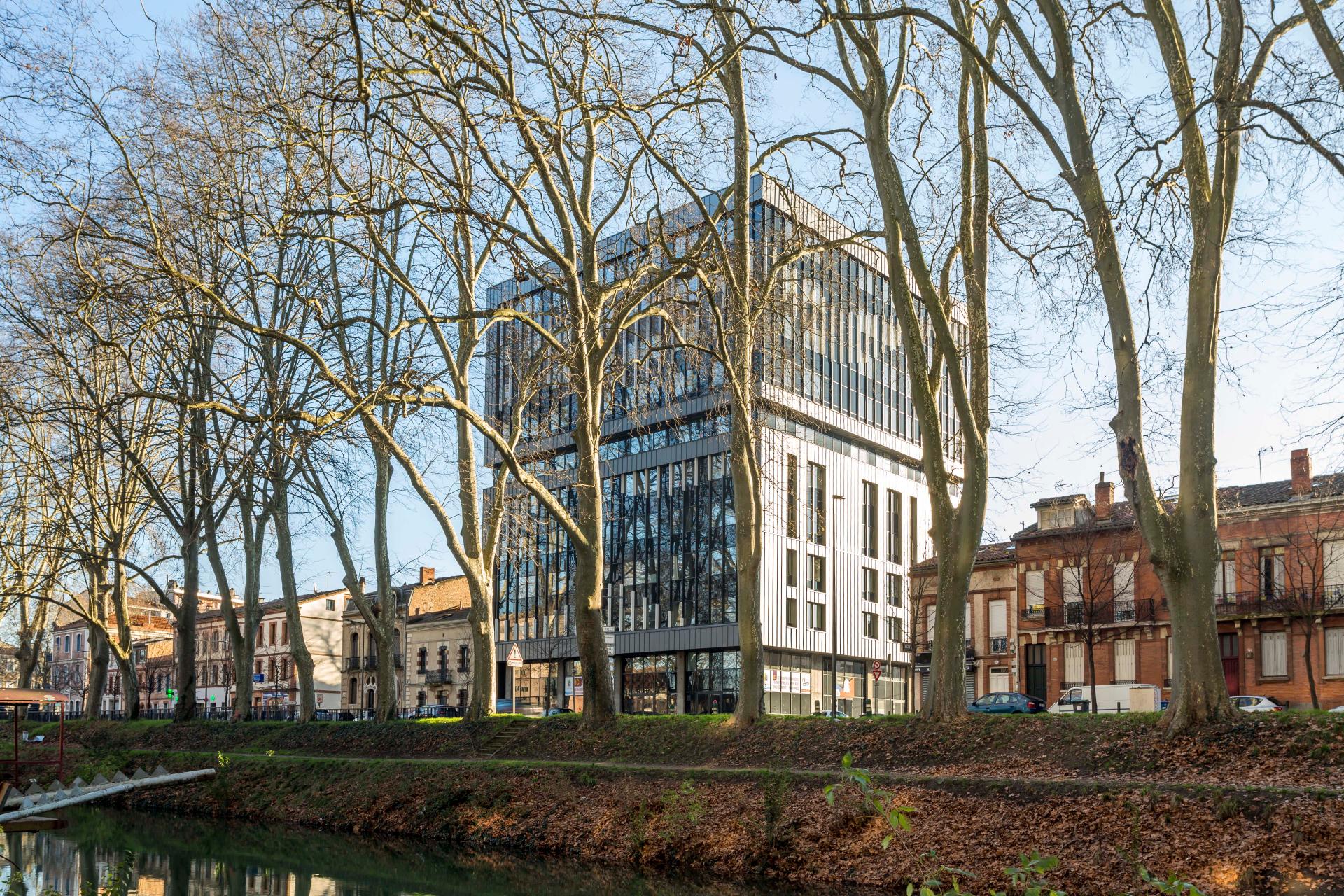
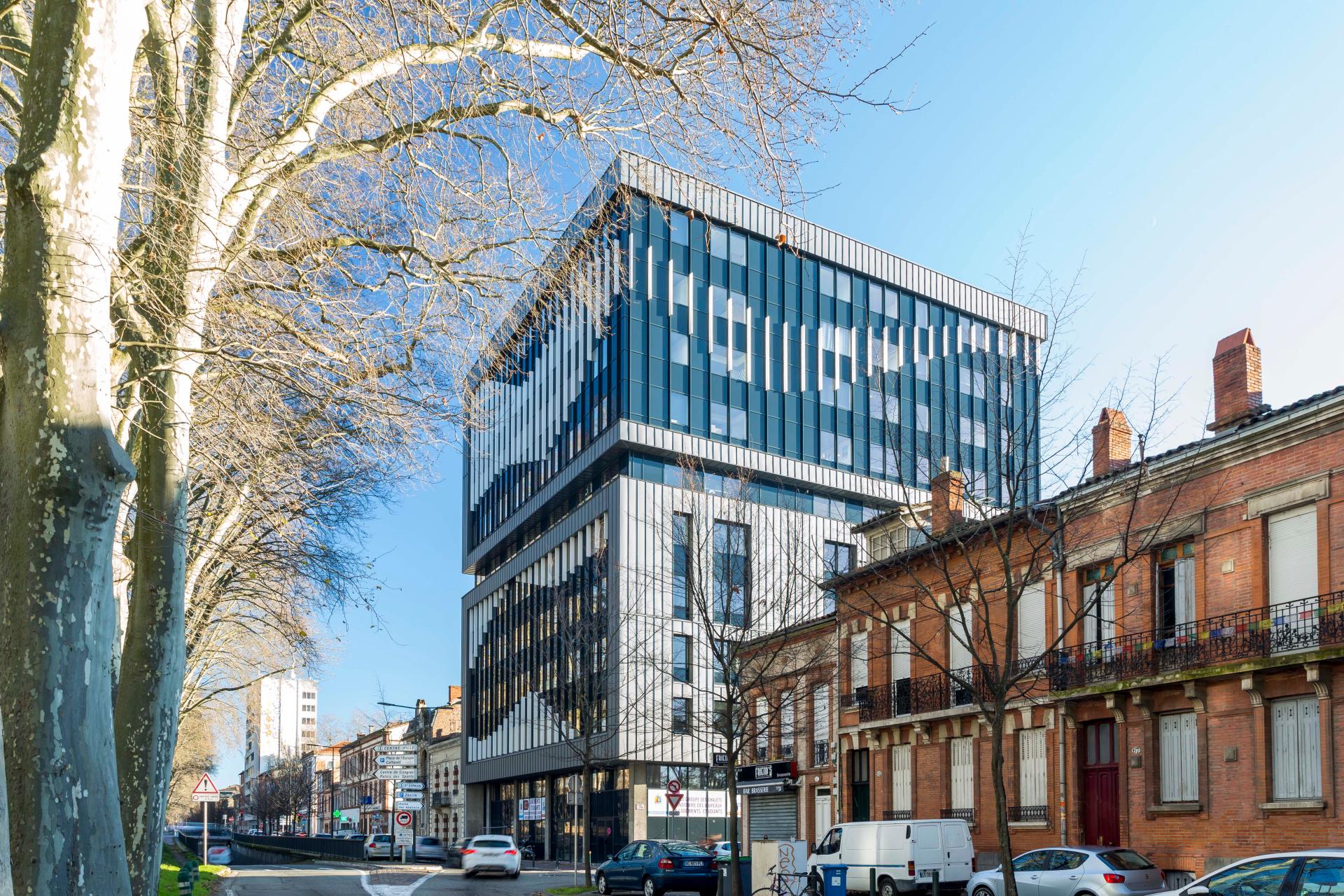
In a resolutely "loft" and industrial spirit located on a fringe of land between the Garonne and the Brienne canal, the R+9 building which dates from the 1970s stands out from its immediate environment by its height and its profile.
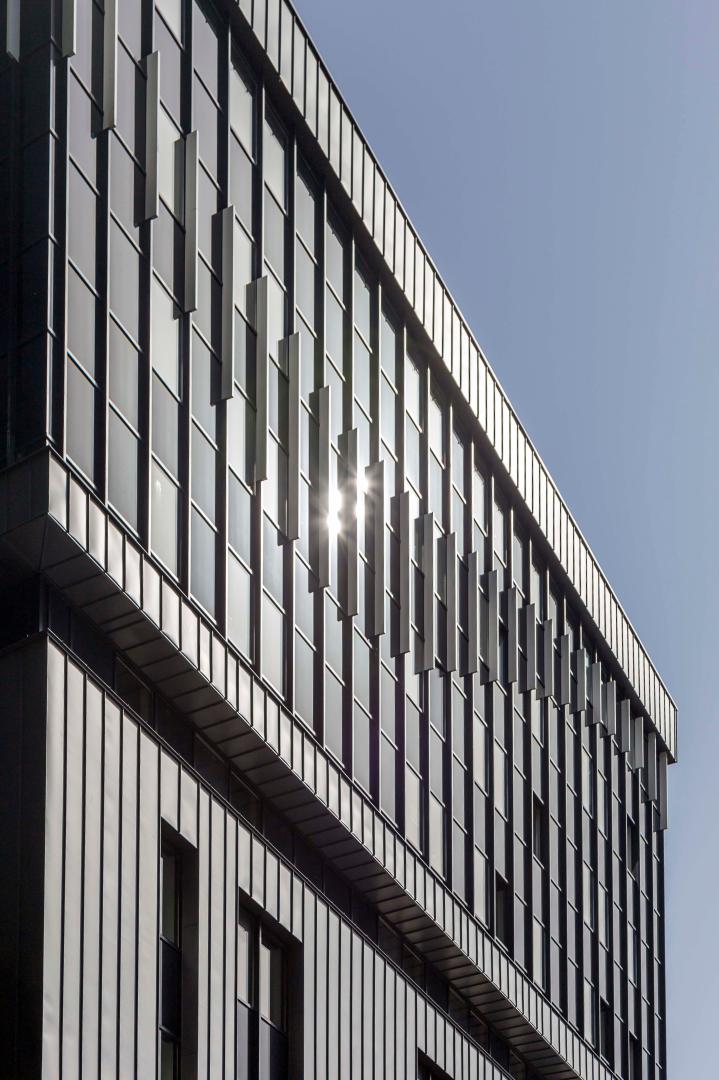
The kinetic facade of zinc and glass perfectly integrates with its environment, white and black blades to form a wave, the circulations leaving the raw structure visible. The waves are a reflection of the canal. The new exterior of the tower was designed to bring the tower closer to the scale of the surrounding buildings. The project functions by opposition of scale and the treatment of the façade is intended to obtain a style similar to that of the nearby houses.
The materials have their full place in this large-scale project.
Thus, the principle of "architectural brutality" is supported by the apparent networks in iro tube for electricity and in electro-galvanized tube for the heating networks. The facades reveal a mix of aluminium curtain wall with a random effect through white-on-black thorn cladding and fully recyclable lacquered steel standing seam cladding with a low carbon footprint.
The architecture thus plays with the interweaving of the old and the new on the scale of a building.
Key objectives for inclusion
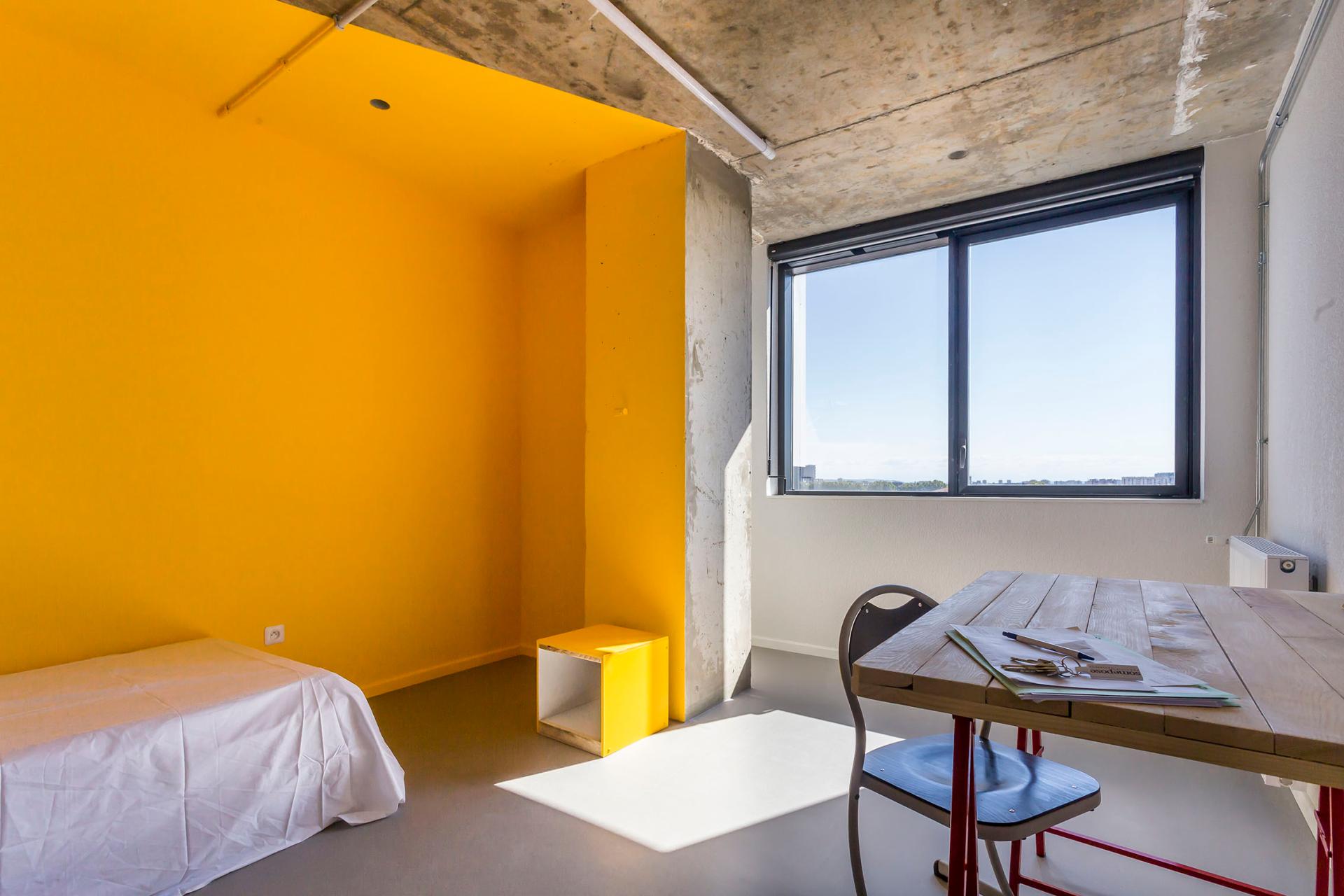
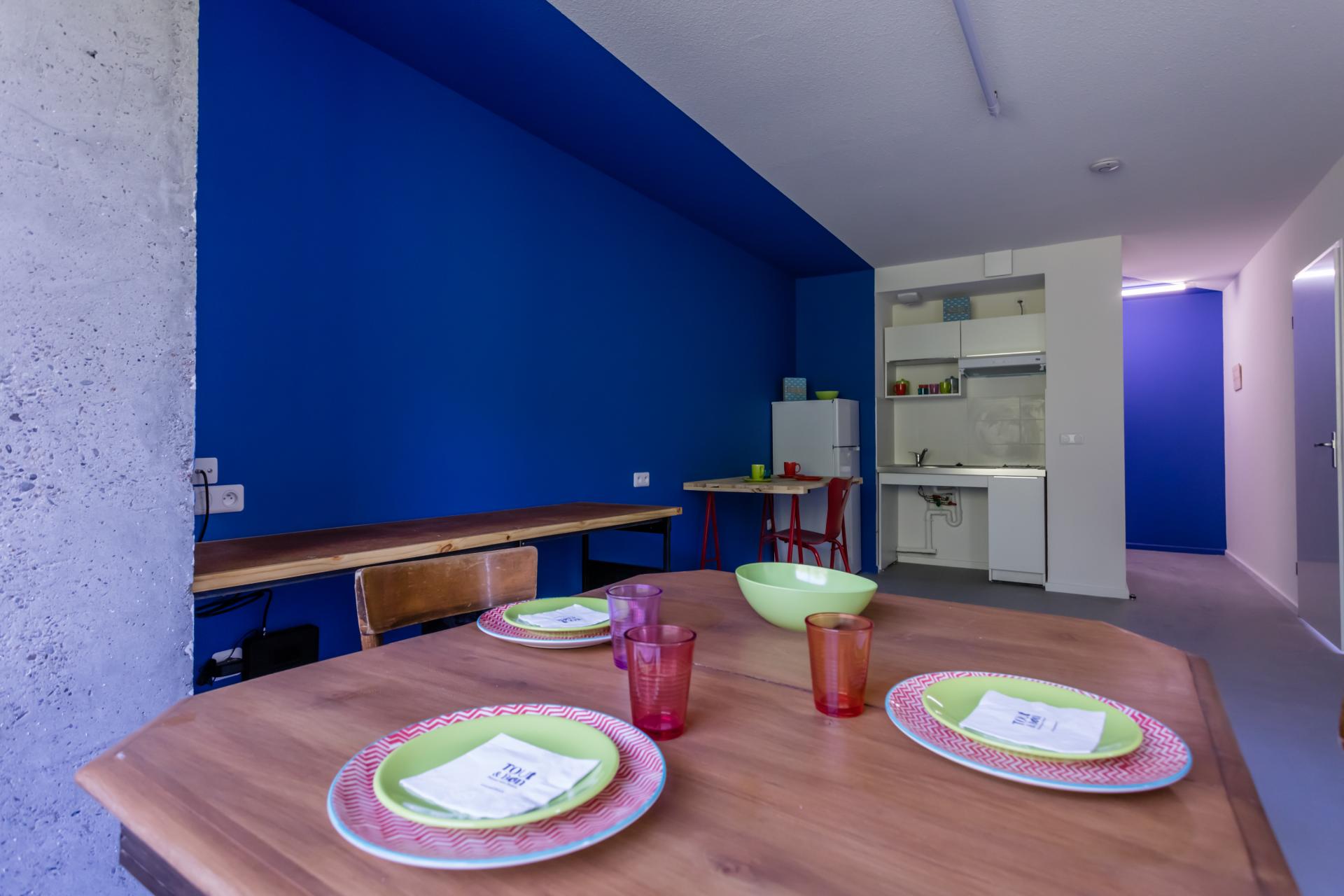
The inner transformation is radical. The structure and the concrete ceilings are preserved and left visible. They are the markers of the first life of the building. In each studio, a spot of colour extends by visual effect on a wall and a part of the ceiling to affirm the strong architectural party of the project while facilitating the appropriation of the studio by the student.
This random combination is also deployed in the common areas while bringing a specific identity to each level for ease of use.
This logic of working with the existing went as far as the choice of furniture which is composed exclusively of "upcycled" elements by working with the association "Merci René".
The innovation of this project lies in both the transformation of offices into housing and also, to equip all housing with second life furniture.
The desire of the Chalets Group and Letellier Architecte was to apply the same philosophy of "recycling", "continuity" and "reuse" to both the building and the furniture throughout the project. The unifying factor was the transformation of the use of the building, and the client and architect became a team with close ties and the same objectives.
To study the feasibility of this furniture reuse project, the Chalets Group joined forces with the cooperative enterprise Merci René, a "sustainable environment facilitator", whose mission was to fit out the spaces with second life furniture, resulting from reuse, overcycling* and responsible new furniture, and to support the student tenants in raising awareness about the circular economy.
This collaboration is part of a logic of eco-responsibility, sustainable development and social integration.
Users excited about their "apartment-like" habitats, an eco-responsible, respectful, award-winning project, a success.
Results in relation to category
This project took shape with a desire to strengthen the circular economy. It is part of the transformation of the city in a sustainable way. It draws its foundation from the history of the building, its architecture, its design while renewing it, bringing a contemporary touch and projecting itself into the future of the district and the city. The project was born out of the transformation of the former MSA and Chamber of Agriculture of Haute-Garonne building, located along the Brienne Canal, into 153 student apartments.
This transformation advocates the use of the circular economy. The building itself is a reflection of this. It integrates perfectly with the environment of the project while radically changing the interior. The structure and the concrete ceilings are preserved and left visible. They are the markers of the 1st life of the building, it is in this that the project already meets the values of the circular economy.
It is through the involvement of construction companies and social economy companies that the project will draw on resources and materials to benefit the operation of the site, the ecological footprint and economic performance.
The actors of the construction industry have thus been awakened to new approaches, a new look and also new expectations. The rental management team of the Chalets Group has also been very involved in this innovative project, which is different from other traditional student residence projects. This project also brings about a different way of working. All parties involved became actors in the project, whether at the time of construction, delivery or ongoing management today.
The purpose of the project is to be collaborative in an eco-responsible approach by working, in particular the layout, with recycled furniture coming for the most part from a local ecosystem, it thus reuses objects and materials for a second life for the benefit of the student tenants.
How Citizens benefit
To study the feasibility of this furniture reuse project, the Chalets Group called on the Merci René association, a "sustainable environment facilitator", whose activity is dedicated to fitting out spaces with second life furniture, resulting from reuse, overcycling* and responsible new furniture. The three stages of the project were:
- The study of the feasibility of the project on all aspects (organisational, legal, budgetary, planning and resources) conducted between October 2018 and February 2019 to measure the possibility of finding the necessary furniture for the 153 units of this new residence, with a global approach of collecting needs from a sample of students, and precise definition of supply networks for the material and associated costs.
- The accompaniment, purchase and installation of furniture from local structures of the Social and Solidarity Economy (integration companies, associations, cooperatives) so that the residence is able to accommodate students for the start of the 2019 academic year.
- Supporting student tenants through circular economic awareness ("do it yourself", selective sorting, salvaging...) and specific workshops organised with the students in order to make them aware of these practices and create social links.
This initiative is part of a logic of eco-responsibility, sustainable development and social integration. Thanks to René's cooperation with a network of local partners and SSE actors, the Chalets Group has been able to awaken to this new ecosystem.
Merci René's support is not insignificant for the Chalets Group, which relied on a circular economy professional who provided skills, expertise and a different perspective. This support allowed not only a sample of students to be real stakeholders in the project, but also the traditional construction ecosystem, including the prime contractor and the owner, to become involved in the project in a different way.
Innovative character
The innovation of this project lies both in the transformation of offices into housing, reusing a building for another purpose is a still an uncommon practice, and also, to equip all housing, common areas and the manager's office with second life furniture.
The desire of the Chalets Group was to pursue the same philosophy of "recycling", "continuity" and "reuse" for both the building and the furniture.
Transform by choosing second life furniture (second-hand, recycled, overcycled) for the fitting out of student accommodation, the manager's office and reception area and the common areas (instead of new furniture). The use of this second life furniture is a particularly innovative approach, especially on the scale of 153 social rental units. Each unit has a unique design that will tell a story.
In addition, transforming the eco-responsible layout of the residences into a lever of social cohesion between the residents: a dynamic is developed around awareness-raising workshops on eco-responsible practices ("do it yourself", selective sorting, salvaging, ...) in order to promote these practices among the students and create a social link within the residence and in connection with the neighbourhood. The health crisis has made it impossible to resume the normal course of the initiated workshops, but we hope for an improvement of sanitary conditions to put them in place at the beginning of the academic year in 2021.