Coverage for the Ronda de Dalt
Basic information
Project Title
Full project title
Category
Project Description
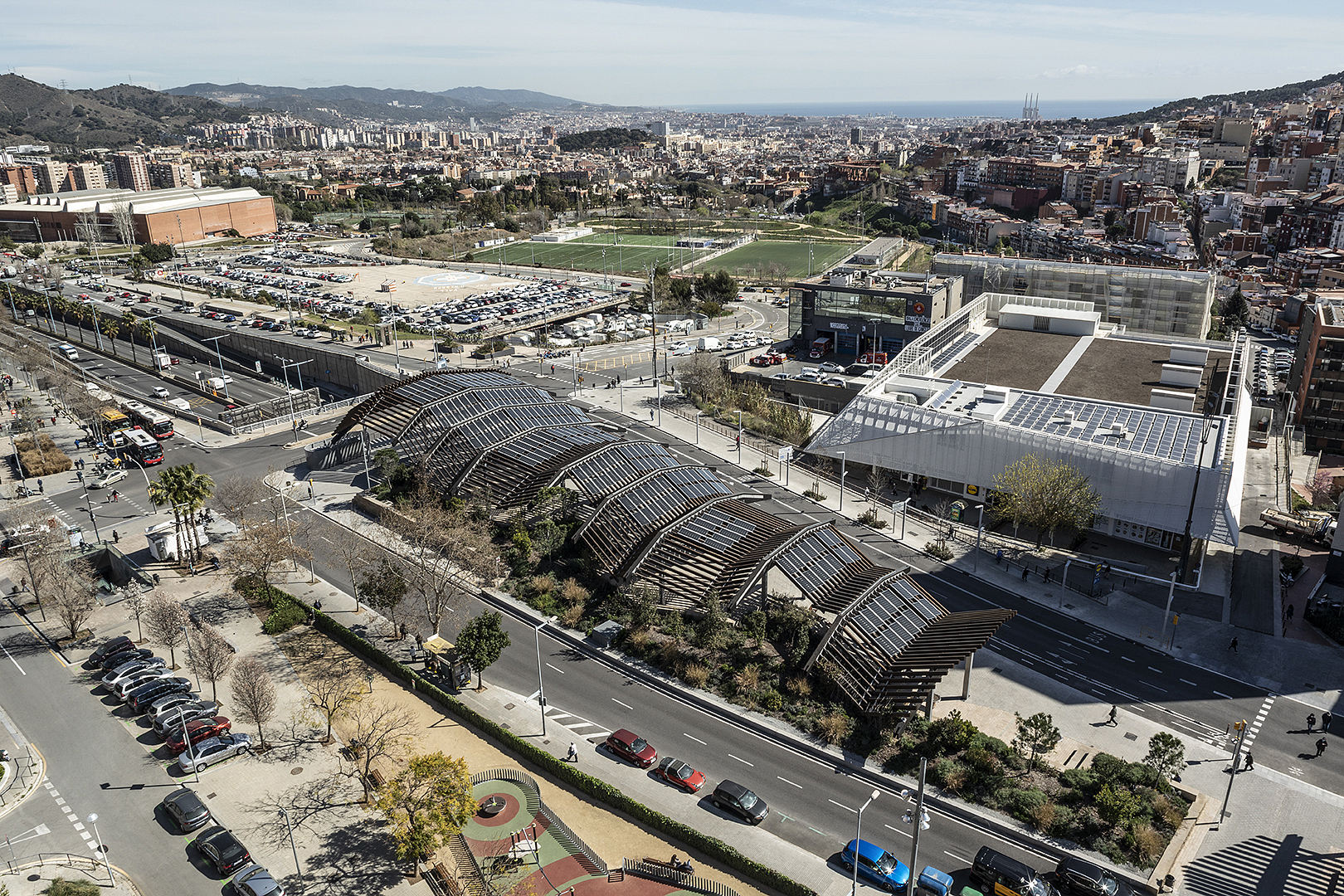
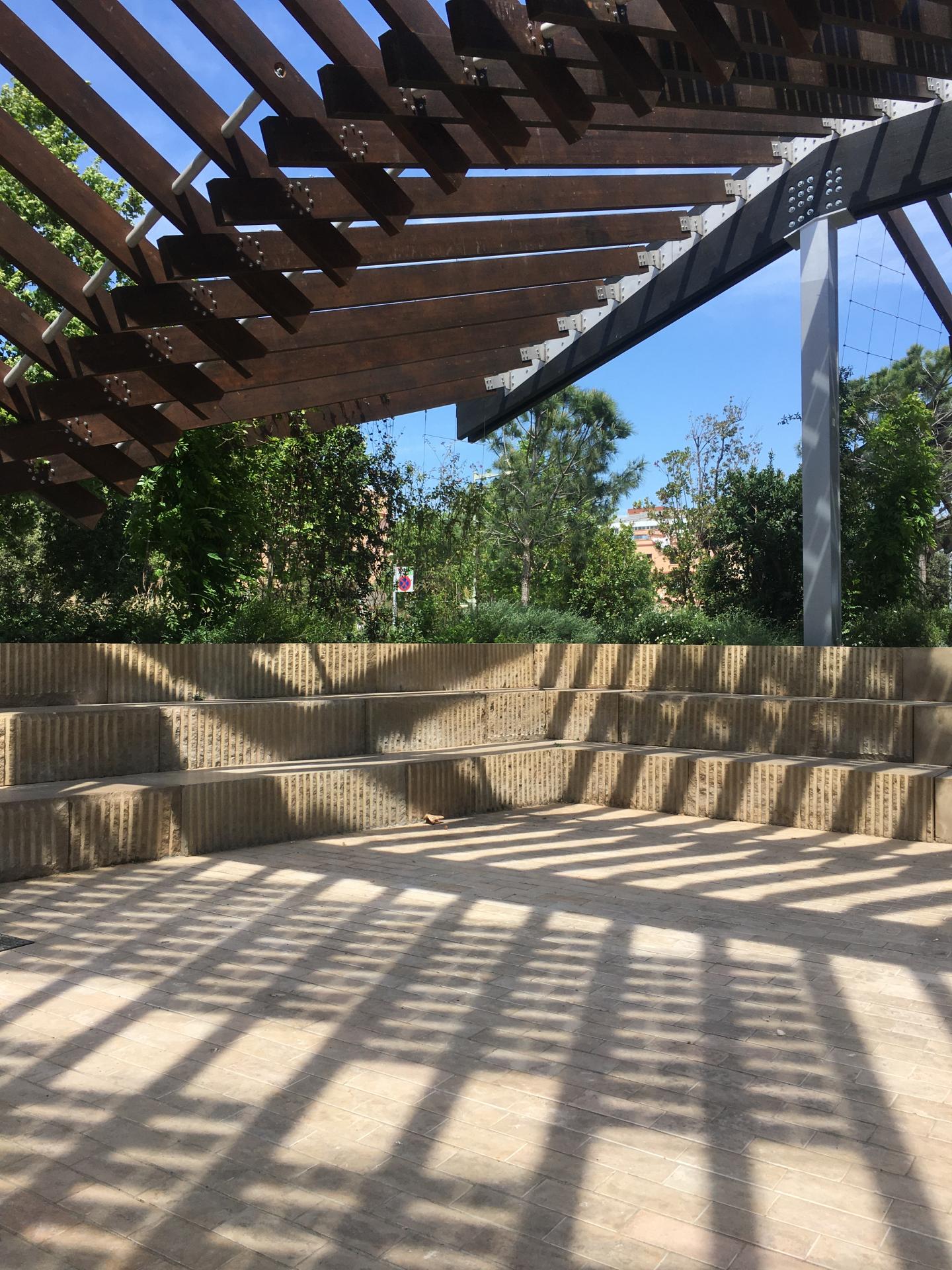
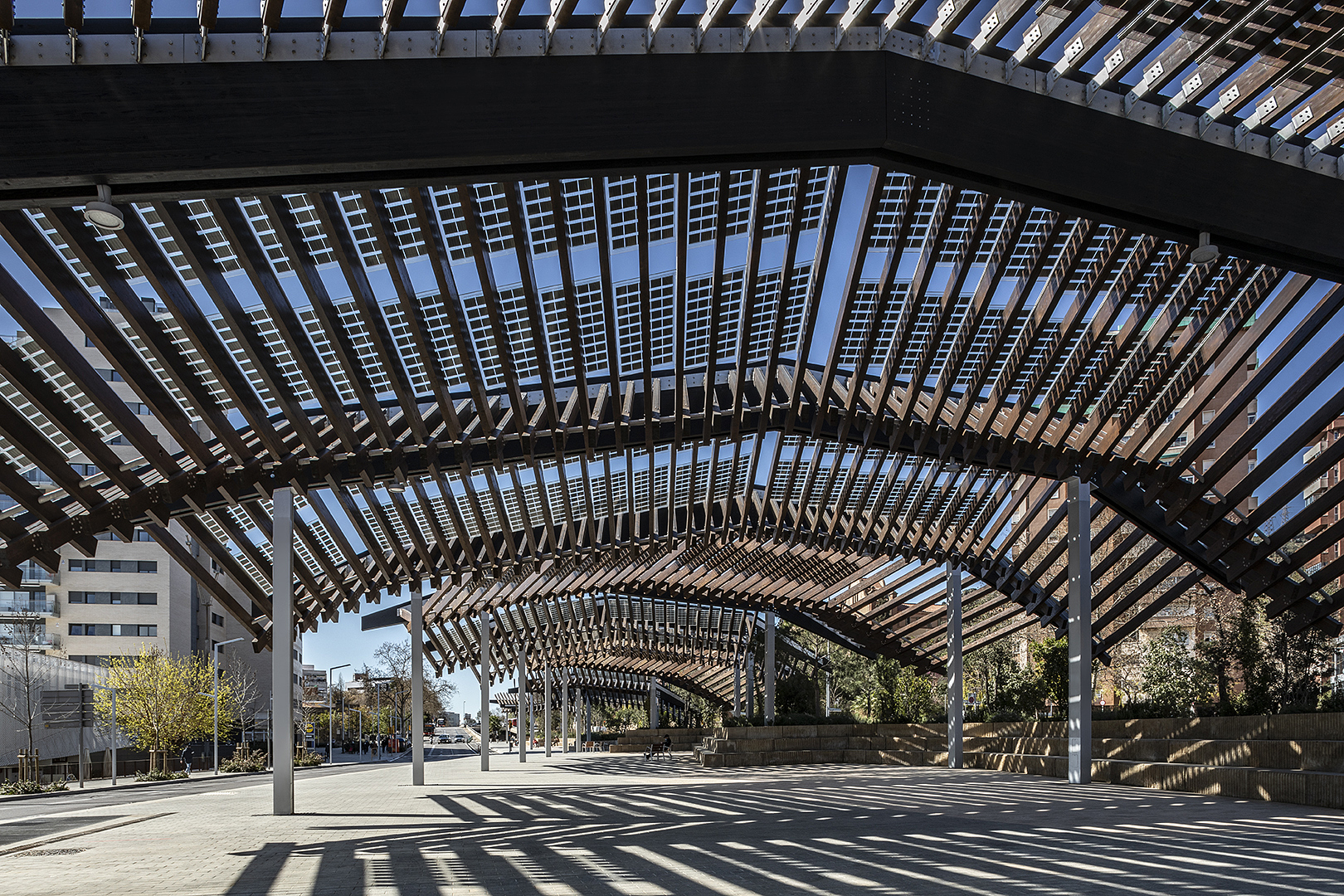
The new coverage of the Ronda and its urbanization is a clear example of urban recycling,where the demands and demands of the city change,and with it its spaces. Three large wooden pergolas with photovoltaic panels, which little by little will be colonized by vegetation, shade the square and the boulevard, making this new social axis a quality public space. A new public space is designed in line with the climate emergency despite the technical conditions of the road infrastructure.
Project Region
EU Programme or fund
Description of the project
Summary
Barcelona's emblematic road ring was designed in the 1960s. Many political, technical, and economic disagreements hindered its completion for three decades. Barcelona's 1992 Olympic games were the definite thrust for a project that implied an unprecedented urban transformation in the city.
30 years later it has been possible to recover social life in front of the Vall d'Hebron Market, between the neighborhoods of La Teixonera and Sant Genís dels Agudells, where the traffic of the Ronda had created a gap in the public space of the city, generating important communication problems between the upper neighborhoods of Barcelona and the rest of the city. A new paradigm of mobility has left cars behind as the main character. The infrastructure has been reclaimed as an active part of our city's free space system, highlighting the importance of walking, neighbor interaction and pacifying our streets.
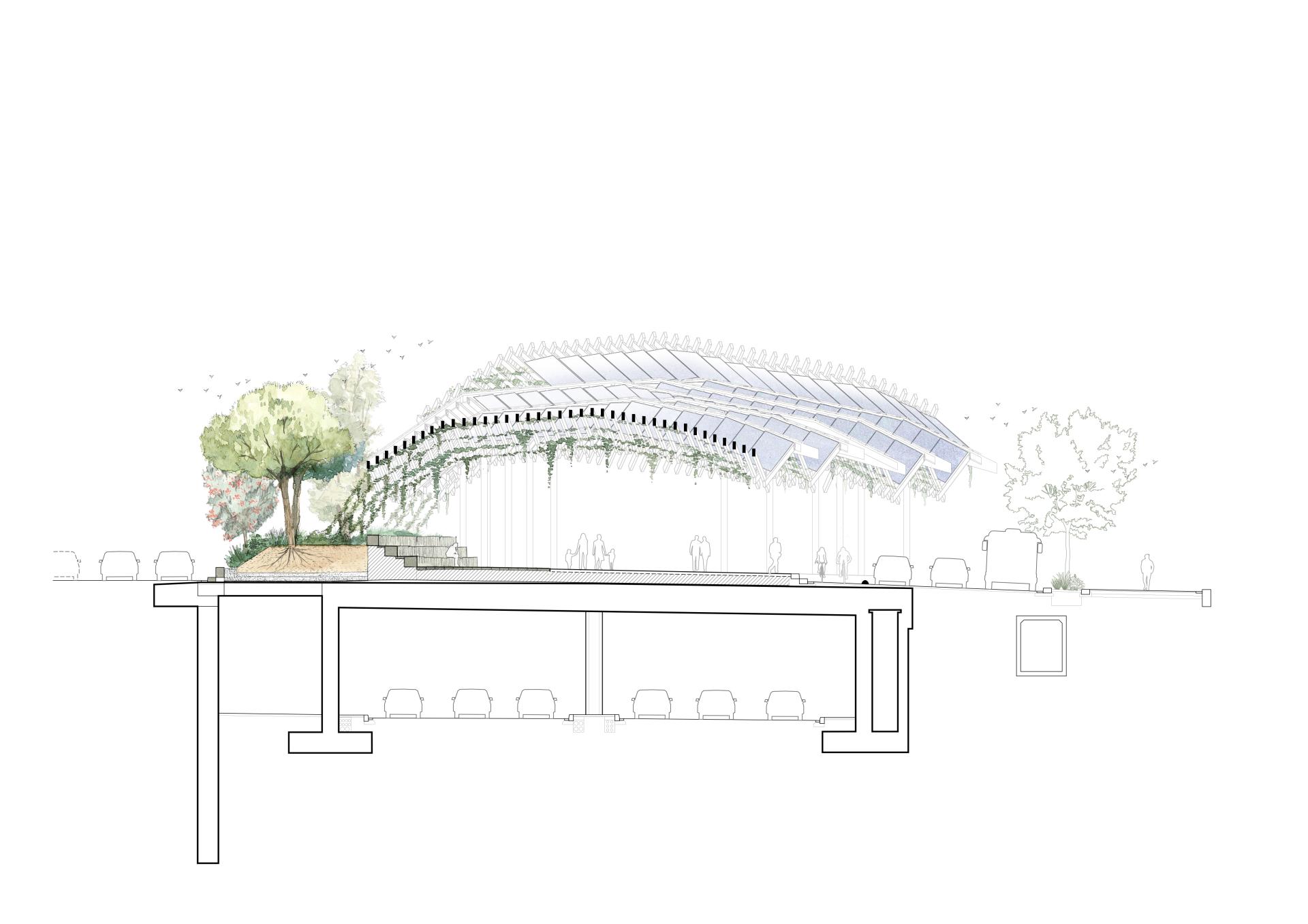
The great challenge when designing the new public space for the city, won thanks to the coverage of the road infrastructure, has been to generate a quality space with the best conditions for pedestrians, saving the technical difficulties of generating life on a huge concrete slab. This has been achieved through the introduction of new green areas, a large meeting space with a continuous stone step and the design of several wooden pergolas, which, in addition to introducing renewable and natural materials in the new square, have allowed the introduction of the generation of clean energy by placing a photovoltaic installation on them. It is a new public space that actively helps to reverse the climate emergency in which we find ourselves.
Key objectives for sustainability
The main objective of the project was to restore the ecological connection between Barcelona and Collserola, generating a public space capable of producing clean energy, returning to the city part of what the infrastructure of the Ronda had taken from it.
Collserola is a natural park located to the northwest of Barcelona, which constitutes one of the largest masses of biodiversity in the area, and that until the construction of the road ring entered the city. To recover this green connection, a large continuous green area has been designed on the north side of the promenade, which, thanks to the placement of stone benches that serve to contain the land, has allowed us to generate a space of vegetation where native species of trees, shrubs and carpets, accompany the pedestrian throughout the entire walk.
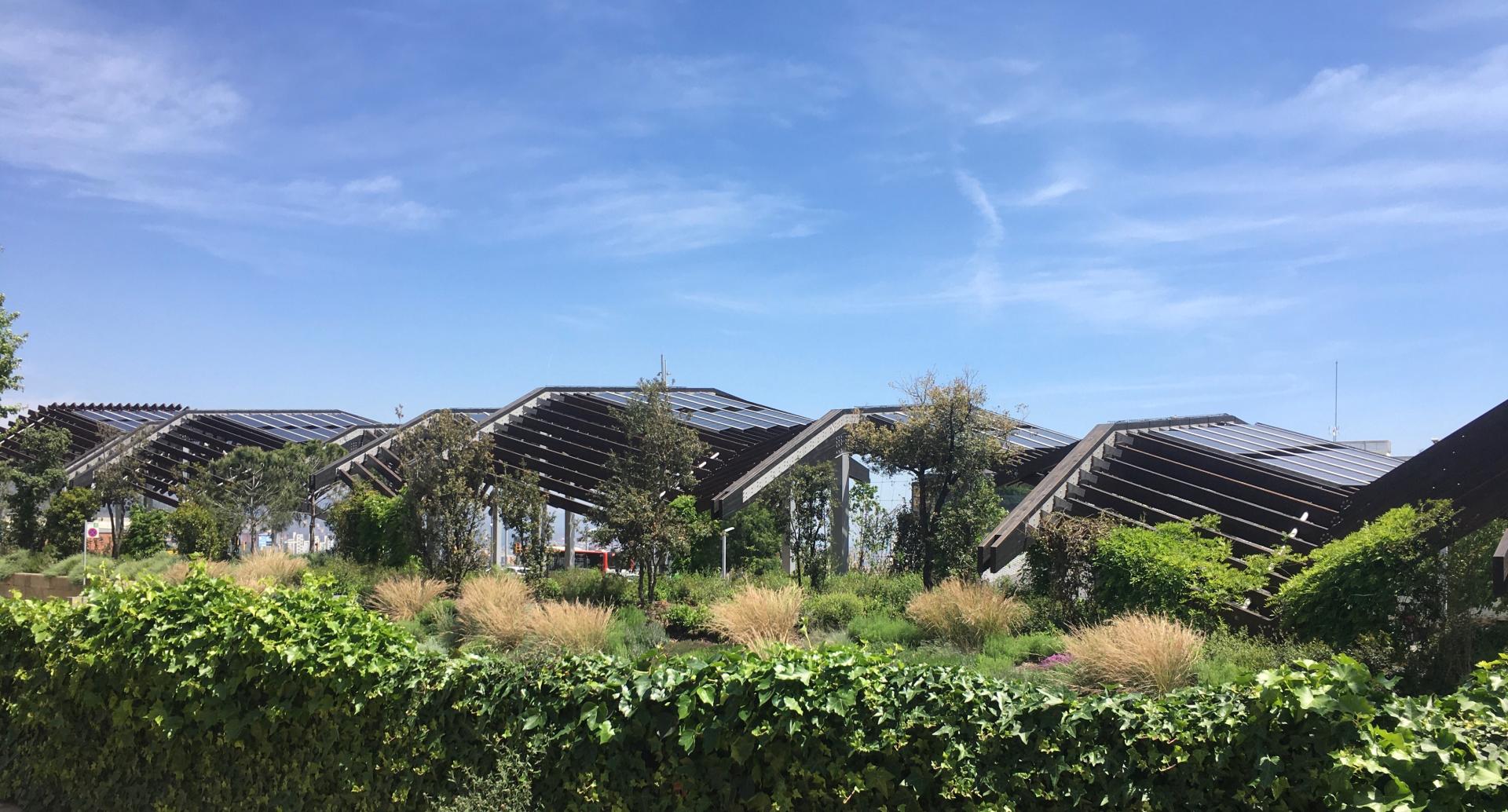
Three wooden pergolas complete the new public space, creating a shaded space that allows vegetation to spread and green invade much of the structure. The largest pergola incorporates a photovoltaic installation, with an installed power of 43 kW. The energy generated by this pergola will be used for self-consumption by the municipal market located right next to the square, thus improving the quality of the city's public facilities.
Key objectives for aesthetics and quality
The strong asymmetry of the environment, due to the presence on the mountain side of the Vall d'Hebron enclosure, practically along its entire length, allows an asymmetric section to be enhanced. A strip of vegetation of variable width on the mountain side becomes an ecological connector between the Collserola Park and the different green spaces around the Ronda, extending the Mediterranean forest landscape of the Sierra over the new civic artery.
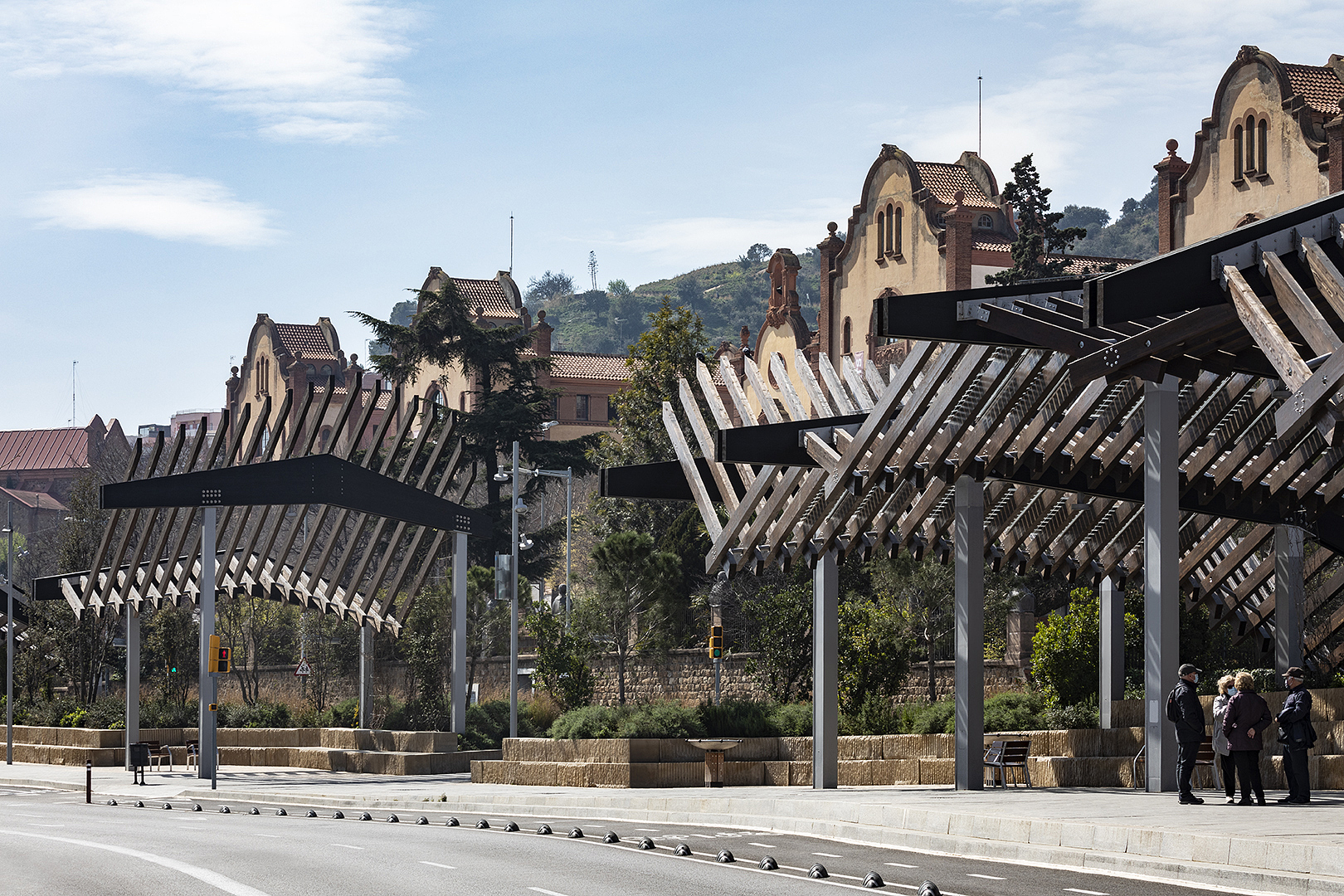
A linear garden of autochthonous species will allow us to re-naturalize this part of the city gained from cars, making it healthier. Accompanying the vegetation, some stone steps from a nearby quarry create different meeting spaces, where the citizen can evade the noise and the intrinsic speed of the city, to really feel in a space of pause and connection with nature.
The folds that characterize the wooden structure generate south-facing planes on which the different groups of photovoltaic panels have been placed. A total of 580 m2 have been covered with 218 transparent modules. The installation of solar panels with double glass gives them a light appearance, while maintaining transparency and continuous vision of the sky from the square. These solar panels, oriented to optimize the incidence of the sun, generate a broken shadow on the promenade.
Key objectives for inclusion
The new public space in the Ronda de Dalt represents a direct pedestrian connection between the neighborhoods of La Teixonera and Sant Genís with the rest of Barcelona, and especially with its immediate surroundings. Until now these neighborhoods, located in the highest area of the city, were practically isolated, making life extremely difficult for their neighbors, whose age group is in the elderly.
The new connection facilitates the transit of pedestrians, connecting the neighborhood with two important public facilities such as the Market and the Vall d'Hebron Hospital.
In addition, all the space generated is fully accessible, solving the urbanization through a single plan that does not have barriers or obstacles for any citizen. In addition, special attention has been paid to the design of the green area to ensure that it complies with the requirements of gender and inclusive urbanism, avoiding the creation of hidden spaces, dead spots or dark spaces, creating a safe public space for everyone.
Results in relation to category
The Ronda de Dalt square is located at the crossroads between the Market and the Hospital, connecting two neighborhoods hitherto isolated by the road. The square generates a meeting space equipped with shade, which is designed for the location of markets, fairs and neighborhood festivals. The space has the electrical installation necessary to connect the stalls of a weekly market and has the ideal dimensions and location to generate all kinds of public and community activities.
Along the walk, different types of uses are also incorporated. Several generational games, located in the small squares created by the route, allow the elderly to enjoy themselves.
The placement of children's games with colored pieces on the pavement means that the little ones can also find a leisure place in this new space, together with the living and rest areas that allow them to sit along the entire length of the new pedestrian axis.
How Citizens benefit
Since its inception, the project has actively incorporated the residents affected by the intervention. Through participatory meetings, the concerns and needs of citizens have been incorporated into the design process, jointly analyzing the entire urban environment to find the most appropriate uses and elements to meet all the needs of the neighborhood.
Innovative character
A new public space is designed in line with the climate emergency despite the technical conditions of the road infrastructure.The new coverage of the Ronda and its urbanization is a clear example of urban recycling,where the demands and demands of the city change,and with it its spaces.It is an innovative example because it maximizes green and shading areas in the new spaces gained,it brings Collserola closer to the city to improve urban and indigenous biodiversity,it uses natural materials to make a friendly and sustainable public space and energetically it compensates the construction by converting the city in a productive landscape.
For the materialization of the new civic axis,aware of the weight that architecture has in the climate emergency,we have opted for materials that allow us to carry out a sustainable and healthy development of our cities.The pergolas of La Ronda,unique in the city for size and format,have been a challenge when building them,based on an innovative design on one of the most representative infrastructures in the city.
For the materialization of the pergolas,we have opted for wood,a natural,sustainable and renewable material that has excellent technical qualities for use in practically any type of construction.But their use not only improves the quality of our cities,but also increases the forests used for their production, improving their maintenance and favoring rural employment.The selected wood is European larch pine,one of the strongest and highest quality woods available for the construction of structures in Europe.It is a wood found in the north of the Iberian Peninsula,in France and in the center of the continent,avoiding the importation of tropical woods.The vertical cut ends of the beams and the placement of an upper finishing piece,protect the points most susceptible to water ingress,preserving the material from deterioration.In addition, the stainless-steel joints ensure the maximum durability of the structure.