Freezone
Basic information
Project Title
Full project title
Category
Project Description
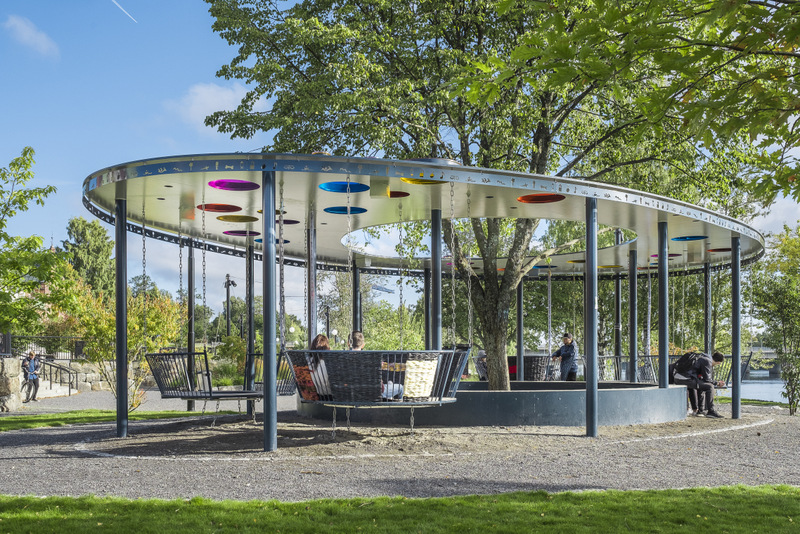
Freezone (In Swedish “Frizon”) is one of Sweden's first public outdoor environment that focuses on young girls taking place in the public space. Through dialogues between young girls in Umeå, the city administration, architects, designers and builders, the girl’s ideas and design have resulted in an equal and including meeting place “without expectations”, for everyone to enjoy for socializing and hanging out.
Project Region
EU Programme or fund
Description of the project
Summary
Young girls are an underrepresented group in spontaneous sports and activity areas and other public spaces. They are also underrepresented when it comes to participating in dialogue on urban development projects in public environments. In the work with the new "Seasons park", the municipality therefore, with special support from the National Board of Housing, Building and Planning, reached out and asked young girls in Umeå how they experience public space; about expectations, justification, security and about taking and giving space.
The municipality worked together with girls from a high school class, girls who were contacted via the municipality's field group and girls from cultural program UNIK, where interpreters were used. The girls were invited to describe their experiences of the public space, and to discuss and think about situations where they felt safe and insecure in a public environment. During the project, a number of workshops were conducted, focusing on dance, photography and other artistic expressions.
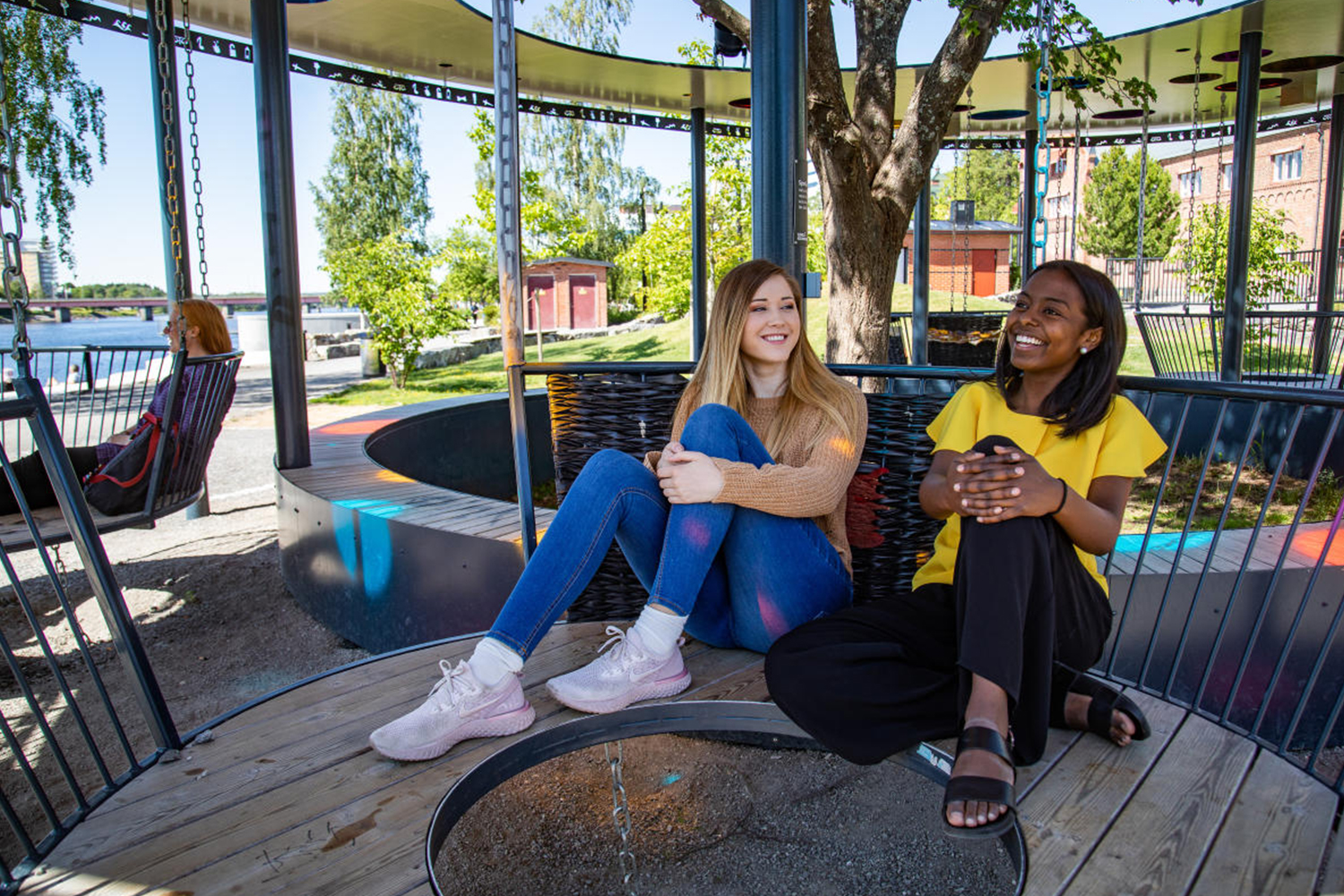
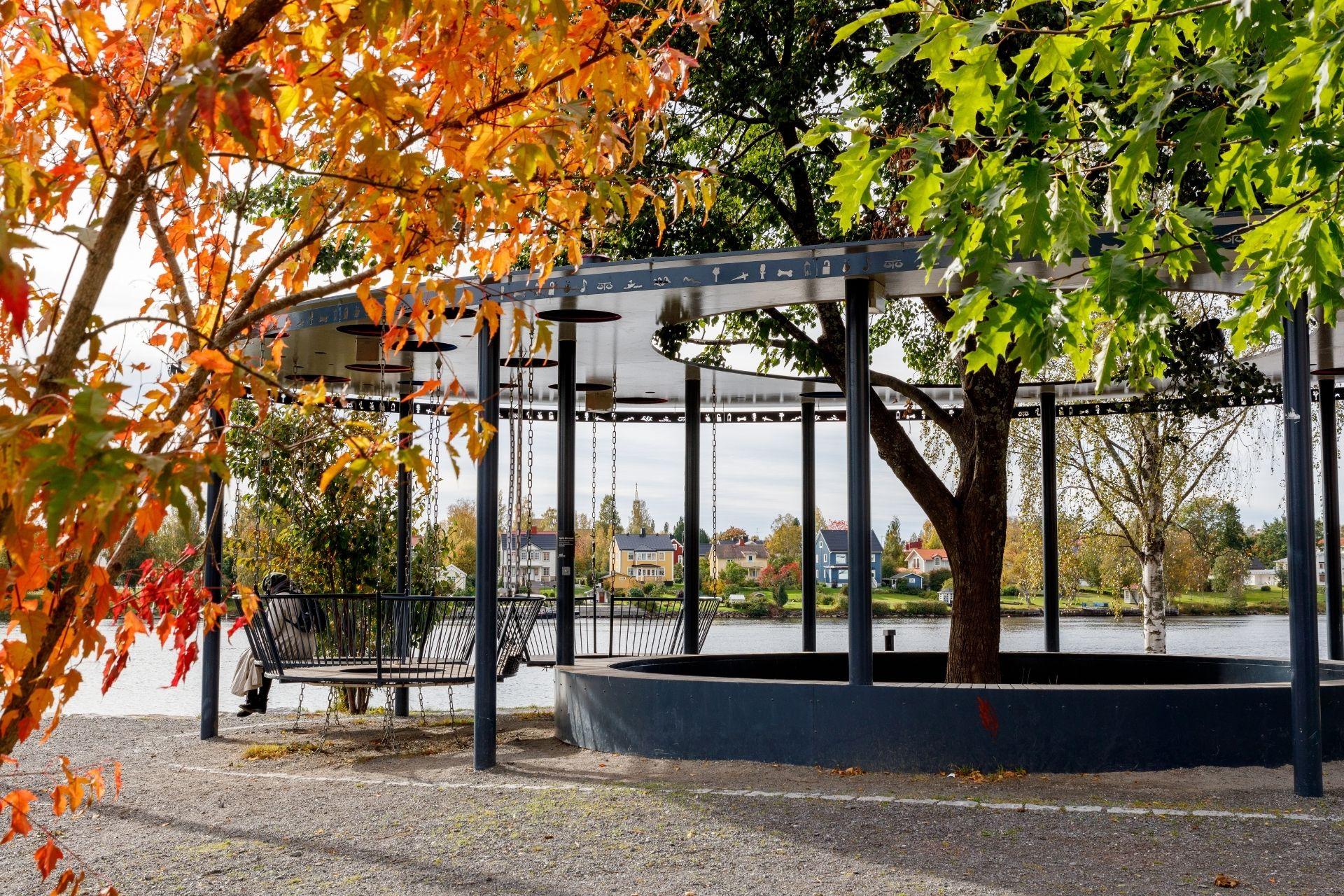
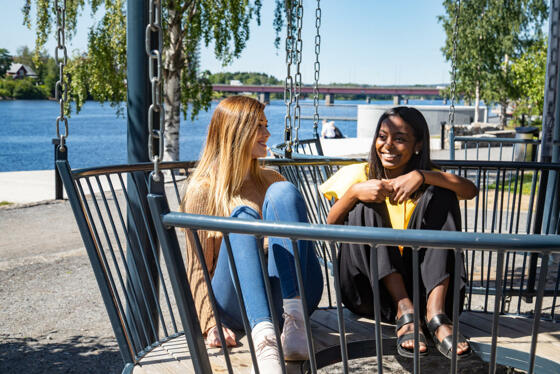
The results of the work with the young people have formed the basis for the design of the meeting place in the park. They worked with visibility, lighting and proximity to other nearby spaces used by people. Frizon is a meeting place to socialize, with seating and hanging areas, electrical outlets, wifi and the opportunity to listen to music through speakers. The Freezone has been given a carousel-like shape. A pattern with symbols made by the participants has been placed under the steel roof as a “floating edge”. The symbols represent the girls' own imprints on the physical place. All steel in the construction has been painted in a Parisian blue color. The roof has been stained with plexiglass for light. Under the roof there are hanging swings and a bench – made to fit a person of average height for women in Sweden (164 cm). In this way, the body of a young women is made the “public norm”.
Key objectives for sustainability
The work with Freezone was part of a national project "Gender equal public spaces" with the purpose to develop methods for dialogue that challenge traditional structures in society with claims to public space.
Many public spaces in the city tend to focus on activities and sports. While these public spaces are positive and well used, it is also a fact that they are most used by boys and young men and young girls are (sometimes heavily) underrepresented. This fact, together with the basic fact that everyone (through taxes) contributes to the building of the city, and the ambition that everyone should have at least one favourite public space where they feel safe and welcome, the city of Umeå decided to think in new ways. With Freezone, the key objective was to enhance social sustainability in the city center by creating a public space free from expectations, fears and insecurities, where EVERYONE (including boys and men) should feel welcome and included to use it.
The result from observations of Freezone (made by Klara Hellgren, SLU, in her essay Teenage Girls’ Public Places – A Case Study of Frizon in Umeå) shows that "the most common activities among teenage girls is to sit on the swing seats, talk, listen to music and eat. The most common activities among teenage boys is to climb, sit or stand, talk, listen to music and to play. The observations also show that Frizon is used by several age groups and genders during the day. In the afternoon, the teenagers are in majority and at sunset there are only teenage girls in Frizon. The teenage girls' evening visits indicate that Frizon is perceived as a safe place. Conclusions that can be drawn from the results are that Frizon is an equal place since it is used by both boys and girls, and that Frizon's design principles attract people of all age groups."
Key objectives for aesthetics and quality
The procurement for the builder and architect was based on the results from all the discussions and dialogues held with the young girls, in order to clarify the basic requirements for the design of Freezone. The place (Freezone) was also to be designed with high artistic quality and thus the requirement in the procurement was also that an artist and a lighting designer should participate in the working group. The role of the design would be to contribute to creating a unity in the new park landscape along the river, Umeå's new front, and provide social and aesthetic added value in the city. Freezone would be designed with security in mind, e.g. visibility, lighting, proximity to other areas with other people etc. Tyréns AB was selected, in collaboration with the artist Kerstin Bergendal, to construct and design the meeting place based on the dialogue work and the vision Freezone - an equal place.
We believe that the objectives of Freezone has been achieved – also in terms of aestethics and quality of experience. Gender issues was worked on with the help of norm-breaking art and image for a more inclusive dialogue in the planning process. An important result was the working method of reaching out to and engaging young girls in the conversations about the development of the city's public spaces. The target group's ideas, thoughts and suggestions clearly affect the design of the meeting place. We have gained new experiences and knowledge about young women's experiences of the city that will be useful in other similar projects. Through the experience exchange meetings within the city administration and other internal and external people who have been linked to the project, awareness of gender equality issues in urban planning has increased.
Key objectives for inclusion
The project with Freezone was all about social inclusion and sustainability, striving to give everyone the right to have at least one public space in the city where they felt welcome and safe, and to be able to influence how the city is being built.
The method chosen in order for the target group to influence the conversation and the result was based on an open discussion climate and norm-breaking wokshops based on the target group's own experiences and experiences. Another important result is that young girls in Umeå have had the power and influence to influence the design of a public urban space. According to the girls themselves, the approach to gender equality as a starting point in dialogue has provided increased understanding and knowledge of how norms can limit their existence, and well-being, in the city's public spaces.
The young people we met often previously assumed that it was they themselves who would change, in order to better manage perceived unsafe places in the city that they preferred to avoid. When the discussion instead was about actively changing the environment, imaginative solutions were often given on how unsafe places and situations could be removed and / or prevented.
Freezone has also increased the understanding of the importance of finding new ways and daring to experiment to reach other target groups in the urban development process. We hope that the internal work with experience meetings and internal dissemination of the project has increased awareness of our own (the city administration) approaches in the dialogue work.
Results in relation to category
Freezone developed a public space for everyone, but with focus on girls and womens participation and inclusion in the city. The development of the method for citizen dialogue was named “inclusion by exclusion”, since it excluded those who normally participates in citizen dialogues and included those who normally did not (young girls). The method has contributed to new routines and insights of young girls' experiences of the city and the public space. It also increased the understanding of the importance of finding new ways and daring to experiment to reach other target groups in the urban development process. The city administration’s internal work with spreading experiences and knowledge from the work with Freezone has increased the awareness of city administrations approaches in the dialogue work.
Freezone is designed to be a “safe place” and “without expectations”. One of the most important design aspects for the architect, put forward from the target group, was the ability that the girls wanted to “be able to see others, but not self be looked upon” in the public space. The girls didn’t want boys to look at them. A roof was put on top, and the design is therefore transparent (no corners or places to hide), and the lightning is regulated according to on stage, off stage and back stage. One of the most important design principles for the target group, was that the public place shouldn’t be perceived as “girly”. That’s why it was painted in Parisian blue.
Even though Freezone was designed from your girls’ perspective, it is used by all kinds of people all year round. In that sense it is an equal place in the city. One conclusion from this is that design principles that attract teenage girls, and that have been developed together with them, leads to creating more equal public places.
How Citizens benefit
Freezone was all about including a group that usually didn’t participate in citizen dialogues in the design of new public spaces. Totally around 30 young girls participated in the dialogue around Freezone, and their views formed the underlying design principles in the the design- and building process. One concrete example of their imprint on the physical place is the pattern with symbols made in workshops during the dialogue, that has been placed under the steel roof as a “floating edge”.
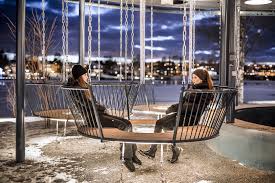
Girls and boys use Freezone in different ways; the majority of girls sit in the swings, talk, listen to music, eat, while the boys climb the tree and the roof, run and plays, and also listen to music and talk. In the middle of the day, all age groups are represented.
Innovative character
The built environment affects. The city is both exciting and scary and the experience varies during the light and dark hours of the day. Where we stop to stay in the city space says something about how the urban environment is experienced. The public environment is an arena where gender roles are created and recreated. The park is important for young people’s creation of their identity, by watching, and being looked upon, by others. The common vision for Freezone was to create a place free from expectations, fears and unsecurity.
The dialogue method used for Freezone is called “inclusion by exclusion”. This separatistic method, where boys and men were excluded from the dialogue, is not the most common citizen dialogue. It did however result in an equal public place now being used by everyone, all year around.
With gender equality as a method, we have reached a greater depth in questions about, for example, the participants' experiences of expectations of young girls in the city and how a good place in the city is planned. Through their participation, the city has developed a straightforward and open form of dialogue receptive to the unexpected by controlling the conversation as little as possible. The purpose is not to influence the participants' thoughts with a specific end result in mind, or guide their ideas around the design of an equal place. The approach is based on that the participants should feel involved in the process. All workshops, discussions and visions about an equal place has largely been about inspiring the participants to design and steer the dialogue forward themselves. The hope was that it would give the participants greater freedom to vision and fantasize about the design of an equal place.
The method and process has been developed with support from the National Board for Housing, Building and planning.