Gollierstrasse
Basic information
Project Title
Full project title
Category
Project Description
At Gollierstr. 86, 86a, 84, 84a - c and Westendstr. 151, two neighbouring properties in Munich, GWG München, has realised a district development, which changed an outdated housing situation with an unattractive courtyard to a modern, lively ensemble with high living- and open space-quality. The six buildings, including a new elemented-timber construction, offer 73 rental apartments, three retails units and two artists’ studios with a total of 5,165 m2 of living space and 326 m2 commercial space.
Project Region
EU Programme or fund
Description of the project
Summary
With over 30,000 apartments, municipally held GWG Städtische Wohnungsgesellschaft München mbH is one of the largest housing associations in the Munich area. In the tense housing market, GWG Munich creates high-quality, inexpensive and sustainable apartments and takes care of the renovation and modernization of their facilities. In addition, GWG Munich supports the state capital Munich in urban development with ecological and innovative model projects.
Object description
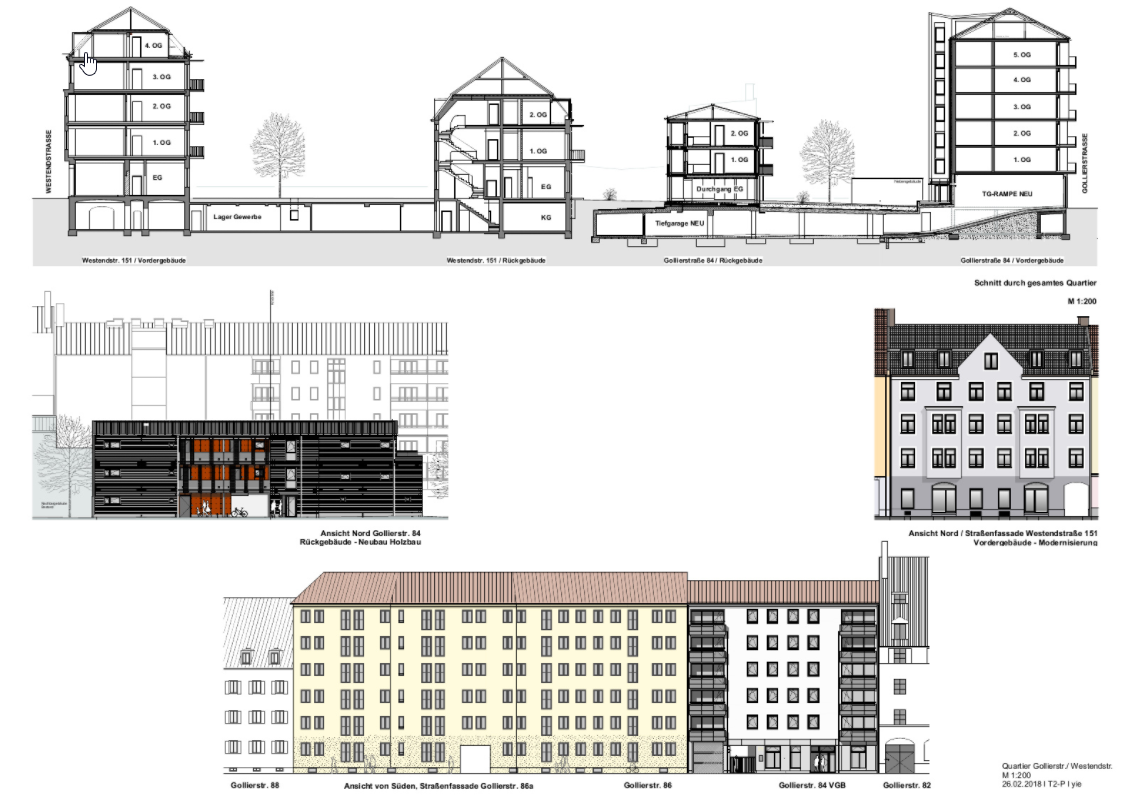
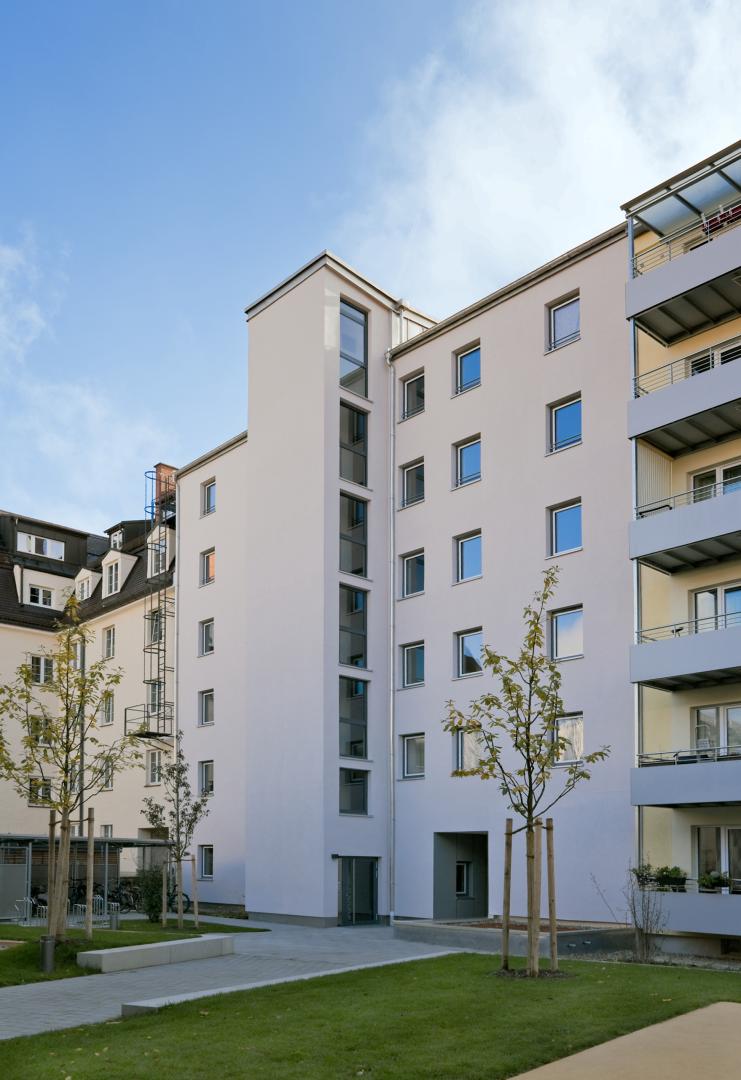
At Gollierstrasse 86, 86a, 84, 84a - c and Westendstrasse 151, two neighbouring properties in Munich, GWG Städtische Wohnungsbaugesellschaft München mbH, has realised a district development, which changed an outdated housing situation with an unattractive sealed- surface courtyard to a modern, lively ensemble with high living- and open space-quality. The six buildings, including a new elemented-timber construction, offer 73 rental apartments, three retails units and two artists’ studios with a total of 5,165 m2 of living space and 326 m2 commercial space as well as 31 underground parking spaces. The residential complex on Westendstrasse and Gollierstrasse was built by GWG München in two sections between 2015 and 2017.
Urban development
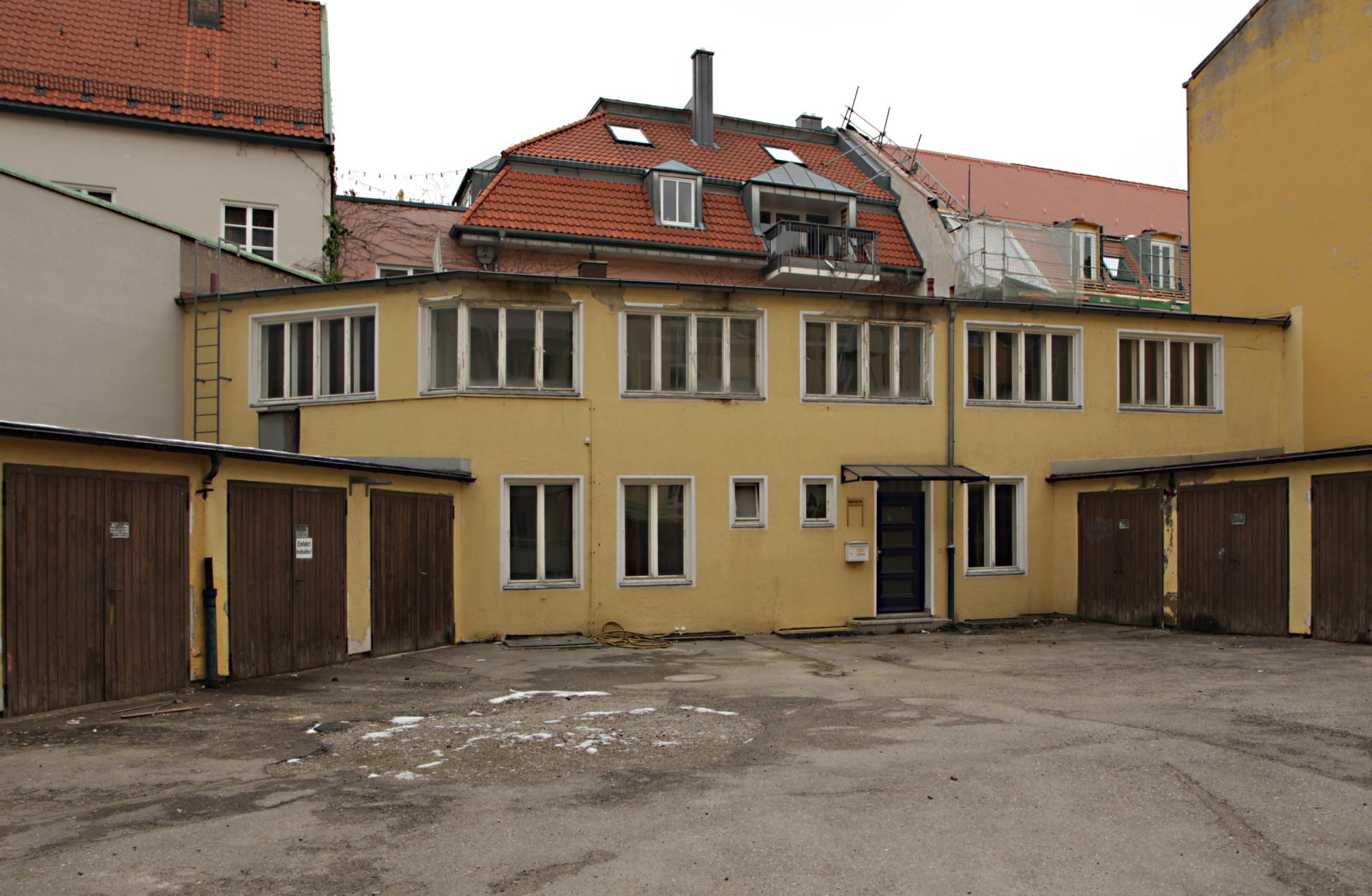
The two properties were sharing a boundary between their courtyards. Both yards were accessible via drivable passageways and were in both cases completely sealed and only used as traffic or storage areas. The inner courtyard at Gollierstrasse contained two smaller commercial buildings, ripe for demolition, as well as a small underground car-park.
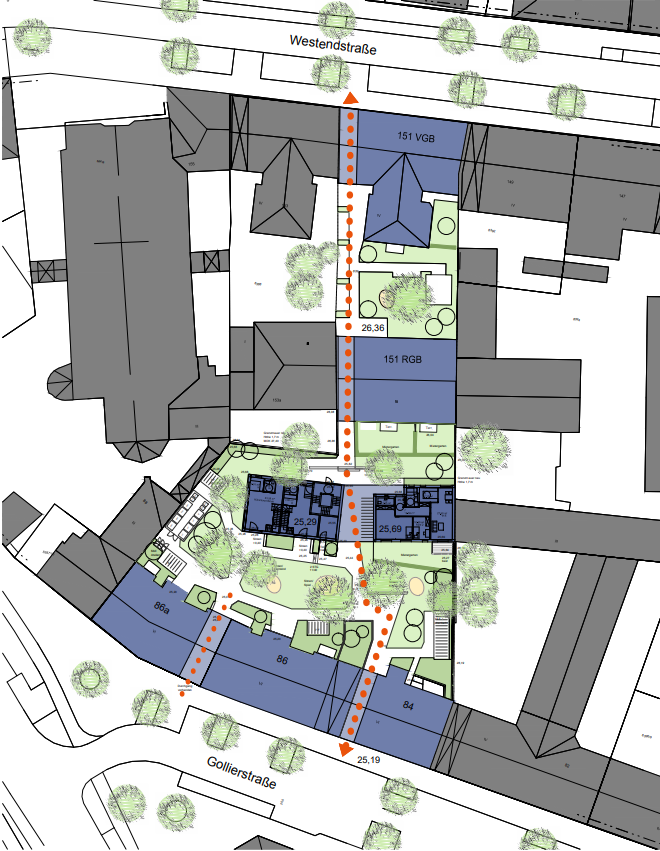
The two building groups Westendstrasse 151 and Gollierstrasse 84-86 had no spatial or urban development relationship to one another. Both courtyards were without open space-quality and without greening. The overall idea was a barrier-free neighbourhood connecting Westendstrasse directly to Gollierstrasse, a car-free environment with a continuous open space between the buildings
Key objectives for sustainability
Before the modernization, the heating supply for all buildings came from fossil fuels. In the course of the project, heating was rearranged to district-heating. The modernization of Gollierstraße 86, 86a (built in 1957) was implemented according to EnEV 2009, designed as an efficiency house 70, on Gollierstrasse 84 (year of construction 1964) according to EnEV 2014, Westendstraße 151 (year of construction 1900) according to EnEV 2016 for existing buildings with essential component improvements. The new building in the courtyard of Gollierstrasse is an ecological wooden building in massive construction with a CO2-consumption of only 7 kg / (m²a) and an annual primary energy requirement of only 11 kWh / (m²a).
The open space concept was developed from the ideas of an overall urban planning concept. It provides a mix of private tenants' gardens, a new organization of ancillary areas ideal for bicycles, new play areas and seating opportunities that invite residents to stay and linger for a while. The greening concept with trees, bushes and lawns in the now unsealed courtyard area also increases the quality of stay.
Key objectives for aesthetics and quality
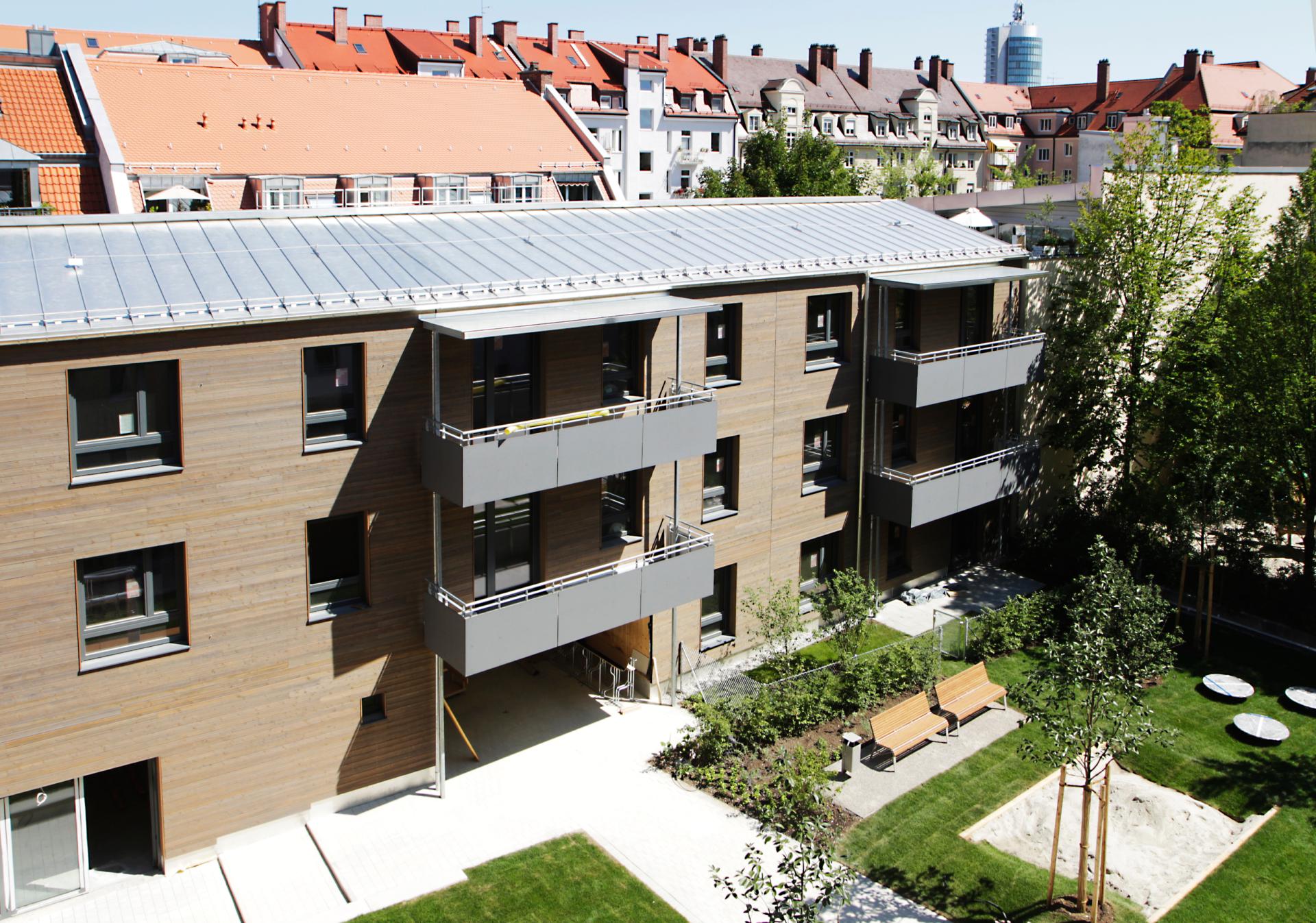
The existing buildings were modernized and a new wooden building with an underground car park was added. The apartment mix ranges from 1-room apartments with 30 m² to 4-room apartments with 114m² for families. Except for a few construction-related exceptions, all apartments have new balconies, mainly oriented towards the quiet inner courtyard.
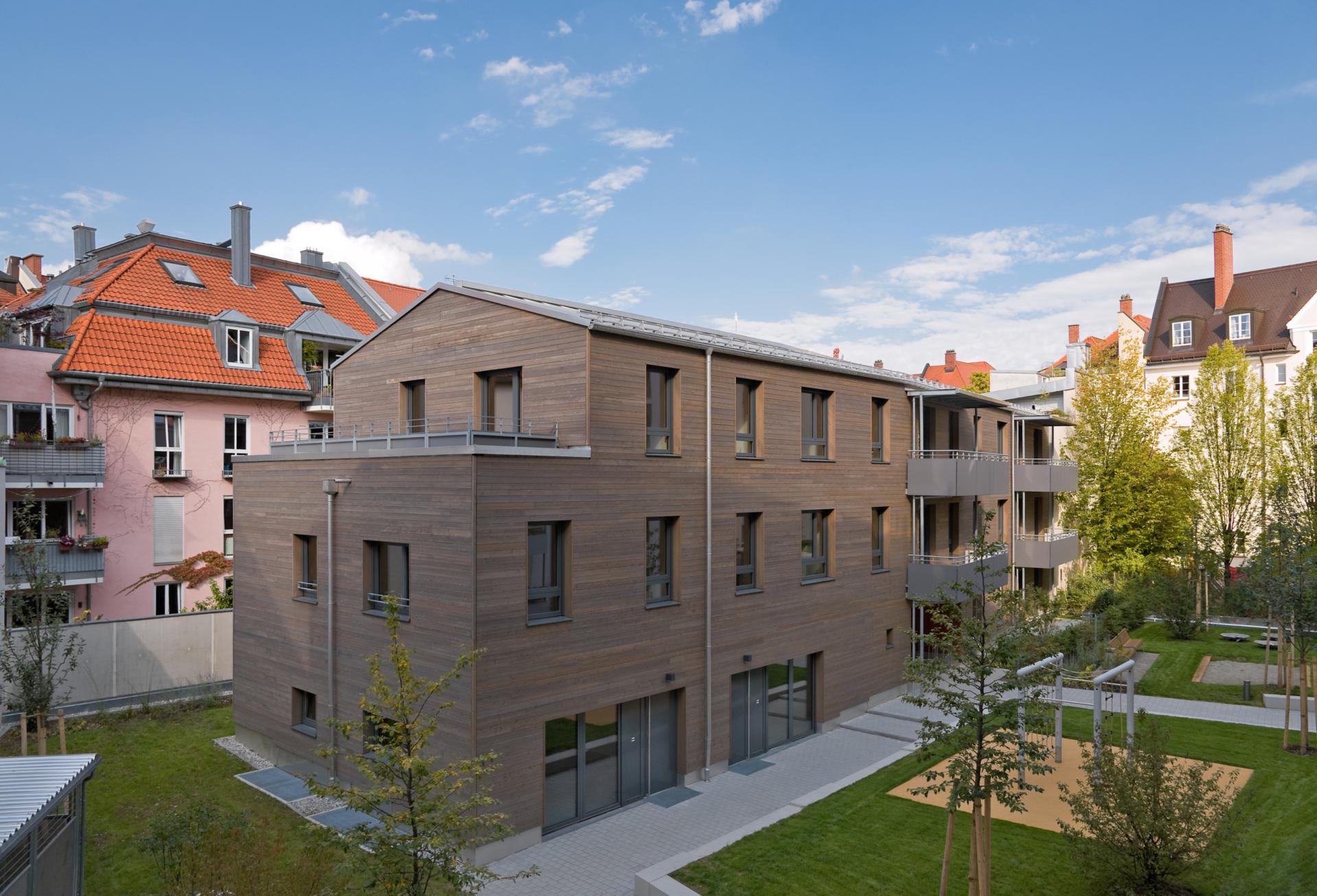
The additional three-storey timber constructed building, situated in the courtyard of Gollierstrasse and moved away from the existing buildings, improves illumination and strengthens the open space-quality in the court-yard.
The old asphalt surfaces in the inner courtyards were removed in favour of lawns, bushes and shrubs. Various large trees provide shade in summer. The originally separate and from an open-space perspective unusable courtyards are now connected, so that all residents can stay there together.
The new quality of stay in the inner courtyards is outstanding. The now green areas without car traffic create the possibility of lingering for a while, meeting of generations and a general improvement of communication opportunities within the neighbourhood.
Key objectives for inclusion
The different apartment sizes offer a possibility for living in the buildings at all stages of live. In addition, by installing elevators in four buildings on Gollierstrasse, the apartments are mostly barrier-free or low-barrier usable. The bathrooms of 50% of the apartments are also barrier-free, as is the crossing of the courtyards between Gollier- and Westendstrasse.
The new courtyard-concept with play- and sitting areas invite different generations to meet and engage with each other.
Results in relation to category
Before the modernization, the courtyards of the two properties were completely sealed and unattractive for the residents except for parking and storage purposes. Even two existing commercial shacks were ready for demolition and no longer in use. This space was a rather sad example for sealed inner-city space.
The asphalt surfaces in the inner courtyards were removed in favour of seating areas, play equipment, lawns, bushes and shrubs. Various large trees provide shade in summer. The originally separate and unusable courtyards are now connected, providing a large common area for all residents.
The new quality of stay in the inner courtyards is outstanding. The now green areas without car traffic areas, create the possibility of lingering for a while, meeting of generations and a general improvement of communication opportunities within the neighbourhood.
How Citizens benefit
With a view to sustainability green spaces in inner cities reduce air pollution, environmental noise and improve the climate. Potential for exercise, encounters with fellow humans and other outdoor activities have a health-promoting effect. “The greener the cities, the higher the quality of life” - sealed surfaces, as they existed before the project, prevent all of these. The special focus in this project was therefore the development of an attractive and green courtyard for residents and neighbours within an inner city block-development.
Innovative character
This project transformed neglected to valuable space in an innercity ensemble. Since the original buildings were built – in case of Westendstrasse 1900, for Gollierstrasse in 1957 resp. 1964 - these inner courtyards had only been considered for traffic or storage. After completion it is a showcase for greening such spaces while still providing parking spaces.