Ruins of Livonian Order castle in Dobele
Basic information
Project Title
Full project title
Category
Project Description
Preservation and development of significant cultural and historical heritage for the improvement of cultural tourism offer in Latvia /Zemgale region has resulted in conservation and reconstruction works of the national architectural monument - Dobele Livonian Order Castle Chapel - to create and offer new services to residents and tourists. The castle mound of the Livonian Order of Dobele, together with the ruins of a stone castle, is the oldest and most important evidence of the history.
Project Region
EU Programme or fund
Which funds
Other Funds
Dobele municipality has attracted European Union funding for the implementation of the construction project Dobele Livonian Order Castle Chapel Wall Restoration within the framework of the specific support objective 5.5.1. “Preservation, protection and development of significant cultural and natural heritage, as well as development of related services”, implementing the joint cooperation project “Preservation and development of significant cultural and historical heritage for improvement of cultural tourism offer in Zemgale region”. funds from the local government, taking a loan from the Treasury, as well as from the state budget.
Implementation year 2018-2021.
Description of the project
Summary
Preservation of cultural and historical heritage is essential in the context of future generations, which gives everyone the opportunity to get acquainted with the uniqueness of the object by learning stories. The conservation of the chapel combined the sustainability and authenticity of the heritage. Dobele municipality has been carrying out conservation work on a regular basis since 2002, and in 2004 it invited residents to discuss the further development and use of the object in the creation of cultural products and the creation of a sense of community. Combining old masters and new technologies, a solution was found to create a space in the ruins of modern materials, preserving the existing silhouette without interfering with the old. For the preservation of the masonry parts, mainly conservative works and local restoration were performed in the construction part, where technical preservation was essential for human safety. Maximum attention was paid to the preservation of the plaster, which is one of the very important special values of Dobele castle ruins in the context of other similar Latvian objects. The new constructions and surfaces are subordinated to the set of historical elements, neutral, with plaster finish. The interior uses a carved stretched metal mesh, which is used in the handrail elements, the perforations of the roof terrace level exterior wall are designed in a lattice to guarantee the safety of visitors. Working on the upper surfaces of the chapel walls, which will remain exposed to the atmosphere even after the completion of the construction works, a unique, as the author himself said, “Gaudi style” formation was found - a concrete shell cover. As a result of the solution, all walls were covered by marking the planes horizontally. Architect Pēteris Blūms emphasized: "Reviving the ruins is a challenge to the modern mentality.
Key objectives for sustainability
During the construction works, archaeological research of the walls, conservation and construction of new infrastructure were performed. The castle walls were first preserved, as well as the critical losses were restored, which was detailed by the author's supervisor together with the direct performer - the conservator. The new constructions and surfaces are subordinated to the set of historical elements, neutral, with plaster finish. The interior uses a carved stretched metal mesh, which is used in the handrail elements, the perforations of the roof terrace level exterior wall are designed in a lattice to guarantee the safety of visitors. Working on the upper surfaces of the chapel walls, which will remain exposed to the atmosphere even after the completion of the construction works, a unique, as the author himself said, “Gaudi style” formation was found - a concrete shell cover. As a result of the solution, all walls were covered by marking the planes horizontally.The silhouette of the building acquires a new element - the western wall is completely covered by a roof and a vertical accent above the remains of the walls of the southwestern tower. At the beginning of the strengthening of the walls, new elements were discovered, the preservation of which is an important testament to history for future generations. This solution will complement the preservation of previously unknown relic elements of the walls of the upper part of the western wall of the chapel ruins.
Key objectives for aesthetics and quality
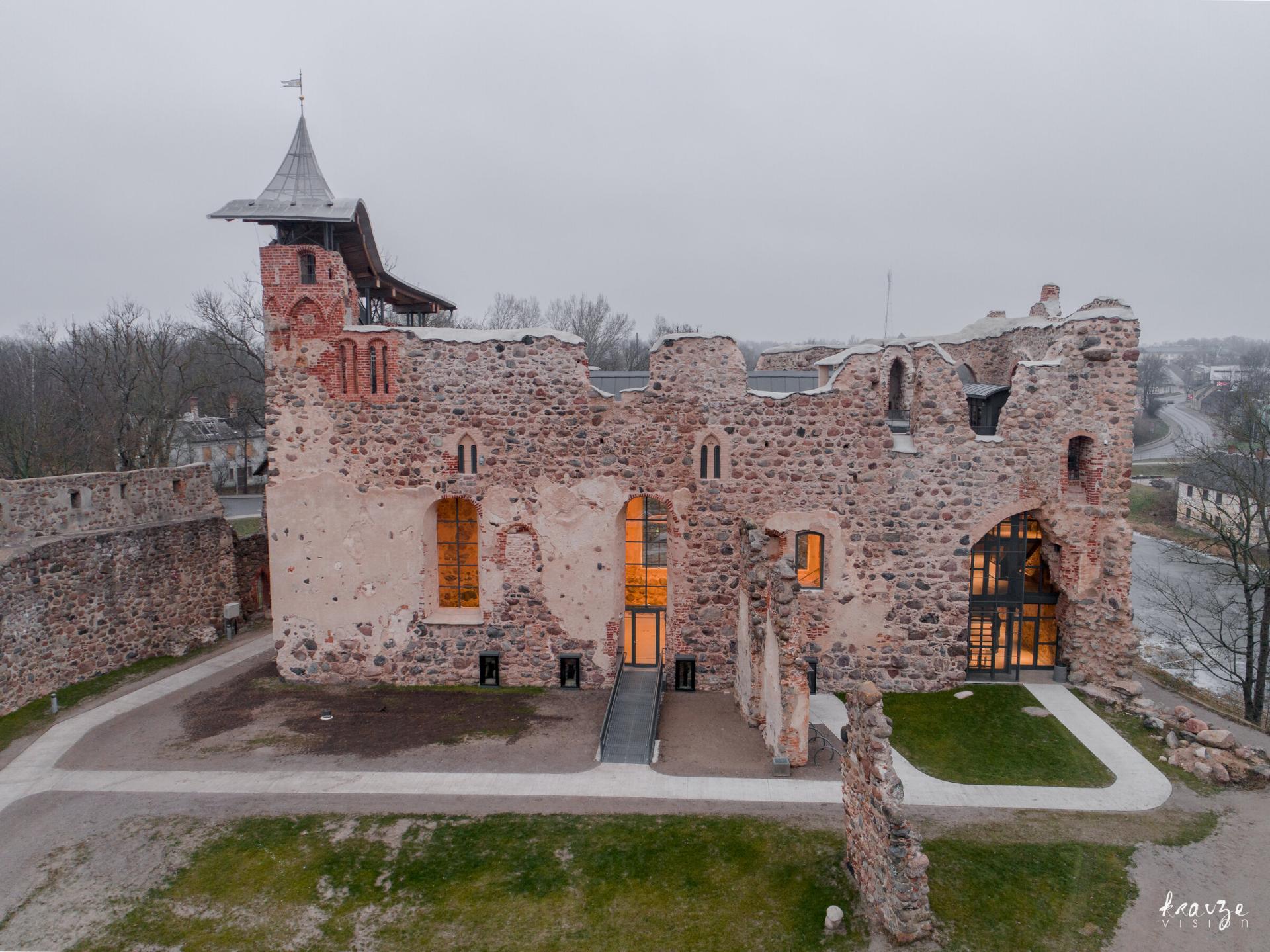
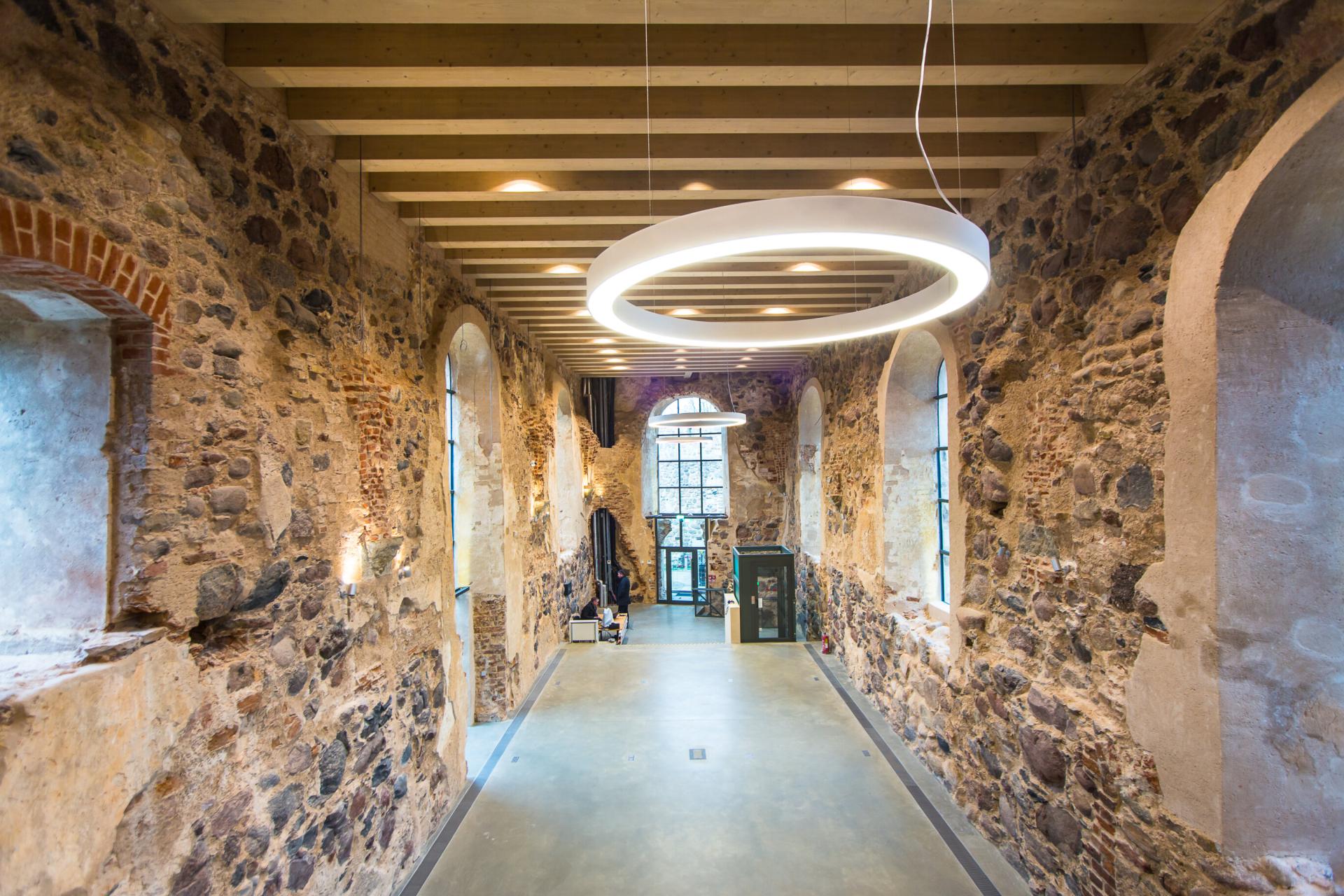
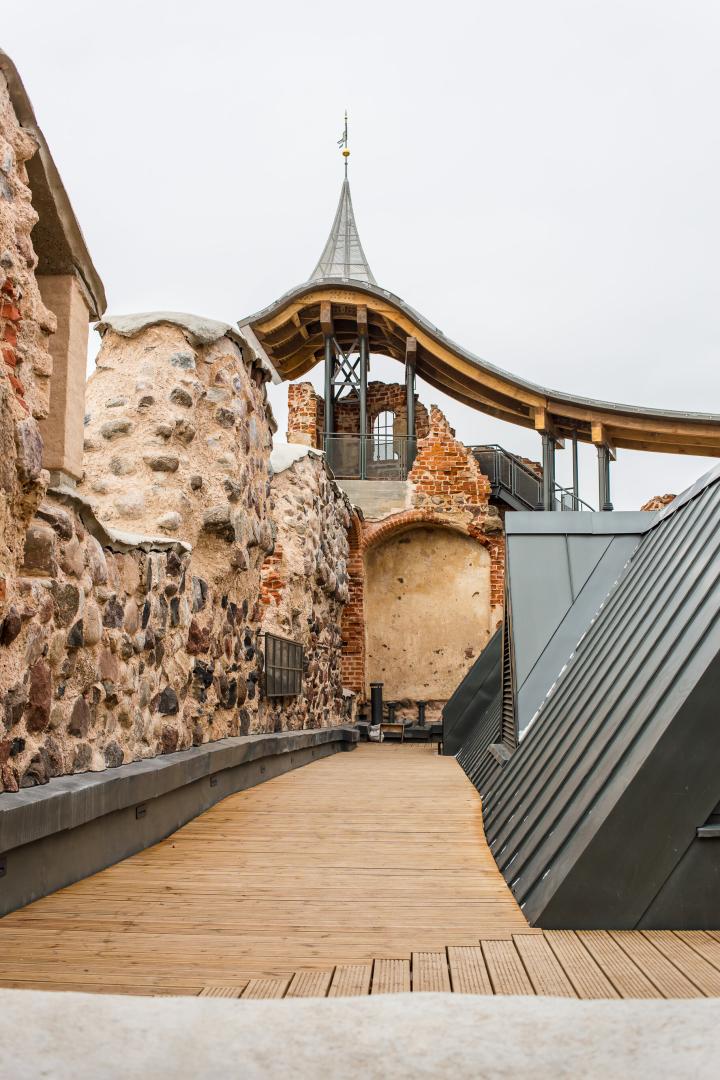
The chapel of the Livonian Order castle has partially regained its shape and turned into a modern building surrounded by ancient walls with exhibition halls and a viewing area on the roof. The development of the project and the acquisition of construction permits took 15 years, with periodic interruptions. The subsequent construction work was finished in three years. The revitalized ruins will house Dobele Castle museum, an information center, and a multifunctional conference hall. There are museum galleries and technical premises, as well as public toilets, in the basement. Wheelchair accessibility is provided on the ground floor and basement levels. The roof terrace level accommodates the heating and ventilation equipment, while also providing views of the surrounding landscape. Extensive use of glass and expanded steel constructions provide a sense of transparency and lightness. The western wall rooftop layer and the turret spire are made from stainless steel expanded mesh symbolizing a gently placed veil. The former chapel’s sanctuary hall is transparently whitewashed, yet monumental. The dangerous ruins have been replaced with a contemporary space with an authentic stone wall shell providing modern functions, design, and comfort. In addition, now it is possible to examine this architectural heritage site up close, by visually and tactilely exploring previously inaccessible places and artifacts. This is comparatively new and unique ruin preservation and rehabilitation concept.
Key objectives for inclusion
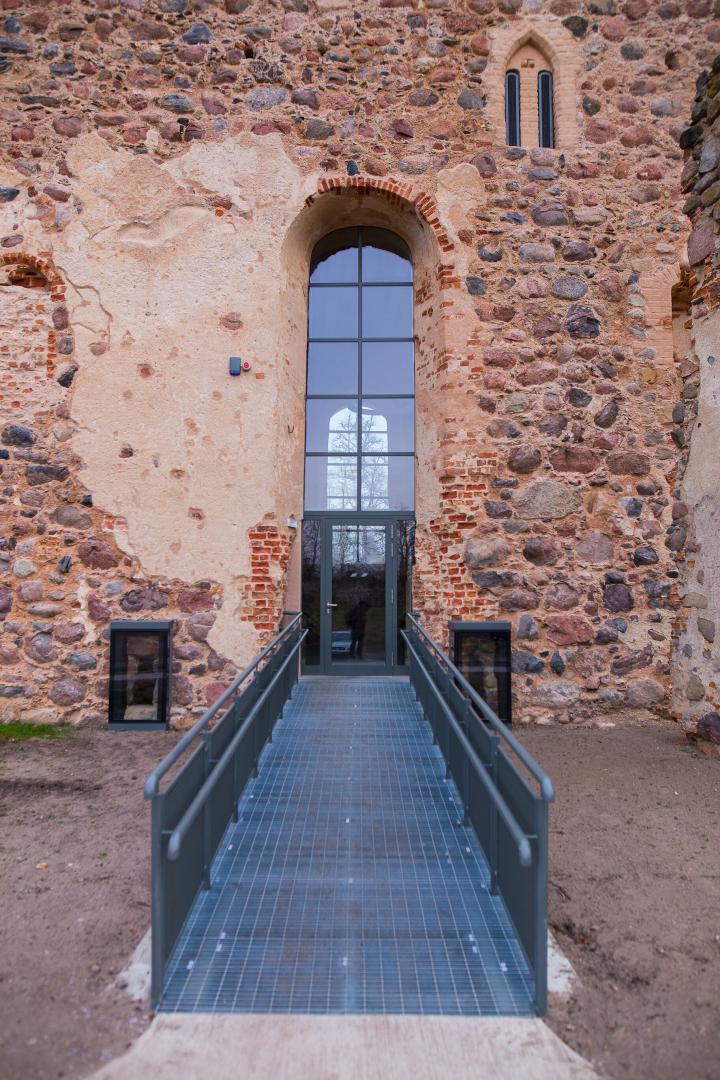
Within the framework of the project, only all possible environmental accessibility solutions have been developed. The complexity of the building, the uneven walls, and the available space was a big hassle for the designer, however - a platform for the disabled has been built, which ensures the accessibility of the environment in the basement and the ground floor. Braille pattern on the railing supports. There are also ramps and a separate entrance on the east side of the building.
The dangerous ruins have been replaced with a contemporary space with an authentic stone wall shell providing modern functions, design, and comfort. In addition, now it is possible to examine this architectural heritage site up close, by visually and tactilely exploring previously inaccessible places and artefacts.
Results in relation to category
In 2002, the architect Pēteris Blūms came up with what was then a daring idea for the preservation of the castle’s main dominant, the ruins of the chapel. He proposed to protect the existing stone wall shell of the building and its former interior elements by conserving its remains, removing rubble and earth from the basement, reconstructing the floor and roof structures between the building’s walls, and connecting the building to the city’s utility services, while still preserving the character of the castle’s former chapel. The development of the project and the acquisition of construction permits took 15 years, with periodic interruptions. The subsequent construction work was finished in three years.The revitalised ruins will house Dobele Castle museum, an information centre, and a multifunctional conference hall. There are museum galleries and technical premises, as well as public toilets, in the basement. Wheelchair accessibility is provided on the ground floor and basement levels. The roof terrace level accommodates the heating and ventilation equipment, while also providing views of the surrounding landscape. Extensive use of glass and expanded steel constructions provide a sense of transparency and lightness. The western wall roof top layer and the turret spire are made from stainless steel expanded mesh symbolizing a gently placed veil. The former chapel’s sanctuary hall is transparently whitewashed, yet monumental. The dangerous ruins have been replaced with a contemporary space with an authentic stone wall shell providing modern functions, design, and comfort. In addition, now it is possible to examine this architectural heritage site up close, by visually and tactilely exploring previously inaccessible places and artefacts.
How Citizens benefit
Since 2002, Dobele municipality has been carrying out regular wall conservation and landscaping works. In 2004, old master Pēteris Blūms was invited and had a discussion with the aim to develop a goal for the preservation of castle ruins. Residents and interested parties were invited to the meeting to express their opinion. A solution was developed, which was created in a sketch project, and only after less than 20 years, a completely new solution was implemented. Every year, Dobele municipality organizes European Cultural Heritage Days in the castle territory, introducing the residents to the discoveries and offers an opportunity to learn about the process of preserving the castle territory.
An operational strategy of the castle castle complex of the Livonian Order of Dobele has been developed, the aim of which envisages actions for the development of the castle territory as a high-quality cultural and historical environment for the inhabitants.
Innovative character
This is comparatively new and unique ruin preservation and rehabilitation concept. The implementation of the project was complicated because medieval ruins have irregular forms. Therefore, any detail or solution of its conservation and reconstruction is unique and created for a particular location. The reconstruction occurred parallel to the archaeological excavations. Special solutions of the project:
- The moulded fibre-reinforced concrete covers of the stone masonry walls form a shell that follows the configuration of the ruins and is separated from the stone masonry with a ventilated air gap.
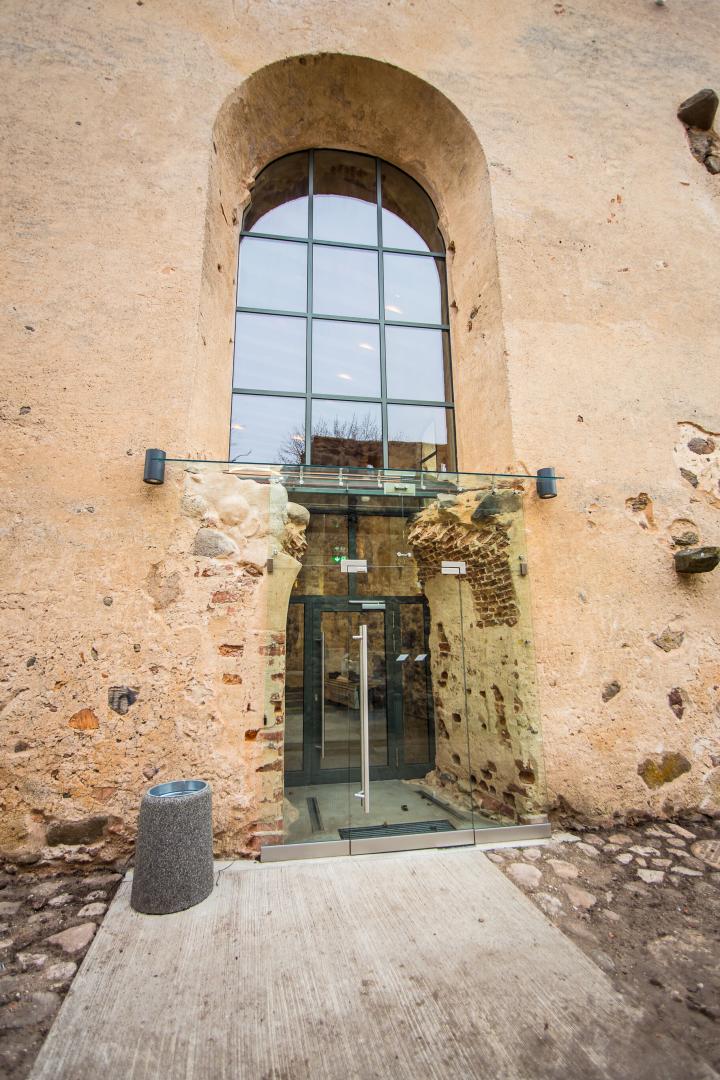
- The main entrance’s portal arch is intentionally not restored. Instead, a completely glazed portal has been created, displaying conserved parts of the former arch. In this way, the philosophy of the project is demonstrated to the visitor already at the entrance of the building – abstaining from full restoration to fully preserve the remaining parts of the original.
- The original basement light slits were too narrow to glaze them in a traditional manner. As a result, an insulated bay window solution was developed.
- Following the project’s philosophy, the chapel’s ruins have retained their pre-reconstruction silhouette state.